India – Haryana State University – Dr. Dalip Khetarpal
THE ELECTRICITY FAIRY
Dear friends, let’s begin by presenting these ideas, which may seem to have come to you relatively randomly, because they reflect what I’ve published online over the months…
The first concepts I’m going to develop relate to electricity, and I’ll list them here one after the other.
First of all, a note about electrical insulation in the transmission of electricity from one point to another. Yes, because while this energy can very easily be transported by cable, an electric wire, a metal wire that carries the precious electricity through its conductive properties, we have never yet, for technical reasons related to the difficulty of insulating the current, succeeded in distributing it otherwise than by using an overhead network of suspended electrical wires.
However, this is very expensive to maintain, it’s dangerous and fragile, and it also costs a lot in terms of energy loss because air is not a good insulator. Therefore, this system, which is still poor and unsightly for the natural environment of the facilities, is ultimately only a last resort, which satisfies no one.
My proposal is to use ceramic insulation to design tubes of what is called “technical ceramic” in chemistry, surrounded, for example, by rubber, an elastic material that is very resistant to temperature variations, to bury electrical cables rather than suspending them.
“Technical ceramic electrical insulation” is becoming increasingly cheaper to produce, thanks to advances in our chemistry. It is a material that is already well known today for other uses.
The rubber-like material surrounding the tube will be easy for experts to define, produce, and install, and this solution for burying wired cables, long sought after by everyone in the sector, would thus be within our reach.
I had this idea as a child, observing the insulating properties of ceramic and reflecting that its production costs would soon, and increasingly, decrease. Today, burying electrical installations thus insulated would undoubtedly cost much less than maintaining our suspended cables.
And the electricity fairy certainly still has much to offer us; we still have so much to discover! One of my development ideas, which I will present to you now, relates to this again: the photovoltaic-powered lamp.
Wouldn’t it be possible for us to design a lamp that, connected to a rechargeable battery and a photovoltaic cell capable of transforming its light into electricity, would be virtually perpetual?
You probably understand well that with a dedicated photovoltaic cell, which would serve as its main power supply in a short circuit, such a lamp would provide light almost in perpetuity.
And the answer to the question of whether it would be possible with our current technology to design and then manufacture such a tool is simply: yes!
It would even be very easy for us, apparently, since most modern photovoltaic cells react to the electric light emitted by a light bulb.
The battery that would serve as the lamp’s switch and for the eventual replacement of the cell could be recharged through the same circuit, making the device particularly durable.
It’s a brilliant idea, isn’t it? I urge my contemporaries to implement it.
One last remark concerning electricity, which I can make here, would be to consider increasing the radiation of light bulbs by covering them with mirrors.
This is what we do for flashlights and headlights.
I therefore urge you to consider that it would be very easy to design “nightlights” that, by simply covering them with one or more light-emitting diodes, would provide satisfactory supplemental lighting equal to or better than that of a current, bare light bulb, for example, with a single diode.
One or two diodes, powered by small batteries, for example, or by the mains, would then undoubtedly demonstrate great longevity and cost their users almost nothing in terms of energy consumption or maintenance.
This idea, which I myself have already seen developed at the artisanal level, would make it possible to provide electric lighting to populations that are either disadvantaged or deprived of access to distribution networks.
It would undoubtedly also prove very practical for anyone who needs outdoor lighting, and I’m thinking here in particular of the military, who would see the advantages of a mirror-clad LED lamp in terms of portability and ease of powering or repair.
Mirror-clad light sources have been used since ancient times. It was already mentioned at the legendary lighthouse of Alexandria.
As for LED bulbs, they are booming today, becoming increasingly cheaper and more efficient!
(…)
A text by Timothee Bordenave in Paris, France.
Autumn 2025. For Dr. Khetarpal at the Afflatus Creations Peer Review, in India.
a bent nail, a handful of mulch two mismatched buttons
and no explanation at all
Rain at Tipperary Station
I left the city before dawn,
bags light but exhausted
a sheep grazes by the fence
no timetable posted
the train comes once a week
or maybe not at all
I approach the small brick building
stone platform damp with moss
Tipperary sign flaking green paint
rails dark with rain
cupping my hands
to breathe warmth
into the cold iron smell
a single gull drifts over the hill
and disappears into fog
in my coat pocket
a ring of keys I forgot to return
the station clock still ticks
but no one waits
only a paper cup rolling
end to end along the platform
rain my only company
Obedience
I found myself sitting still
the litter box in the corner
hours gone before I noticed
the sour aroma rising
I had not moved to clean it
the cat began to watch me
a calm stare unblinking
as if he understood the change
his eyes fixed steady on mine
quietly saying obey me
soon I was skipping work
to refill his dish with chicken
ordering catnip in bulk
canceling dates and dinners
for extra hours of petting
my mother wrinkled her nose
father scowled at the box
he said this is no joke
toxoplasma gondii lives in there
it gets inside and bends the will
he spoke of rodents drawn to cats
of lives cut short in teeth and claws
I only stroked the warm fur
calm as a priest at prayer
my father said one day you will not know
where the parasite ends and you begin
I shouted for them to leave
kicked the door shut
their footsteps fading on the stairs
perhaps it is my own desire
to serve this harmless pet
or perhaps it is a parasite
humming in my head
telling me I am happiest this way
Baskin Cooper is a poet and visual artist based in Chatham County, North Carolina. A PhD in psychology who lived in Cork, Ireland, he explores folklore, lyricism, and personal history through multiple art forms. His work has appeared in Ink & Oak, Verse-Virtual, O2 Haiku, and ONE ART, with new work forthcoming in The Khaotic Good and The Woodside Review.
Nobel Literature Laureate László Krasznahorkai and the Light Within Ruins: The Enduring Power of Literature in Times of Crisis
Emran Emon
When the Swedish Academy announces that László Krasznahorkai wins the 2025 Nobel Prize in Literature, the citation—“for his compelling and visionary oeuvre that, in the midst of apocalyptic terror, reaffirms the power of art”—resonates with remarkable timeliness. In an era marked by uncertainty, war, climate anxiety, and the slow erosion of collective meaning, the Academy’s choice of the Hungarian novelist feels almost prophetic. Krasznahorkai, often called the “writer of the apocalypse,” has long been the literary chronicler of chaos—yet he is also, paradoxically, one of its most powerful antidotes.
Born in 1954 in Gyula, Hungary, Krasznahorkai belongs to a Central European lineage haunted by totalitarianism, despair, and disillusionment. He follows the literary footsteps of Kafka, Musil, and Bernhard—writers who dissected the human psyche amid societal collapse. With this Nobel Prize, he becomes the second Hungarian laureate, after Imre Kertész in 2002, whose own work bore the moral scars of the Holocaust. But whereas Kertész chronicled survival under tyranny, Krasznahorkai explores the spiritual desolation that follows it.
His debut novel, Satantango (1985), which took seven years to publish due to censorship, announced the arrival of a writer unlike any other. This postmodern masterpiece portrays a decaying village awaiting the return of a mysterious figure—a narrative of false prophecy, collective delusion, and moral decay. The story unfolds through pages-long sentences, each a labyrinthine reflection of confusion and decay. When Béla Tarr adapted the novel into a seven-hour cinematic epic in 1994, the two artists became inseparable in the public imagination—Tarr giving visual form to Krasznahorkai’s textual apocalypse.
Krasznahorkai’s prose style is both ‘his weapon and his world.’ His sentences are famously long, unbroken, and rhythmically relentless, sometimes extending across several pages. To read him is to enter a current that refuses to let go—a sustained meditation, an intellectual marathon. This stylistic audacity is not ornamental; it is existential. His syntax mirrors the chaotic continuity of consciousness, the endless unraveling of perception. In his world, there are no safe pauses. The absence of paragraph breaks traps readers in the same feverish continuum that entraps his characters. The result is hypnotic—exhausting, yes, but profoundly immersive.
Critics have called this approach “obsessive.” Krasznahorkai once responded by describing his method as “reality examined to the point of madness.” Indeed, his writing feels like an inquiry stretched to its breaking point—a sustained stare into the abyss until form itself begins to tremble.
In this respect, Krasznahorkai’s art recalls Proust’s interior infinity and Faulkner’s density, yet it is distinctly his own: not memory’s labyrinth, but apocalypse’s slow unfolding. His syntax makes the reader experience disorientation as a moral act—forcing us to inhabit confusion rather than flee from it. If one were to distill the essence of Krasznahorkai’s fiction, it would be the persistent nearness of collapse. His worlds are suspended between hope and ruin—often rural, provincial spaces that serve as microcosms for humanity’s larger failures.
In The Melancholy of Resistance (1989), the arrival of a mysterious circus and a dead whale in a small Hungarian town triggers chaos, paranoia, and moral dissolution. The novel’s absurd premise unfolds into a profound allegory about society’s vulnerability to hysteria and demagoguery. Adapted by Béla Tarr into the film Werckmeister Harmonies, the story becomes almost biblical in tone—a meditation on collective blindness and the failure of enlightenment.
For Krasznahorkai, apocalypse is not a future event but a permanent condition of existence. His characters—fallen intellectuals, wanderers, monks, derelicts—inhabit a world perpetually on the verge of collapse. Yet, he resists nihilism. Beneath his darkness lies a persistent belief in the redemptive force of art and moral contemplation. His more recent works, such as Seiobo There Below (2008) and A Mountain to the North, a Lake to the South, Paths to the West, a River to the East (2018), signal a spiritual evolution. Moving beyond European decay, these texts draw on Japanese and Buddhist aesthetics, embracing the idea of eternal recurrence, sacred precision, and aesthetic humility. Through them, Krasznahorkai seems to shift from apocalypse toward illumination—from despair to the fragile beauty of being.
The Nobel Committee’s phrasing—“reaffirms the power of art”—is crucial. Krasznahorkai’s worldview, though soaked in ruin, insists that art remains the final refuge of meaning. His works argue that literature’s endurance lies precisely in its ability to face darkness without flinching.
In his 2015 Man Booker International Prize acceptance speech, Krasznahorkai said that literature is the last space where “the complexity of the human soul is still allowed to exist.” This conviction radiates through every sentence he writes. His novels challenge a world of simplification and speed—a world increasingly allergic to ambiguity. His art is not escapist; it is resistant. It resists simplification, commodification, the flattening of experience. In that resistance lies a politics of the spirit—a subtle defiance against conformity and amnesia. By making readers dwell in discomfort, Krasznahorkai reminds us that true art should disturb before it consoles.
No discussion of Krasznahorkai is complete without acknowledging his deep collaboration with filmmaker Béla Tarr, whose visual language mirrors the author’s prose. Films such as Satantango and Werckmeister Harmonies are not mere adaptations; they are extensions of a shared vision—long takes, grayscale landscapes, and slow pacing echo the rhythm of Krasznahorkai’s sentences. This partnership between writer and filmmaker redefined how literature and cinema can converse. Tarr’s camera, like Krasznahorkai’s pen, denies instant gratification. Both invite the viewer—or reader—to confront time itself, to witness the erosion of meaning and the endurance of beauty in the same frame.
The Nobel Committee described Krasznahorkai as “a great epic writer in the Central European tradition that extends through Kafka to Thomas Bernhard.” Indeed, Krasznahorkai redefines what “epic” means in the modern age. Gone are the heroes, the conquests, and the gods. In their place stand weary villagers, failed intellectuals, anonymous bureaucrats—all trapped within absurd systems or meaningless waiting. His epics unfold not across battlefields but across the corridors of consciousness, where doubt replaces destiny.
In this, Krasznahorkai revives the moral grandeur of the epic form within the despair of the modern condition. His protagonists may not triumph, but their persistence to perceive—to see clearly even in darkness—becomes its own kind of heroism. Though deeply rooted in Hungarian soil, Krasznahorkai’s imagination is global. His later works draw inspiration from Japanese temples, Chinese landscapes, and Buddhist philosophy. This cosmopolitan evolution positions him as a rare bridge between Western metaphysical pessimism and Eastern contemplative serenity.
Whereas his early novels depict the failure of human systems, his later ones seek harmony beyond them. In Seiobo There Below, art itself becomes divine—a force through which human beings glimpse eternity. The novel’s episodic structure, spanning from Kyoto to Venice, portrays art as an act of devotion, not production. This Eastward gaze expands the emotional and philosophical scope of European modernism. It suggests that the answer to apocalypse may not lie in reconstruction but in attentive stillness—in seeing, in silence, in art.
The Nobel Prize now secures Krasznahorkai’s position among the literary titans of our age. But his true legacy lies not in institutional recognition, rather in his courage to write against the grain of the times. In an age of brevity, he writes long sentences. In an age of clarity, he embraces confusion. In an age of distraction, he demands attention. His art thus becomes an act of resistance—not only against despair but against superficiality.
His readers, scattered across languages and continents, share a common experience: the exhaustion that gives way to revelation. Reading Krasznahorkai is to endure, but in that endurance, one feels the renewal of attention, the recovery of depth, the reawakening of wonder.
The world of 2025—fractured by wars, rising authoritarianism, digital addiction, and ecological grief—may seem far from the obscure villages of Krasznahorkai’s fiction. Yet his novels speak directly to our condition. When the social order disintegrates, when meaning feels lost, what remains? For Krasznahorkai, art remains. The act of describing, of perceiving—of refusing to turn away—is itself a moral stance. His literature becomes both a mirror and a sanctuary: it reflects collapse but also shelters the human capacity for awe.
In awarding him the Nobel Prize, the Swedish Academy implicitly recognized this truth: that art’s endurance amid ruin is not decorative but essential. Krasznahorkai’s fiction does not escape catastrophe; it redeems it through attention. In every long sentence, every moment of delay, there is resistance to erasure.
László Krasznahorkai is the writer of the end who writes for the future. His Nobel Prize is not only a triumph for Hungarian letters but for the idea of literature as a spiritual vocation. His works are reminders that art’s highest duty is not entertainment but revelation—to confront, to clarify, to sustain. He has shown that even amid “apocalyptic terror,” the written word can remain a light—trembling, flickering, but unextinguished. And perhaps that is his ultimate gift: the belief that beauty endures, even when the world does not. As the great Hungarian laureate once said, “The apocalypse is not coming—it has already arrived.” But in his prose, we discover something else, something the Nobel Committee, too, must have felt—that in the very ruins of language, there still rises the stubborn flame of art.
Emran Emon is an eminent journalist, columnist and global affairs analyst.
“Methodology of Teaching Time and Its Units of Measurement in Primary School Mathematics Lessons”
Urganch davlat pedagogika instituti
Boshlangʻich taʼlim fakulteti
“Boshlangʻich ta’lim metodikasi” kafedrasi mudiri
p.f.f.d.(PhD), dotsent Yusufzoda Shabnami Yunus
Urganch davlat pedagogika instituti
Boshlangʻich taʼlim fakulteti
Boshlangʻich taʼlim yoʻnalishi 3-bosqich 236-guruh
talabasi Jumanazarova Munojot Elmurod qizi
Annotasiya: Ushbu maqolada boshlang‘ich sinf o‘quvchilarini vaqt tushunchasi va uning o‘lchov birliklari bilan tanishtirish jarayonining metodik asoslari tahlil qilingan. Tadqiqotda o‘quvchilarda vaqt tushunchasini shakllantirish, uni turli didaktik usullar orqali mustahkamlash hamda o‘rgangan bilim va ko‘nikmalarni amaliyotda qo‘llay olishga yo‘naltirish yo‘llari yoritilgan. Shuningdek, maqolada vaqt o‘lchov birliklarini o‘qitishda samarali metodlar, dars jarayonida qo‘llaniladigan o‘yinli topshiriqlar va amaliy mashg‘ulotlarning ahamiyati asoslab berilgan. Natijada, boshlang‘ich sinf o‘quvchilarida vaqt haqidagi ilmiy tasavvurni shakllantirishning metodik tavsiyalari ishlab chiqilgan.
Kalit soʻzlar: Miqdorlar, vaqt tushunchasi, soniya (sekund), daqiqa (minut), soat, kun, tun, hafta, oy, yil, asr, ko‘nikma.
Annotation: This article analyzes the methodological foundations of introducing primary school students to the concept of time and its units of measurement. The study highlights methods for forming the concept of time among students, reinforcing it through various didactic techniques, and directing them toward applying acquired knowledge and skills in practice. The article also substantiates the effectiveness of using active teaching methods, game-based tasks, and practical exercises in teaching time measurement units. As a result, methodological recommendations for developing scientific understanding of time among primary school students have been proposed.
Keywords: Quantities, concept of time, second, minute, hour, day, night, week, month, year, century, skill.
Аннотация: В данной статье проанализированы методические основы ознакомления учащихся начальных классов с понятием времени и его единицами измерения. В исследовании освещены пути формирования у школьников представления о времени, его закрепления с помощью различных дидактических методов и направленности на практическое применение полученных знаний и навыков. Также обоснована эффективность использования активных методов обучения, игровых заданий и практических занятий при изучении единиц измерения времени. В результате разработаны методические рекомендации по формированию у учащихся начальных классов научного представления о времени.
Ключевые слова: Величины, понятие времени, секунда, минута, час, день, ночь, неделя, месяц, год, век, навык.
Introduction
Human life is directly connected with the meaningful and rapid passage of time. Time flows continuously — it can neither be stopped, slowed down, nor reversed. Therefore, people perceive time relatively. As the President of the Republic of Uzbekistan, Shavkat Mirziyoyev, emphasized: “Time is life, and it does not wait for us.” Indeed, time is one of the most important quantities in human activity, expressing the duration and sequence of events.
Time is an inseparable part of human existence and is one of the most complex quantitative concepts to study. Children’s understanding of time gradually develops through daily activities and observations. The first perceptions of time begin to form during the preschool period. Time represents the sequence and duration of events, helping to determine their position in the past, present, and future.
This article highlights the methodological foundations of teaching the concept of time and its measurement units in primary school mathematics lessons. It also analyzes how to form students’ understanding of time, direct them toward practical activities, and effectively use visual aids and information technologies during the learning process. The proper use of digital tools increases students’ interest and helps them consciously comprehend the concept of time.
Main Part
As the great mathematician N. Wiener stated, “The main task of mathematics is to find the order hidden within the chaos surrounding us.” Indeed, mathematics helps to reveal the system and patterns hidden behind various forms of disorder in the world. In this process, correctly organizing time plays a crucial role. Therefore, teaching the concept of time and its measurement units to primary school students is of great importance.
In the early grades, the concepts of quantity and time hold a special place in students’ cognitive development. When teaching time measurement units, it is advisable to build students’ understanding through real-life examples, combining theoretical knowledge with practical application, since time serves as the main criterion for distinguishing events in daily life.
The smallest unit of time is the second, followed by minute, hour, day, week, month, year, and century. Among these, day and year are derived from natural phenomena, while hour, minute, and second were developed by humans through centuries of observation and research. The Earth’s rotation around its axis forms a day, while its revolution around the Sun forms a year, which consists of 365 or 366 days. The accumulation of six hours per year leads to one extra day every four years, resulting in a leap year. Over centuries, systematic observation led to the formation of the modern calendar system.
The division of one day into 24 hours is also based on ancient astronomical observations.
The main goal of studying time and its measurement units in primary school mathematics is to help students master the relationships between different units of time and to develop the ability to determine time using a clock.
Teaching by Grade Levels
�� Grade 1: During the preparatory stage, students are introduced to the concepts of “before” and “after.” For example, using visual materials that depict the twelve months of the year, the teacher may ask:
“Which month comes before March?”
“Which month comes after May?”
“What comes three months after May?” Such questions help students develop an understanding of sequence and the passage of time.
In Grade 1, students also learn concepts such as morning, afternoon, evening, night, today, yesterday, and tomorrow. Using a classroom calendar, they begin to grasp the relationship between day, week, month, and year. The teacher may engage students in discussions such as:
“What role does time play in human life?”
“What important events happen from childhood to old age?” These conversations expand students’ thinking and strengthen their understanding of time.
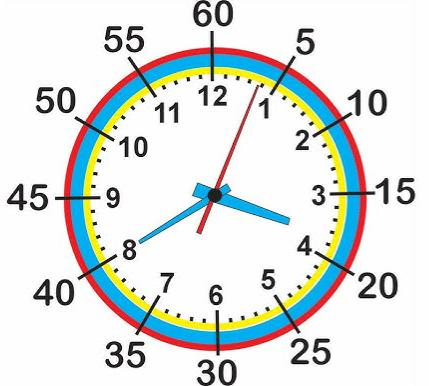
�� Grade 2: At this stage, students are introduced to the concepts of hour and minute, learning how to measure time using a clock, compare expressions of time, and perform related calculations. In addition to theoretical explanations, it is advisable to use model clocks for practical activities.
For example, by observing the clock face and moving the hands, students visually grasp the passage of time. The teacher can ask situational questions such as:
“What time of day does this clock show?”
“What are people usually doing at this time?”
“Where is the Sun at this moment?” Such questions help students connect time with real-life situations.
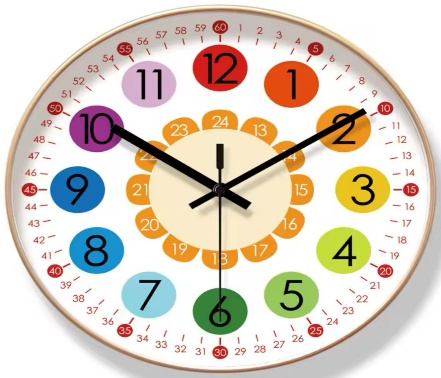
Additionally, using interactive exercises such as “funny clocks”—with colorful and variously shaped clock illustrations—can make learning more engaging. These activities help students develop skills in identifying time, observing changes in the clock hands, and distinguishing between different time intervals.
In the 3rd grade, the topic “Hours, Minutes, and Seconds” is used to explain the concept of time and its units of measurement. In this topic, students are introduced to the smallest units of time — the second and the minute — and develop skills in converting between them as well as performing addition and subtraction operations involving time.
Using practical examples related to students’ daily lives gives effective results when studying this topic. For instance, students may be given tasks such as “Determining the time they leave home and the time they arrive at school,”“Counting how many vehicles they ride,” or “Calculating how long each vehicle takes to reach its destination.”
Through such exercises, students learn to connect time measurement units with real-life situations and to analyze them independently. Based on this, they gain practical experience in performing operations involving time.
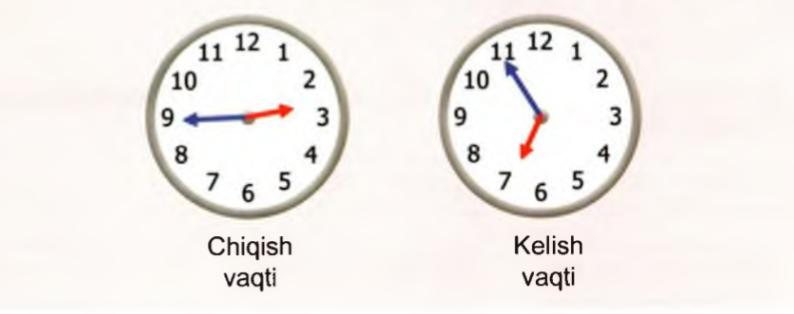
For example, the following exercise can be given: “An electric train departed from the Southern Station at 8:25 a.m. and arrived at Khojakent Station at 9:10 a.m. How much time did the train spend on the way?”
By solving this problem, students develop the ability to determine time intervals and perform addition and subtraction operations with hours and minutes.
necha minut yo‘l yurgan?”
��Studying Time Measurement Units in the 4th Grade
In the 4th grade, time measurement units are studied as a continuation and expansion of the topics covered in the 3rd grade. The following information is presented to students as a reminder:
Time Units
Their Relations
1 century = 100 years
1 year = 12 months
1 year = 4 seasons
1 year = 365/366 days
1 month = 30/31 days
1 week = 7 days
1 day = 24 hours (1 d = 24 h)
1 hour = 60 minutes
1 minute = 60 seconds
When explaining that one century equals 100 years, it is effective to use real-life examples. For instance, the teacher may say: “A person who lives for 100 years is said to have lived for one century.” When teaching that one year consists of four seasons, students are introduced to the names of the seasons — spring, summer, autumn, and winter — and learn that each season contains three months. Each season can be explained with the following distinctive characteristics:
Spring – flowers bloom, birds return, nature awakens.
Summer – fruits ripen, the sun shines brightly.
Autumn – crops are harvested, leaves turn yellow.
Winter – snow falls, it becomes cold, the New Year is celebrated.
Thus, students learn to distinguish between the seasons, understand their sequence, and remember the months associated with each one.
In addition, using modern information technologies increases the effectiveness of lessons. For example, showing video clips, animations, or interactive presentations related to time measurement units on a monitor or computer helps students retain information better. In this way, theoretical knowledge is effectively combined with practical demonstrations.
In primary school textbooks, such information is presented in a similar manner, which helps to gradually develop students’ thinking abilities step by step.
Conclusion
In conclusion, when teaching time measurement units to primary school students, it is most important to first develop a basic understanding of the concept. Some students may have only heard about time units at home, while for others the topic may be completely new.
Therefore, it is crucial to use visual aids, educational games, multimediapresentations, and video materials during the lessons. Such approaches help students grasp the topic more quickly, enhance their thinking abilities and observation skills, and broaden their worldview.
Moreover, it is necessary to systematically promote the culture of effective use of information technologies in general education schools.
References
Decree of the President of the Republic of Uzbekistan: “On Measures to Improve the Quality of Education and Develop Scientific Activity.” – November 6, 2020.
There is no experience quite like sitting alone in a totally darkened barroom at 5 AM on a Sunday morning staring at the upturned legs of the barstools, drinking pints of Bass Ale, listening to the leaking faucet drip into the stainless-steel sink.
The second hand scans the face of the clock, smoke rings dissipate in the antique, hand engraved Harp Lager mirror behind the bar.
The barman considers the room; the beer puddles on the peeling linoleum floor, the mud-streaked foot sliding prints, the broken glass shards, the spent matches, the blackened cigarette ends, the twisted plastic drink sticks, the wadded paper napkins strewn everywhere amidst the general rubble.
The barman considers these details of his life quietly as he drinks his Bass.
The clock hands move, the water drips, this is chaos revealed, this is the silent hour, the quiet hour when all that remains are the smoking ruins after The Fall.
Ordering Details:
In the heat of the night the barman consolidates his orders.
Pours beers from chrome plated taps, shakes drinks one handed over his shoulder, cracks ice in the palm of his left hand with a mallet wielded by his right hand.
Considers his world.
Finds Poems:
Music Men
They heard
tunes in
their heads
no one else
would ever
hear
They were
so whacked
out on
where they
had come
from and
where they
were going
they didn’t
have any
time for
the here
and the now
They were
music men
lost in
the ozone
and their
plane was
coming down
so fast
you could
see the
spirals
in their
eyes
More quarters fall into the jukebox. The pin ball machines in the background are ringing, automatically totaling unknowable scores.
Working Details:
The barman is an extremely precise, particular man of habit.
All the tools of his trade: his bottles, glasses, fruit mixes, and the like must be exactly where they are meant to be all the time.
Whenever he assumes a shift, he scrupulously examines the subject and orders his material; creates an environment in which he may comfortably function.
Riders of the Purple Sage
Had that
well worn
world weary
look of
men who’d
spent too
much time
somewhere
people
shouldn’t
go
Said ” line
‘em up boys.”
as if this
were the
last chance
saloon
Creation Details:
In the heat of the night, the barman considers his room as if it were a blank sheet of paper; every crowd as a mass of unknowns which must be ordered and controlled.
It is the barman’s role to assign meaning to every detail, to every person, to everything that he sees
Downhill Racer
She didn’t
look like
the crazy type
but she kept
switching her
drinks as if
she didn’t know
what event
she’d signed up
for
All I knew
was she’d
better look
out
She was going
down the
hill way
too fast
The Savage Muse, Details:
Outlaw
He was
plenty heavy
alright
Had all
of those
classic
bad moves
you associate
with movie
bad guys
out West
I thought
maybe he
had a black
hat in the
trunk of
his car
Thought maybe
he carried
a gun
and knew
how to use
it
thought
maybe he
was after
my ass
just for
the hell
of it
As an artist, the barman has no time for motivations; his only concern is the effect of the cause.
Escaping Details:
The Tenth Victim
She had
the look
of a woman
waiting
for her
tenth victim
She wore
only enough
clothes to
keep her
from being
arrested
Had a long
thin scar
the length
of her
right fore-
arm
Asked me
for a Vodka
Gimlet
Up
Sat drinking
her 20 dollar
bill until it
was gone
watching the
door
Watching me
in case
he didn’t
show
The barman is an escape artist.
He lives out on the street unprotected, confronting his material head on, directly engaging in a vicious, psychic tug of war with his savage muse.
At the end of his nightly struggle, the barman watches the sun rise outside the darkened barroom drinking Bass Ale as the water drips in the stainless-steel sink.
He is always too numb and too tired to look for or to find poems.
Diplomatic Cooperation in Combating International Terrorism
Norqulova Nordona Abdurahim qizi
Qoraqalpog’iston qishloq xo’jaligi va agrotexnologiyalar instituti yurisprudensiya yo’nalishi 2-kurs talabasi norqulovanordona@gmail.com
Annatatsiya ushbu maqolada xalqaro terrorizmga qarshi kurashishda davlatlarning diplomatik hamkorlik yo’llari va usullari tahlil qilinadi. Tadqiqotda xalqaro terrorizmga qarshi kurashishda davlatlarning o’zaro diplomatik , ijtimoiy, iqtisodiy va siyosiy jihatdan hamkorliklarining rivojlanishi va bu orqali terrorizmning ta’sirini ancha kamaytirish yo’lari va usullari ochib beriladi.
Kalit so’zlar xalqaro terrorizm, siyosat, davlat boshqaruvi, terrorizm, davlat, xalqaro huquq, diplomatik hamkorlik, globallashuv.
Abstract This article analyzes the ways and methods of diplomatic cooperation of states in the fight against international terrorism. In the study, the development of mutual diplomatic, social, economic and political cooperation of states in the fight against international terrorism and ways and means of reducing the impact of terrorism will be revealed.
Key words: international terrorism, politics, state administration, terrorism, state, international law, diplomatic cooperation, globalization.
Aннотация В статье анализируются пути и методы дипломатического сотрудничества государств в борьбе с международным терроризмом. В исследовании будет раскрыто развитие взаимного дипломатического, социального, экономического и политического сотрудничества государств в борьбе с международным терроризмом, а также пути и средства снижения воздействия терроризма.
International terrorism is a broad concept. It refers to a large-scale threat aimed at disrupting inter-state political and social order by carrying out terrorist acts in various countries. Emerging in the 1960s, it developed significantly toward the end of the twentieth and the beginning of the twenty-first centuries. International terrorism is a form of activity intended to inflict harm on one or several countries to achieve political or economic objectives. Its main goals are to destabilize government administration, cause economic and political damage, undermine the foundations of the social order, and violate human dignity, honor, and rights. The main characteristics of international terrorism include globalization, professionalization, and reliance on extremist ideology. To achieve their goals, terrorist organizations actively use mass media and social networks. International terrorism not only poses a threat to international legal order and political relations among states but also negatively affects the development of several countries.
The issue of combating international terrorism was first discussed at the international level in 1934 within the League of Nations. This discussion was prompted by the assassination of Yugoslav King Alexander I and French Prime Minister Louis Barthou in Marseille on October 9, 1934. At that time, the main forms of terrorism included hostage-taking, hijacking of civilian aircraft, and political assassinations. The most powerful and dangerous international terrorist organization of that era was the Palestine Liberation Organization (PLO), established in 1969 under the leadership of YasserArafat. In the late 1960s, the Soviet Union (USSR) recruited members of national movements worldwide who adopted terrorist tactics and trained them in special camps. After the September 11, 2001, attacks, when Al-Qaeda terrorists targeted several facilities in the United States, international terrorism grew even stronger. According to experts, more than 20,000 terrorist acts have been committed to date, resulting in hundreds of thousands of casualties and victims — most of them civilians.
Main Part
International terrorism is one of the most dangerous and serious global problems for all states. To prevent this threat, several countries have joined forces and are cooperating. Recently, a conference was held within the Shanghai Cooperation Organization (SCO), attended by representatives of SCO member states, observer countries, dialogue partners, the SCO Secretariat, and other international organizations.
During the conference, participants exchanged views on pressing issues related to countering the modern threats and dangers posed by international terrorist organizations. They shared advanced experiences in combating terrorism and extremism, emphasizing that terrorism in all its forms poses a serious threat to peace and security.
Attention was drawn to the fact that terrorist organizations are attempting to acquire new types of weapons and military equipment, geolocation and satellite communication tools, and are increasingly using unmanned aerial vehicles (drones), artificial intelligence technologies, and information and communication technologies to carry out terrorist activities. The Islamic State (ISIS) terrorist organization has shifted to a decentralized network-based operational model, leading to new threats and challenges — particularly in the Middle East and Afghanistan — where the security situation has deteriorated. It was noted with concern that international terrorist groups entrenched in Afghanistan are approaching the borders of SCO member states and that their members, upon returning to their countries of origin, are reactivating dormant extremist cells.
During the discussion, the participants also emphasized the need to strengthen international cooperation to counter the use of the Internet for terrorist purposes and to prevent the spread of extremist ideologies online. [2]
On March 3–4, 2022, an international conference titled “Regional Cooperation of Central Asian Countries within the Framework of the Joint Plan of Action for the Implementation of the UN Global Counter-Terrorism Strategy” was held in Tashkent.
In his speech at the United Nations, the President of Uzbekistan noted that effective cooperation was being carried out to ensure security in Central Asia and acknowledged the successful implementation of the UN Global Counter-Terrorism Strategy in the region. The President stated:
“We support holding an international conference dedicated to the ten-year results and future prospects of the Regional Joint Plan within this Strategy.”
In addition, several legislative acts have been adopted in Uzbekistan, including:
“On Combating Extremism”,
“On Combating Terrorism”,
“On Combating the Legalization of Proceeds from Crime, the Financing of Terrorism, and the Financing of the Proliferation of Weapons of Mass Destruction”, as well as other regulatory and legal documents.
At the Tashkent International Conference, the unique experience of Central Asian cooperation in implementing the UN Global Counter-Terrorism Strategy was presented. Participants also discussed international and regional efforts to combat terrorism.
Within the “Development Strategy” of the Republic of Uzbekistan, under the 6th priority area — “Developing effective mechanisms to combat extremism and terrorism” — several measures have been implemented, including:
Improving preventive mechanisms aimed at eliminating the root causes of terrorism, enhancing the socio-spiritual environment, preventing the influence of extremist ideologies, and addressing the problems of individuals affected by such influences;
Forming a strong and stable immunity among the population, especially the youth, against terrorist and extremist ideologies;
Improving the international legal framework for combating terrorism and expanding contractual cooperation with foreign states, regional, and international organizations;
Strengthening the capacity of diplomatic missions, consular offices, the External Labor Migration Agency, and other institutions working with citizens residing abroad;
Exchanging information and experience with foreign states and international organizations in combating extremism, terrorism, and their financing;
Actively participating in the work of international and regional organizations combating extremism and terrorism;
Coordinating joint actions within the UN Global Counter-Terrorism Strategy implementation framework in Central Asia;
Expanding Uzbekistan’s role in promoting international initiatives aimed at enhancing information exchange and cooperation in counterterrorism across Central Asia;
Intensifying international efforts to ensure peace and stability in Afghanistan, and involving the country in regional cooperation processes, including counterterrorism initiatives.
Uzbekistan supports the UN Global Counter-Terrorism Strategy and has ratified 14 international conventions and protocols related to countering terrorism and religious extremism. [4]
Conclusion
In conclusion, terrorism today negatively affects sustainable development and the well-being of many countries worldwide. Its impact can be observed in political, economic, and social spheres. A state that is not peaceful and stable can never achieve development in any area. To eliminate this threat, countries are joining forces and assisting one another in this common struggle. For example, the international community, together with Uzbekistan, is actively helping the people of Afghanistan, and Uzbekistan plays a significant role in these humanitarian and peace-support operations.
References
International Terrorism: A New Kind of Warfare, October 6, 2012.