
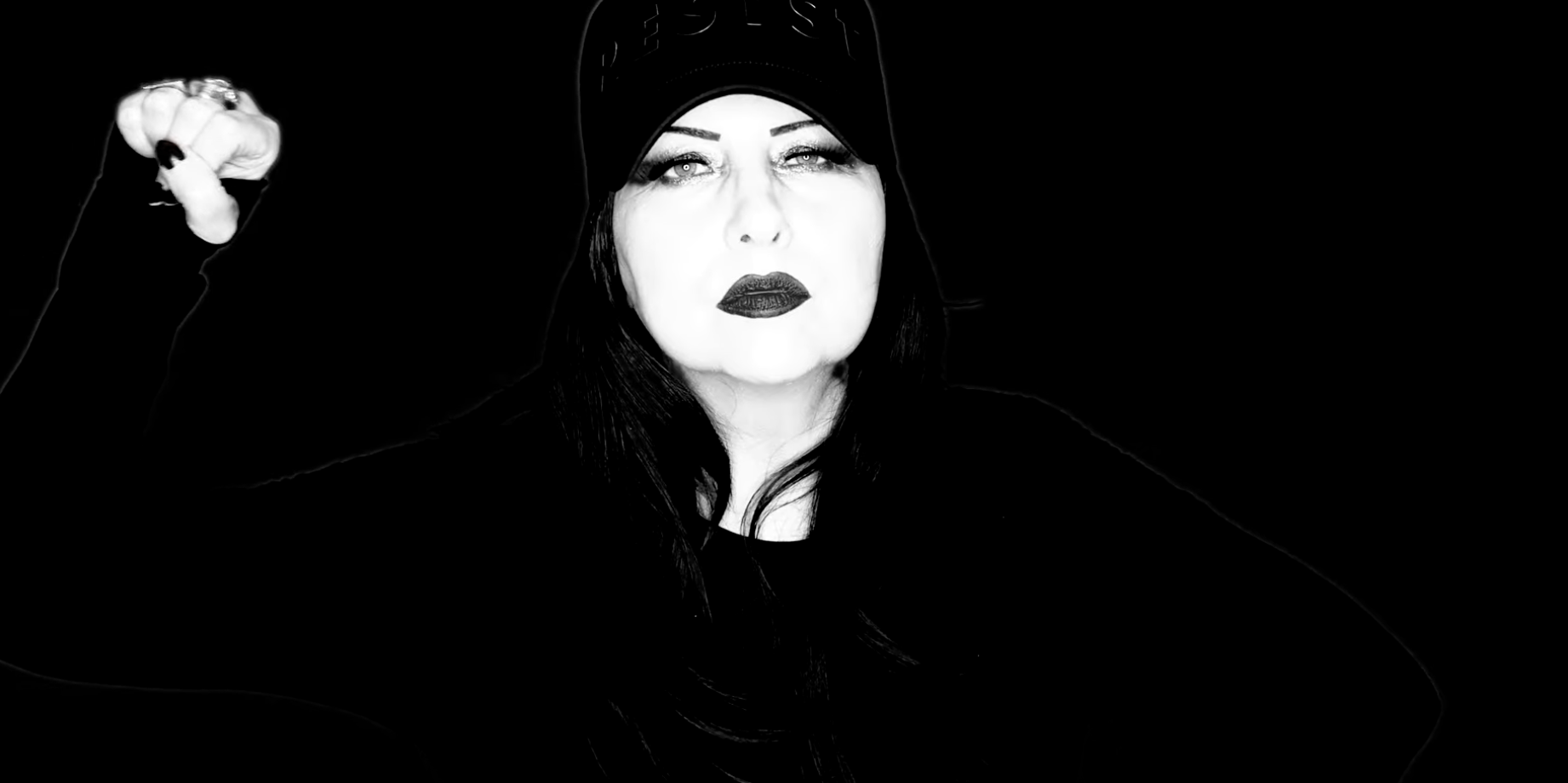
Tairrie B Murphy: Outlaw Spirit and the Return of My Ruin
I first interviewed Tairrie B Murphy at a coffee house in Hollywood. The setting was intimate, far from the roar of amplifiers, and she teased me about probably eating all the cookies once she left. That playful moment revealed her warmth and humor, qualities that coexist with her volcanic stage presence. During that interview for Juggernaut: The Magazine of Extreme Music, she told me I was her hero for putting Karyn Crisis on the cover. She even hung that cover on her wall. For Tairrie, Karyn represented a kindred outlaw spirit—fierce, feminist, uncompromising.
That resonance was later captured visually when Amelia G and Forrest Black of Blue Blood magazine photographed Tairrie with her own variation on Karyn’s iconic angel wings. Where Karyn had worn angel wings, Tairrie chose bat wings, a darker inversion, a declaration of her volcanic energy. I designed that cover in collaboration with Amelia and Forrest, ensuring the imagery reflected both homage and individuality. At the end of that interview, she leaned in with a mischievous smile and told me she had a hot date with Burton C. Bell, then frontman of Fear Factory. It was classic Tairrie—candid, bold, and unafraid to let her personal life brush against her public persona.
I was also present when Tairrie opened up for and introduced a secret debut of Sepultura with their new singer. On the marquee, Sepultura’s name was disguised as Troops of Doom. Tairrie performed her ass off that night, commanding the stage with volcanic intensity. I was high on cocaine, and when Sepultura launched into the opening riff of “Troops of Doom,” the rhythm tracked perfectly with my heartbeat, fusing the music with my own pulse in a way that felt transcendent. It was one of those moments where the outlaw energy of the scene, the rawness of Tairrie’s performance, and the primal force of Sepultura collided in unforgettable synchronicity. At another concert headlined by Jack Off Jill and Switchblade Symphony, I found myself backstage in a disappointing encounter with Tina Root, who despite once calling me “cool” in an interview, was standoffish and cold. Then Tairrie appeared. Arms wide, voice sharp and affectionate in its outlaw cadence: “Hey motherfucker!” she called out, reclaiming the moment with boldness and warmth, pulling me into one of her trademark squeezns.
That same night, she made a surprise appearance onstage with Jessicka from Jack Off Jill. The two kissed passionately in front of the crowd—not as a stunt, but as an expression of queer solidarity. It was a gesture of unity, defiance, and shared identity, embodying the raw energy of the era while affirming inclusivity and resistance.
Tairrie has always spoken about her career with defiance. She once declared, “Age is meaningless; I have never felt my art came with an expiration date.” She also reclaimed the word bitch as a badge of power, describing herself as “a bitch in total charge of herself.” That ethos runs through her career, from her rap beginnings to her volcanic metal persona. Power of a Woman (1990) established her as one of the first women in gangsta rap. She fronted Manhole, later renamed Tura Satana, then formed My Ruin in 1999. In later years she revisited hip‑hop with tracks like Beware the Crone, infusing witchy Gothic aesthetics into her rhymes. “Sometimes I miss that rapper part of me and the freedom to check a motherfucker with my lyrics,” she admitted, underscoring her refusal to be confined by genre.
Her personal life has been as intertwined with her art as her music. Tairrie and guitarist Mick Murphy married in the Smoky Mountains of Tennessee in 2008. Their union is both personal and artistic: together they released multiple My Ruin albums, ran their own imprint, and later launched new projects like SWTEVL. After years in Los Angeles, the couple relocated to Knoxville, Mick’s hometown. Tairrie described it as a “life‑changing move” that allowed them to focus intensely on new music. Their 2011 album A Southern Revelation was written in direct response to political and industry betrayals, sharpening her activist streak. “Being that I’m an ex‑rapper, certain things come very easy to me and I have always loved a good ‘dis’ song. I learned to vent my anger in songs very early on,” she explained.
Her forthcoming My Ruin album, Declaration of Resistance, continues this tradition—a protest record against authoritarianism and censorship, created in the shadow of Trump’s presidency. My collaborations with Amelia G and Forrest Black extended beyond Tairrie. Later, they photographed Dina Cancer and Lesli Spivey from Penis Flytrap for my exclusive interview with Dinah. Those sessions reinforced the outlaw aesthetic that runs through this scene. I remain friends with Lesli and Lucifer Fulci to this day, connections that testify to the enduring bonds forged in underground music and art.
After more than a decade of silence, My Ruin—the duo of Tairrie B and Mick Murphy—are back with Declaration of Resistance. Scheduled for release in late 2025, it marks their first full‑length record in twelve years. The album is framed as a protest record, aligning with their belief in free speech, freedom of expression, and freedom from religion. The lead single, Compromised, dropped in October 2025 to coincide with the nationwide #NoKingsProtest, underscoring their commitment to art as activism. Mick Murphy described the release as My Ruin “getting very LOUD” again, inviting fans to join them on a new journey.
From teasing about cookies in a Hollywood coffee house to bat‑winged photo shoots, from surprise backstage hugs to kissing Jessicka onstage in queer solidarity, from rap beginnings to Gothic witchcraft rhymes, from Los Angeles to Tennessee, from collaborations with Dina Cancer and Lesli Spivey to lasting friendships with Lucifer Fulci, and from the secret Sepultura debut where her performance tracked with my own heartbeat, Tairrie B Murphy has always embodied the outlaw archetype. Bold, feminist, uncompromising, and intensely human, she continues to shape her persona into something completely unique. With Declaration of Resistance, she proves once again that her art has no expiration date—and that her outlaw spirit burns brighter than ever.