
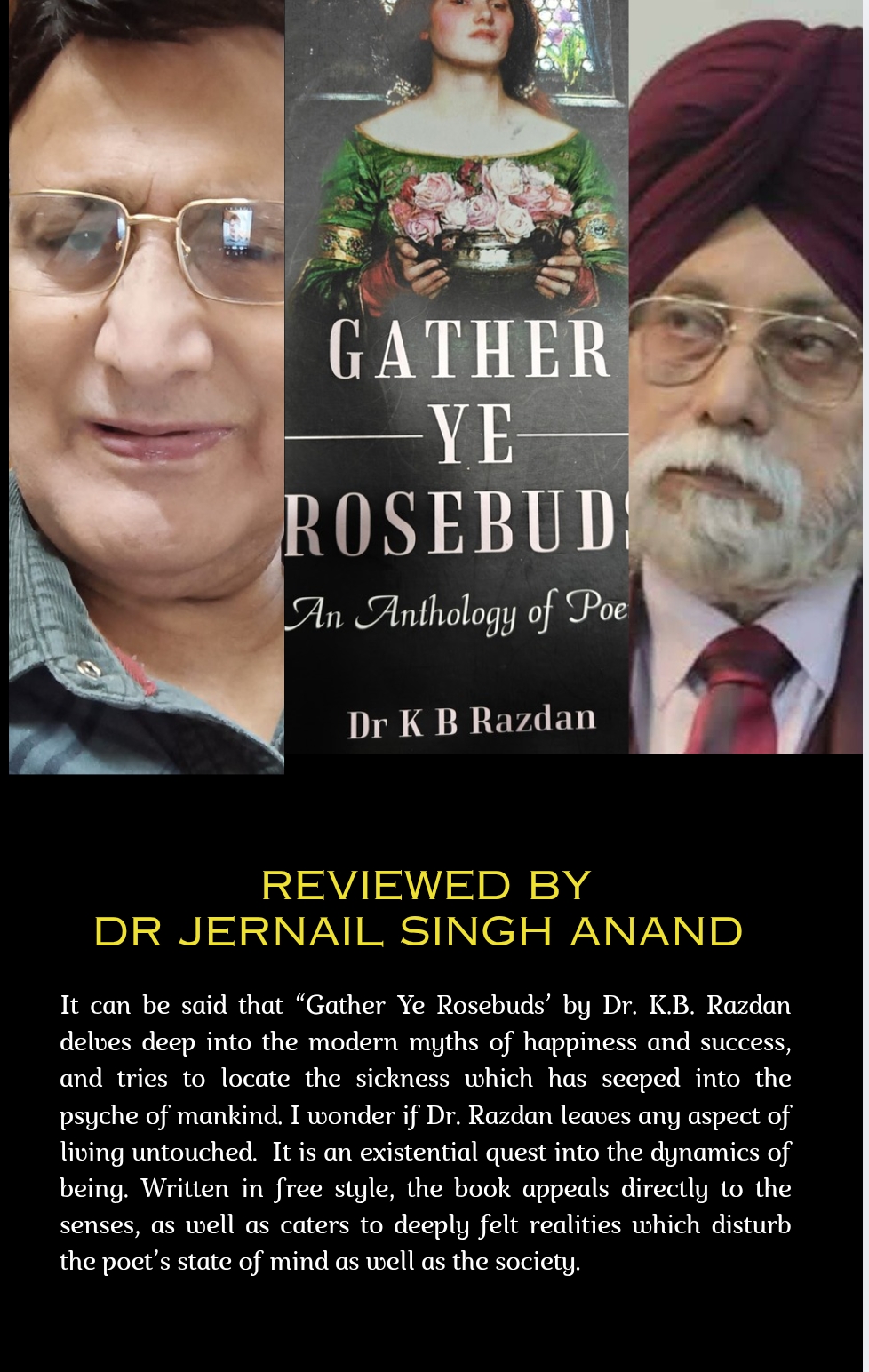
DR. KB RAZDAN: GATHER YE ROSE BUDS: AN EXISTENTIAL QUEST INTO THE DYNAMICS OF BEING
Writing poetry is a very personal affair and different poets write for different reasons. The most intriguing thing about poetry is that the poet who once starts writing, even if he is writing on a specific topic, does not know when and where he will conclude his poem. This is the power and independence of poetry. No poet can claim suzerainty over it.
Dr KB Razdan is a wizard of words who has guided students of literature at the University of Jammu for three decades, as Professor and Head and then as Dean Faculty and Convener of Board of Studies. He has taught modern and postmodern American fiction, poetry drama, comparative literature, critical theory, translation and translation theory. Having weathered so many disciplines, he possesses the finer sense of aesthetics essential to craft a masterpiece out of the rock material of ordinary life. A poet handles ordinary material, but he extends to it his philosophic shine and it starts radiating subliminal messages.
Dr. Razdan, has a keen sense of the dignified status of poetry. Leaving aside formalistic aspects of poetry, he is more concerned with what he has to say. What shape it takes, let the poetic moment decide. A higher passion draws words from his inside, and they flow into poems, as at a village well, driven by oxen, the ‘tinds’ [the chain of iron pots ] draw water from inside, and let it flow, fertilizing the earth. His verses are like mustard leaves grown on a fertile land, dangling their tiny heads in sheer frolic, carrying messages far beyond their transitory being. The poet rightly calls his work a ‘Cosmodrome of Poetic imagination and Poetic euphoria.
‘The Sieve of Time’ and the talk of filtration hangs heavy on the poet’s creative psyche, the image of the sieve recurs, focusing our attention on the fact how time throws off everything retaining in the sieve only the last remains of man. The somber mood of the poem lends it a touch of deep philosophy, and draws it closer to the fatalistic moorings of Hardy.
What is Poetry? For the poet, poetry is a realization, a revelation:
……a realization
That becomes a revelation,
A Soliloquy erupts akin to a Volcanic eruption.
Here the poet appears to drift away from Eliot’s view of a poem as an escape from emotion, when he calls a poem ‘a soliloquy’. He also deviates from William Wordsworth for whom a poem is a spontaneous overflow of powerful feeling, recollected in tranquility. Dr. Razdan’s poetics appears to be rooted in urgency which lends its excitement, passion and a rare flow to his poems.
‘O Lord What Fools these Mortals Be’ derides human wisdom which breeds manipulators schemers and crooks. The poet rejects “pretended prudence” and thinks that the wisdom of apes and dogs far transcends the wisdom of human beings. ‘Every Man is Two Men’ talks of the split personality of man, which is home to both the base as well as the sublime. Judas and Christ may be two different personalities, but both are equally loved by the mother who begets them. ‘A Rendezvous with the Contemporary Sphinx’ appears to focus on the narcissistic tendencies in man, and the poet warns one should know oneself if he wants to know the world. He criticizes too much dependence on mind, which can become nemetic [cause for nemesis ] for mankind:
O Ye frivolous man, should ye know yourself, you shall know all men all women” .
‘What’s in a Name’ engages with a quote from Shakespeare, but Carlyle’s reference in the poem is starkly beautiful: No name. No shame.
‘Images and Voices’ opens into the vistas of spiritual and cosmic dimensions. Here, the poet invokes Walt Whitman and his image of a Composite Man when he says
“What I assume, you shall assume
For every atom belonging to me, belongs to you as well.”
‘A Noble Sad Heart’ compares human mind and heart in an unconventional manner.
Our mind is a sponge, our heart is a stream, ….
Most of us choose sucking rather than running..
‘The Lustonian Blundrbuss’ takes a dig on marital ethics, while ‘When Life Walks in the Procession of Freedom’ supports the cause of women who walk out of unhappy marriages. ‘Song of Adam’ makes a plea for innocence in a world full of guile. The poet considers Ethics as the panacea which can heal the world of its maladies, and friendship is the elixir which can guarantee blossoms of Peace, Prosperity and Plenty on this earth:
“Let friendship be a Great Deluge,
A Deluge that engulfs our planet,
With the Blossoms of Peace, Prosperity and Plenty
And let the phenomenon of Ethics
Become an Ideal Panacea to Heal.
-Friendship, An Oasis of Rejuvenation,
Dr. Razdan considers marriage an unequal partnership in which the woman is ‘a sacrificial victim’. [‘The Throne of Tribulations’] From family to the social ethos, Dr. Razdan finds the world under the siege of Mammon, the Undisputed Controller, as a result of which it has been reduced to a ‘Maelstrom of Malevolence’, marked by greed and lust.
While on Nature, ‘The Tree and the Man’, presents a searing indictment of humanity, where the tree calls man a monster, and a desperado, whose mind and conscience are in consonance with darkness. ‘The Day Dreamers of Mankind’ again blasts the myth of Adam, where men think, God in his kindness, will offer them another Eden, and endow them with a modicum of Good Sense, giving them a new opportunity to “create a tripartite Realm of Purity, Innocence and Heroism.” Nothing bad in entertaining such dreams, thinks the poet.
The poet talks of a buffer zone between Right and Wrong and Truth and Untruth – a No man’s territory which constitutes the battle ground for corrosive conflicts. ‘Ethics of Pure Love’ looks upon parents as bows from which children are shot like arrows, as Kahlil Gibran has said. The poet turns ecstatic in ‘O My Loriana Lore Lee’ giving a final lesson in love:
Can it be
That you merge in me and me in thee?
‘Malady of Gossip’ perhaps embodies a great truth of life, told so beautifully:
A dilemma I find hard to negotiate
My house says to me:
“Do not leave me for here dwells your past,
And the road says to me:
“Come, and follow me,
For I am your future”
This to me appears to be the height of poetic craftsmanship. The language and thought both achieve classical heights., I feel the poetic thrill in these lines.
‘The Trojan Horse’ is a metaphor for people who approach you with Mephistophelean joy. The description of a poet in ‘Anatomy of a Poet’ conjures a scene which resembles the ruins on which the statue of Ozymandias stood:
A poet is a king dethroned,
Sitting amidst the ruins of his palace
What truth can be more piercing and elevating at the same time, as we come across in this exiomatic expression:
It is very simple to be happy, but it is very difficult to be simple.
‘The Unassuming Society Man ‘is a bitter critique of modern society, where he compares human mind to a “war room where thoughts play Chess/Making moves and using weapons weird.” ‘Ethics of colours’ points out that men have complete mastery in changing colours beating even chameleons at the game. ‘Unethical Monomanics’ derides human beings who fall a prey to inordinate passions, corruptions, jealousy, greed etc. It is hard to find a more strident criticism of our times:
It is a world of atrophied values
Of frozen emotions, fossilized love
In conclusion, it can be said that “Gather Ye Rosebuds’ by Dr. K.B. Razdan delves deep into the modern myths of happiness and success, and tries to locate the sickness which has seeped into the psyche of mankind. I wonder if Dr. Razdan leaves any aspect of living untouched. It is an existential quest into the dynamics of being. Written in free style, the book appeals directly to the senses, as well as caters to deeply felt realities which disturb the poet’s state of mind as well as the society.
Dr. Jernail Singh Anand, with an opus of 190 plus books, is Laureate of the Seneca, Charter of Morava, Franz Kafka and Maxim Gorky awards. His name adorns the Poets’ Rock in Serbia. His work embodies a rare fusion of creativity, intellect, and moral vision. Email: anandjs55@yahoo.com