
Uzbekistan’s Quiet Transformation: How a Young Nation Is Redefining Central Asia
In a world that grows noisier by the day, not every transformation announces itself with fanfare. Some unfold quietly—steadily reshaping the cultural and political geography around them. Uzbekistan is one such story.
For many Americans, Central Asia remains a distant concept: a region glimpsed through brief headlines or geopolitical maps. Yet, at the heart of this vast land lies a young nation rewriting its identity with remarkable speed and confidence. Over the past decade, Uzbekistan has emerged from international obscurity to become one of the most dynamic reformers in its region. Once known primarily for its Silk Road past, the country is now building a narrative equally rooted in innovation, openness, and civic awakening.
More than 60% of Uzbekistan’s population is under the age of 30. This demographic reality is not just a statistic—it is a driving force. Across universities, research centers, cultural hubs, and digital platforms, young Uzbeks are redefining what it means to be a modern Central Asian citizen. Many of them are multilingual, globally connected, and ambitiously future-oriented. They launch start-ups, initiate community projects, lead volunteer movements, and participate in nationwide reforms. Their voices are increasingly heard in public policy, education, environmental protection, and cultural revival.
In a region often portrayed as traditional and conservative, Uzbekistan’s youth represent a bold new energy—one that challenges stereotypes and invites the world to reimagine Central Asia. Since 2016, the country has introduced sweeping reforms in governance, economy, education, and international openness. Visas were liberalized, markets diversified, civil society strengthened, and new digital platforms created to support transparency. These policies do more than modernize the state; they reshape the everyday lives of citizens—particularly young people.
Public activism is growing, with youth councils, debate clubs, environmental movements, and anti-corruption initiatives taking root. Programs such as the national “Honesty Map,” created to promote integrity in public services, demonstrate a new wave of civic consciousness rarely highlighted in global media. For the first time in decades, the world is watching Uzbekistan not as a relic of the Silk Road but as an emerging actor with its own vision for progress. Uzbekistan’s transformation is not limited to politics or economics—it is deeply cultural. Cities like Samarkand, Bukhara, Khiva, and Tashkent are experiencing a creative revival. Museums are being renovated, festivals expanded, and heritage sites restored with global expertise. At the same time, contemporary art, fashion, literature, and film are gaining new platforms. Young designers mix ancient patterns with modern aesthetics; filmmakers explore social themes; writers introduce Uzbek identity to wider audiences. This blend of history and innovation creates a cultural mosaic that is uniquely, unmistakably Uzbek.
For decades, global narratives about Central Asia were shaped elsewhere. But today, Uzbekistan is increasingly telling its own story—and telling it well. Its young reformers, artists, scholars, and activists are contributing to a new regional identity: one that values openness, creativity, and responsible leadership. In a century defined by chaos, uncertainty, and shifting world orders, Uzbekistan offers an alternative model of growth—slow, steady, and grounded in the power of its youth. Uzbekistan’s transformation is ,,quiet” only in the sense that it has not yet dominated international headlines.
But for those who look closely, the signals are clear:
a young nation is rising, and with it, a new vision for Central Asia. As global attention increasingly shifts toward emerging regions, Uzbekistan stands ready—not just as a country with a rich past, but as a society boldly building its future.
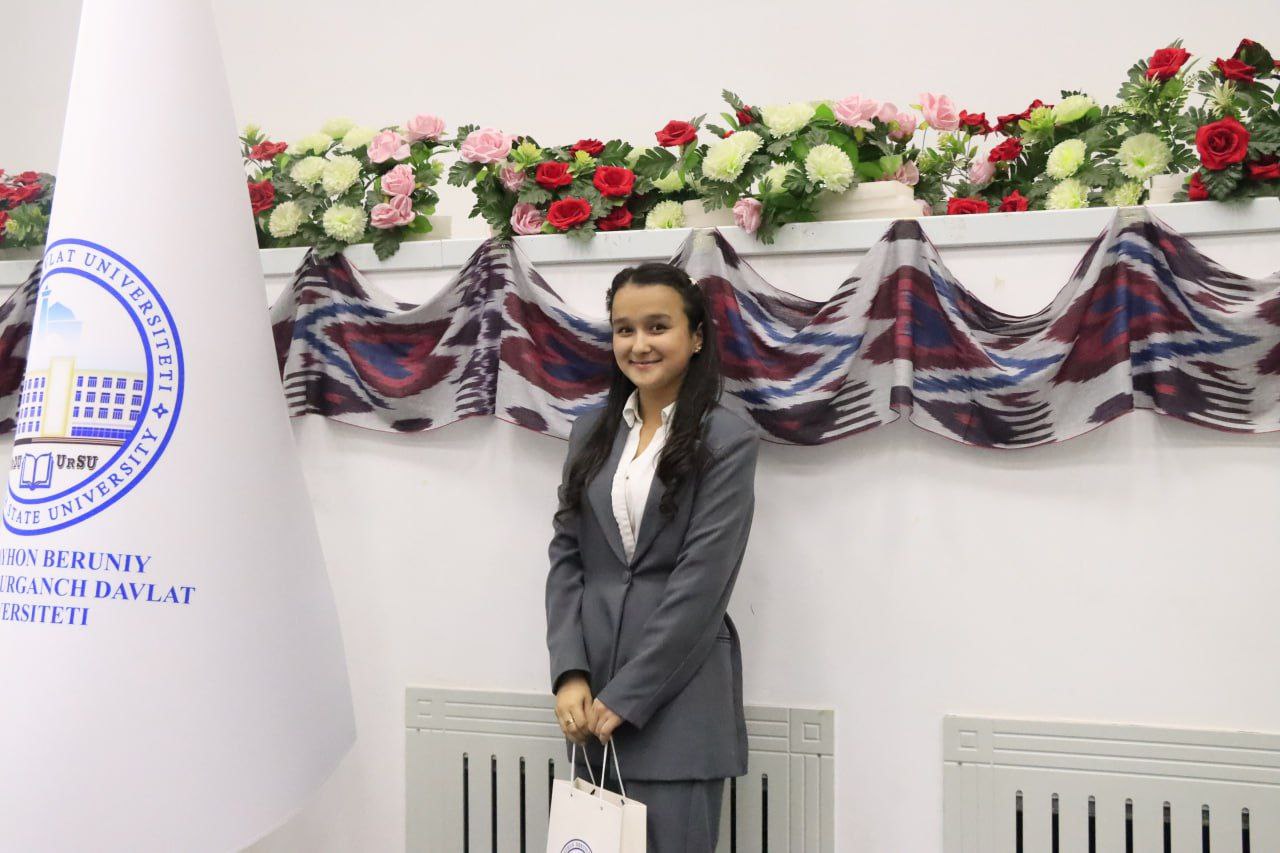
Dildora Khojyozova, 3rd-year student of Geography at Urgench State University named after Abu Rayhon Beruni.