
PEDAGOGICAL VIEWS OF ABDULLA AVLONI
Daminova Sevinch Tuychi qizi
3rd-year Student, Primary Education Program,
National Pedagogical University of Uzbekistan
Abstract
This article analyzes the life and pedagogical views of Abdulla Avloni, an Uzbek enlightener, poet, playwright, and educator. It examines Avloni’s role in the development of public education in Uzbekistan, the essence and significance of his work “Turkiy Guliston or Morality,” as well as his ideas on enlightenment and national awakening. The article scientifically explores the thinker’s interpretation of education and upbringing as the most important factors in human life, the theoretical and practical aspects of his pedagogical activity, and his contribution to the development of the modern Uzbek school system. In addition, the relevance of Abdulla Avloni’s views on knowledge, morality, upbringing, and patriotism for today’s education system is highlighted.
Keywords: Abdulla Avloni, pedagogy, upbringing, enlightenment, morality, Jadid school, education, national awakening.
At the beginning of the 20th century, the national awakening and enlightenment movement gained wide momentum in Turkestan. During this period, among the intellectuals who called the people toward knowledge, culture, and progress, Abdulla Avloni occupied a special place. As a poet, playwright, publicist, public figure, and most importantly, a devoted educator of the people, he left an incomparable mark on the history of Uzbek pedagogy. Abdulla Avloni dedicated his entire life to enlightening the nation and educating the younger generation in the spirit of knowledge and morality.
Throughout his career, Avloni worked as a teacher, established new-method schools, created textbooks, and encouraged the public toward enlightenment through the press. His pedagogical views were innovative for his time and continue to play a significant role in shaping the modern education system today.
The thinker’s work “Turkiy Guliston or Morality” is considered a masterpiece of Uzbek folk pedagogy. In this work, he scientifically presents his views on morality, upbringing, knowledge, and human development. Avloni’s ideas on education and upbringing have retained their relevance not only in his own time but also in the present day. Therefore, studying his pedagogical heritage and applying it to modern educational practice holds great scientific and practical significance.
Abdulla Avloni (1878–1934) is one of the most prominent enlightenment figures, educators, and writers to emerge during the period of national awakening of the Uzbek people. He was born on July 12, 1878, in the Mergancha neighborhood of Tashkent, into a family of craftsmen. Showing an interest in learning from an early age, Avloni first studied at a traditional school and later at a madrasa. Entering the world of literature and enlightenment in his youth, this talented young man began writing poetry at the age of fifteen. In his early works, he called on the people to escape ignorance, study in new-method schools, and acquire knowledge and professions.
Avloni’s enlightenment activity was primarily manifested in the field of journalism. In 1907, he published the newspapers “Shuhrat” and “Osiyo”, serving as their editor and promoting ideas of enlightenment, unity, and progress. Although the tsarist government soon shut down these publications, Avloni did not cease his activities. He continued his work in the newspapers “Sadoyi Turkiston”, “Turon”, and the journal “Kasabachilik Harakati”, making an invaluable contribution to the formation of Uzbek journalism. He regarded the press as a force that awakens the people, calling it “a lamp that illuminates the darkness of ignorance.”
Abdulla Avloni’s pedagogical activity formed the essence of his entire life. He viewed teaching not merely as a profession but as a sacred duty in service to the nation. In his lessons, he paid special attention to nurturing students’ independent thinking, patriotism, and moral purity. He considered expressive reading, emotional engagement with texts, and sincere communication between teacher and student as essential components of the educational process.
In “Turkiy Guliston or Morality,” Avloni deeply analyzes the issue of human perfection. According to him, upbringing is the fundamental foundation of human life. He famously wrote: “For us, upbringing is a matter of either life or death, salvation or destruction, happiness or catastrophe.” Through these words, Avloni interprets upbringing not only as a personal matter but as a factor determining the fate of the nation.
In his works, he divides upbringing into four main directions:
The timing of upbringing – education must begin from early childhood;
Physical upbringing – a healthy mind is formed through a healthy body;
Intellectual upbringing – developing intelligence, striving for knowledge, and cultivating thinking; Moral upbringing – instilling virtues such as honesty, conscience, patience, and compassion.
Avloni’s pedagogical views were considered innovative approaches in his time. He regarded education and upbringing as inseparable concepts “like body and soul,” emphasizing that teaching and moral education complement one another.
The thinker viewed morality as the highest human virtue. In “Turkiy Guliston or Morality,” he divided human behavior into two categories: good morals and bad morals. Good morals include patriotism, cleanliness, courage, conscience, patience, and kindness, while bad morals include ignorance, anger, laziness, lying, and greed. Avloni supported these ideas with verses from the Qur’an, hadiths, and the wisdom of thinkers such as Socrates, Aristotle, Ibn Sina (Avicenna), Sa‘di, and Bedil.
As an educator, Avloni sought to cultivate love for the mother tongue, respect for knowledge, diligence, and loyalty to the homeland among the younger generation. His poems and fables written for children possess strong educational value, fostering love for books, labor, and nature. In his poems about the Motherland, the poet depicts the homeland as a beautiful, generous, and prosperous land, instilling a sense of pride and honor in children.
Avloni’s work “A Brief History of the Prophets and the History of Islam” was written in a religious-enlightenment direction, aiming to acquaint the younger generation with Islamic history and enrich their spiritual world. This work was widely used as a textbook for primary schools in its time.
The thinker was not only a writer but also an active practical educator. During the 1920s and 1930s, Abdulla Avloni taught at the Teachers’ Seminary in Tashkent, the Faculty of Pedagogy, and the Central Asian University, where he trained many young teachers. During these years, he compiled the textbook “Literature Chrestomathy,” thereby laying the foundation for the methodology of teaching Uzbek literature in schools.
Throughout his life, Avloni devoted himself wholeheartedly to the enlightenment of the nation. In recognition of his services, he was awarded the honorary title “Hero of Labor” in 1927 and “Shock Worker of Public Education of Uzbekistan” in 1930. His name is still remembered with great respect in the history of the Uzbek education system. Today, schools, streets, scientific centers, and a museum at the Institute for Advanced Training of Teachers in Tashkent bear the name of Abdulla Avloni, honoring his invaluable contribution to education and enlightenment.
Abdulla Avloni regarded education as a powerful force leading the people toward freedom, culture, and progress. He emphasized the irreplaceable role of the teacher’s personality in educating the younger generation as well-rounded individuals. Therefore, Avloni can be regarded not only as a great figure of his own time, but also as one of the founders of the entire history of Uzbek pedagogy.
In conclusion, Abdulla Avloni is a great educator, poet, and enlightener who left an indelible mark on the spiritual and educational life of the Uzbek people. His views remain highly relevant not only for his own era, but also for the modern education system today. In his pedagogical activity, Avloni placed upbringing at the center of human life, interpreting it as the most important factor in the nation’s prosperity and the development of society.
His work “Turkiy Guliston or Morality” is a masterpiece of Uzbek pedagogical thought. It addresses the issues of educating a well-rounded generation based on values such as moral integrity, aspiration for knowledge, patriotism, compassion, and humaneness. For Avloni, education and upbringing were inseparable concepts; he highly valued the teacher as the most important figure shaping the future of the nation.
Even today, the ideas put forward by Avloni—humanism, moral education, loyalty to national values, love of knowledge, and the cultivation of independent thinking—are fully aligned with the main directions of modern education. Therefore, the legacy of Abdulla Avloni stands as the foundation of Uzbek pedagogy and an inexhaustible spiritual source in the upbringing of the younger generation.
References
Zunnunov, A. (2004). History of Pedagogy. Tashkent.
Dolimov, U. Abdulla Avloni as the Founder of Uzbek Pedagogy of the National Awakening Period.
Ziyouz. (n.d.). Retrieved from www.ziyouz.com
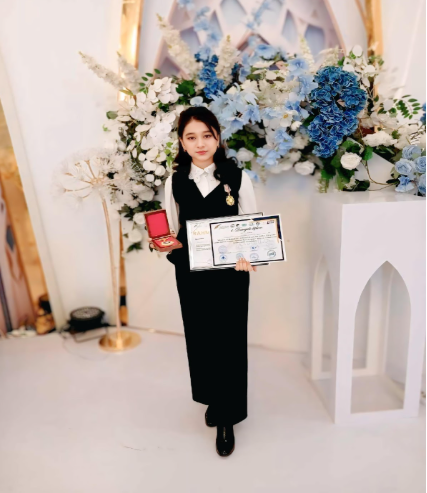
Daminova Sevinch Tuychi qizi was born in 2006 in Shahrisabz district, Kashkadarya region, Uzbekistan. She graduated successfully from Secondary School No. 72 in Shahrisabz district, Kashkadarya region. Since 2023, she has been a student of the present-day National Pedagogical University of Uzbekistan.
During her academic journey, she has distinguished herself through her high level of activity, strong interest in science, and initiative. She has carried out volunteer activities at the Pinnacle Science Republican Scientific Center, contributing to the promotion of scientific research among young people.
Sevinch Daminova is the author of scientific articles published in prestigious journals of countries such as the United States, Singapore, and Russia, which reflects her recognition at the international level as a young researcher. She is the holder of more than 50 diplomas and certificates and has actively participated in numerous national and international competitions.
In 2025, she became the recipient of the “Future Star” Statuette, organized on the scale of the Commonwealth of Independent States. She has also been awarded the “Advanced Generation” badge and the “Devoted to High Science” badge. In the “Mosaic of Nations” competition organized by the Jadids International Scientific Research Association, she won first place and was awarded the “Friendship” badge.
She is the author of a number of poems and international scientific articles, successfully combining creativity and scientific research. She is a determined and ambitious young scholar who aims to contribute to the development and prosperity of her country in the future.