
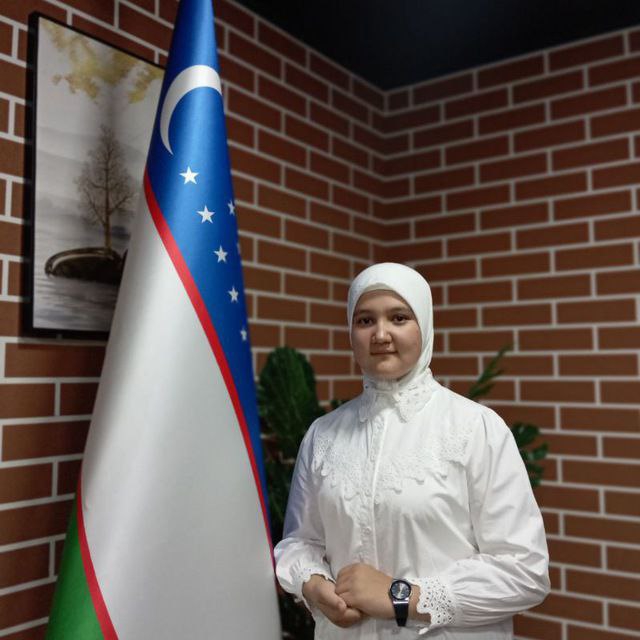
1st-year student, Faculty of Humanities and Languages, Kokand State University
Zahiriddin Muhammad Babur – The Legacy of a Great Commander and Thinker
Zarifa Odilova Nozimjon qizi
1st-year student, Kokand State University
Scientific Supervisor: D.O. Hasanova, Doctor of Philology (DSc)
Abstract
The article discusses the role of the great poet and statesman Zahiriddin Muhammad Babur in world civilization, his life principles, and his acts of public service. Babur’s humanistic ideas and his contributions to introducing Eastern culture are highlighted.
Keywords: Zahiriddin Muhammad Babur, statesman, great historical figure, India, prominent personality, poet, historian, Baburnama.
Introduction
February 14 holds special significance for the Uzbek people and the entire Turkic world. This day is widely celebrated as the birth anniversary of the great commander, eminent statesman, talented poet, and unique historian Zahiriddin Muhammad Babur. Over the centuries, Babur has left an indelible mark on human history through his courage, intellect, and rich spiritual legacy.
Babur was born on February 14, 1483, in the city of Andijan, into a family belonging to the Timurid dynasty. His father, Umarshaykh Mirza, was the ruler of the Fergana region. At the young age of twelve, Babur ascended the throne and faced the complex currents of political life. Battles for Samarkand, internal conflicts, and political instability strengthened his young heart. Despite these hardships, he acted with courage and determination—qualities that later elevated him to the status of a great historical figure.
During a period of political turmoil in Transoxiana, Babur set a new goal for himself. He captured Kabul, established a secure base, and began his campaign toward India. In 1526, he achieved victory at the Battle of Panipat, founding the powerful Mughal Empire in India. This empire later became a center of political stability and cultural advancement in South Asia for several centuries. Under Babur’s reign, science, art, and architecture flourished.
The most remarkable aspect of Babur’s personality was his mastery of both the sword and the pen. While he demonstrated courage on the battlefield as a commander, he also expressed his delicate sensibilities in the creative realm. His famous work, the Baburnama, is one of the rare treasures of world literature and historical scholarship. In this work, the author provides detailed and sincere accounts of his life, the political events of his era, cities, natural landscapes, and the customs of the people. The clarity of language, vivid descriptions, and authenticity make the work uniquely valuable.
The Baburnama is not only a historical document but also a literary masterpiece. It includes valuable observations on the nature, climate, flora, and fauna of Fergana, Samarkand, Kabul, and India, reflecting Babur’s broad worldview and keen powers of observation.
Babur’s poetry also deserves special attention. His divan contains ghazals and rubais celebrating love, loyalty, longing, patriotism, and human virtues. Poems written during his years away from his homeland express deep feelings of nostalgia and yearning. Babur was also a builder; he established gardens in Kabul and India, paying attention to landscaping and beautification. The gardens he created later became famous as “Babur Gardens,” standing as vivid examples of Eastern architecture and landscape art.
Today, Babur’s legacy serves as a model for younger generations. His life demonstrates that hardships and trials should not deter a person. On the contrary, those who face challenges with courage achieve great heights. The name Babur symbolizes glorious history, strong will, and profound intellect. His birth anniversary reminds us to revisit our history and rich cultural heritage. Studying Babur’s legacy, promoting his works, and instilling them in the consciousness of youth is our sacred duty, as a nation aware of its history has a bright future.
References
Baburnama. Tashkent: “Yulduzcha,” 1989.
Zahiriddin Muhammad Babur. Divan. Tashkent: Literature and Art Publishing House named after Gafur Ghulam, 1965.
V. Zohidov. Babur and His Literary Heritage. Tashkent, 1960.
R. Nabiyev. Babur’s State and Diplomacy. Tashkent, 1994.
History of Uzbek Literature. Vol. 5. Tashkent, 1978.
National Encyclopedia of Uzbekistan. Vol. 2. Tashkent, 2002. Article: “Babur.”
“Humanistic Ideas in the Personality of Zahiriddin Muhammad Babur,” 2022.
Pingback: Synchronized Chaos First March Issue: Fingering the Spines | SYNCHRONIZED CHAOS