
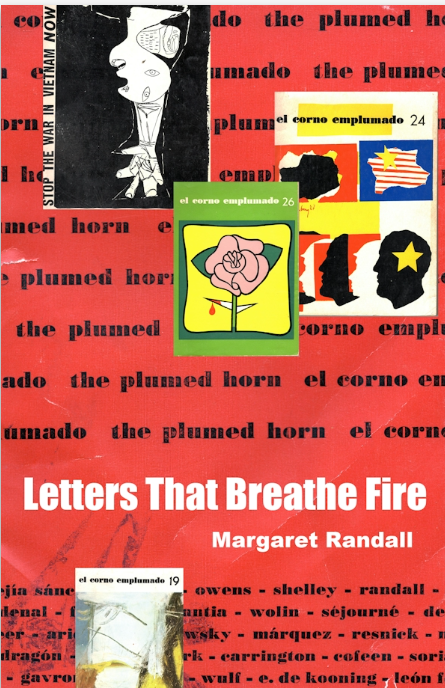
Keeping the fires burning:
A book review of “Letters that Breathe Fire” by Margaret Randall
by J.T. Whitehead
When confronted with a book that is both very well done, and also very important, it’s difficult to avoid being hyperbolic. Margaret Randall’s book, “Letters that Breathe Fire,” is both of these things. It is an exceptionally well-done anthology of letters from dozens of significant and well-loved poets and writers, pulled from a near-decade of her work with Sergio Mondragon putting together the remarkable bi-lingual literary journal, El Corno Emplumado / The Plumed Horn. The letters from Issues # 1 through # 31, from January, 1962, through April, 1969, are not only wonderful reading, but they are just as significant for their cultural and historical importance.
I can appreciate a book of letters by any favorite author or poet; with the letter we see the writer advancing his or her or their thought without any deference to the rules that define a work of art. With pretty much all of the poets in this book, the last accusation that would stand up against them is “pretense.” But it remains the case that with letters, we see more of the person, engaging in a different form of communication that is guaranteed to be authentic. Their poetry follows every poet that ever came before them, regardless of which precedent they choose to respect. But with letters, we get to sit on the barstool next to each poet, and just converse. That by itself is one of things that makes the book such a wonderful book to read.
I can think of three general or “big picture” reasons for why this is a book that one should buy, and read. The book is a philosophical work. The book is also a cultural artifact, or snapshot; perhaps a photo album full of snapshots would say it better. And as noted the book is just a very good book full of great writing. All three reasons should not only encourage an individual reader. If anyone reading this review has anything to do with the stock of any library, especially one connected with any campus, the book belongs on your shelves for these reasons.
The book is of great interest to anyone interested in political philosophy. Do not misread me. I’m not saying it is a work of political philosophy. I’m saying that it is an “act” of political philosophy. The family of thought it exemplifies dates back to long before, yet represents, the “Theses on Feuerbach,” which state that the philosophers have understood the world so far, but that the point is to change it. The book is itself an endeavor in that direction.
But the tradition of thought to which this book belongs is a tradition that pre-dates the works of Marx, a fact no right winger understands. It dates back to the “Book of Acts.” This gives us some idea of how long the struggle for social justice has been happening. And along the way, some have realized that ideas can change reality, that the interaction between ideas and material reality is not a one-way, deterministic street in which material stuff determines what we think – that history is not simply following material or economic leads, but that it can be inspired by something less physical, like words. The book opens with a great quote that grasps this: Jose Pepe Mujica laments a generational error that was once believed: that social change was only a matter of changing material reality, when in fact culture occupies an immense role, and that the struggle for justice can be waged on the cultural level as well. The error he corrects began in the 1800’s with Engels. We’ve grown. Ideas matter, and can make a difference. As the German philosopher Jurgen Habermas taught, communication is a form of action. This book is a “work” of political philosophy, not in the sense that John Locke’s Treatises are such works, or Hobbes’ Leviathan. I mean: this book “does” good work, and proves Habermas’s thesis.
Margaret Randall’s book is also the best “archive” in the history of culture and ideas that I have encountered in decades. I will admit some bias, but I think the bias is a good one. While clerking for a bookshop I reached the point at which I imagined a Venn diagram of poets, and found it to be complex, when looking to specific publishers that date from approximately the 50’s, if not sooner, until the 70’s if not later. I would check the spine for publishers and I gravitated towards works published by Ferlinghetti at City Lights, Barney Rosset at Grove, James Laughlin at New Directions, or John Martin at Black Sparrow. They overlapped when it came to the poets. What attracted me was the manner in which they blew open the entire field. Those houses gave me a chance to read Kenneth Patchen, or Allen Ginsberg. The Beats happened, and the mimeograph era was likely also in full swing, (but for that one may have to locate a hard-to-find book by Christopher Harter). In any case, born in 1965, I could only observe, as if in a documentary, what appears to have happened:
Poetry became, suddenly, more . . . democratic.
Margaret Randall’s excellent compilation, “Letters that Breathe Fire,” are letters from those poets to one another. It is the best sample of what was happening when poetry became more democratic. It became more democratic because of the work she and Sergio Mondragon were doing with The Plumed Horn.
The book is also wonderful as a piece of cultural history. The Horn, placed these letters from the poets and contributors on special, colored pages. This was effectively a bulletin board for writers and thinkers to communicate with the readers, and with one another. This was before Facebook, before Instagram, before blogs, before computers. This was a public forum, made possible by Randall and Mondragon. We are reminded again of Habermas’s premise that communication is a communal act. And all this predated the computer age.
What makes this book such a better read than letter collections by one poet is the sheer number of poets we get to hear from. I’ve read Creeley’s, or Pound’s, or Bukowski’s letters, appreciating the poet if not their politics (Pound), but not at once cover to cover, without interruption. I couldn’t. It was too much Creeley, Pound, or Bukowski. This was not so with “Letters that Breathe Fire.” This book is anything but monotonous. Diverse in voice, the book includes, by my rough count, at least 100 poets. Some poets, given the mission of the literary journal, appear as expected. Ernesto Cardenal is the most obvious example. But even the metaphysical and leaping poet Robert Bly makes an appearance. The poets are as diverse as the following partial list would indicate (in order of the table of contents): Robert Kelly; Clayton Eshleman; Jackson Mac Low; Ernesto Cardenal; Ted Enslin; Diane Wakoski; Gary Snyder; Thomas Merton; Lawrence Ferlinghetti; Tom Raworth; Charles Bukowski; Robert Bly; Denise Levertov; Cid Corman. And more.
My limited list does not intentionally omit the Central or South Americans: I listed poets whose works I have read, and this book, “Letters that Breathe Fire,” has helped me understand my deficiency. Because of Randall’s book I now have a new list of poets to explore, all from south of the border. I chose the poets for the above list simply because of my familiarity with them, because I knew that they were could be as unlike one another as, say, T.S. Eliot is from Wanda Coleman. Listing them, I knew I was making the point about their different voices. Randall’s book is a treasure trove for any poet who wishes to be introduced to new voices, for just this reason. I’ve read Americans who live south of Texas, and more than Neruda or Borges. But now my list has grown, thanks to this book. If the above list is short it is due to a lack of exposure, on my part, and not bias.
With each new poet’s letter, I discovered a new gift, different from the previous. I’m reminded of an advent calendar or a childhood treasure hunt, in which each new opening or each new advance reveals some new treasure. This is why this collection of letters is so much more enjoyable, for poets and other readers, than any other letter collection limited to one poet. One would expect their letters to display the differences. They do. More importantly, for the reader, is reading how much they shared of their humanity. Their diversity, as poets goes, is only one reason for why they best represent humanity. But they are on humanity’s side. These poets are with us, not against us. It’s that human, that basic.
This is an important book. It is itself an act of resistance, an act despite being “words.” It is communicative action. It captures our literary and cultural history. It is also, simply, wonderful reading, and not just for poets, and not just for philosophy students, but for all of us. The poets in this anthology wrote great poetry. Do not be surprised at how great they are at writing letters, to one another, and to us.
Letters That Breathe Fire can be ordered from NYU Press.
Pingback: Synchronized Chaos’ Second March Issue: Polyphonic Archive of Humanity | SYNCHRONIZED CHAOS