
La Belle et la Bête
Opera Parallèle
Zellerbach Hall
Berkeley, California
Beast Against Beauty
A review by Christopher Bernard
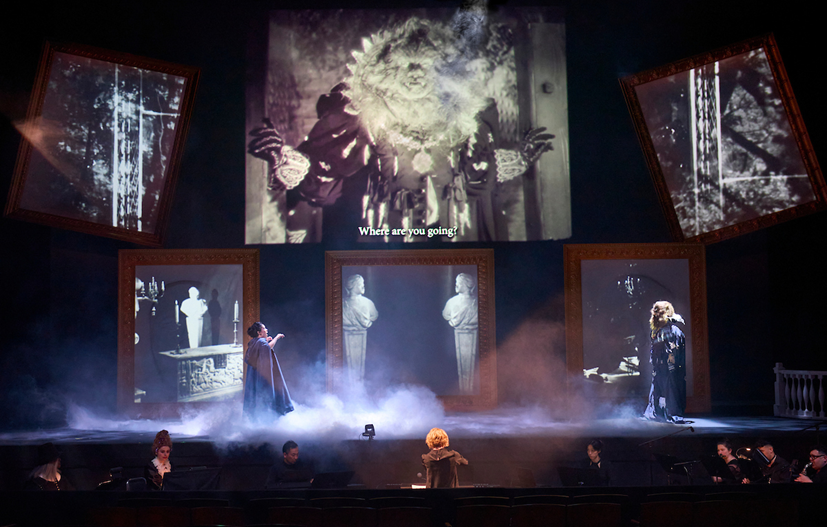
Over a recent weekend in March, Cal Performances hosted an original production by the local company Opera Parallèle, combining movie and stage, of Philip Glass’s uniquely beautiful conversion of Jean Cocteau’s classic film La Belle et la Bête into a cinematic opera.
The original “Beauty and the Beast” was written by the eighteenth-century French novelist Gabrielle-Suzanne Barbot de Villeneuve and appeared in her book La Jeune Américaine, et les Contes marins. The story, set in a romanticized High Renaissance France of François Premier and Diane de Poitiers, was later revised and abridged by Jeanne-Marie Leprince de Beaumont in the version best known down the generations. The story’s magnetic appeal has never weakened; in the age of toxic masculinity, it has never been, in some ways, more timely.
To say nothing of the aggression inherent in all masculine sexuality: Has there ever been a sensitive young man in love with a beautiful woman who did not, at some time, darkly suspect that, in reality, he was ugly, disgusting, unworthy of either loving or being loved—a beast indeed? Has there ever been a woman who wasn’t afraid at some point of bringing out the beast in the man who claimed he loved her? And, the claims in the fairy tale notwithstanding, how often has it occurred, not that the beast turned into Prince Charming, but that Prince Charming turned into the Beast?
Cocteau’s film, a masterpiece of French surrealism from the middle of the last century, contains some of cinema’s most famous sequences: the line of chandeliers held by disembodied arms protruding from a corridor’s halls, the moving eyes in the faces carved into a mantel above a blazing chimney fire, a pearl necklace turning into a writhing snake in the hands of a wicked sister, the dissolves from beast to human and from human to beast, and Belle’s gliding down a night-time hallway with windblown curtains without apparently stirring a foot, to name only a few.
The original script, itself rich with poetry yet containing enough realism to empower the magic, and Georges Auric’s film score work with these magical images to create a world of consummate fantasy speaking the curious truths poetry is uniquely capable of expressing. Philip Glass’s decision, half a century after the film’s release, to strip out and replace not only the soundtrack and sound design but all the dialogue as well into an immense musical fabric proved to be, not only as provocative as any surrealist gesture, but brilliantly successful and entirely aligned with the soul of the work. Unlike the notorious mustache on the Mona Lisa, Glass’s gambit enhances and even completes the work in a way one can only feel the original artists (with, of course, the possible exception of the silenced M. Auric) would have completely approved. It doesn’t displace the original but provides a perfectly viable alternative.
When I heard about Opera Parallèle’s production, I imagined one of three possibilities: a straight screening of a silent version of the film, with sound provided by live singers and instrumentalists, much like what I was lucky to experience on my first exposure to Glass’s setting. Or it might be an entirely live staging, with a few discreet bows to the film. Or it might be the most interesting but most perilous of the three: a fusion of the film with live action. But if they tried the latter, how would they solve the problem at the heart of any such attempt: how integrate the two without their blundering regularly and clumsily into each other? Because if staging and film weren’t merged into a seamless whole, it could be, indeed would be fatal: the genius of the film would require equal genius, above all in judgment, taste, and tact, in the staging, otherwise it would be in danger of overbalancing, then irretrievably sinking, the performance.
If this third choice were attempted, surely (I thought) the director would realize that film and staging would need to alternate; presenting them both at the same time would have to be generally avoided, for obvious reasons: the audience would not know which one to watch, the staging or the screen (or if two screens were used, which screen?). Staging theater is not like staging a dance or a concert, where multiple strands of movement or sound can be processed by the human mind without what is aptly called brain freeze.
One of the main problems was that some in the audience might resent any attempt to deflect their attention from the brilliance of Cocteau’s film. Concentrating the audience’s focus is, of course, one of any stage director’s primary responsibilities; diffusing attention must be avoided except for brief periods and for reasons that are perfectly clear to the audience as well as emotionally telling, whether dramatic or comic. And deliberately dividing their attention can court disaster.
Alas, this production did not solve the problem described, mostly because it did not seem to realize there was a problem to solve in the first place. The film and the staging stubbornly refused to combine; at times, they even stood in hostile and irreconcilable opposition: the concept for the piece was often at war with the piece’s aesthetic, with frustrating consequences.
Almost all of Cocteau’s film was screened on a darkened wall placed mid-stage as part of the handsomely designed and lit set (kudos to the unnamed set designer). At apparently random moments, live singers, in full costume, walked onstage and, distractingly, more or less imitated what appeared on film. In a few instances the film was paused and the action of the story was given entirely by live singers on stage. These few scenes were the most effective in the performance; effective enough for one to wish there had been more.
To add to the problem of divided attention, there were also a (gratefully) few attempts to screen a second film, which again imitated the action in the Cocteau. The concluding scene of the production abandons Cocteau’s film entirely, replacing it with a shot-by-shot imitation of the film’s famous concluding sequence, this time of the singers we had seen live onstage. If this was meant to bring all of the elements of the performance together in a transcendent conclusion, it was only partly successful.
It is always dangerous to fiddle with a masterpiece once; to fiddle with it twice can be fatal.
Fortunately, the musical elements of the evening came off, for the most part, very well: Hadleigh Adams was in excellent form in multiple roles, including the Beast, as was Chen Kang as Belle. Sophie Delphis did fine double duty as both of the evil sisters, and Aurelien Mangwa was strong-voiced in three well-differentiated roles. Nicole Paiement conducted the small but powerful ensemble, perhaps pressing too hard at times on the volume. The wonderful costumes were designed by Natalie Barshow, and not to be forgotten, given the opulence of the era in which the story takes place, were the hair and makeup designs by Y. Sharon Peng.
_____
Christopher Bernard is an award-winning novelist and poet. His most recent book is the poetry collection The Beauty of Matter.