
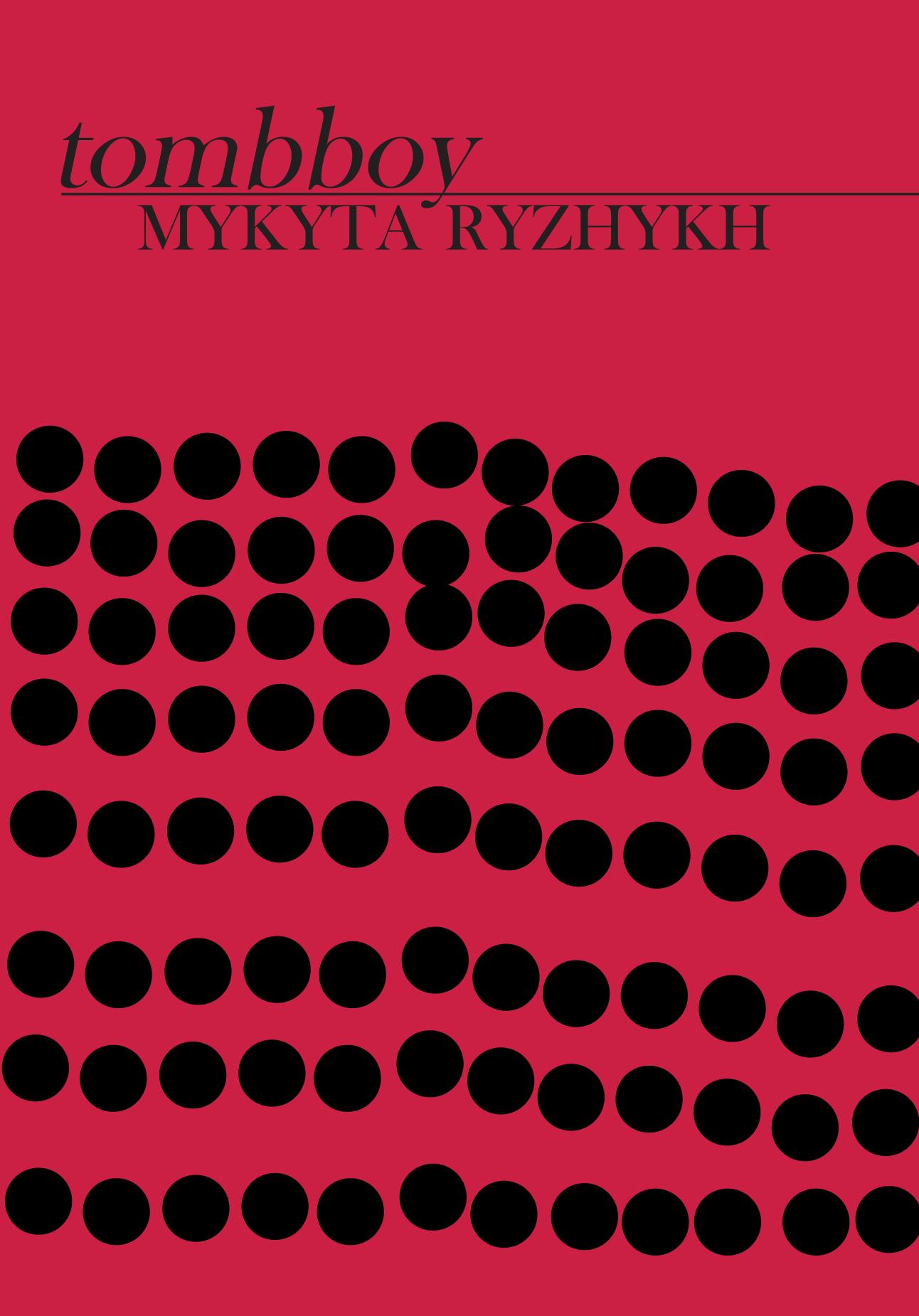
Mykyta Ryzhykh’s new collection tombboy depicts what Margaret Atwood pointed out in her famous quote, “War is what happens when language fails.”
Through repeated phrases, inverted words, special characters, checklists and tables, and italicized product specifications, Ryzhykh breaks language and meaning. He creates a mood of absurdity and confusion where we feel lost, without landscapes or place names or titles or even recognizable syntax to orient us. Like ee cummings, Ryzhykh eschews capitalization, but rather than representing a bold individual artistic statement, the choice reinforces the low status of nameless humans in this barren world.
Death and loss recur as motifs in tombboy, through the title poem and several others that mention cemeteries, sandcastles disappearing at high tide, checkmate at the end of a chess game, a coffin embedded in a birthday cake, bees separated from their hives. One piece consists almost entirely of blacked out text, illustrating the loss of the poem’s meaning as well as its narrator, and another is merely a blank page. Another describes a bird purely in the negative, listing everything the animal lacks, and wondering aloud how it will fly.
Most of the poems focus just on conveying the feeling of dislocation and disorientation without speculating on its causes. However, near the beginning, a few pieces suggest that violence of various sorts has ruptured the world. One piece references “bombs tears grenades grenades of tears” and a destroyed house, and another poem mentions a suicide. The poetic subjects are universalized: the description in the line following the first reference to ‘tombboy’ suggests he/she could be male or female. People have lost much of their individual humanity here and become an anonymous, alienated mass.
The collection ends on what is perhaps a note of kindness, although as tenuous and fragile as the world of this book. Poem #46 serves as a kind of lullaby to a child not yet born, with a repeated chorus urging them to sleep. We see the first glimmer of tenderness and hope in this poem, as the unborn will have ‘the strength of the stones we once were” and the speaker begs them to “kill me with your love.”
Although the object of the poem is mortal: “posthumous ants will eat you” and will come into a tenuous world “where they may be crippled for life,” they “were once fish/we should become birds.” They, like us, belong here, and despite war, violence, and the breakdown in human language and connection, still have a place in our broken world’s long history.
Mykyta Ryzhykh’s tombboy was recently published and can be ordered from Lost Telegram Press.
Pingback: Synchronized Chaos’ First July 2026 Issue: Questing for Renewal | SYNCHRONIZED CHAOS
Pingback: tombboy gets reviewed and another nod – Lost Telegram Press