
LIFE ONLINE
Every morning, the first thing Malika looked at was not the window, but her phone. For her, a new day did not begin with sunlight, but with the notifications appearing one after another at the top of her screen. Someone had liked her photo, someone had sent her a new message, and someone else had probably already written, “Where are you?” She could exchange messages with dozens of people before even getting out of bed, yet sometimes she failed to hear her mother’s voice from the next room: “Are you awake, my dear?”
Malika’s life online looked beautiful. Every photograph was carefully chosen, every frame had just the right light, and every caption created the impression that her life had already fallen perfectly into place. University, books, coffee, walks, friends, small victories, and thoughtful reflections on life—her page had everything. Her number of followers kept growing. Sometimes she found herself thinking that she had never even met some of the people she spoke to every day in real life.
Anyone who visited her page would have had no reason to doubt that Malika was happy. Only Malika herself sometimes did. For three years, she had spent more time thinking about how her life looked to others than about how it actually felt to live it.
One day at university, a professor gave the students a simple assignment:
— Turn off your phones for one hour today. Do not send any messages, take any photographs, or go on social media. Just look around you. Spend one hour observing people.
Laughter filled the classroom. Some thought it was a joke. Someone said, “Can we really survive an hour without our phones?” Malika laughed too.
But once she turned her phone off, the room suddenly looked different.
She noticed that the hands of the girl sitting beside her were trembling. Malika had always thought of her as cheerful and self-confident. Now she saw the girl repeatedly writing the same sentence in the corner of her notebook:
“Can I do this?”
Down the corridor, a young man who was usually joking and making everyone laugh stood alone by the window. Messages kept arriving on his phone, but he did not answer a single one. No one knew what was hidden behind the calmness on his face.
When the hour was over, the students turned their phones back on. Screens lit up one after another. Notifications returned. Everyone slipped back into their familiar digital lives.
But during that one hour, Malika had begun to understand something: people hide far more than they choose to show.
From that day on, she began looking at her own page differently. There were hundreds of photographs there. But not a single one showed her lying awake at night, staring at the ceiling. None showed the moments after she had argued with her mother and sat alone regretting it. None contained the words, “I’m afraid,” “I’m tired,” or “What if I can’t do it?” She had shown the world the most beautiful version of herself while hiding her most genuine self even from herself.
One evening, she decided to write a new post. She used artificial intelligence to help her draft it. Within seconds, the screen filled with beautiful, emotional, almost perfect sentences:
“Sometimes there is a silence within the human heart that even the closest person cannot hear…”
Malika stared at the text for a long time. The sentence was beautiful.
But those were not her own words.
She deleted everything and put the phone down. A few minutes later, she typed a single sentence herself:
“I’m not okay today.”
She did not post it either.
She turned off her phone and went into her mother’s room. Her mother was sitting on the bed, reading a book.
“Mom…”
“Yes, my dear?”
Malika was silent for a few seconds. Then she rested her head on her mother’s shoulder.
“I’m tired.”
Her mother closed the book. She did not say, “Everything will be fine.” She did not say, “This too shall pass.” She simply stroked her daughter’s hair.
That was when Malika realized that sometimes a person does not need advice. Sometimes they simply need someone willing to stay.
That evening, she spent a long time without her phone.
The next day, she received a message from the young man from the university.
“Excuse me, may I ask you something?”
“Yes,” Malika replied.
A few minutes later, his message arrived:
“I thought your life was perfect because that’s how your page looked.”
Malika stared at the screen for a moment. Then she wrote:
“I thought the same about yours.”
There was a pause before his reply came:
“So we both judged each other by the photographs on our pages.”
Malika laughed.
They eventually became close friends. Perhaps that was the strange thing about life: sometimes the person who understands you most is someone who has been living inside the same illusion as you.
After that, Malika did not abandon social media. She did not want to reject her entire online life or portray the internet as something bad. She simply changed one thing: she stopped living to show her life and began living it for real.
Some days, she posted nothing. Some days, instead of taking photographs, she called a friend. Sometimes she and a friend would simply walk around the city without their phones, talking and laughing. Over time, her number of followers decreased. But her real conversations increased.
A year later, she began going through the photographs stored on her old phone. There were thousands of them. Most were beautiful. But she noticed that the most precious ones had never been posted online.
A photograph of her resting her head on her mother’s shoulder. A candid shot of a university friend laughing. A simple photograph of her father walking home beneath an umbrella in the rain. And a picture of herself smiling genuinely on a day she had never shared with anyone. None of them had likes. None had comments. Yet Malika could see her real life in every one of them. She turned off her phone screen. The room grew quiet. There had been a time when turning off her screen made her feel as though everything had come to an end. Now, it was the opposite. The screen went dark, but her life went on. The wind moved outside. She could hear the dishes clinking in the kitchen. Her phone lay silently on the table. Malika smiled.
At last, she understood something simple: a person can always be online, but the greatest loss is not being disconnected from the network—it is becoming disconnected from life itself.
My name is Kozimjonova Saidaxon Alisher qizi. I was born on November 27, 2007, in Asaka District, Andijan Region, Uzbekistan. I am currently a third-year student majoring in Economics at the Faculty of Economics and Management, Andijan State Technical Institute.
From an early age, I have been passionate about numbers, analytical thinking, and economics. To me, economics is more than just an academic discipline—it is a vital field that helps us understand the development of society and improve people’s lives. For this reason, conducting research and pursuing lifelong learning have become an integral part of my life.
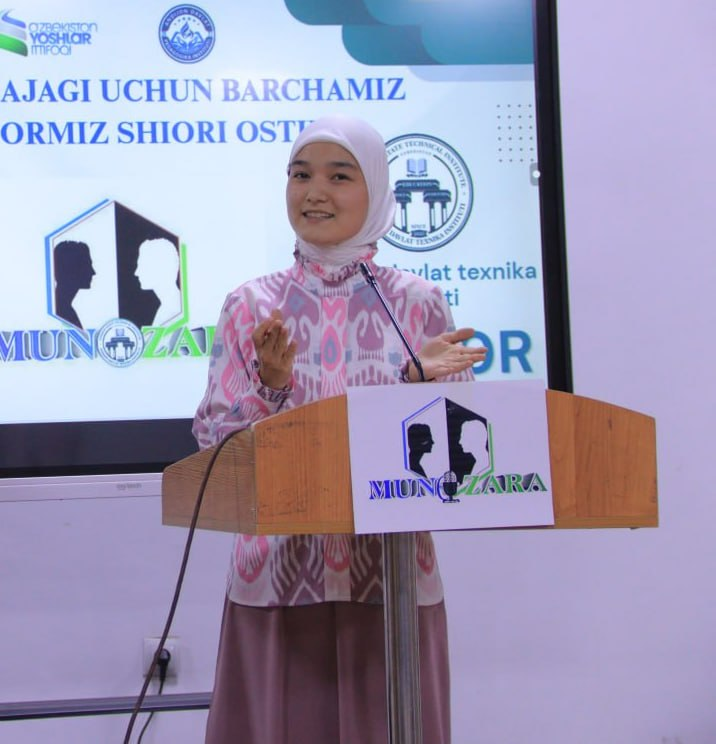
To date, I have published more than 30 scientific articles in national and international publications. I have also presented my research at six scientific and practical conferences. During my academic journey, I became the regional winner of the Economics Statistics and Data Analysis Olympiad and later represented my region at the national stage. In addition, I won first place in the institute stage of the “Zukko Kitobxon” (Intelligent Reader) competition, participated in the national “Munozara” (Debate) tournament, and have been an active participant and winner in numerous academic and intellectual competitions.
After entering university, my interests expanded beyond academic research to include creative writing. Reading books, participating in literary events, and creating stories that touch people’s hearts have become an important part of my life. Life Online, the story you are about to read, is my second work of fiction. I believe that every story I write should encourage readers to reflect, inspire kindness, and promote universal human values.
I am also actively involved in community service. I participate in volunteer initiatives and am the founder of a volunteer-focused startup initiative under Ko’ngilli.uz. To me, contributing to society is more valuable than any personal achievement.
Reading is one of my greatest passions. So far, I have read more than 50 books, each of which has broadened my knowledge, enriched my perspective, and inspired me to pursue greater goals.
My guiding principle is: “Seek knowledge from the cradle to the grave, acquire it, and share it with others.” I firmly believe that knowledge elevates individuals, while education has the power to transform society.
My greatest ambition is to become one of the leading specialists in the field of economics, further develop my academic career, and use my knowledge and experience to benefit others. If my writing or my work can make a positive difference in even one person’s life, I will consider that my greatest achievement.