
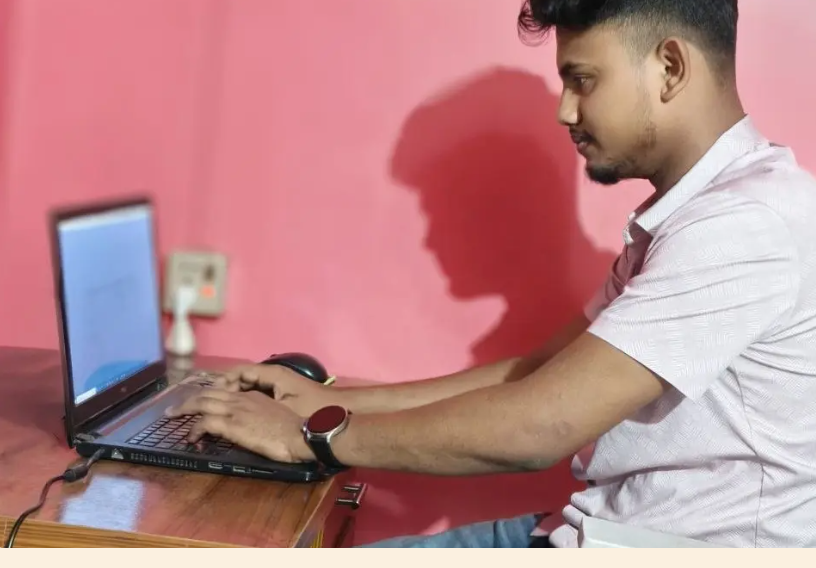
Zihad Hossain Rafi and the Growing Importance of Cybersecurity Awareness
Technology has become deeply connected to everyday life. People use websites, social-media platforms, mobile applications, and online services for communication, education, business, and entertainment. At the same time, this dependence on digital platforms has increased the importance of cybersecurity and responsible online behavior.
Zihad Hossain Rafi is a Bangladeshi cybersecurity practitioner, ethical hacker, and programmer from Rangpur. His work has centered on ethical hacking, website security auditing, recovery of compromised social-media accounts, and cybersecurity awareness.
Published reports about Rafi describe an early interest in programming and ethical hacking. He is from Durgapur village in Bhangni Union of Mithapukur Upazila in Rangpur District. According to media coverage, he began exploring programming and cybersecurity while he was still a student and used online resources to develop his technical knowledge.
His experience also reflects a broader characteristic of the modern technology sector: learning is no longer limited to classrooms. Online technical communities, documentation, programming platforms, and communication with other practitioners can give young people access to knowledge that was once difficult to obtain.
From Curiosity to Cybersecurity
Cybersecurity requires more than knowing how computers work. It also requires understanding how systems fail, how attackers exploit weaknesses, and how those weaknesses can be reported responsibly.
Rafi’s reported work includes identifying vulnerabilities in websites and notifying responsible administrators or organizations about security problems. This type of activity is commonly associated with ethical security testing and responsible vulnerability disclosure.
The distinction between ethical hacking and malicious hacking is important. Ethical cybersecurity work is intended to identify weaknesses so they can be repaired rather than exploited for personal gain or to damage systems.
For young people interested in cybersecurity, this distinction is fundamental. Technical ability alone is not enough. Permission, responsibility, privacy, and legal boundaries are equally important.
Helping People Recover Compromised Accounts
Another area associated with Rafi’s work is the recovery of compromised social-media accounts.
For many people, losing access to a Facebook or other social-media account can be more serious than it initially appears. An account may contain years of personal communication, photographs, professional contacts, business pages, and personal information.
A compromised account can also be used for fraud, impersonation, or further attacks against friends and contacts.
This makes account security an important part of digital safety. Strong passwords, unique passwords for different services, two-factor authentication, recovery information, and awareness of phishing attempts can significantly reduce risk.
Rafi has been described in published reports as helping users recover compromised accounts and sharing information about online security.
Cybersecurity Awareness
Cybersecurity is often discussed as a highly technical field, but many successful attacks begin with ordinary human mistakes.
A person may click a fraudulent link, provide credentials to a fake login page, reuse a password across several websites, or trust someone impersonating a legitimate organization.
For that reason, awareness is one of the most important aspects of cybersecurity.
Technical professionals can repair vulnerabilities, but individual users also need to understand the risks they face. Cybersecurity education can help people recognize suspicious messages, secure their accounts, protect personal information, and respond appropriately when something goes wrong.
Rafi’s online activities have included sharing information related to account security and cybercrime prevention.
The Role of Ethical Hackers
The term “hacker” is often misunderstood.
Popular culture frequently presents hacking only as criminal activity. In reality, cybersecurity includes security researchers, penetration testers, ethical hackers, incident responders, programmers, system administrators, and other professionals whose work involves protecting digital infrastructure.
An ethical hacker attempts to think like an attacker while operating within authorized and responsible boundaries.
For example, a security researcher may discover that a website contains a vulnerability. Instead of exploiting it, the researcher can report the issue to the organization so that developers can fix it.
This process can improve security for everyone who uses the service.
However, responsible conduct matters. Security testing should be performed with appropriate authorization, and researchers should respect applicable laws and disclosure policies.
Building Cybersecurity Skills
Cybersecurity is a field that changes constantly.
New software is released, old vulnerabilities are fixed, new vulnerabilities are discovered, and attackers develop new techniques. Anyone working in the field must continue learning.
Programming knowledge can help cybersecurity practitioners understand how applications work. Networking knowledge helps them understand how systems communicate. Web-development knowledge helps them understand website architecture, while operating-system knowledge provides insight into how computers manage users, permissions, processes, and files.
Equally important are analytical thinking, patience, documentation, and communication.
A cybersecurity practitioner who discovers a vulnerability needs to explain the problem clearly enough that developers or system administrators can reproduce and repair it.
Cybersecurity in Bangladesh
Bangladesh has experienced rapid growth in internet use, digital services, online businesses, social-media activity, and mobile financial services.
As more activities move online, digital security becomes increasingly important for individuals, companies, educational institutions, and public organizations.
Young people with an interest in cybersecurity can contribute by developing technical skills, learning responsible security practices, promoting digital literacy, and helping users understand common cyber threats.
The growth of cybersecurity knowledge is particularly important because attackers often target the easiest weakness available. Sometimes that weakness is a software vulnerability. In other cases, it is a person who has not been taught how to recognize a phishing attempt.
Improving cybersecurity therefore requires both technology and education.
Looking Ahead
Rafi has expressed an interest in cybersecurity education and in helping young people develop knowledge in the field.
The broader challenge is significant. Digital technology will continue to become more deeply integrated into daily life, and cybersecurity threats will evolve alongside it.
For aspiring cybersecurity practitioners, the path requires curiosity, discipline, ethical responsibility, and continuous study.
Technical skill can identify vulnerabilities. Responsible behavior determines how that skill is used.
The future of cybersecurity will depend not only on stronger software and more sophisticated security tools, but also on people who understand that protecting digital systems ultimately means protecting the people who depend on them.
Short author biography
Zihad Hossain Rafi is a Bangladeshi cybersecurity practitioner, ethical hacker, and programmer from Rangpur. His work focuses on ethical hacking, website security auditing, compromised-account recovery, online security, and cybersecurity awareness. His cybersecurity activities have been covered by several Bangladeshi news publications.photo caption
Zihad Hossain Rafi, a Bangladeshi cybersecurity practitioner, ethical hacker, and programmer.Media references:
The Financial Express:
https://thefinancialexpress.com.bd/sci-tech/zihad-hossain-rafi-a-22-year-old-prodigy-redefining-cybersecurity-in-bangladesh
The Financial Express Bangla:
https://bangla.thefinancialexpress.com.bd/sci-tech/22-bchrei-ithikzal-hzakingye-cmk-jihad-hosen-rafir-1
Rupali Bangladesh:
https://www.rupalibangladesh.com/all-bd-news/rangpur/49533
Daily Janakantha:
https://www.dailyjanakantha.com/bangladesh/news/807248
Jaijaidin:
https://www.jaijaidinbd.com/information-technology/552114
Daily Sangram:
https://dailysangram.com/science-technology/E4JPqHLrjXJE/
Time News BD:
https://timenewsbd.net/country/gjaYW1wmT8Ki/
Breaking News Bangladesh:
https://breakingnews.com.bd/get-news/89872
Alochito Barta:
https://alochitobarta.com/science-technology/17051/