
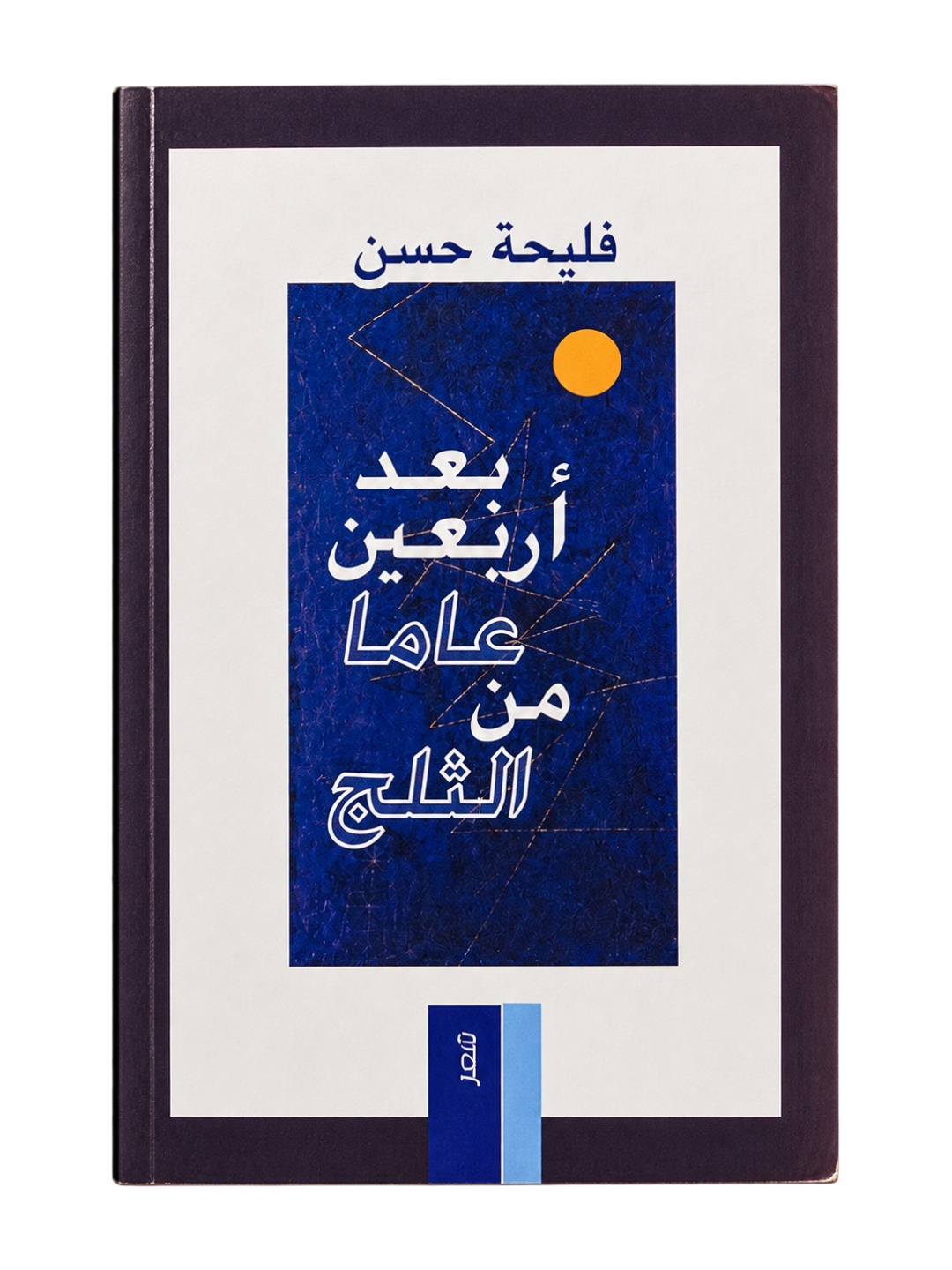
Memory and Time in the Poetry of Faleeha Hassan
A Critical Reading of the book “After Forty Years of Snow”
By Raida Jarjes
Faleeha Hassan’s poetry represents a quiet yet profound voice in contemporary Iraqi literature. Rather than relying on rhetorical intensity or immediate emotional expression, her poems contemplate experience from a distance, allowing memory and time to transform lived moments into poetic knowledge. In After Forty Years of Snow, this approach becomes particularly evident: the poem is concerned less with the event itself than with the traces it leaves behind.
The Title as a Threshold
The title After Forty Years of Snow immediately introduces the reader to an extended landscape of memory. In Gérard Genette’s concept of the paratext, the title functions as an interpretive threshold through which the reader enters the text.
Here, “forty years” suggests the maturation of experience and the long passage through memory, while “snow” evokes silence, stillness, coldness, and emotional suspension. The collection therefore begins not within the experience itself, but in its aftermath—when memory has already begun transforming pain into understanding.
The Poetic Self
Hassan’s poetic self is neither conventionally lyrical nor directly confessional. It is reflective, sensory, and constantly moving between memory and the present.
This is evident in poems such as “A Date at the Restaurant,” “We Women,” “This Evening,” and “My Old Friends,” where everyday details become entry points into deeper questions of absence, belonging, and remembrance.
Her feminine perspective is equally significant. It does not appear merely as a subject of the poems, but as a distinctive way of perceiving and interpreting the world.
The Rhetoric of Silence
One of Hassan’s most striking qualities is her linguistic restraint. Her language is concise and precise, often allowing silence and textual space to carry as much meaning as words.
Short sentences, pauses, and unfinished gestures invite the reader to participate in completing the emotional landscape of the poem. This “rhetoric of silence” transforms absence itself into a poetic device.
Even ordinary moments, drinking tea in New Jersey, observing New York, or noticing someone smoking beneath a window, become charged with memory and emotional resonance.
Time, Memory, and Exile
Time in the collection does not move in a straight line. Past and present repeatedly intersect, while memory disrupts chronological order. The past is not recalled simply through nostalgia; it becomes material for questioning, reflection, and self-understanding.
Similarly, exile extends beyond geography. It becomes an existential condition—a quiet sense of displacement carried within the self.
The body itself becomes an archive, preserving the traces of cold, loss, war, distance, and remembered experience.
Conclusion
After Forty Years of Snow reveals Faleeha Hassan as a poet deeply concerned with what remains after experience has passed. Her poetry moves beyond the event toward its echo, beyond loss toward its understanding, and beyond memory toward knowledge.
Through restrained language, fragmented time, and a remarkable use of silence, Hassan creates a poetic world in which what is left unsaid may resonate as strongly as what is spoken. Her collection thus offers a distinctive contribution to contemporary Iraqi poetry—a poetry in which memory does not merely preserve the past, but continually recreates its meaning.
Notes :
Gérard Genette (1930–2018) was a French literary theorist and critic.
Faleeha Hassan, After Forty Years of Snow. First Edition. Dar Amargi for Printing and Publishing, Iraq, 2024. 158 pp. ISBN: 978-9922-9567-2-5.