
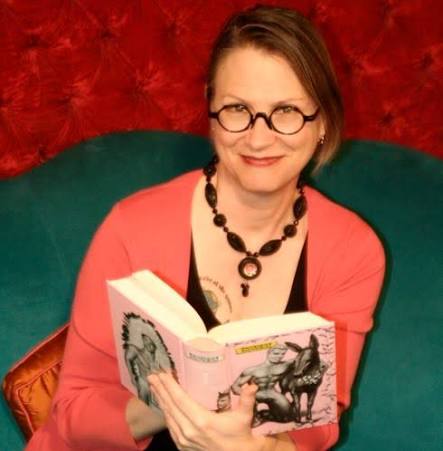
I recently spoke with Dr. Carol Queen on my YouTube show, The Kandy Fontaine Show. Carol is one of those rare figures whose voice shaped entire eras — sex‑positive culture, queer visibility, bi identity, erotic writing, community education. She’s someone whose work helped build the terrain so many of us walked on. Having her on the show felt like opening a door back into the world that raised me.
We started by talking about the 90s. Carol said, “The 90s and into the very beginnings of the 2000s were such a rich time for anthologies.” She paused, remembering. “Tiny presses that actually still had enough money to publish their books. And we both met so many interesting people that way, even if we never met them in the flesh. We all devoured those books when they came out. It was a wonderful community of writers doing different stuff and expressing different sexualities.”
She added, “Thanks for taking me on a backwards tour to that. Those were such great days.”
That was the ground we stood on. And from that ground, we drifted — naturally — into talking about artificial intelligence. Not as a tech topic, but as a cultural one. Carol said, “These days, if you see a riff, you’ve got to count the em dashes in it to find out if a human being even riffed it.” She wasn’t joking. She was naming the uncanny flattening happening in creative spaces.
I told her about something author/editor Thomas Roche said to me more than a decade ago — long before AI was in everyone’s pocket. I told him that all the 70s dystopian nightmare movies had warned us about this future. Carol nodded and said, “I don’t even pay attention to that. I don’t even know what they’re doing. I just know a lot of things are generated by the AI. They’re texts written by AI.”
I compared AI‑generated writing to Eggo waffles — food‑adjacent. Carol burst out laughing. “Food‑adjacent product,” she said. “Somebody somewhere is in a lab, and they think they’re doing creative practice in their space. Even though we didn’t ask for these products to emerge, we have every right to question the whole scenario around the product.”
Then she pivoted, the way only Carol can, from critique to lineage. “I want everybody who was raised by the algorithm to really look backwards,” she said. “Because we can’t look forward if we don’t do that.”
She talked about the counterculture we came from, agreeing with my sentiment that “there’s only 10 people in the counterculture.” I told her about Ken Goffman aka R.U. Sirius pointing out that the phrase “slutty detective” (a moniker for my Kandy Fontaine character) came from the Kathy Acker novel Empire of the Senseless: “We’re all slutty detectives in the city of mirrors.”
Queen took things one step further and listed the cities: “San Francisco, Los Angeles, New York, Paris.” Then she added, “We’re all standing, looking at history spool out, and we’ve all got a different point of view about how we need to talk about it.”
We talked about queer lineage and gay martyrs. Carol said, “Somebody had to suffer. Somebody had to push.” She talked about neurodivergence. “Great big overlap of the neurodivergence communities,” she said. “Oh yes.”
Then she told one of the most beautiful stories I’ve ever heard from her. “When I was ten,” she said, “I walked through a high school fair and picked up a flyer with a weird little bird drawn on it.” She paused. “What was it? It was a copy of The Realist that I, a 10‑year‑old, picked up and took home.” She sighed. “I wish I had that now. I would make a shrine. The future called to me via The Realist on that table. How did it get there? I will never know.”
She told another story about lineage, this time about actress Olivia Wilde, inspired by our discussion of Oscar Wilde’s De Profundis: “I saw two Olivia Wilde movies in one night,” she said. “And apparently in high school she stole Oscar Wilde’s name to have as her own, to be an inspiration to her as she went forward into the world. That didn’t used to happen. But apparently once in a while it happens now, and that is very moving and excellent.”
She talked about Spectator magazine. “The way we got Spectator,” she said, “was that the Berkeley Barb was like, ‘Times are changing, we gotta shut down,’ and the people who did the sex section — which was a pull‑out section in the middle — were like, ‘Wait! Leave us the sex section. We still have work to do over here.’” She laughed. “Lane and Kat, bless their hearts. I am, in many ways, a writer because I picked up that flyer with The Realist information, but then they gave me a gig writing essays for Spectator, and I could write them anything I wanted.”
She talked about Paul Krassner. “I wrote for Paul a couple of times,” she said. “Loved that guy. I hope people keep Paul’s name alive. He spanned some scenes.” She laughed again. “Paul stepped in to edit Hustler for two minutes while Larry Flynt went to rehab. You kinda can’t get gigs like he managed to bounce from thing to thing. It’s not like that anymore.”
She talked about the algorithm again, circling back. “Somebody is there,” she said, “and this is their creative process. Okay. But I want everybody who was raised by the algorithm, and raised by the refrigerator case at the grocery store, to really look backwards.” She paused. “Because we can’t look forwards if we don’t do that.”
She talked about the need to remember. “We’ve got to remember what our backstory allowed us to explore and do,” she said. “That’s one of the things that’s so important to me. I’m so proud of having come into the writing world in the 90s.”
She talked about the young ones. “Our young one didn’t look just like this young one today,” she said. “But we’re all standing, looking at history spool out.”
She talked about the algorithm one more time, summing it up. “It’s the new wolves,” she said. “The new wolves.”
Our conversation lasted for three hours; I’ve just plucked out a few gems. It was packed full of fun, theory, jokes, laughter, a very beautiful meeting of minds. I felt something I hadn’t felt in a long time: the sense that the counterculture — our counterculture — isn’t gone. It’s just harder to find under the noise. But it’s still here. Carol is still here. I’m still here. And we’re still riffing.