
A placid rebellion
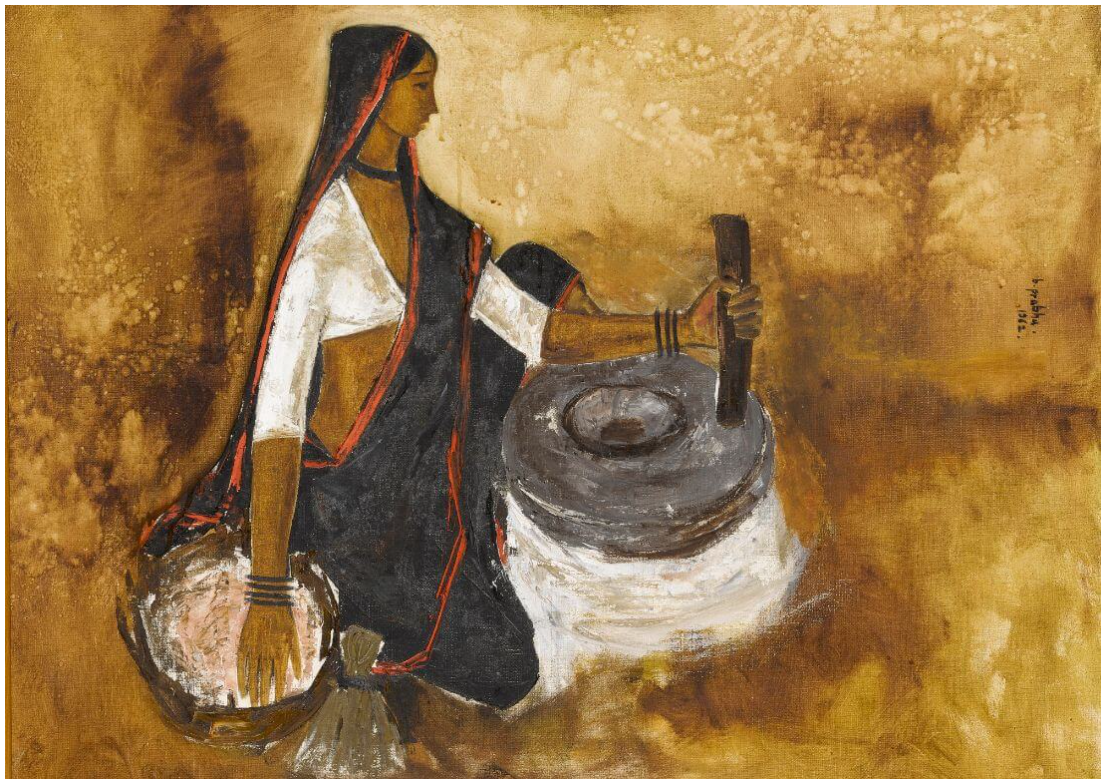
‘Wheat’ by B.Prabha (Oil on Canvas)
18th May, 2025. Unaware that it was International Museum Day, I dialled Bengaluru’s National Art Gallery to check if it was open to visitors. A chirpy receptionist welcomed me to explore the museum anytime between 8 am and 4 pm. Thanks to Sunday traffic, I reached the venue pretty early. They’d converted a 100-year-old heritage mansion into a space to celebrate Modern Art. By a hair’s breadth, I escaped the security’s persistent efforts to usher me into a selfie booth, where I was expected to make a social media post, tagging and thanking the Ministry of Culture for doing its job. I silenced my phone and fed it to my wide-mouthed tote bag.
On the ground floor, exhibits showcasing the evolution of Air India’s creative media and merchandise, including its mascot, cartoons, ad posters and comics, set the stage. A few steps further, majestic paintings and sculptures created by distinguished alumni from renowned art schools of Mumbai, Pune, Vadodara, New Delhi, and Santiniketan adorned the mansion’s expansive white walls. Each piece dazzled under dim picture lights, accompanied by QR codes to offer us a digital experience.
As I strolled along the building’s veranda, paintings of artist B. Prabha stopped me in my tracks. Her works eerily transported me to a time and place that evoked postcolonial India. Like a fly on the wall, I watched silver-clad fisherwomen selling their fresh catch; a servile maiden playing her veena; young girls sharing warmth beneath a single shawl; a group of ladies seated amid earthen water pots and hungry children perched on their poor mothers’ curvy hips. The dusky, slender figures, tinged with melancholy, went about their daily chores. B.Prabha famously said, “I have yet to see one happy woman”. Her canvases were matted with themes of maternal strength, rural labour and feminine helplessness. Her subjects seem to yearn for an escape from their mundane obscurity.
“Wheat” stayed with me because of its raw yet subtle portrayal of sacrificial motherhood. With one hand anchored on a mortar and the other scooping wheat grains from a wicker basket, I saw a long-faced mother grinding golden kernels into atta, perhaps to make rotis, a staple food in North Indian households. She wore a crumpled blue cotton saree bordered with red dye, along with black plastic bangles and a choker. Her white blouse plunged into the depths of a tired chest pulsing with woeful beats. Sadly, some cultures define a woman’s modesty and reverence by how well her body is veiled. But she didn’t seem to care for her slipping pallu. The kitchen’s sooted walls were faint reminders of women who toiled before. The machines, both human and “man”-made, should keep running to feed the clan. Beside her, lay a potli pouch holding her humble riches- probably coins and betel nuts. She looked as though she dreaded the rut’s longevity. Like the grains, she watches her desires, urges, and aspirations sucked in and crushed under the centripetal force of domesticity.
Many months later, I bought Maxim Gorky’s “Mother” at my mom’s insistence. She had read the Tamil translation and wouldn’t stop talking about it. I opted for the English edition. We discussed and analysed the chapters in our little book club. For some reason, between the pages of “Mother”, B.Prabha’s “Wheat” kept flashing before my eyes.
“Mother” is Maxim Gorky’s fiery magnum opus. Revolution in pursuit of a greater good is traditionally built on bloodshed and polemical beliefs. The Youth of pre-revolutionary Soviet realise that words can be far more extreme than weapons. With Czarist censorship rampant across the country, gendarmes mercilessly confiscated any literature that critiqued the regime, especially books and essays that provoked people to question the state of affairs. Nilovna, the Mother, remains an indomitable symbol of courage among those whom society labelled too weak to change the world.
This paragraph is a testament to this woman’s willpower. Beneath her calm demeanour, a vindictive rage simmered in silence. Mother knew how to make bed, bake bread and brew samovar to fuel the radical flames of her young rebels. Mother also knew that only intellectual freedom could ultimately liberate her class from tyrannical clutches. A meek, apolitical housewife lends her grit to embolden a cause that resists mass oppression. Her story foreshadows a revolt aimed at cleansing an unjust social order. The embers of her heart, once smothered by the ashes of outdated constructs, sparks a reformation that shook the foundations of ivory towers.
“It is my aim to paint the trauma and tragedy of women”, said B.Prabha.
“One word of praise from a woman is dearer to me than a whole ode from a man”, said Maxim Gorky.
Both are no more, but their works linger on, making a compelling case. Even a worm will turn. Our world loves to take tolerance for granted. A woman is rewarded for her endurance. The more she bears, the bigger the badge. History will be kind if she carries on without complaints. It’s not like her to fight on the streets. Her ‘No’ cannot mean ‘No’ and her consent is too feeble to be heard. Her safety is assured as long as she adapts to misogynistic microcosms. Artists like B.Prabha and Gorky take it upon themselves to expose such stinking stereotypes time and again. Because art on the canvas of activism will always be a work in progress.
Tamizh Ponni VP is a stoic art buff who loves literature, visual arts and music. Tamizh’s articles, poems, stories and paintings have been published in many anthologies, digital journals and educational blogs. Tamizh spends most of her time painting, reading, writing articles, stories and poems, playing piano and watching documentaries/movies.
————————————————————————————-
Prabha, B. Wheat. National Gallery of Modern Art, Bengaluru.
“B. Prabha.” Wikipedia, Wikimedia Foundation, https://en.wikipedia.org/wiki/B._Prabha. Accessed 27 Oct. 2026.
Gorky, Maxim. Mother. Rupa Publications India, 2023
Gorky, Maxim. “One Word of Praise from a Woman Is Dearer to Me than a Whole Ode from a Man.” Goodreads, https://www.goodreads.com/work/quotes/6489758-selected-short-stories. Accessed 27 Oct. 2026.