Essay from Oynur Azimova

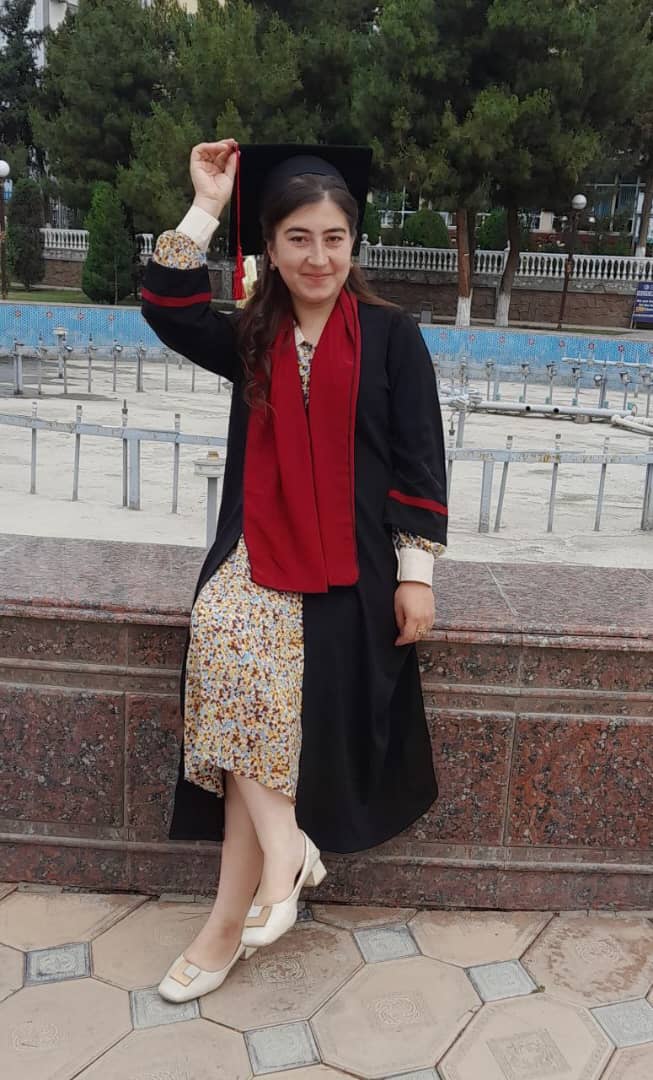
Young Central Asian woman with a blue graduation cap and gown and red sash standing outside near a green tree on a lawn near a white school building.

A Letter to O‘tkir Hoshimov

“Life is like a storeroom with a locked door.”

Assalomu alaykum, dear teacher.

In the vast kingdom called literature, where I still wander without having found my true place, I have gathered all my humility and courage to call you my mentor.

It was through your books that I first felt the truth — how vividly and honestly life’s scenes could be reflected in art.

When I read your story “The Affairs of the World” (“Dunyoning ishlari”), I felt as though my own mother — her kindness, her wisdom, her entire life’s path — had found its way into your book. It seemed to me that this story was written about my mother.

Your novel “Between Two Doors” (“Ikki eshik orasi”) — I first read it when I was fifteen, and then three more times in later years. Not because I didn’t understand it, but because my soul needed it, because the heart itself longs for such a book.

Each time I read it, there are three moments that make me cry:

When Robiya marries her uncle Shomurod, when Kimsan meets a heroic death, and when Munavvar’s life ends in such sorrow.

There are, in truth, countless moments in that book that tear at my heart.

While reading it, I even found myself upset with you — why, dear teacher, why did you give poor Robiya such a bitter fate? It pains me deeply. She loved Kimsan all her life, she waited for him. Yet in the end — by fate’s decree and her mother’s will — for the sake of her little son Muzaffar, she was forced to marry her uncle, the same man who once told her:

> “Don’t hold your wedding without me — I’ll come and arrange everything myself.”

And Kimsan… even in his final moments of life, he said,

> “At least one of you, I will take with me,”

and drowned with the fascist in the river.

Even years later, the shadow of that war fell upon Muzaffar and Munavvar’s marriage, breaking hearts anew.

Every one of your books draws me into their world — I live beside your characters, breathe their emotions, and feel their joys and sorrows as my own.

I am your daughter in spirit — one who dreams of writing works that live forever, and who will always remember you with pride.

With love and gratitude,

Your student,

Oynur Azimova

The Need for Creativity

Creativity — it is like an addiction, a beautiful yet incurable illness.

Whoever is struck by it lives a lifetime battling the fever of inspiration. In the end, such a person either creates beauty — or serves discoveries that bring both greatness and tragedy to humankind (like the invention of the atomic bomb).

Every human being, in some way, is sensitive to the world around them — to the living and the lifeless — they observe, reflect, and are inspired. Each person possesses some form of creative ability.

But only through talent and nurturing can that ability be developed and brought to light.

Human nature itself is creative. Everyone finds rest in some form of creation — some in drawing, others in composing music or conducting research that nourishes the soul.

So, what gives birth to creativity?

1. Healing:

When a person falls into depression, engaging in their favorite form of art or creation helps them heal and find balance again.

2. Broadening worldview:

Those who create regularly have more active minds, think independently, and are capable of making their own decisions.

3. Fame:

A desire to be remembered as a remarkable individual — to leave one’s mark in the memory of humankind.

4. Material need:

Some people sell their creative works or create for financial reasons.

Whatever the motivation, creation is a necessity — it is the voice of the human soul searching for meaning, beauty, and immortality.

— Oynur Azimova

Oynur Azimova A’zam qizi was born on March 11, 2003, in Kitob district of Kashkadarya region. In 2021, she graduated from Secondary School No. 65 of the district with excellent marks and a silver medal. The same year, she was admitted to the University of Journalism and Mass Communications of Uzbekistan.

From a young age, inspired by her mother, Oygul, she developed a love for literature and poetry. Her creative works have been published in various regional and national newspapers and journals. The young poet’s first collection of poems, titled “My Talent — My Title” (“IQTIDORIM — UNVONIM”), has been published and warmly received by readers.

Essay from Boboqulova Durdona

(Young Central Asian woman with a gray coat, white top, and long dark hair in a ponytail).

Boboqulova Durdona Sanjar qizi

Student of Shahrisabz State Pedagogical Institute

2nd year, Faculty of Mathematics

IMPROVING THE QUALITY OF ELECTRICAL ENERGY: MAIN PROBLEMS AND THEIR SOLUTIONS

Abstract:

This article provides a detailed analysis of the main problems causing the decline in the quality of electrical energy. In particular, it examines factors such as voltage fluctuations, harmonic distortions, reactive power imbalance, and voltage unbalance, and their negative effects on the stability of the power grid and the operation of consumer electrical devices. The article proposes several modern technical solutions to overcome these challenges, including the reduction of harmonics through passive and active filters, methods for reactive power compensation, voltage optimization technologies, and real-time monitoring systems that allow continuous observation of the network’s condition. The research results hold significant scientific and practical value for improving power quality, enhancing energy efficiency, and ensuring the reliability of the power supply system.

Keywords: power quality, voltage fluctuations, harmonics, reactive power, filters, voltage optimization, monitoring system, energy efficiency, reliability

Introduction

In recent years, the rapid development of industry, transport, information technologies, and services, along with the introduction of new technologies and global economic growth, has led to a sharp increase in the demand for electrical energy. Consequently, there is a growing need to ensure the stable and uninterrupted operation of power supply systems, maintain high energy quality, and use existing resources efficiently.

Power quality has become a crucial factor in providing continuous energy supply to both industrial and domestic consumers. A decline in power quality is mainly manifested through voltage fluctuations, harmonic distortions, excessive reactive power consumption, and voltage asymmetry. These negative factors seriously threaten the stability and efficiency of the electrical network. For instance, voltage fluctuations and harmonic distortions can lead to improper operation of industrial equipment, accelerated wear, energy loss, and reduced production efficiency. Similarly, excessive reactive power and voltage asymmetry cause uneven distribution of voltage and current across the network, potentially damaging consumer equipment.

Therefore, technical and technological solutions aimed at maintaining and improving power quality are essential. This article analyzes these issues in depth and presents a number of modern methods and technologies to address them. These include passive and active filters, reactive power compensation systems, voltage optimization technologies, and real-time monitoring systems. Applying such methods can improve power quality, ensure the reliability of power supply systems, and enhance energy efficiency. The article also provides practical recommendations for the application of these solutions.

Main Part

Power quality refers to the degree to which the supplied electrical energy meets established standards (such as GOST, IEC, and PQ norms). The demand for high-quality power is increasing, as it is essential for the smooth operation of technological processes across different sectors.

The main indicators of power quality include voltage level and stability, frequency stability, harmonic content, temporary voltage changes (such as dips or surges), voltage asymmetry, and reactive power. Each of these indicators must be maintained within optimal limits to ensure reliable and efficient operation of electrical equipment.

Voltage stability in the power grid is crucial for ensuring continuous and quality power supply. Sudden voltage drops, rises, or interruptions can cause industrial machinery shutdowns and failures of information systems, leading to significant economic losses—especially in high-tech industries and critical sectors such as healthcare and banking.

Nonlinear loads such as digital devices, variable frequency drives (VFDs), and computer systems generate harmonics in the system. These harmonics lead to overheating of transformers, electric motors, and cables, thereby reducing overall system efficiency, increasing energy consumption, and shortening equipment lifespan. Harmonics are assessed according to IEC 61000-4-7 and IEEE 519 standards, and corrective measures are applied accordingly.

Excessive reactive power reduces the ability of the power system to transmit useful (active) power, leading to overloads at power stations and decreased energy efficiency. To mitigate this, technologies such as Static VAR Compensators (SVCs), automatic capacitor banks, and shunt reactors are used to improve system efficiency.

In three-phase systems, uneven load distribution results in voltage asymmetry, which causes motors to overheat, vibrate, and operate less efficiently. Maintaining voltage balance is therefore essential.

To eliminate harmonics, passive LC filters and active power filters (APFs) are widely used today. Active filters detect harmonic currents in real time and inject counter-phase currents to cancel them out. This method provides high precision and fast dynamic response, allowing the system to adapt to varying loads.

Voltage stabilization is achieved through Automatic Voltage Regulators (AVRs) and Uninterruptible Power Supply (UPS) systems. AVRs control voltage fluctuations to maintain stable output, while UPS systems ensure continuous power supply—especially vital in fields like medicine, IT, and finance.

Smart grid technologies, Internet of Things (IoT)-based monitoring systems, and power quality analyzers enable continuous observation of network parameters in real time. They help identify disturbances early and take corrective action promptly. By collecting and analyzing real-time data, potential problems can be detected and addressed before they cause major issues.

Power quality analyzers measure voltage, frequency, reactive power, and harmonics, providing accurate diagnostics of network conditions. These tools are crucial for maintaining stable, reliable, and high-quality power supply.

Conclusion

The article has analyzed the key factors that degrade power quality—voltage fluctuations, harmonic distortions, reactive power imbalance, and voltage asymmetry. These issues negatively affect the stability of power systems and the efficiency of electrical equipment, leading to production interruptions, increased energy losses, and reduced overall system performance.

Modern technical solutions are proposed to address these challenges, such as reducing harmonics using passive and active filters, compensating reactive power, optimizing voltage, and employing real-time monitoring systems. The use of active filters, reactive power compensators, and smart monitoring technologies (such as IoT-based systems and power quality analyzers) significantly enhances system reliability and efficiency.

Improving power quality leads to higher energy efficiency, reduced losses, and extended equipment lifespan in industrial and domestic systems. Moreover, the adoption of modernized technologies ensures a stable and reliable power supply. Such technological approaches contribute to the sustainable use of global energy resources, reduction of environmental impact, and overall economic growth, promoting the implementation of environmentally friendly and energy-efficient technologies.

Essay from Rustamova Shakhnoza

Rustamova Shakhnoza Umidbek qizi, 1st-year Master’s student at Webster University. Photo above is of a young Central Asian woman with a long dark ponytail, gray coat, and white top.

Tree of Patience

In a small village lived a young man named Qudrat. His family was poor but rich in love. Qudrat’s childhood was filled with hard work — in summer he worked in the fields, in winter he gathered firewood. From an early age, he understood one thing: life never hands you happiness ready-made; everything must be earned through patience and effort.

In that village, most people believed that “a good education is only for the rich,” and poor children simply accepted their fate. But Qudrat was different. He held his old books close and studied late into the night by lamplight — sometimes even in darkness when the candle burned out.

His mother often said:

— “Son, don’t strain your eyes. Accept your fate. You’ll never achieve much.”

But Qudrat would smile and answer:

— “Mother, a person’s fate is like a tree of patience. If you don’t plant it and water it, it will never bear fruit. I will take care of my tree.”

Years passed. Qudrat finished school and dreamed of studying in the big city — but he needed money. Still, he didn’t give up: he worked on construction sites by day and read books at night. His friends shook their heads at him.

— “You’re wasting your time,” they said. “The city’s doors will never open for you.”

But Qudrat whispered to himself:

— “With enough patience, even mountains will move.”

Life tested him. One day, he injured his leg at work and couldn’t walk for months. But even then, he didn’t abandon his books. “The body may hurt, but if the spirit is strong, the path will be found,” he told himself.

Finally, his dream came true — he was admitted to university. Life in the city was hard: paying rent, saving money for food… Sometimes bread and water were all he had. But whenever hunger made his vision blur, he remembered one phrase:

— “The tree of patience does not bear fruit in a single day.”

Years went by. Qudrat learned not only knowledge but also patience. Each difficulty became a lesson: a delayed stipend taught endurance, a cold room taught resilience, loneliness taught self-belief.

After graduation, he returned to his village with big dreams. The village children now looked at him differently — the poor boy who once planted his “tree of patience” had grown into a wise, educated man.

One day, a group of young people approached him and asked:

— “Brother Qudrat, how did you achieve all this? Life is hard for us too — we have dreams, but we can’t find the way.”

He smiled and pointed to a young sapling growing under the willow tree.

— “Do you see this tree? I planted it when I was a child. Every spring, I watered it, protected it from the wind, and covered it during the cold. Years passed, and now it stands strong and bears fruit. Dreams are the same — if you don’t nurture them with patience, they’ll wither.”

The young people listened and felt inspired.

Years later, Qudrat’s tree of patience became a symbol of the whole village. People rested beneath its shade, young folks gathered to talk, and in every fruit the tree seemed to whisper:

> “Hardship is not meant to stop you, but to strengthen you.

Patience turns struggle into happiness.”

“THE SWALLOW THAT NEVER RETURNED”

The spring breeze blew softly, moving the white clouds across the village sky. The branches of trees were again covered with green leaves, and the pleasant earthy scent rising from the fields filled the air. In that same village, near the river, there lived an old man named Hamro.

Hamro had traveled to many places in his youth — he had seen both cities and the countryside. Yet, he chose to spend the last season of his life in his native village, where his childhood memories were preserved. Every day, he sat under the big willow tree in front of his house, gazing into the distance — as if waiting for someone.

One early morning, swallows rose into the sky. They chirped, circled over the yard, and then flew away toward the mountains. Watching them, Hamro smiled gently, as if talking to them:

— “Oh swallows, you come every spring and leave every autumn. But I still remain here. Perhaps one day, I will fly away with you,” he whispered softly.

That morning, his granddaughter Asal came out into the yard and approached him.

— “Grandpa, you’re watching the swallows again?” she said, smiling.

— “Yes, my dear. Seeing them leave is wisdom, but waiting for their return is hope,” replied Hamro.

Asal didn’t fully understand her grandfather’s words but nodded affectionately.

 The Mysterious Encounter

One day, as Hamro dozed off under the willow tree, he had a dream. In the dream, he was a young boy again, watching a swallow’s nest by the river. Suddenly, a woman dressed in white appeared before him. Her face was bright, and her voice was gentle.

— “Hamro,” she said, “your life is drawing to an end. But don’t be afraid. A swallow will come to accompany you — it will guide you to the other world.”

Hamro woke up in a sweat, his heart pounding. “Could this dream be a sign?” he wondered.

A week later, a single swallow flew into his yard and began to build a nest on the roof. Strangely, all the other swallows had already migrated to the mountains — this one had stayed behind.

Hamro looked at it with wonder.

— “So, you’re the swallow that never returned,” he said with a soft smile.

 Departure and Return

Days passed, and Hamro grew weaker. Yet every day, he sat under the willow, watching the swallow. It seemed as if there was now a silent bond between them.

One night, under the moonlight shining into the yard, the swallow flew into his room. Hamro was awake, lying quietly on his bed. The bird perched gently on his shoulder. In that moment, Hamro closed his eyes, and a peaceful smile appeared on his face.

When Asal entered the room in the morning, her grandfather looked as if he were sleeping peacefully — but he never woke again. Outside, a lone swallow circled above the yard and then soared into the sky until it vanished.

From that day on, the villagers remembered Hamro as “the man who left with the swallow.” Every spring, when they saw a swallow flying over the village, they would say:

— “Look, Hamro has come back.”

Essay from Dr. Reda Abdel-Rahim

Scene of a large outdoor stadium in the Egyptian desert, with pyramids in the distance.

The Great Egyptian Museum is Egypt’s Gift to the World 

Dr. Reda Abdul Rahim 

There is no doubt that the connection of the Grand Egyptian Museum site with the Giza Pyramids gives it a special importance that is not available to other museums, as it is a museum of all ancient Egyptian antiquities within sight of the majestic Giza Pyramids in a visual association that calls for reflections on the symbolism of the place, the connection between the past and the present, and between modern technologies, and the techniques of building pyramids from stones. And I will take you, dear reader, on a brief trip to this great edifice, on a visit that urges you to visit it as soon as possible, to stand on the greatness of grandparents and grandchildren together.

Large white stone statue of an ancient Egyptian god or pharaoh with a headdress and tunic.

The Grand Egyptian Museum takes triangular geometric shapes that overlap in the facade different dimensions and shades of color, with a rhythm of dark triangles in color with the use of transparent alabaster(alabaster) sometimes in variations extending to the landscape layout surrounding the museum, with a visual extension on the one hand to the top of the Great Pyramid and on the other to the top of another faraway landmark.

The visual relationship of the museum, from a perspective that emphasizes the close connection between modern Egypt and what was lost in the Tallied. In front of the museum stands an obelisk symbolizing Majesty and power, belonging to King Ramses II from the city of San al-Hajar, east of the Delta, it was moved by lifting it on a base of four columns, engraved with the name of Egypt in all languages of the world, the base was designed to show at the bottom of the obelisk the cartouches of King Ramses II, becoming the first hanging obelisk in the world.

Various stone busts of gods and goddesses from ancient Egypt behind glass in a museum.

From the spacious obelisk Square, visitors enter the museum through a pyramidal gate to the main square, where the huge statue of Ramses II stands, which was initially transferred from MIT hostage in 1957 to the railway square” iron gate”, which has since been named Ramses Square. the huge statue rises in the museum’s spacious, high-rise interior courtyard with its pyramidal geometric shapes in which natural light manipulates with geometric designs through transparent alabaster stones and others in sloping ceilings that intersect with geometric formations triangular architectural blocks, suggesting pyramidal voids through which visitors move to a great staircase lined with statues of great Kings, while your steps lead you on 24-meter-high steps, through a distance of 64 meters, from the era of ancient Aquarius to the Greco-Roman era, through 72 statues, including the statue of Queen Hatshepsut, Amenhotep III, Akhenaten.

King Senusret I, in his Osirian form, and the god Ptah, whom the ancient Egyptians believed to have created the world with a word, also overlooks us through the eternal past, while Amenhotep III appears to us with “RA Hor my sister” to remind us of the cosmic philosophy of which the Royal Institution was an integral part, and RA The Sun God of Heliopolis was united with Horus the God of the south when the two countries United. The visitor passes on the stairs ascending from the thresholds of history to the era when the Mediterranean world opened up to the ancient Egyptian civilization, which in the Roman era combined Osiris and APIs into a Greek god called” Serapis” to spread his worship in the third century BC. From the great staircase through the glass facade overlooking the pyramids, the visitor enters the twelve exhibition halls, which begin with prehistory and end with the Roman era.

Image of the Sphinx in Egypt projected over an obelisk at night.

The shows celebrate three main themes: the property system, society and beliefs in galleries with an area of up to 18 thousand square meters. It is used to display collections and artifacts of more than 54 thousand pieces from different eras, and from all over Egypt and its spots, which are full of time-preserved Antiquities, rare collectibles in a chronological sequence that allows the visitor to choose his path through the ages, exploring societal transformations in each era. In addition, the museum includes a display of two of Khufu’s boats, and galleries dedicated to the contents of Tutankhamun’s Tomb, displayed together for the first time since its discovery in 1922.

Poetry from Duane Vorhees

ONCE, I WORE A DELICIOUS FACE

Deltas don’t forget distant headwaters.

The bare winter branch no longer flowers.

The butterflies of my youth

have matured into maggots.

That which was garden

has transformed by time’s arson;

the glowing bud, the smoldering rose

have become like pollen ash.

To harvest the remaining me

you pearlers must dive deep.

THE RIDDLED UNRIDDLING

Our togethered time was

antic —

anticipation of futured frolic is keen.

Not knowing how becoming comes,

we remained riddlesome.

What wealthy beggars we were!

As innocence succumbed to weariness,

our fountains – they limited;

our foundations – eliminated.

Your footprints faded. I no longer heard your call.

High above all heights,

tiny rags of cloud still cling to sky’s naked skin.

Afterwardness knits,

or tears,

pastward threads.

THROWN

I’m being thrown,

knocked into next Wednesday,

but all my bones

are boxed up like hens’ eggs.

In my young nest

I dreamed of being bird.

Dreams cannot last

against this cruel, hard world.

I was plucked and packaged

and sold in market aisles.

I’m a javelin

but not a boomerang,

a-hovering

in the air like a hanged

man. I’ve lost my grounding,

my home is in the sky.

I’m being thrown,

knocked into next Wednesday,

but all my bones

are boxed up like hens’ eggs.

LIBIDO THEOLOGY AND DEVELOPMENTAL STAGE THEORY

Time was still new

in the cooling cosmic stew,

and the immortal prepubescent

was still learning omniscience.

After establishing The Environments

God granted Himself a day of rest.

But, already bored with nascent existence,

He remained experimentally restless.

And so the Creator became the Render

and divided humanity into genders.

But His novel dirt-and-rib mixture

was still a static creature.

And the world still lacked tension,

drama, and dynamic evolution.

So, in order to bestir the universe,

God manifested as serpent.

The event was mankind’s catalyst

for stress, embarrassment, and sex.

And while the snake did shed and shed and shed

God, changeless, new-knowing, stayed frustrated.

Though lacking yet any human ego

God sought to assimilate libido.

The divine adolescent jonahed a whale.

But the erotic projection failed:

the prophet was one the whale couldn’t stomach.

And soon time exhausted the Tanakh.

And divine anxiety became more urgent.

How could God continue as virgin?

Then God knew Mary and begat himself as Son.

And that’s how God finally became human.

WE WITHIN HE WHEELS: DALIT

At the temple festival the tables went hummming under the cabbage, rice, and melons. The summer sun waning. The baldbearded helium balloons dancing grandly among nubile paper lanterns, buddhas bronze/rotund. Ah, the season it was of Experience Superior — the feelings of love and the perceived reciprocity of love, when, past all balance and sense and generational propriety, exuberant amidst the consuming and consumed, we two, lanternballoon-alike, food and Buddha commingled, music and the truth congealed.

That’s why your paradox didn’t register at the time.

And the Children happy as tadpoles aswim in father’s river. And the Children pampered like feathers adrift in mama’s balloon.

Now my beauty  r  e  a  c  h  e  s    o  u  t  In search of your moist and hidden cottage. (Remember the crisp sunflowers asmoke unkempt against the steep&damp scampismelly dirt path. Recall the rose-of-sharon labyrinth oft-credited –before and since — as the soul’s taoWay, eelslick & serpent straight, into the nirvanic heart of notUnbeing.) Your thatched and pointed little house — it’s not where last I fingered its locks. The knobs now I’m told are handled some other way.

But even so, blind and blind, my beauty reaches out

reaches                              out

my blind beauty reaches

                              Out into cold and empty vacuum.

And the Children pampered like feathers adrift in mama’s balloon, and the Children dappled in shadow ajoy in haughty first light.

Your holy mantra for the season: Iloveyou can’t love you. And the rutting neophyte at your knees picked at the koan’s echoed contradictions. I angled it in the light, squinting along its crosshairs, but the scope just would not focus. Flash powder applied, I tried to freeze it in its frame. But the quiver could never quite gel. Dusted for prints, but no proper whorl ever emerged to point its finger conclusively. “I love you can’t love you.” I parsed the riddle into phonemic meaninglessness but the significance never decoded.

Affixed onto the acrylic stage for minutest examination, clarity persistently remained at yet one remove. Until Enlightenment came at last, slowly in a rush. I’d always known you’d go, of course, but not so suddenly. And not so soon. The painful puzzle pieces shuttered into place. And the Children dappled in shadow ajjoy in haughty first light, and the Children, dapper as bluejays, agreed in bawdy verdure. I love you can’t love you. Clause the first personal, in classic equipoise with clause two cultural. Subject-clause by predicate controlled, the halving twins yining and yanging about, plusandminus all at once. The treasured self, forbidden/desired, embraced/abhorred.

(My fellow amthropologists, take careful note: her heart’s harsh judgment was conditioned by decades and millennia of micromacroforming. Metaphorically speaking, as such, I am the incest taboo. In those society eyes, I’m the catamite in the homophobic gym, the nigger in the genepool, the sheep in the unbleating humanfold. In objective terms, and all in econocultural context of course, her loving me was always te equivalent of fucking the corpse.)

And the Children, dapper as bluejays agreed in bawdy verdure, and all us Children vampiric taters in God’s root cellar.

But the mantramoth, addicted, tethered herself to the tortured flame. The cycle doomed to turn and flutter, return and flutter, and flutter away. Return again, again away, covering and recovering the same old ground, rut after rut after rut again.

And koan’s mystery deepens.

But the Children happy as tadpoles.

Poetry from Harry Stammer

haiu-qt seared #33

? Y d f g

a E 8 ; f i g

 ! Z e g h

haiu-qt seared #32

b s t o p

s q u o n d r

c t o p q

haiu-qt seared #29

b o w t a

p e r y a h a

Z o T w e

harry k stammer lives in Santa Barbara, CA USA. His books include tents – 2007 Otoliths,  grounds – 2013 Otoliths, tocsin – 2019 Otoliths, –48 – 2021 Sandy Press, sidewalkss – 2021 Concrete Mist Press, walls’t’s – 2021 Sandy Press, alleys’t’ – 2023 Concrete Mist Press, and Getting to One with Eileen Tabios – 2023 Sandy Press. harry’s sound/poem pieces can be found at https://harrykstammer.bandcamp.com

Essay from Dildora Xojyozova

Young Central Asian woman with an embroidered headdress over long dark hair in a ponytail, brown eyes and small earrings, and a pink and white patterned top.

Ecotourism: A Journey Not Only to Nature, but to Ourselves

In today’s rapidly globalizing world, travel has become more than just a hobby – it is a lifestyle, a symbol of freedom, and an exploration of identity. Millions of people cross borders each year to see new places, breathe in new air, and collect memories that last a lifetime.

Yet, behind the growing excitement of tourism lies a silent cry — the cry of nature struggling to breathe under the weight of human footsteps. Forests shrink. Rivers lose their purity. Wildlife retreats into silence. In such a moment, tourism cannot remain the same. The world no longer needs tourists who only consume nature — it needs travelers who protect it. This is where ecotourism rises as a new philosophy of travel.

Ecotourism is not about luxury resorts or crowded entertainment parks. It is about visiting nature with care, respect, and love. Ecotourists step lightly, listen carefully, and learn deeply. They seek not only beauty, but meaning; not only adventure, but responsibility. To travel responsibly means to understand that every leaf has value, every bird song is a story, and every river is a pulse of life.

Ecotourism reminds us that nature is not a backdrop for photos — it is the foundation of our existence. Environmental crises are no longer distant warnings; they are our daily reality. Climate change, soil degradation, water scarcity, and species extinction threaten the balance of our planet. Ecotourism is one of the most effective ways to connect humans back to the earth, raise awareness, and create economic incentives for conservation. In many countries, this industry has become a model of sustainable development. Local communities gain employment, protected areas receive funding, and travelers return home with a renewed respect for the planet.

Uzbekistan is blessed with natural diversity — from the ancient sands of Kyzylkum to the majestic Chimgan mountains, from the mysterious Ustyurt Plateau to the rising hope of the Aral Sea ecotourism zone. These places are not just landscapes; they are national treasures.

Yet natural beauty alone is not enough. We must nurture it. Promote it wisely. Protect it fiercely. A single careless campfire can turn a forest into ash; a single plastic bottle can pollute a river for decades. Ecotourism teaches us that loving our homeland begins with caring for its nature. A tree planted today becomes a shade for tomorrow. A river kept clean becomes life for generations. Protecting nature is not a duty — it is an honor.

Ecotourism shapes a culture where humans and nature grow together, hand in hand, heart in heart. Travel, but travel responsibly. Discover, but do not destroy. Touch the earth, but with kindness. Because while nature has sheltered humanity for thousands of years, now it is humanity’s turn to shelter nature.

Dildora Xojyozova is a young geography student and environmental enthusiast from Uzbekistan. Passionate about sustainable development and nature conservation, she actively participates in academic, social, and ecological initiatives. Dildora promotes environmental awareness among youth and dreams of contributing to global eco-tourism development. With a strong dedication to education and research, she aims to become a leading specialist in geography and sustainable tourism.