History: The Foundation of the Future — Memory, Lessons, and National Identity
,, A nation that forgets its history does not lose its past—it loses its future. For the future is always built upon the foundation of memory ”
History is not merely a collection of dates, events, or stories about the past. It is the memory of a nation, a guide for the present, and one of the most important foundations for building the future. Every nation’s progress is closely connected with the experiences it has gained throughout its history. Knowing history does not mean living in the past; rather, it means learning from it in order to shape a wiser and more prosperous future.
In today’s era of globalization, the world is becoming increasingly interconnected. Rapid technological development, the constant flow of information, and cultural interaction have created remarkable opportunities for humanity. At the same time, they place an important responsibility upon every nation: while embracing modernization, we must preserve our historical memory, national identity, and cultural values. A society that forgets its past cannot build a stable future.
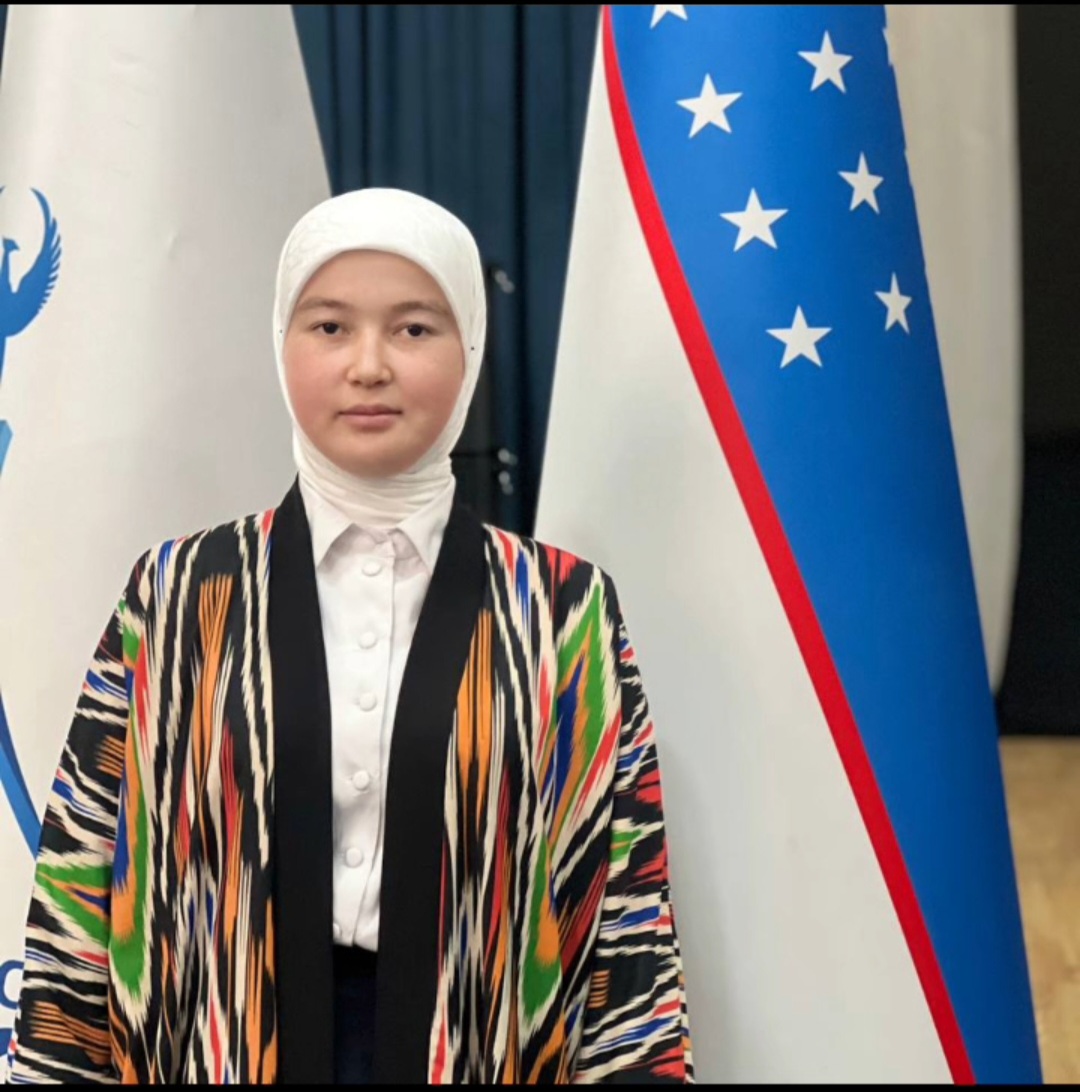
Uzbekistan is one of the countries with a rich and remarkable historical heritage. For centuries, this land served as a crossroads of civilizations, where science, culture, and trade flourished. It gave the world outstanding scholars, thinkers, poets, and statesmen whose contributions continue to inspire humanity. Figures such as Imam al-Bukhari, Abu Rayhan al-Biruni, Ibn Sina (Avicenna), Mirzo Ulugh Beg, Alisher Navoi, and Amir Temur left a legacy that extends far beyond the borders of Uzbekistan. Their achievements should not merely be a source of pride; they should encourage us to reflect, learn, and continue their pursuit of knowledge, justice, and progress.
One of the most significant examples of this heritage is the political legacy of Amir Temur. His work, Temur’s Code (Temur Tuzuklari), is an important historical source that reflects principles of governance, justice, discipline, and responsibility. Today, it continues to attract the attention of historians and researchers interested in the history of statecraft. Its lasting value lies not only in its historical significance but also in the timeless principles it promotes: responsible leadership, justice, and dedication to the common good.
Another important chapter in Uzbekistan’s history is represented by the Jadid reformers of the early twentieth century. They believed that education, enlightenment, and modern thinking were the true foundations of national development. Through new schools, newspapers, and cultural initiatives, they sought to awaken society and prepare future generations for a rapidly changing world. Their vision of an educated and progressive nation continues to resonate in contemporary Uzbekistan, where education and scientific development remain among the country’s key priorities. History tells us not only about victories but also about mistakes. It reminds us that internal divisions, ignorance, and the neglect of education often lead to decline. Therefore, the true purpose of studying history is not to memorize facts but to understand their meaning and draw valuable lessons from them. The experiences of the past serve as a reliable guide for making wiser decisions in the future.
Today, Uzbekistan is moving confidently along the path of development. In this process, preserving historical heritage, studying the intellectual and spiritual legacy of our ancestors, and fostering patriotism and national pride among young people have become increasingly important. The generation that will shape tomorrow must first understand the roots from which it has grown.
History does not ask us to live in the past. Instead, it invites us to engage in a meaningful dialogue with it, to learn from its lessons, and to recognize our responsibility for the future. History is not simply what has already happened; it is the foundation upon which tomorrow will be built. The future depends on the knowledge, wisdom, determination, and historical awareness of today’s generation. Only a nation that respects its history, learns from its experience, and preserves its identity can build a confident and sustainable future.
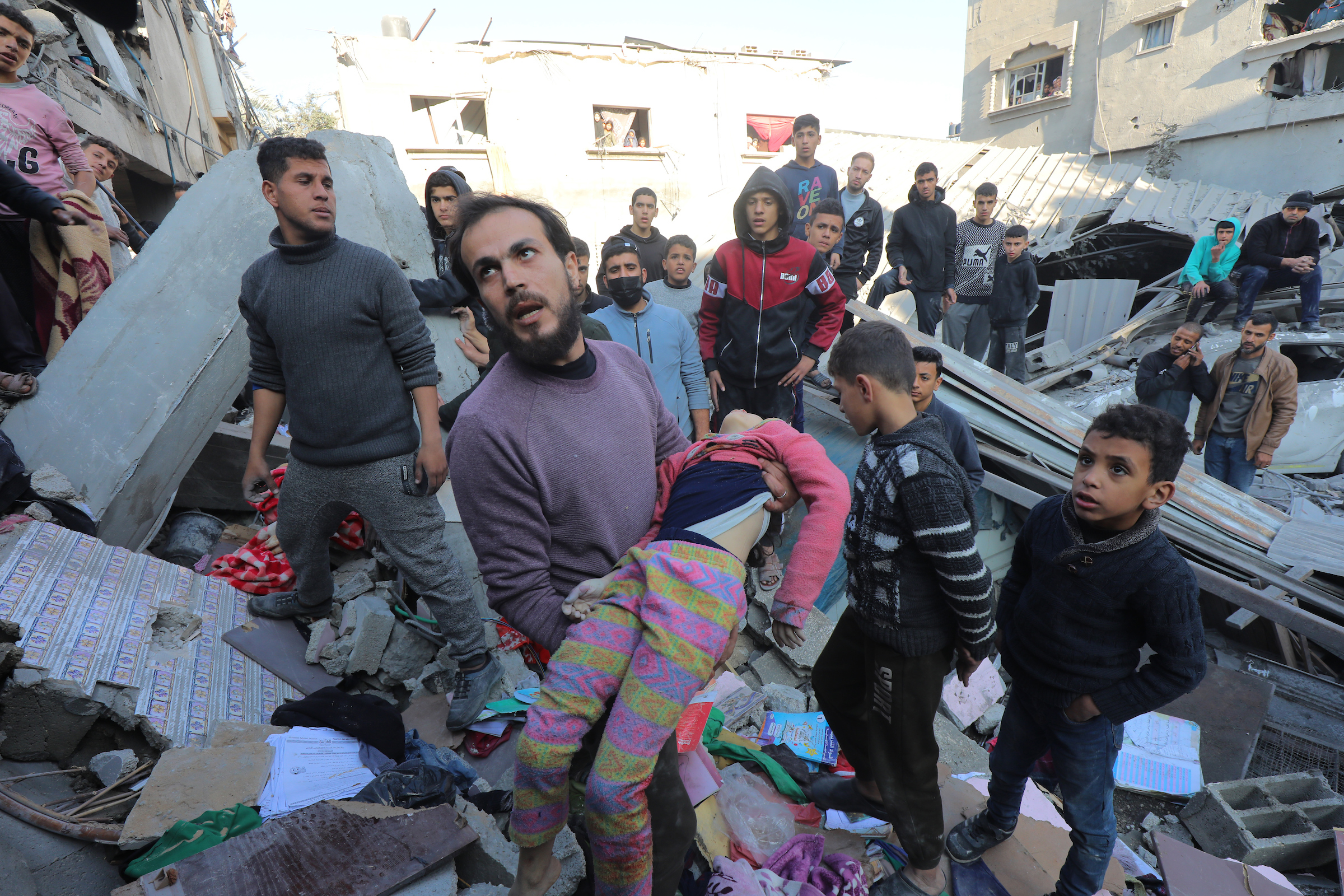
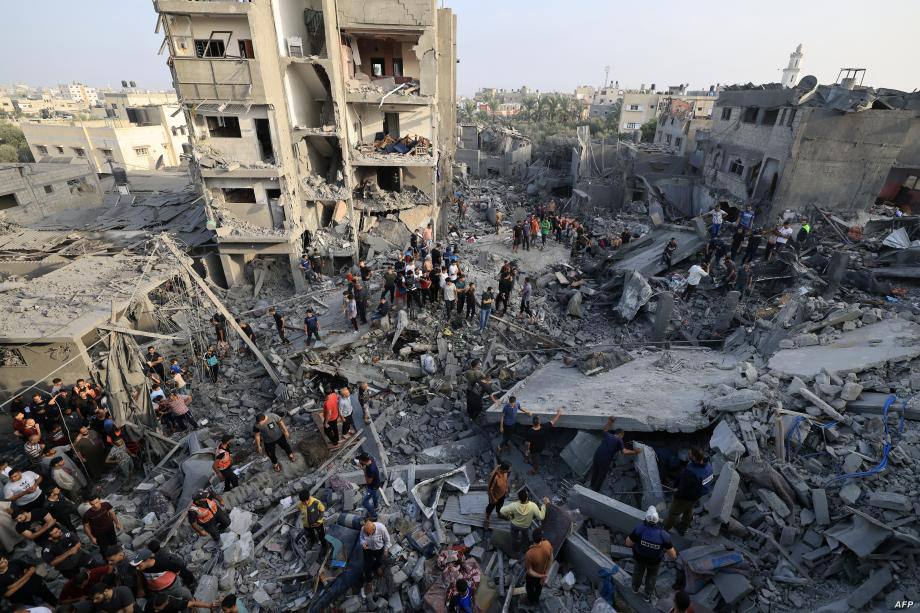
Residents and civil defense teams conduct search and rescue operation under the rubbles following an Israeli attack on Al-Wawi family building in Nuseirat Camp, Gaza Strip, on December 30, 2023. Photo by Naaman Omar\ apaimages
The stone…
The identity of the legitimate Palestinian resistance
Dr. Reda Abdul Rahim
Professor Mustafa Bahgat Badawi says in his book “talk about us and about Israel”: As I always say, Israel is not only a threat to the entity of Palestine, but it represents a real danger even to the smallest house in the most remote village of this entire Arab homeland. The conclusive evidence is what happened in Beirut, in Sidon, and what could happen in any other location or village in any part of the entire Arab homeland with an Israeli” infiltration adventure”. Hence, the Arab countries should give the gift of one man, settle their differences and prepare –rightly and diligently – to confront their bitter enemy. The Stone play written by Dr. Ahmed Asaker revolves around the legitimate Palestinian resistance against the Israeli entity that usurps our lands, and any Palestinian resistance is an important and necessary thing for Arabs as a single nation suffering from an existential threat due to this cancer that has been planted on its land.
In the first and second chapters, Dr. Ahmed Asker, in an intelligent interview that is not devoid of psychological connotations, presents the vision of each party in this continuous and eternal conflict, the Israeli entity puts forward its future plans through a discussion among its members, and we know from it how to use America as a cudgel to crush us, and the implementation of all its plans, which has already happened.
Marzel: the most powerful country in the world right now is America, followed by Britain, and the Arab countries around us, the most powerful of which are Egypt, Iran, Syria and Iraq. – What?!
Marzel: we will sow discord between America and one of these countries that I mentioned, and we will make the American president, who is a strong ally of ours, and a precious catch, head towards one of them, let it be the state of Iraq, this is the one I want now.( Pp. 18: p. 33) The writer went on to reveal their evil plans, which are currently being implemented on the ground towards Egypt and the entire Arab nation, we read:
Marzel: Egypt was strangled from the south, we strangled it with Sudan and water, and here we are strangling Sudan and strangling it from the south from which we are kidnapping it. We surrounded his West and separated him from it. Then we have treaties that we will not break now. Egypt is not now. It is Syria and then Iran that I want, and also I don’t care from the first and from the second, and if it were up to me, I would take the two countries together. They are from the countries of the axis of evil that we have created, and let’s call them state sponsors of terrorism (P.27).
While the resistance leaders are mired in disagreements and talk about the past that is useless behind it, standing on the ruins is a pure Arab heritage, we Arabs pay a lot of attention to the past, and we rarely look at the future, and I do not say we plan for it. And this is what the writer wanted to clarify in the second chapter: Platoon leader: for fifty years, sir, they have been spreading murder and slaughter among us as if it were their eternal chant. Have they not yet seen, Sir, from the rivers that flow and the seas that run for the blood of our men and our leaders all these years-all this praise – I mean sacrifice? -! Abu Al-Qasim: they want to take us out of here.
They are stealing our ancestral past, destroying it, they want to uproot us, and as our resistance movement intensifies and grows stronger, we call for their peace (pp. 36: p.49). Abu Al-Qasim (the second scene of the second chapter): we are peace. Our religion is peace. No, boss. They are the advocates of war, the opponents of peace. Their hands are still stained with the blood of innocent people in the cities and camps of Deir Yassin, Sabra, Shatila, Qana and others. Sheikh Mujahid Al-Qaid Ahmed Yassin appears in the third scene of the second chapter to put his hand on the reasons for the division between the leaders of the battalions and the leaders of the Palestinian factions, which also applies to the countries of this great Arab homeland, we read some of what he said: Sheikh: don’t you see, leaders and leaders, that we have divided into many peoples and many teams. Abu Mustafa: yes, Sheikh. God has many divisions and many people. Shaykh: and don’t you see, leaders and leaders. That our enemy is all one! Voices: yes..Yeah The sheikh: so why is this band? -! Why the band Why the band is often and always why, leaders! Voices: it’s always the band, Sheikh. Sheikh: rather, it is a search for personal glory, for false heroism to support our cause.
Not to establish our state and to support our people or peoples (pp. 56, 57). The Palestinian people were and still are in need of a real leadership that would be vigilant and the magnitude of the danger it faces, and when such leaders emerged, they would mobilize the national feeling behind them quickly and effectively, as happened in the case of Sheikh Izz al-Din al-Qassam, who was only a legitimate authority in Haifa but believes in the importance of an organized revolution to prevent the establishment of a Jewish national homeland in Palestine. The Palestinians must rely on themselves first in their struggle against Zionism. Sheikh al-Qassam started his revolution with just ten of his men, each with only a rifle and a small amount of money.. They decided to direct their revolt first against the mandate Authority, which was arming the Jews. Then al-Qassam was martyred with his men in an unequal battle against the British authorities on November 20, 1935. But this martyrdom inflamed national feelings in Palestine to a huge degree..
The masses refused to march ten kilometers to mourn the body of the martyrs, which was a natural prelude to the comprehensive Palestinian revolution in 1936. Returning to Sheikh Al-Qaid’s refutation of the significance of this conflict, we read: Sheikh: they want us in a permanent conflict, in a conflict with our enemy, in a conflict with each other, with ourselves. May the bleeding of the land, wealth, agriculture and our blood remain, May the bodies of our martyrs remain. May our blood and oil continue to provide the West with prosperity and progress, well-being and wealth In the third chapter, the writer limps back to the history of the Jenin Camp massacre, opening his conversation with the question of who made a profit on Jenin If we have touched the difference between their thinking and ours, and Sheikh Al-Qaid put his hand on the causes of division in the second chapter, then through this chapter he refers to another disease that has afflicted the nation, the disease of betrayal – which he was one of its victims-until one of the soldiers in the fifth chapter shouts: the number of traitors, Sir, exceeded the number of the enemy..
They are many, and another says: their danger is greater than the danger of the enemy(P .138). Shaykh: we are monitored, father Al-Qasim.. The enemy is monitoring our movements. He sees us and knows the steps of our guys, and I think that’s the accuracy with which our leaders hunt. That skill he shows in assassinating them, only an internal betrayal of elements belonging to us..Their Apaches could do nothing in heaven if only one on Earth was guiding them and illuminating their black vision(P.83). If the massacre of the Jenin camp shows the ugly face of the Zionists; those who were killed unarmed and buried in mass graves, it also shows that this ugliness befell everyone who prevented weapons from reaching the people of the camp .And whoever this damned woman supplied Israel with all these modern weapons. In an intense bitter dose, the fourth chapter witnesses the martyrdom of Sheikh Al-Qaed, the daughter of Jenin, and the daughter of the Resistance leader Abu Al-Qasim, so the writer paints us a very dark painting that sheds tears, and her chest boils, yes.
There is no state that has been wrapped up by a night like the night of Palestine, like the death of Palestine .. Funeral after funeral, martyr after martyr. And if the first chapter recognized the consistent pattern of resistance thinking by using stone as a weapon of resistance with which they intimidate the enemy of Allah and their enemy, and resorting to qualitative and individual operations, Abu Al-Qasim Our resistance is no longer limited to a man blowing himself up in a car, a tank, or a few soldiers for them (P.162). The writer promises us that the advice of the martyr Sheikh Al-Qaid has come to fruition, and that the legitimate Palestinian resistance has changed its way of thinking, it will not wait for the enemy’s attack on its land, but will transfer the battle on its land and inside its settlements.
From the first moments of birth, Israel has embraced the offensive doctrine in the war, allowing it to always keep in its hands the military initiative, which provides it from the very beginning many advantages against any Arab party it faces. Since the first truce that was reached with Israel, it has always been the one that initiated the violation of the truce against the Arab side, at a time when the Arab side believed that the international character of the agreement would deter Israel from breaking it! Thus, in light of this sudden violation of the truce, Israel increased the area of the lands it captured, so that at that time it became 77% of the territory of Palestine, while the partition decision guaranteed it only 55%. Israeli Defense Minister Moshe Sharett said that I would prefer that we attack the Arabs and the world condemns US. It’s about waiting for the attack and the world supports us. ..
We read: Abu Al-Qasim: I promise you that after cleansing our house, ourselves and our people from traitors and agents. They never came back to hack us again… This is my first and most important task in my next stage and I will not fight… And I’m not going to wake up to an infection until I’m done with it. I will destroy their houses as they destroy ours and I will scatter them as they have scattered US… I will change our tactics, plans and war with them… Those whose hearts are different and we count them as one… I’ll make them different… I’m gonna hit them in their backyard.. I’m going to throw our missiles at them and our catapults… The one who will cut their backs… And the Katyusha that will melt their skins (P. 158). The third scene of the last chapter explains a commando operation known as the snake’s head, in which Abu Al-Qasim was targeted by a group of Zionist soldiers and their commander, an operation that Israeli newspapers described as the day of panic, the day of sorrow.
Abu Al-Qasim returned from it, wounded, martyred and joined the processions of martyrs, dreaming and we are with him: I want to see this today. The one where one of our cubs is raised…The flag of Palestine fluttered high on every hillock… And he raises it at every foot of our slopes. I want to see this boy who comes by day and takes away from us this night (p. 173).
“I speak Spanish to God, Italian to women, French to men, and German to my horse.”
This famous quote, attributed to the multilingual Holy Roman Emperor Charles V, reflects a belief that has endured for centuries: that every language has its own unique personality. Even today, French is often described as romantic, Italian as musical, and German as harsh or rigid. Japanese is widely associated with politeness, while English is seen as direct and practical. These descriptions have become so familiar that many people accept them without question. But how accurate are these perceptions? Do languages truly possess personalities, or are they simply reflections of the attitudes we attach to them?
At first glance, it may seem obvious that languages sound different and therefore create different impressions. However, linguists argue that our emotional responses to languages are influenced by much more than pronunciation or grammar. The way we judge a language is closely connected to the way we view the people, culture, and society associated with it. In other words, our opinions about languages are often social rather than linguistic.
According to sociolinguists, the appeal of a language has far less to do with its grammar or pronunciation than with our perceptions of the people who speak it. Dr. Vineeta Chand of the University of Essex argues that when we admire a particular country or culture, we often transfer those positive feelings to its language. Likewise, languages spoken by socially or economically marginalized communities are frequently perceived as less attractive—not because of their linguistic features, but because of the social status of their speakers. This demonstrates that language attitudes are deeply influenced by society and are rarely based on objective linguistic facts.
This pattern is clearly visible in the modern world. The growing popularity of Mandarin Chinese, for example, stems largely from China’s economic influence rather than from its sounds or grammatical structure. English, meanwhile, continues to dominate international communication because it provides access to education, business, science, technology, and countless professional opportunities. For millions of learners, English is more than just another language—it is a bridge to higher education, international careers, and global connections. In many cases, people are not evaluating a language itself; they are evaluating the opportunities that language can provide.
Yet stereotypes remain remarkably persistent. French is still considered romantic, Italian melodic, and German harsh. Linguists, however, argue that these qualities are not inherent characteristics of the languages themselves. Instead, they are social perceptions shaped by history, culture, media, literature, films, and our experiences with the people who speak them. Because these images are repeated over generations, they eventually become accepted as common sense, even when there is little evidence to support them.
How do such perceptions emerge? Language attitudes refer to the beliefs, opinions, and emotional responses people develop toward a language and its speakers. These attitudes may be positive, negative, or neutral, but they are never inborn. Rather, they are gradually formed through family, education, media, cultural influences, and personal experience. As societies change, so do these attitudes. Throughout history, some languages have gained prestige while others have lost it. Consequently, the value we assign to a language often reflects changing social realities rather than any intrinsic quality of the language itself.
Research also supports this perspective. A study highlighted by BBC Future explored how speakers of twenty languages described colors, smells, tastes, and shapes. The findings offered fascinating insights into the relationship between language, culture, and human perception. Rather than proving that one language is richer or more expressive than another, the study showed that different communities develop specialized vocabularies according to what is most important in their everyday lives.
English speakers, for instance, showed remarkable precision when describing colors and geometric shapes. The Jahai people of the Malay Peninsula, on the other hand, possess an exceptionally rich vocabulary for describing smells. Speakers of Persian, Lao, and Cantonese demonstrated greater precision in describing tastes than many other language communities. Researchers concluded that these differences arise not from the complexity of the languages themselves, but from the environments, lifestyles, and cultural experiences of the people who speak them. The language people use naturally reflects what they experience, observe, and value in daily life.
Ultimately, language is far more than a means of communication. It reflects the ways people perceive the world, the aspects of life they consider important, and the experiences that shape their daily lives. Perhaps languages do not possess personalities of their own after all. What we perceive instead is the history, culture, and worldview of their speakers. French is not inherently romantic, German is not naturally harsh, and Italian is not born musical. These are not qualities embedded within the languages themselves, but perceptions we have constructed over time. Understanding this helps us appreciate languages not as collections of stereotypes, but as living expressions of the diverse communities that speak them.
Saymurodova Madinakhon Zokhidjon kizi, student of UzSWLU, faculty of foreign languages and literature
Books have always been considered a source of knowledge. While many people think that reading books is just a waste of time, there are also those for whom books have become an essential part of life. In fact, how useful is reading books, especially in today’s age of technology?
I would not be mistaken if I said that, day by day, not only the number of books but also the number of readers is increasing significantly. As you may have seen on social media, reading is also being widely promoted. Various “new” books are contributing to the growth of many “modern” readers’ personal libraries. There are also opinions that some of the books receiving widespread attention are useless and are not even worth the time spent reading them. There is only one answer to this: “You have simply chosen the wrong book!”
Along with those who enjoy reading scientific and fantasy genres, there are also many readers who are interested in moral and ethical books. It is quite natural that those trending books may not appeal to everyone equally. Besides books that are somewhat “heavy” in content, the “lighter” ones are actually the right choice for beginner readers.
«”If we improve by one percent every day, by the end of the journey we will be thirty-seven times better,” says one of the leading experts, James Clear, in his book Atomic Habits. Daily reading encourages us to be disciplined and also helps us gradually get rid of bad habits, becoming one of the small steps that lead to great results.»
In conclusion, rather than spending time aimlessly on the internet, spending that “wasted” time on reading books opens the way for us to develop good habits. At the same time, a well-chosen book can help us look at life from a broader perspective.
I was born in Khiva district, Khorezm region, Republic of Uzbekistan. Currently, I am a first-year student at Urgench State University named after Abu Raykhan Beruniy.
DID YOU GET MARRIED TO HER WHEN I WAS IN THE MENTAL HOSPITAL?
by Abigail George
Published by ZamaShort 1stApril 2026
Blurb
In DID YOU GET MARRIED TO HER WHEN I WAS IN THE MENTAL HOSPITAL? Abigail George takes the reader on the big dipper of her poetry, riding us through shocks and thrills in the carriage of her life with mental illness, a stigma she was branded with at age 16. En route, we become as Eve, but abandoned by Adam, teeth tearing apart the apple of knowledge, alone; we become akin to Lady Macbeth, trying to wash the blood Netanyahu has spilled – nothing is separable from anything else, and the language relentlessly stirs the pot of our inescapable oneness. This is a writing-witch’s brew, cooked to nourish and forever transform your understanding of mental illness, womanhood and writing.
* * *
Review
Dear Abigail
Your story, DID YOU GET MARRIED TO HER WHEN I WAS IN THE MENTAL HOSPITAL? is not meant to be an easy read. I know it took it out of you to write it, and I am not surprised by that. While I read it, I felt almost as if I were being confronted with the life that might have been mine, had it not been for … what? The two facts of your childhood that distinguish your life and mine most significantly, in my opinion, are, firstly, the fact that you were burdened with the stigma of mental illness. As you write in the 24th of a total of 25 passages, or prose stanzas, that make up this work: “It was my destiny to call stigma a companion” (The Sea.) Oh, I empathise with you saying how tired you are of the illness:
I am tired of being mentally ill, this chronic sickness, this flame, the powers that be. I watch it burn between my fingers. It tastes of Palestine. Cold stone turned into rubble. Make it go
away but it doesn’t go away. (Longing, and on Reading that Sad Story ‘Flowers For Algernon’, Here are Some Thoughts.)
I was diagnosed with mental illness in my 30s, but I was compelled fiercely to refuse the stigma, because my father told me in no uncertain terms to right myself, he did not want to, or could not, pay for more sessions with the psychiatrist. (I don’t have medical aid, you see.) And I had a three year-old child to look after. So, I weaned myself gradually off the meds I was told I’d need to take for life, and focused instead, fully, on having to mother, and having to be a wife. You lament that those age-old, anonymous roles weren’t for you – “I could never be wife material […] I could never raise children. Oh, madwomen couldn’t do that” (Longing, and on Reading that Sad Story ‘Flowers For Algernon’, Here are Some Thoughts.) These roles can indeed help, can ground us – as you, too, I think, are finding, by having to look after, to mother, to care for, your two-year-old niece, and your elderly, vulnerable father – ?
But back to the illness with which you were loaded at such a young age, as we discover in your bio that precedes your story. As I see it, this load was weirdly and unwillingly (or unwittingly?) linked into the thing you state unequivocally saved you: language, poetry. I will say more to try to explain what I mean by this, but before I do that, I want to name the second significant event that for me distinguishes your and my destinies in, I hope, mutually instructive ways: the fact that both your parents supported and encouraged your writerly gift. We learn from your bio that your father proofread your drafts when you were in your twenties and thirties, and that your mother “recognised my talent for writing early on” and bought you a typewriter, first a manual and then an electric one, wow! And this happened even though she “makes it a point never to read anything I have written”, preferring Barbara Taylor Bradford and Danielle Steele novels. Well, as Richard Bach famously observed: “Rarely do members of one family grow up under the same roof.” Still, your brother, though far from filled with joy over your life, as you describe him, nevertheless published your first book. The bitter contradictions life forces us to accept! And so: Writing was a sign from God […] it gave me a reason to live, a purpose and I could heal myself, and others. (From your Bio)
Despite the hatred and the absence of peace around you, despite the sickness inherent in the social structures of school and the nuclear family, despite the fact that your family members, teachers and peers “had no time” for you and “severely bullied” you, “leaving [you] breathless, or half deranged with all the negativity in [your] environment”, you found “a sea of wildflowers” in poetry, “a bed on which [you] could rest the vessel of [your] body.” (From your Bio) That is beautiful. The same motif serves your experience of reading: Reading, you write in Eating Rice and Potatoes with some Steadfast Patience, “is for the wildflowers in our imagination to blossom”.
You begin your story addressing your First Love. Later, in Don’t You Forget About Me, Pinky Swear Promise Me, R., you address your toddler niece, then, in We Need to Discuss Crystal Meth, Struggle, the Healer, and Forgiveness, it’s your brother you’re talking to. And in This is My Convent, you talk directly to Anne Sexton. And then, in Poem for Gaza, Songs for Me, you revert to your First Love, O. Have I got that right? Seeking a hearing, a connection, a conversation – just like any ordinary woman, like any social creature.
I like the way each of your passages, your prose stanzas, begins with a sentence full of capitals, there is something stately and leonine about that.
Years in Summer Days.
Let Me Sleep Now in Peace, Please.
I mean, it reminds me of the Lion in Saint-Saëns’ Carnival of the Animals, the way you make the words march in, heads held high, bringing that energy of the Unquestionable Arrival of the Sovereign. And that allows, later, for the “vessel of [your] body” to claim her vulnerability in the ‘aquarium’ of your suffering, to announce:
I Don’t Know How to Start.
Or:
The Gap Between Symbol and Reality. (The final passage.)
… where the capitals seem to submerge the reader, with equal grandeur, but no longer breathing with lungs, there is almost a having to hold the breath as you write that:
The sea began screaming at me.
And:
I held the blueprint of my wound and stopped breathing.
(Finding Machiavellian Turning Points in Having a Nervous Breakdown.)
Henry Lombard calls your story “claustrophobic” in her comment, and remarks that you “prove” writing to be “a holy act of reclamation”. That is what I want to dwell on now, I mean the role of literary language and its implicatedness, as I see it, in illness, and in “the brutality” which “was the same”, whether you were at home reading a magazine “whose words hurt [your] eyes”, and “A refugee camp falls out”; or whether you were in Israel, which you discovered while your mother watered the garden, in Finding Years in Summer Days, or whether Netanyahu speaks, in Gaza is not Dead, and you squeeze blood out of stones in a refugee camp and wash soiled garments in the sea. The aroma of death, the rubbish, and decay, I need to get it off my hands. (Forgiven, but not Forgotten, it Doesn’t Matter you see.)
Now you are Lady Macbeth, and all of humanity’s horrors are yours to cleanse. And the reader is with you and it’s awful.
So, what is happening here, the way I see it, is that language is dumping itself into you, into us, via an unchecked flow of sounds and images. You write that “when it appears in the newspaper it has a beating heart” (Finding Years in Summer Days) and there is this sense of the limitlessness, the continuous increment, the boundarylessness, that dreadful slipperiness of the medium you use:
I can’t throw out my feminine energies with the past, nor with the pasta water. (Octopus Flowers in the Dark.)
Or:
Nothing grows inside this garden except the dead bodies of children, and snails who were somehow not involved in the Palestinian struggle. (Silence.)
And:
These pills fill me or are they peas? (For Gaza’s Flame Gatherers, Those on the Frontlines and the Ambulance Chasers.)
The snails are actually comical in their non-involvement, a last, languid bastion of feet and feelers in Eden. Even the pills and the peas bring in the curl of a question mark, or is it a shy smile, after their shared p’s – ? But when you “fry the ham in the pan” (A New Love), I accidentally read “harm” for “ham”; and in This is My Convent I see you eat “my friend egg”, and only afterwards realise it’s a perfectly regular “fried egg”. I mean, what is happening is that the language is uncontained, or should that be untamed? The verbal stew of torment is bewildering, the fine details are so awfully human, again I gasp for breath, asking, where is reality, where is the realness of the animal I am, my connection to the wind? I want to run away and breathe an air free of language. Maybe on the mountain, who “have ears and a kind of feminine energy” (Finding Years in Summer Days)? I have to admit that I don’t have the tenacity, I don’t have your ability to live this remarkable destiny of showing the world that the word was NOT God, the word was far, far too HUMAN!
The truth reveals itself. Unlike your mother, who eats an apple “in tiny bite-sized pieces” (Octopus Flowers in the Dark), you “tear the apple apart with [your] teeth” and “deconstruct [dried fruit] on [your] tongue” (A New Love), and “Gaza falls like the neck of a wildflower falls” (For Gaza’s Flame Gatherers, Those on the Frontlines and the Ambulance Chasers.)
So, you are Eve, abandoned by Adam to a fallen Eden, eating the whole apple by herself, teaching us that we have not survived the Age of Permissiveness, where the sea is language and, as female writers, we inhabit an ocean of suicidal female poets: “Ingrid Jonker’s sea” (Finding Machiavellian Turning Points in Having a Nervous Breakdown). Who can deny this fact? Yet you crave for your mother to SAY she loves you, her gifts of actions are NOT enough (Longing, and on Reading that Sad Story ‘Flowers For Algernon’, Here are Some Thoughts). I was the same, exactly so, where I likewise craved to hear words from my parents that I eventually learned to accept could not and still cannot be articulated by the soft animal that is love. Is that why the following paragraph touches me so deeply?
My spirit has evolved because I loved you. On lonely nights I gather this fact of life to myself. […] What is this observation that challenges me to overcome my suffering? (I Don’t Know How to Start.)
You write, “I don’t know how to end this on a positive note, so I will end here” (I Don’t Know How to Start) – words which must surely move even the most coolly detached of readers.
And then!
Then you ask. You ask with a directness that jumps beyond words, it’s the gentle curiosity of a wild animal. Cautious, but fearless. The Gentle Curiosity of Woman. You jump, no, you pounce straight to the heart of matter (not “the matter”, just “matter”):
As a poet, as an individual, whose joy matters most to you? What is your response to loneliness?
Oh, Abigail, thank you for those questions! I want to do nothing more than respond. I want you to know, and I want myself to know that, As a Poet, As an Individual, it is The Voices of The Earth that matter most to me. And my response to loneliness is To Move. To Walk. To Extend a Kindness to Someone. To Make Something Using My Hands. Maybe then, after all, to write (By Hand). For, to be a female who writes, I have learned, I may not prioritise the role of ‘being a writer’. For a writer such as I am – and this is, despite everything I did not want and did not ask for, a destiny of choice – the act of writing must come last of all. For a woman, writing is a verb, not a name, not an identity. Then it is easier done than said.
I see your story as the beginning of The Dance Of Wildflowers In The Wind. Your wildflowers. Your seeds and your planting. For, the way I see it, your hands are clean now. From All The Work – writing and otherwise – which you have done and still do, through the summertimes of your father’s embrace, through the winters of your mother and sister and brother, through your wound’s blooms every spring (Finding Years in Summer Days) through to “the silken smell of autumn” (Let Me Sleep Now in Peace, Please) – a smell my nose is now hunting to harvest!
J.J. Campbell (1976 – ?) is a 3 time Best of the Net nominee and two-time Pushcart Prize nominee. He’s been widely published over the last 30 plus years, most recently at Drinkers Only, Mad Swirl, The Rye Whiskey Review, The Beatnik Cowboy and Yellow Mama. His most recent book, to live your dreams, published by Whiskey City Press, is available from Amazon by going here: https://a.co/d/06qUrWxm