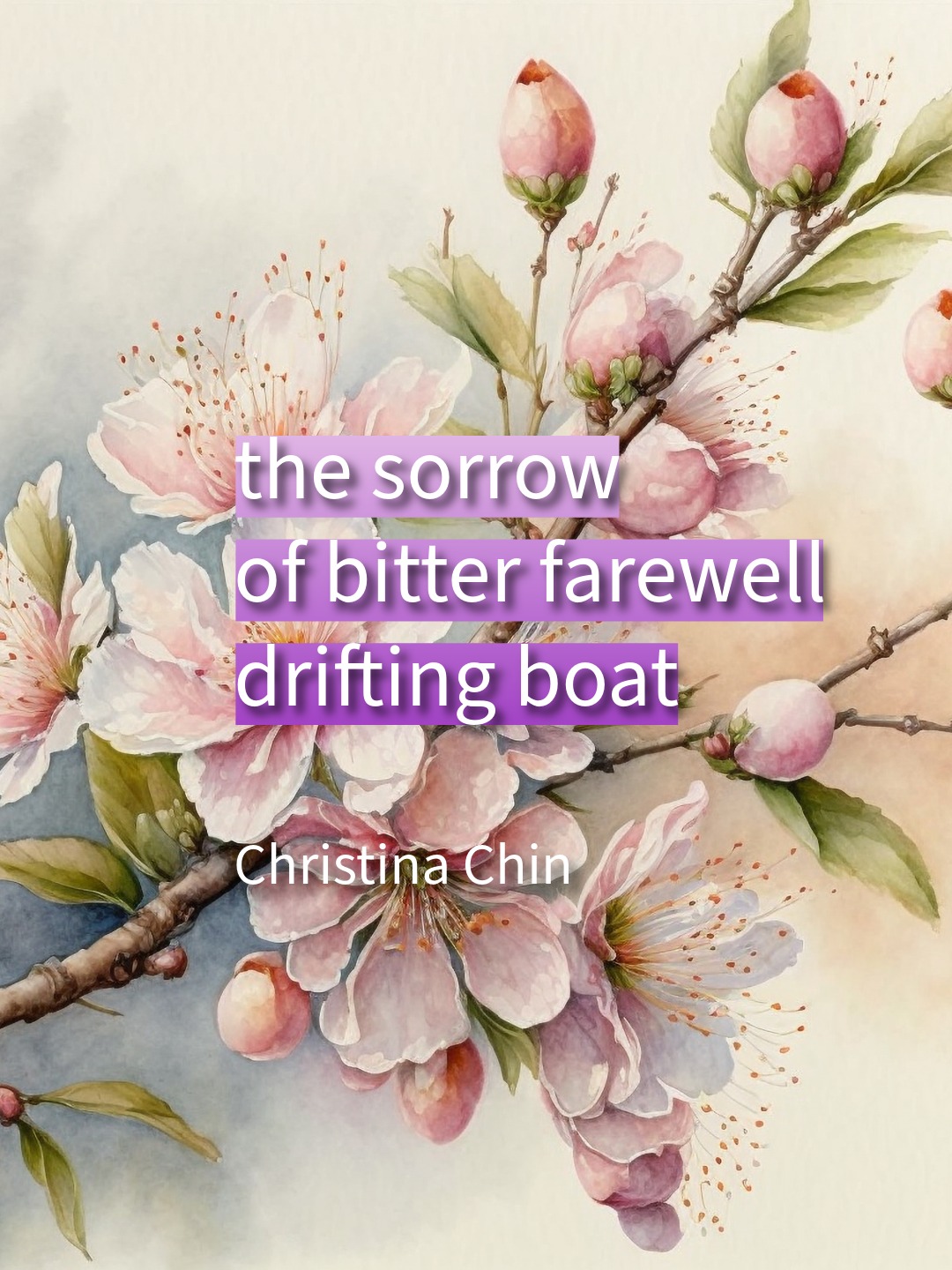
Haiga from Christina Chin

THE LUNAR DIET
On late nights you’ve seen that Diana chick
and you’ve heard her weightloss schtick.
”In one month all your bulk will be gone,”
But of course it’s all a con.
Although her so-called Diet of the Moon
with its traces of selenium and witchesbroom
will indeed disappear your unwanted shape
and you’ll vanish all your extra weight,
but it will all come back again,
your loss will become your gain
and all too soon
you’ll mushroom, you’ll boomerang, you’ll balloon.
THE REALM OF THE GODS WHO CONTROL OTHERS’ CREATIONS
While your muses canary you awake
my parrot perches asleep in its cage.
I burn in the absence of their flame
but you tower up like a crane.
And those birds do prophet our futures:
your doves and my vultures,
your peacocks and your hawks,
my silent shell’s empty bells.
Though we’re feathered alike, you and I,
your plumes atlas the sky
and mine mattress my sighs, my sighs.
The eagle captured my pigeon
and fed it to your nestlings.
“LET’S PLAY HOUSE,”
I said, “Let’s get more personal.”
I didn’t know what would happen,
that you would act like a vacuum
and treat me like furniture.”
EYE JOB. NOSE JOB. AND RED CROSSES.
The steeples in Seoul:
Needles in the sky, sewing up all the stars.
They’re red
They’re red
from the stanch of old Korean faiths.
Red! Red!
clotted up after lost Korea’s face
As red
as the stars
on all those tanks
sent south
to patch over those scarlet steeples.
The new needles
hammer forged;
thread, sickle sliced.
THE MISSIONARY
My pilgrimage was blessed!
I counted off
the beads she strung
across her chest, her precious
rosary.
So
I’d passed
my first test, one step
upon the way. To finalize
my quest, incessantly
I prayed.
And when,
at last,
I pressed into
her nunnery, my passion
came to rest, enveloped
in glory.
Her cloister was a nest
of sacred ecstasy.
…
Question?
Will you come to see me again?
If you are willing to call on me
Meet me in such a way
That we won’t part again
In anticipation of your arrival
I have been staying awake
As though I won’t have to sleep back again
I am impatient to touch the gait of those feet
You are turning this way
Only for my sake
Will you plant some flowers for me
Before you take your way again?
Or at least, will you leave behind some flowers?
I will devote myself to them
So that they won’t wither ever again
Will you say something for me
From your pious lips?
I shall consider your words my prayer;
Will you kindly shed for me
A drop of tear?
I shall consider it my elixir
In the parching desert heat;
Will you light me a lamp before you part again?
I shall consider it the moon
To light my dark nights
In the past too
I always waited for you
As long as I had hopes
And had life
I still wait for you
When I have no life left
And no hope left, either
Will you really come
For my sake?
ABOUT MYSELF:
Rehaan Khan is a US-based Nepali poet. He started writing since his school days and made formal entry into the writing fraternity with the launch of his Nepali poetry collection Anautho Sapana (2013). His fame as a poet rose with the publication of Ujyaloka Maliharu (2020), a joint collection of poems by ten Nepali poets. The Festivity of Dilemmas (2026) is his third collection of poetry and the first one in the English Language.
Fells with You
It was quite dawns
When it storms the skies,
I have seen the world
In your hopeful eyes.
I have found my peace
Within a steady view,
Because the journey
May have with you.
In two wandering souls
With one steady pace,
We are finding our rhythm
In time and space.
Even the map of life
Are vast and wide,
But with your fingers
It’s locked in mine.
Biography
Dr. Debabrata Maji’s journey is one woven with the artistry of words, the precision of engineering, and the resounding echoes of literary passion. His life’s path meandered through the structured world of engineering before blossoming into an awe-inspiring legacy in the poetic realm. Despite pursuing a career in engineering, the written word never loosened its grip on his soul. It was as if poetry was inscribed into his very being, waiting patiently for the right moment to erupt into brilliance. And erupt, it did. What followed was an unstoppable rise through the ranks of the World Poetic Fraternity, marking Dr. Maji as a luminary in contemporary literature. His literary prowess, distinguished by a profound sensitivity and refined craftsmanship, has been recognized far and wide. The world acknowledged his contributions by bestowing upon him twenty two Honorary Doctorates, a testament to the depth and impact of his work. Recognition followed in waves, with twelve prestigious Annual Literary Awards adorning his illustrious career – one of the most remarkable being the Silver Saraswati Statue, a symbol of divine wisdom and artistic excellence.
The weight of his influence is evident in the vast array of publications that carry his name. His unique poetic creations have graced numerous magazines, newspapers, and contemporary anthologies, reaching readers across India and beyond. His artistry, rooted in heartfelt emotions and intricate expressions, carved a distinct space within global literary landscapes. Dr. Maji’s written legacy is solidified through thirteen remarkable poetry collections, each bearing the coveted ISBN. His Bengali version books – Kavita Bichitra, Kavita Darpan, Probad Angina, Premer Boikunth, Sonnet Bhaskar, Harano Bamsari, Smarane Manane, Barnera Rahasya, Vande Mataram and English versions Dreamscape, The Peace, The Divine Glow, Maxims 500 are more than literary works; they are extensions of his soul.
They have found their way into the hands of eager readers, offering solace, beauty, and wisdom through poetic verses that transcend time. These titles bear witness to his unwavering commitment to poetry and the sheer brilliance of his literary craft. His story is not merely about accolades or achievements. Very recently he was conferred with ‘Swarno Padok’ by Kolkata based Bango Sanskriti Sangsad for his book ‘The Peace’. It is about a man who dared to transform life’s melodies into poetry, leaving behind an enduring legacy that will inspire generations to come.
The Fate of Uncle Mammadhasan’s Donkey
Back then, in those beautiful days,
Uncle Mammadhasan was happy, his family was happy, and his donkey was happy too.
In summer, Uncle Mammadhasan worked at a Pioneer camp.
All the Pioneer children knew his donkey.
The donkey knew them too.
It could even tell the city Pioneer children from the village children.
He took very good care of the donkey.
He bathed it in the river,
burned garma to drive away its flies.
The Pioneer children even fought with each other
for the chance to bathe the donkey.
He had convinced us that
when the donkey was bathed, it rained.
But this time it did not rain.
Bullets rained.
The fire of war flared up.
The war began.
The fire of war drove away fairness, mercy, and conscience
like flies.
Uncle Mammadhasan’s two sons became martyrs.
He settled in a remote village as a refugee.
And his donkey was stolen.
This loss burned Uncle Mammadhasan
as much as the grief for his sons.
In those years there was no natural gas in the district.
Everyone carried firewood with donkeys.
The price of a donkey had gone up;
the value of a human being had gone down.
Uncle Mammadhasan’s donkey
had been sold to firewood traders.
Every day it was under a heavy load.
There was no one who knew its suffering.
And one day it died under its load.
They did not even leave its dead body alone.
They gave it to a sausage factory.
…
These were Uncle Mammadhasan’s last days.
He was eating cheap sausage.
The railway wagon where he lived
was a source of a bad smell.
He ate sausage
at the table where he killed flies with a fly swatter.
The heat gave him no peace either.
He no longer killed flies.
He fanned himself with the fly swatter
to cool himself.
It was real torment of hell.
That donkey’s cleanliness
no longer exists in this world.
I wish I could bathe that donkey
in the river once again.
And with the water
with which I bathed that donkey,
I wish I could put out
all the fires of war.
Wet Stars
I lean against the wall.
The sky is half torn open —
stars threading through broken cloud,
rain falling like it can’t decide
whether to drown the night
or just wash it.
The streetlamps along the sidewalk flicker,
surrendering one bulb at a time.
Below them, the puddles hold
whatever’s left of the sky —
a smear of starlight and headlight,
no longer telling which is which.
Then she arrives.
The rain doesn’t care that she’s coming.
It falls exactly as it would
on an empty street.
Her hand reaches me
before her face does —
a cigarette held loose between two fingers,
nails long, lacquered a green so bright
it cuts through the rain
from half a block away.
She lifts the cigarette,
and for a second
its ember is the one star
on this street
that isn’t drowning —
small, orange, only hers.
I hear her
before I see her shoes —
ankle boots, leather, six centimeters of heel,
striking the wet ground
like small, deliberate clocks.
Her coat is long,
black leather, soaked through,
and it doesn’t shine
so much as exhale —
the smell of rain
caught in old hide,
each step releasing a little more
of the storm she’s already walked through.
She doesn’t slow down.
She walks straight toward me
never breaking stride.
She sits down beside me.
The smell of it pulls
something loose in me —
two months ago, my uncle paid me
not in money
but in a leather coat,
worn soft by someone else’s years,
and I carried it home
like a small fortune.
My brother saw it
before I’d even hung it up.
“Will you give it to me?”
And I did —
the way you hand over
the one warm thing you own
without quite deciding to.
I watched him wear it.
I watched it become his —
like an old door
I keep forgetting is there,
until tonight, when it opened again,
beside her, in the rain.
II
Her fingers find my hand,
slow, like she’s not entirely sure
she’s allowed to.
We don’t talk.
We just look.
Then, without deciding to, she leans in.
Smoke and the chemical
sweetness of her lipstick
reach me before she does,
mixing into something
that isn’t quite a smell anymore.
When the gap between us
runs out of room,
her mouth finds mine,
and I swear the stars hung lower,
trapped between the buildings, blurred by rain,
close enough to mistake for witnesses.
Then it’s over.
We pull apart too fast,
the way you let go
of something hot
before you’ve decided if it burned you.
She goes one way.
I go the other —
walking home under the same wet sky.
III
By morning,
the puddles that held the sky
are dry again —
no trace of the stars
mistaken for witnesses,
no trace of us.
The city had room enough
for the rain.
It never had room
for us against the wall.
——————————————-
When Little Boys Fall in Love
Age 5 — The Sand Kiss
You hated it when someone
kissed your nose.
I buried you deep
in warm sand,
then stole a kiss
beneath the sky.
The waves kept our secret.
Age 6 — First Light
Your nails chewed down
to rosy tips,
sorting bottle caps
with quiet concentration.
You gave me your father’s crown.
I slipped it silently
into my pocket.
Age 7 — The Promise
Beneath sheets stretched
between two chairs,
your breath smelled sweet.
You whispered in the cotton dark:
“Promise our hands will never part.”
Age 8 — First Mercy
Gravel dug deep into my palm.
You kissed the stones away,
the sting turning calm.
Salt and copper on my skin—
your tender lips
made healing begin.
Age 9 — The Communion
You bit the apple,
passed it to me.
I held those tooth marks
like sacred things.
We rode our bikes
at nine each morning,
the air cool,
the streets empty.
When cousins came,
I told them I was busy.
“You might come tomorrow,” you said.
I turned away,
stubborn with pride.
Age 10 — The Fracture
“He throws things
when the bottle’s empty.”
You traced the rusted gate
with careful fingers.
Your voice cracked
like old hinges.
I counted my heartbeats—
sharp, cold—
not knowing yet
what to do
with someone else’s pain.
Age 11 — The Shift
Two knocks: your father.
Three knocks: safe.
But when they cornered me
at school,
you looked away.
I stood there long
after they had gone,
waiting for you to turn back.
You didn’t.
That was the day I learned
that love and courage
are not always
the same thing.
Age 12 — The Breaking
Your mother combed your hair
on Sunday mornings,
pressed you close.
“They say boys like us shouldn’t—”
You stopped.
Looked at the window.
As if the word itself
had weight
you couldn’t carry.
Age 13 — The Aftermath
I passed your house at dawn.
Counted steps since you were gone—
forty-seven to the old front tree
where you used to yawn
beneath the sky.
The moving truck came Thursday morning.
Your mother waved.
My heart broke quietly.
Inside the tree, I found your note—
three words in your handwriting,
the letters uneven,
pressed hard into the paper
like you meant them to last:
I’m sorry. Goodbye.
Coda — Forty Years Later
Sometimes I wake to phantom knocks—
two, then three, then silence.
If I could ride
those streets again,
I’d knock—two, then three—
and wait.
Not to explain.
Not to forgive.
Just to let the boy
behind the door
know that I remember—
every tooth mark,
every promise,
every morning
we chose each other
before the world
taught us not to.
The crown.
The apple.
The rusted cap.
Inside the house,
a boy
holding the door
a second longer
than necessary.
got my chakra
got my chair
eyes are going
can’t tell one from the other
keep trying to sit and
falling out of
enlightenment