W. Jack Savage is a retired broadcaster and artist. He is the author of six books (wjacksavage.com) To date, thirty-two of Jack’s stories have been published by various online and print magazines, and eighteen of his pictures have been published as well. Jack and his wife Kathy live in Monrovia, California.
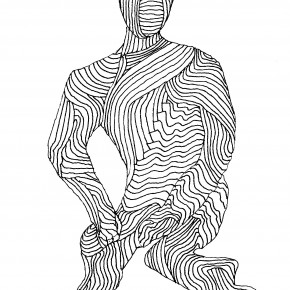
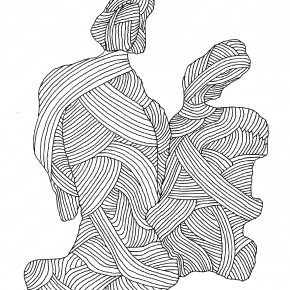
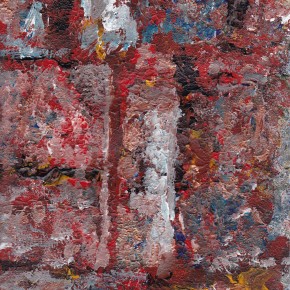
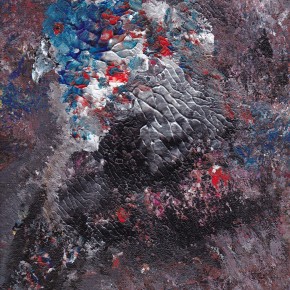
From top left: Love’s Yearning, Watching the Watchers, Mother and Son, At The Ready and The Ruins Seemed Familiar.
Staff looks at her world-building as a means of escape, creating another world to enter when our own becomes harsh. Her realm, Danovian, is no gentle paradise for its inhabitants, as plenty of tragedy occurs by accident as well as through revenge and malice. But it is a place where good, evil and loyalty matter, and there are redeeming elements, both within the story itself and through her act of transforming her stress into a new creation.
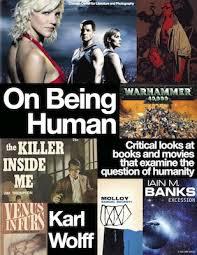
Karl Wolff’s essay collection On Being Human, reviewed by Christopher Bernard, looks into what our philosophy, actions, popular culture, religion and science have suggested over the past centuries about who we are and the meaning and value of human life. Bernard, and other thinkers, speculate that our current worldviews may not adequately equip us to sustain life on this planet. We may need to do more work to create our inner worlds if we hope to survive.
In her monthly Book Periscope column, Elizabeth Hughes reviews Rita D’Orazio’s Italian immigrant family saga novels Don’t Look Back and Katerina, as well as Lisa Henthorn’s young women’s fiction piece 25 Sense and Michelle Bellon’s romantic suspense novel Rogue Alliance. D’Orazio, Henthorn and Bellon’s books present characters with difficult pasts, who must heal from a variety of losses and mistakes in order to be able to trust again. Their inner landscapes become as much a part of the setting of their stories as the government top-secret research facility, corporate office, or California immigrant communities where they live.
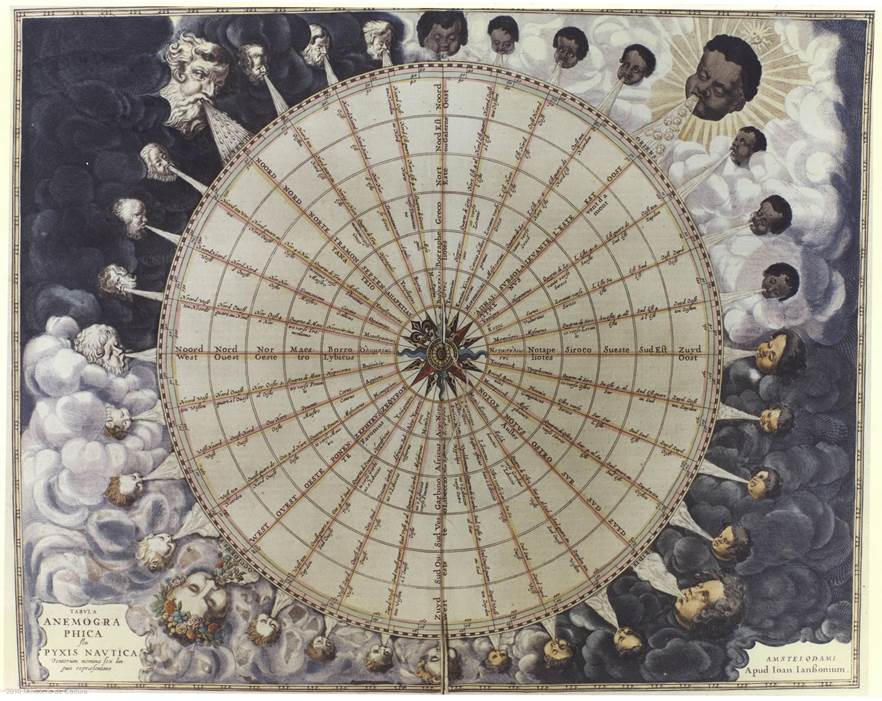
A wide variety of poets evoke sensations and landscapes through their words. Amy Huffman brings us to a beach harbor, where we watch ship sails move in and out with gusts of wind and waves grind rocks into sand at water’s edge. Virginie Colline condenses her thoughts down to haiku, showing us cats’ eyes, ice, and ocean waves with an intense focus on a single image. Perhaps Twitter, and the emerging literary form of microfiction, represents a modern Western resurgence of haiku?
Please enjoy the cacophony of sensations that is this month’s issue of Synchronized Chaos Magazine! Our writers invite you to step forward, pick up your backpacks and trail mix, and venture forth into their new worlds.
Various formats, including electronic and a paper edition, available at cclapcenter.com/onbeinghuman
An essay review by Christopher Bernard
The question “what does it mean to be human?” has become daunting. Both more urgent and more problematic in recent decades, it promises to become even more so in years to come. This short book of brief and stimulating essays on “novels and movies that examine the question of humanity,” written by Karl Wolff, a staff writer and associate editor for the Chicago Center for Literature and Photography, brings a number of these concerns to sharp focus. His book does what criticism does at its best: not only raising important questions and suggesting new avenues of exploration but introducing readers to ideas and works new to them, or encouraging readers to revisit and understand them in new ways.
It is odd that up until a few decades ago, the title “On Being Human” could have been used for some anodyne book in an undergraduate “humanities” course on “the miracle of Greece,” the marvels of the Renaissance, and the triumph of the Enlightenment, with a few passing references to such modern sages as Tolstoy, Albert Schweitzer, and Gandhi. Only in the last century, especially the last generation, has the category “human” become problematic, troubling, even empty, as the lessons of the “inhumanity” of human beings learned from the monstrosities of slavery to the carnage of Verdun to the death camps and killing fields of Europe and Asia to the Sixth Extinction have sunk in, and the virtues of our humanity have seemed increasingly overwhelmed by our evils.
It was the beginning of a new session. The young boy put on his
uniform and was set for school. At the end of the term, the boy was
sent home with a note from his teacher thus: ‘This boy should not
report to school henceforth. He’s too dull for knowledge and performed
woefully in arithmetic. He may never amount to anything in life.’ That
young boy however grew to have the most intriguing mind of all time.
His brain became the focus of research into human intelligence and
abstract thinking.
That young boy was Albert of the Einsteins
Centuries ago, a young boy was employed at the Royal Institute,
London, as a laboratory assistant under Sir Humphrey Davy. His major
work was to wash the apparatus, make them available for use, and pack
them back for storage. The young attendant was however curious to know
more. Not only would he do his job, he would also collect the notes
and read them on his own, yet he was not a student – nor did he go to
school. (While he was an apprentice with a book binder, he would wait
behind after work hours and read each book bound!) After fifteen years
of self-education, he had garnered so much knowledge that he succeeded
Davy. Then he got a patent for his first invention, the dynamo.
Couldn’t get enough, cake that is. Turned into one. Frosting for hair, chocolate for nails, double fudge layers in between chinny chin chin. Belly big, laugh one more. Piece that is. No such thing as left over under. Cake. Could hide but the nose nose. No such thing as saving for Aunt Bertha or any other ant or person who might enjoy some. Sugar. Disposal. Not enough hugs just cake. One more. Please. Only.
Tears rolled down Jane’s cheeks as she stared at the framed picture on her bed stand. It was ten in the morning and she was still in bed. She’d been awake for an hour, but she wasn’t ready to face the day. She’s been living like this since the news of the boat mishap which supposedly claimed Steve’s life was published in the Washington Post one week ago. She’d wake up every morning and just stare at the picture she and Steve had taken on the afternoon they visited the mall together for the first time. That was the last time they spent together before the boat mishap. As she stared at the picture, she continued to sob, letting the tears from her eyes trickle down her cheeks and soak up her pillow. So many memories flooded her mind as she stared at the picture: the afternoon she’d received the news about the mishap on the Potomac River, the search team that was launched, and the success the search team had in recovering the other bodies involved, which she didn’t really see as success because Steve’s was not among the bodies rescued. She thought about Sam, John and Philip and the way their unconscious bodies had looked when they were rescued from the river. She was eighteen years old and remembering the summer she and Steve had fallen in love; the summer she had a heart attack and how Steve had been by her side the entire time. Even though they’d only been seeing each other for a year, she felt as though Steve was the reason she was able to face the many challenges of her life. He was the reason she’d found strength to press on with her life after she lost her dad and her doctor told her she didn’t have much time to live because of her heart condition. Every moment she spent with Steve made her feel that she could live longer than her doctor had predicted. Now that he was gone, she wondered whether she would be able to face life anymore. The strength to live was no longer in her and with the passage of each day she felt weaker and weaker. She continued to stare at the picture until she was interrupted by a knock on the door. Her mom poked her head in.
“Breakfast is ready. I made you your favorite: pancakes with gravy.” Jane didn’t respond. She sat up on the bed and continued to stare at the picture. “Sweetie, are you crying again?” When Jane didn’t answer, her mom crossed the room, sat beside her and gently clasped her hand. “Sweetie, you can’t continue to live like this; no amount of tears is going to bring Steve back to life.”
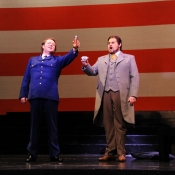
Giacomo Puccini (1858-1924) was one of the finest Italian composers. During my pursuits to research, the forever academic, Opera and particularly this composition and the San Jose Opera, I was surprised to discover that with an ocean and a continent apart there was a direct connection between Milan and San Jose, California during Puccini’s time. David Belasco, born in San Francisco, produced the play from which Puccini derived the opera. Belasco wrote, directed, produced, and acted in a number of plays just a few blocks from California Theatre in San Jose.
I was already mesmerized by the daydream fantasies I had of wringing my heart out at intermission and wearing those funny little flip opera-glasses, but this connection made it all the more enticing.
One of my mentors and teacher of indigenous knowledge and shamanic practices once said “the modern Western culture leaves no place in the music industry for the depth of emotions that help us process the story of being human except the Opera.” Being my first opera show I was very excited to witness and participate in that depth of emotion.