As Creative Facilitator, I, Cristina Deptula, and many others affiliated with Synchronized Chaos, invite you to join with us in defending free communication, online and elsewhere, and protecting individual liberties by rolling back NSA abuses.
The FISA Improvements Act attempts to legalize bulk data collection of phone records.
We need to tell Congress to pass the USA Freedom Act and amend it to make it even stronger.
Dial (202) 999-3996 to be connected to your legislators. If you are not from the U.S. contact your own legislators and encourage them to pressure the United States to support these protections.
The USA Freedom Act is a proposed law that would curtail the NSA’s ability to collect data on US citizens, create a special advocate to champion privacy in the FISA court, and increase transparency around NSA surveillance.
The FISA Improvements Act would allow the NSA to continue to collect telephone records of hundreds of millions of Americans not suspected of any crime—and seeks to restart the bulk collection of Internet communication records.
Undermining encryption is bad: Weakening encryption standards and attacking technology companies makes us all less secure.
International people matter: We must apply human rights values to digital surveillance techniques through transparency, rigorous oversight, and privacy protections that transcend borders.
According to Josh Levy of Free Press:
“Since the first revelations last summer, hundreds of thousands of Internet users have come together online and offline to protest the NSA’s unconstitutional surveillance programs. These programs attack our basic rights to connect and communicate in private, and strike at the foundations of democracy itself. Only a broad movement of activists, organizations and companies can convince Washington to restore these rights.”
Media Advisory for January 10th, 2014
On Anniversary of Aaron Swartz’s Tragic Passing, Leading Internet Groups and Online Platforms Announce Day of Activism Against NSA Surveillance
Mobilization, dubbed “The Day We Fight Back” to Honor Swartz & Celebrate Anniversary of SOPA Blackout
Washington, DC – A broad coalition of activist groups, companies, and online platforms will hold a worldwide day of activism in opposition to the NSA’s mass spying regime on February 11th. Dubbed “The Day We Fight Back”, the day of activism was announced on the eve of the anniversary of the tragic passing of activist and technologist Aaron Swartz. The protest is both in his honor and in celebration of the victory over the Stop Online Piracy Act two years ago this month, which he helped spur.
Participants including Access, Demand Progress, the Electronic Frontier Foundation, Fight for the Future, Free Press, BoingBoing, Reddit, Mozilla, ThoughtWorks, and more to come, will join potentially millions of Internet users to pressure lawmakers to end mass surveillance — of both Americans and the citizens of the whole world.
On January 11, 2013, Aaron Swartz took his own life. Aaron had a brilliant, inquisitive mind that he employed towards the ends of technology, writing, research, art, and so much more. Near the end of his life, his focus was political activism, in support of civil liberties, democracy, and economic justice.
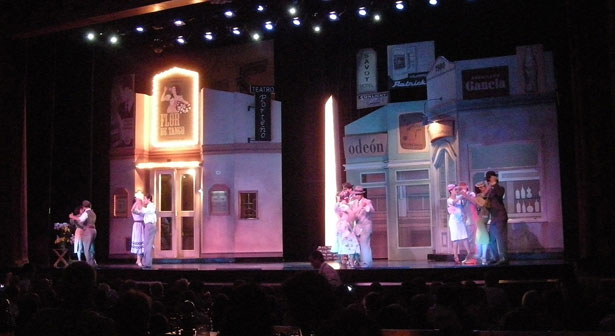
According to Shakespeare, in his comedy of manners and disguises As You Like It, all the world’s a stage. Everyone’s just a temporary player, with a certain role and time to enter and exit this existence.
Yet, even when someone’s not taking center stage, they, or their memory, can still play an important role. In life, as in a dramatic production, a lot can happen behind the scenes.
This month, our contributors pull back the curtain and peer at how nature and society function underneath the surface.
Bea Garth incorporates rich and specific detail about the natural world into her work, making the riverbeds, stones, seaweed and milfoil as lush and sensual as her romantic couples. Elements of the scene that would likely be in the background of a photograph or painting come to the forefront in Garth’s work, where all of life holds value and beauty.
Tom Reiss’ biography The Black Count, as reviewed by Bruce Roberts, tells the story of the real African-American figure who inspired the legend of the Count of Monte Cristo. The book illuminates a heritage of slavery and racial discrimination through the changing fortunes of one man.
Linda Allen’s poetry turns inward, encouraging readers to ask themselves difficult questions about who they are, how they think and treat others, and who they are becoming. Perhaps by changing inner attitudes, we can affect interpersonal behavior, and thus improve society.
Eric Franklin’s new self-development book Peanut Butter Principles, as reviewed by Elizabeth Hughes in her monthly Book Periscope column, advocates a similar attitude of self-reflection, along with discipline, patience, and hard work. Hughes also offers high praise for Deborah Hawkins’ Dance for a Dead Princess, for its suspense and writing quality.
Other contributors look to art and mythology to fuel their musings. Christopher Bernard speculates about the thoughts of the Minotaur, a half-human, half-bull creature feeding on sacrificed young people caught within his labyrinth. Bernard’s work often centers on the search for love and identity despite difficult, alienating circumstances, and this piece touches upon those themes in a unique way.
She, and the month’s other artists and writers, invite you to take your seat and enjoy the show, appreciating the onstage performance while remembering the complex world behind the scenes.
Through February 9 at 1344 Fourth Street, San Rafael
February 11 to 16 at A.C.T. Costume Shop Theater, 1117 Market Street, San Francisco
A riveting portrayal from Marin’s experimental theater company
Powerful, elemental and earthy portrayals suck in the audience for the 70 minutes of Sam Shepard’s lovers caught in an emotional Moebius strip. Chasing each other in an endless loop, unable to find an answer to their love-hate obsession stained by a bitter family secret, they are on the edge. Beyond that is only desolation, physically and emotionally. Even the run down motel room of their encounter is on the edge; beyond is the Mojave Desert. What makes the performances so effective is that the cast understands exactly Shepard’s theme. The raw, brutish roughness of this underbelly of society jumps out as the two vent their passions.
Matt Lai’s Eddie is a gun-toting cowboy and rodeo rider, who has returned to Jeanette Harrison‘s May for the umpteenth time. Life’s illusions and pretense were stripped from them years before, and they know that despair awaits them. Yet they still pretend to each other and themselves that everything can be different. In a rocking chair is the Old Man, Charles Dean, their long-dead equally rootless father, who tries to justify his actions and exists only in their minds. (Director Will Marchetti was the Old Man in the original production with Ed Harris). But the audience can never be sure if their memories are true and if so, if the Old Man’s interpretations are accurate.
Enter Danny Jones as Martin, a wonderfully innocent simpleton, right down to his every expression and action, who is befriending May and is the foil and channel for the lusts and hate. Everything and everyone is one step away from desolation, although only Martin is unaware of it
The Moebius ending, as Eddie’s horse trailer burns, the horses escape and his truck is wrecked, reinforces the theme of eternal desolation and hope and keeps the audience focused until the last second. Will Marchetti has put together an excellent rendering of Shepard’s emotional maelstrom. Alter Theater has chosen a great storefront location for this production, in downtown San Rafael. Like Sam Shepard’s lovers, the company has no permanent home and moves to different storefronts, which makes its mission all the more exciting. The city and Marin should count their blessings with productions like this from the county’s most daring theater company.
According to the Chabot Space and Science Center’s ground-floor Destination Universe exhibit, we are all made of stardust! Dr. Mary Barsony, Adjunct Professor of Physics and Astronomy at San Francisco State University and Research Scientist at the Carl Sagan Center for the Study of Life in the Universe at the SETI Institute, brought this point home during this month’s volunteer enrichment lecture.
Dr. Barsony’s talk chronicled the early history of the universe, starting with the Big Bang and continuing through the formation of lighter and then heavier elements. To begin, she outlined the four basic forces holding our world together: gravity, electromagnetism, and the strong and weak nuclear forces (holding positively charged nuclei together, and allowing the particles to decay during certain reactions). Gravity has proved mysterious due to its relative weakness at the subatomic level, leaving physicists searching for a new unifying theory to explain this.
Also, she oriented us to the scale of the world around us: if an atom’s nucleus were the size of an 0.5mm pencil point at the pinnacle of St. Peter’s Cathedral, the rest of its electron cloud would likely extend throughout the entire dome. And, this ordinary matter, composed of electrons, protons, neutrons and subatomic particles known as quarks, only represents a little over four percent of the universe. The rest, according to current theories, consists of invisible ‘dark matter’ (22.7 percent) and ‘dark energy’ (72.8 percent ). Dark energy is thought to be responsible for the expansion of the universe. We observe this expansion when we see galaxies moving farther away from us. We can detect changes in the wavelengths of light reaching us as galaxies move, a phenomenon known as a ‘redshift’ because the light moves towards the redder, longer-wavelength sections of the light spectrum.
Next, Dr. Barsony explained why scientists are fairly sure that the known universe began with a Big Bang, a point when hot, condensed matter began expanding and cooling. Today’s relative abundances of light elements, such as hydrogen and helium, make sense given the Big Bang theory, as does the background microwave radiation we have detected in the far reaches of the universe.
During the Big Bang, hydrogen and helium formed first, as these elements have the smallest number of protons in their nuclei. The reactions creating these elements were exothermic, giving off heat rather than requiring an input of energy.
Every other, heavier element in the periodic table formed later, within stars at various points of their life cycles. Stars carry out nuclear fusion to power themselves, and a star’s mass determines how much fuel it has and thus how long it will last. When a star runs out of fuel, it can decay to become a red giant, expanding to make room to radiate out the last of its luminous energy. Or, if it is larger, it may become a supernova or even a black hole, an object that has collapsed in on itself, where not even the light reaching it can escape the pull of its gravity.
The universe contains stars of all sizes, although many more are lower-mass than higher-mass. A star near the mass of our sun can fuse elements all the way up to iron in its core, and higher-mass stars can create other elements through a process of slow neutron capture (s-capture). Highly massive stars can produce very heavy elements through rapid neutron capture (r-capture), where more than one neutron gets captured at once. Some heavy elements form under endothermic conditions, where a certain amount of heat is required to start the reaction. The extreme conditions required for heavy metal formation explain the rarity, and thus the value, of precious metals, such as gold, silver and platinum.
Finally, Dr. Barsony illustrated her point by tracing the origin of the elements making up an average person. The iron in our blood originates from fusion in large stars. The oxygen and carbon in the food we eat and the water we drink come from dying solar-mass stars, and the hydrogen in our water from the Big Bang itself. And our gold jewelry definitely arose from deep within a supernova.
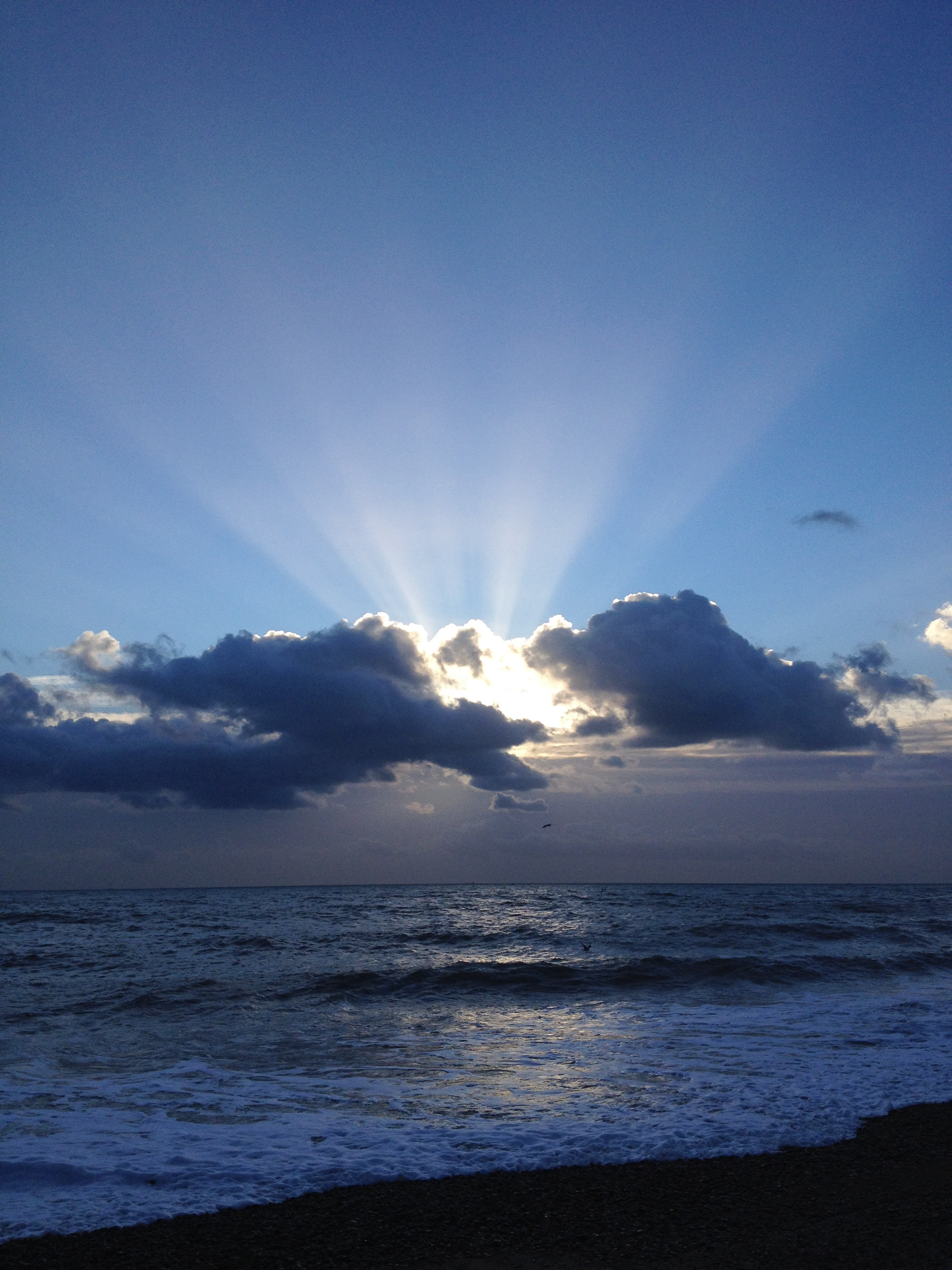
The ones with the dramatic clouds and sunrays were taken on the beach in Brighton, England last week. The one with the mountains was taken in Olden, Norway. The one with the rainbow was taken in the middle of the Straits of Gibraltar on a ferry from Morocco to Spain.