
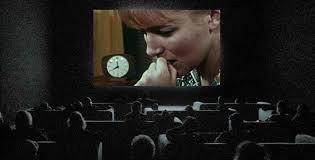
Christopher Bernard on the SF Moma’s new exhibit, Christian Marclay’s The Clock


View of a scene from “The Clock,” by Christian Marclay

ABOUT TIME

Christian Marclay: The Clock

San Francisco Museum of Modern Art

Through June 2


A review by Christopher Bernard


Christian Marclay’s extraordinary work “The Clock” is like no film you have ever seen—and like every film you have ever seen.

The gigantic 24-long film, screening continuously throughout the exhibit, was created by splicing together scenes from films, old and new, in which timepieces appear or the time is mentioned, each moment of the time shown on screen being synchronized with the actual time the work is shown. When the film says 2:19 on the screen, it is (or should be) 2:19 on your watch.

The Clock” is, indeed, a clock—perhaps the most complex timepiece ever devised, and like its fellows, infinitely provocative and suggestive. Watching it is like staring at, well, a clock—and as irritating and hypnotic as watching the minute hand move imperceptibly to the next number on the dial.

Christian Marclay, born in San Rafael, grew up in Switzerland, and now lives in London. As well as being one of the most important video artists now at work, he is also a DJ, using his skills in sampling and mixing in his visual as much as in his musical work. (SFMOMA has a special relationship with the artist, and has other works by him in its collection, including Video Quartet.)

At first I found his new work disconcerting. The steady pounding of scenes from unrelated movies most of which feature a clockface (including watches, sundials, hourglasses) in the fore- or background, sometimes barely visible, and all of them displaying the film’s “narrative” time, seemed mechanical and monotonous at first. I found myself compulsively searching for “the clock” in those scenes where it wasn’t obvious, but soon found the effort more annoying than enlightening.

Then at a certain point, I gave up and gave myself over to the peculiar flow, eddy, whirl, stops, starts, the leaps, swirls and peripeteias, of this immense temporal collage, and ignored the artificial cliffhangers created by scenes that set the audience up and then deliberately go nowhere except to the next minute, and I found myself mesmerized, taken into a dream of time unlike anything I have experienced since the day in childhood when I first discovered clocks and spent part of a morning watching the second hand sweep across the dial, and tried to catch out the minute hand as it moved with immense, majestic slowness toward the great number 12.

(I’ve visited twice so far, each time staying at least two hours; watching from just before 12 noon until 5:30 p.m.—and I strongly recommend taking the work in such long “gulps.”)

Many human experiences, of course, cluster around particular times of day, and as in life, so in film. “The Clock” displays these with clarity and flair: lunches in early afternoon, whether a sandwich grabbed in a diner, or a drawn-out business affair, at the toot of a midday factory horn or as a social occasion big as dinner; then the doldrums of afternoon classrooms; the stampede at 5 o’clock; and the buzz of the following cocktail hour.

Certain hours have always been used as dramatic markers, whether “High Noon” (and yes, the moment you would expect from the Gary Cooper film is here, although, if you blink, you could miss it) or midnight for romantic trysts, or cat burgling. Yet in “The Clock,” these times come and go, without the shock and stop to be found in a movie drama; in fact, with no more than a minute’s time before off we go to the next, equally parsed, equally sized, pitilessly brief slice of an hour.

That some of the minutes in “The Clock” seem longer and are certainly more dramatic than others is even explained in a scene where the psychology of time is discussed: you’re likely to remember “The Clock”’s depiction of 12 noon (with its dramatic lead-up, a countdown that leads to nothing more dramatic than . . . 12:01) a good deal more clearly than its depiction of 3:53 pm, even though both times take exactly a minute to depict.

In the end, as you whir through hundreds, eventually thousands, of scenes from films you have seen, and many you haven’t, from silents of the past and to the digital films of the present; through shots and scenes and entire sequences, some cut up and extended over many minutes, like a great musical cubist fresco, with famous actors flashing by in a fugal collage of faces and voices, you see that “The Clock” is more than just about clocks and watches, moments of panic, joy, terror, suspense, cliffhangers and the knife-edge moment, it is about love, loss, death, birth. About time, in its most human, and most inhuman, forms. It’s about our life, in all its messiness, fragility, and stress, the lives of individuals, and the unending cycle of life on earth, in its monstrous and relentless and yes, beautiful, mystery. In the eighteenth century, the universe was likened to a clock. This Clock can be likened to the universe.

The Clock” is on display at SFMOMA in the weeks leading up to the temporary closure, starting in June, of the museum’s building during expansion. To accommodate those who want to see the work in its entirety, the museum will be open 24 hours on each Saturday in May and during one of the days leading up to the building’s closure.

On other days, though the film in fact screens nonstop, 24 hours a day (in its commodious yet intimate, sofa-furnished gallery, at the end of a short but effectively mazelike corridor), it can only be seen by visitors during the museum’s hours of admission, from 11 am to 5:45 p.m. most days (and until 8:45 p.m. on Thursdays).

The work’s rigid structure does not allow screening of the overnight portions during daylight hours, so those curious about how the work depicts, say, 4:53 a.m. (and this viewer is very much so) will have to visit the museum at the said hour. I’ll be there, with a Red Bull in one hand and a pillow in the other—if I can’t find someone warmer.


Christopher Bernard is a San Francisco novelist, poet and critic. He is author of the novel A Spy in the Ruins and co-editor of Caveat Lector (www.caveat-lector.org).
 

‘Milk and Honey,’ a poem by Michellina van Loder


Milk and Honey


Forgo honey

forgo milk

pocket the money

and lie to your ilk

ameliorate wounds

with hunger pangs

all consumed

laying in your princess bed

cheek bones

shrink-wrapped

in dewy skin

youth wasting away

skinny, slim, thin

tiny, small, smaller

no curves left now

hips sharp peaks

of pride;

an ego in control

don’t let me go

don’t let me go

I’m so hungry so

no, no, no…

so lonely

yet never alone

in this insistent chatter:

You’ll never be good enough.

You’re too fat.

Don’t eat that.

Don’t eat.

Don’t.

Don’t…


Michellina van Loder
PW&E student
Victoria University

A Milton of the Alleys: Christopher Bernard on poet Ernest Hilbert


A MILTON OF THE ALLEYS

Review by Christopher Bernard


All of You on the Good Earth

Poems by Ernest Hilbert

Red Hen Press

96 pages, $16.95


Elegies & Laments

Ernest Hilbert et al.

Pub Can Records


Ernest Hilbert has written some of the most elegant poems in American literature since the loss of Anthony Hecht. A fascinating blend of the Augustan and romantic (an Augustanism that flirts with the sweaty Rochester as much as the marmoreal Johnson, and a romanticism charged with as much street grit as lyricism and longing), with a cadence that can be as wickedly eloquent as Lowell or compressed, as an elegantly held fist, as Bishop, Hilbert holds tight to an understanding of poetry and the role of the poet—proud without complacency, authentic without cheapness, self-respecting and self-mocking—that is (thank God) not particularly popular in poetic circles today. None of the shive and jive of hip-hop rap and poetry slams echoes in these lines, none of the pink-toned shrieks of social networks or the subliterate prattling of Twitter or the smug pyrrhonism of the postmoderns. Yet his poems are as fresh as the morning sun, sharp and alive as the latest headline or a brash tweet.

His latest learned and lyrical productions are a book and a CD. The book contains some 60 loosely formed sonnets, a form that Hilbert has made his own, proving this most classic of forms can contain anything the 21st century can throw at it.

I arrive, one more uninvited guest.

……………………………………

A single white horse

Grazes down below, slowly consumed

By shadows that pour into the valley.” (“Dusk in the Ruins”)

He, or his poetic persona, moves across the world, an “earnest pilgrim,” from the necropolis at Vulci to Iwo Jima , to the bars of TriBeCa and the back alleys of Queens, to Senecan Rome, “from Grub Street to the Brill Building,” to the “dark suburbs” (“The insatiable sprawl thieves as it gives,” as he says in a memorable line in a book packed, jammed and o’erbrimming with lines you will want to linger over, savor, like the wines of Helicon), to New Jersey’s Mullica River, to a graveyard in Philadelphia:

My parched heart slithers in its soaked bone chest,

Gorges on embers and crackles to ash.

Winter twigs are splayed like petrified veins,

Skeletal fingers to cradle a bare nest.” (“Levavi Oculos”)

Any page you open to contains, not a gem, but a treasury, a manuscript of illuminations, lapis lazuli and gold, even when the poet is watching his key chain spatter down a toilet bowl in a late New York club night:

Keys splash in the toilet bowl and clank

Dully on the brown-smudged porcelain throat,

A cloudy silver quiver. The tiny blades

Swim through ripples.” (“City-Scape Gentlemen’s Club, Queens”)

Or, more bluntly:

The city is cat piss and dog shit. It stinks,

And the humid air smells like mold. I lie in bed,

Too hot to move, slick with sweat . . .” (“Kalypso”)

He describes, like a Milton cast away in the alleys, what he sees on a bleak night in the slums of a great, wounded city, or in the hungover misery of a busride down the east coast’s suburban sprawled flank, in a poverty-stricken childhood homelife among “the peculiar clan at cul-de-sac’s end,” in the fissile fossilizing of a convention of archaeologists, in a list (far from incomplete) of America’s robust negatives, in a pixillated Oscar acceptance speech and a rancid envy’s tongue lashing of revenge—all without missing a beat or a foot, though he allows himself a respectable freedom in rhyme.

Hilbert’s CD is a particular treat for his fans: it includes a selection from his book Sixty Sonnets, read by the poet with musical accompaniment, including in some cases, orchestral arrangements, composed by Marc Hildenberger, Dave Young, and Christopher LaRosa. Four tracks, each containing a number of poems, are listed on the jacket and CD (“Failed Escapes,” “Legendary Misbehavior,” “Satires & Observations,” and “Elegies & Laments”), though a fifth track is included on the CD itself, a fine, cool ending to this ingenious journey through sense and sound. One of the tracks records a particularly successful open mike where Hilbert reads, followed by stimulating contributions by Quincy R. Lehr, Paul Siegell, and Kristine Young. And introducing each track are tantalizing mashups of recordings, scratchy and haunting, of older poets, from Whitman to Ezra Pound to Sylvia Plath.

Hilbert has a fine “radio announcer’s” voice that makes up in clarity and tone what it sometimes lacks in flexibility and character (he is not an actor). The poems tend more toward the demotic and streetwise, but never lose Hilbert’s strong imagery, feel for cadence, and rhythmic firmness. A wonderful release.

Postscript for poetry publishers: I loved both book and CD – though I must say I gagged at the listed price of the book. In some ways I hate Amazon for destroying my favorite bookstores (Borders) and wounding others (Barnes & Noble) almost to extinction, but Amazon, through its links to other sellers and various price structures, at least makes it possible to purchase books of poetry at a reasonable cost. When will poetry publishers realize that they might actually get sales if they priced their books reasonably? Many of the people I know who love poetry are “economically challenged,” to put it delicately; they simply cannot lay out $16.95 for a paperback of fewer than a hundred pages (and even Amazon’s “discounted” price is high). I buy very few poetry books for that reason.

Poetry publishers of the world, unite! You have nothing to lose—but your losses. There is a market for poetry out here, but you will need to set a truly economic price for your wares—and not have so much faith that discounters will make up the difference.

Christopher Bernard is a poet, novelist and essayist, and co-editor and publisher of Caveat Lector (www.caveat-lector.org). His novel A Spy in the Ruins is available from Regent Press (http://www.regentpress.net/spyintheruins/).


San Francisco Bay Area folks: Donate Art, Gift Books, and other items to raise cash to promote refugee rights and self-sufficiency!


Synchronized Chaos family in the San Francisco Bay Area:

I’m currently interning as a communications fellow at Oakland’s Asylum Access (http://www.asylumaccess.org), a refugee rights organization advocating for those fleeing violence to be able to leave camps, seek work and start businesses. We currently operate within Thailand, Tanzania and Ecuador and will open two new offices abroad over the next few years. Our lawyers go to practice in these countries, helping refugees get refugee status, representing them in harassment, equal pay and benefits access cases. We’ve been around just a few years and have impacted the ability of over a million people to work, send their kids to school, and not get returned to nations in the midst of genocide and civil war.

We’re hosting a soiree and silent auction near the end of June at the City Club in San Francisco – and are seeking donations for the auction.

They’re looking for high-end items, something that would sell for at least $75-$100.  Framed art and gift books could work very well.    Gift certificates for restaurants, lessons, shops, shows, etc also appreciated.

Please comment here or email me at communicationsfellow@asylumaccess.org if you’re interested, and I’ll put you in touch with the folks organizing the soiree, as they’ll make the final decisions about what to include.  Thank you very much!


Free show tickets available for the Synch Chaos family – storytelling in San Francisco

Producer and publicist Bruce Pachtman has made these available for our community – review if you like, or just attend the show! Interesting experience.

Solo Sundays
Sunday, April 28 -7pm
Stage Werx Theatre
446 Valencia (nr. 16th) SF
Solo Sundays: Hilarious, Heartbreaking & Provocative Solo Performances
Solo Sundays, S.F.’s premier monthly showcase, presents select samplings of veteran virtuosos and top emerging talent in the intimate StageWerx Theatre in The Mission. Beyond stand-up and storytelling, solo theater creates casts of thousands – plus special effects – all bursting from a single performer. The results are hilarious and heartbreaking, passionate and provocative, ablaze with personal visions.
MARGA  GOMEZ
“Lovebirds”
  * * * * *
Wilfredo’s heart belongs to a singer with a tin ear who married a sleeping shrimp. Down the street at the lesbian bar a poorly dressed aspiring butch goes big and runs out of money. Polaroid Phyllis captures their victories and agonies. It’s the seventies and every shot counts. Warning this piece may contain disco music. (work in progress)
GRAY
“Grandma Moses Wants to Tell You: Parables for a Surreal Age”
  * * * * *
In this day and age of digital overwhelm, do you long for good old fashion storytelling? No? “Good. Babushka didn’t want to telling of story anyway.” Instead, she’ll fill her belly with drink while she fills your brain with a dream-like mash-up of the romance, rats, bicycles, bleach, and a man who turns into a pile of sticks right before your very eyes. “Come closer. Listen, or you make Grandma cry.”
JULIA  JACKSON
“Worst. Boyfriend. Ever.”
  * * * * *
Can a bad boyfriend make you gay? No, just miserable. Beer drinking, shit talking, Camaro driving boyfriends are the skeletons in any good lesbian’s closet. Or was it just me?
If people are 100% interested in attending all they need to do is copy this info:
1. Include your name  _____________
2. Solo Sundays at Stage Werx
3. Sunday, April 28 – 7pm
4. Whether they’d like one or two tickets
and send it to brupach@gmail.com. To obtain a ticket I need that info.

Poets and writers! Make your work available to a wider audience through a custom iPhone/iPad app!

Everyone, two people in the Synchronized Chaos family, columnist, poet and software engineer Leena Prasad and writer/software person Rui Carvalho, are offering to help our publication fundraise. They’ll create an app of your poetry for $200, with one-third of the proceeds going to Synchronized Chaos!
Mention Synch Chaos when you order an app and we’ll receive cash. Please contact us by commenting here or emailing us at synchchaos@gmail.com
 If your purchase more than five  iPhone/iPad or Windows apps, the maximum yearly fee will be $50. If your purchase two or more Android apps, the maximum yearly fee  will be $15.
Both Rui and Leena have experience and references regarding their software and development skills, and will provide work samples upon request.
From Leena Prasad, who specializes in haiku, senryu and other Japanese-inspired poetic forms: 
So, you have written several haiku, senryu, or tanka. Maybe you have a collection of haiga. Now what? You can publish them in a book but, really, smart phone apps are where people are spending a lot of their time and these Japanese inspired forms are well-suited for the small screen.
I converted my senryu book ‘not exactly haiku’ into an iPhone/iPad app and can do the same for you. I can also create an Android version. Check out my app by searching for it in the Apple iStore or by following the links at ThinkersInk.com.
–    Basic app package: cover page with menu items (Favorite, Contents, More…) + one author page + 20 pages (screens and menu similar to ‘not exactly haiku’) + ability to mark each page as favorite and  email and tweet the text content + a “more” page with six buttons, one of which links to the author page and five which can link to any url.
–    Additional static screens, $3 / page:  screens and menu similar to ‘not exactly haiku’.
–    Additional dynamic screens, $TBD: customized screens with buttons, etc.
–    Yearly Fee: to keep the app in the online store.
From Rui Carvalho, who handles all types of poetry, including short prose poems and flash fiction: 
I offer top quality apps for Windows Phone and Android. Each app is intended to be a valuable asset for poets who want to value their work and present it to friends and readers all around the world. The standard content is: i) 20 poems; ii) short presentation of the author with maximum of two screens and one photo (optional); iii) a link to an existing website of the author and iv) an inspiration photo per group. If desired, it is possible to add extra poems and/or a short quiz (an extra fee will be applied). The app will be available for countries as USA, Canada, UK, and many others. Additionally, it will be possible to produce apps for iPhone if the author needs at least one  app per platform.
Rui’s writing is available here on his website: http://talesforlove.blogs.sapo.pt

Synchronized Chaos April 2013: Looking Deeper

Welcome to April’s issue of Synchronized Chaos International Magazine! We wish you a lovely Earth Day, and an energizing spring or fall, depending on where you are.

This month’s submissions encourage us to go beyond just absorbing the information and entertainment we see and hear, and to explore and analyze it in more detail. This starts with first fully understanding what we’re considering, as Joy Ding says Lynn Gilbert tries to help her readers do through her oral history biography collection, Particular Passions.

Gilbert, before the invention of the Internet, researched and put together biographies of accomplished women from history, such as computer programmer Grace Hopper and writer Betty Friedan. Using academic oral-history techniques, she lets each person, whether famous or lesser-known, speak for herself, discussing topics such as her inspirations and motivations, work-life balance, and the journey of becoming a pioneer in her particular area of knowledge and encouraging more women to enter her field. Particular Passions aims to look at each woman’s journey in more detail and record chapters of history people entering the workforce nowadays will not remember.

We can also go deeper by contextualizing items and artifacts in terms of history and geography, knowing where and when things happened. Dacia Mitchell takes on this task through her thesis, where she interprets historical cartoons. She describes how 19th century American caricature artists ironically reinforced pre-existing ideas of racial superiority through the seemingly rebellious act of poking fun at politicians, by giving those they didn’t like stereotypical nonwhite features. She discusses her thesis in this month’s installment of her interview with Daily Echo political journalist Randle Aubrey, and goes on to analyze the social functions of media such as talk shows and music, placing things in context by comparing them to cultural artifacts from other times in history. 

Randle Aubrey himself talks about an educational project for Middle East nationals concerning current affairs, entitled Democracy Camp, and highlights the importance of knowing about places before we can talk about them. This can start with something as simple as locating the country or region under discussion on the map, as Democracy Camp participants learn.

Using one art form to reflect the style and sensibility of a piece created in another media, as Neil Ellman does through his ‘painting poems,’ also provides a richer understanding of the work’s structure and content. Some have said that writing about music is like dancing about architecture – i.e. that some formats would be very difficult and nearly ludicrous to translate. This may be so in some cases, but derivative works such as Ellman’s do grant us a chance to more deeply examine the same material by grasping and echoing the underlying aesthetic.

We can also reach greater levels of understanding when we go beyond surface impressions, ideas and criticisms, as Nigerian author and social critic Ayk Adelayok does through his columns. Adelayok’s The One Whose Face is Veiled, My Oga at the Top and Ours is a Nation urge people to look beyond the promises and style of those in power to challenge their corruption, and not to dismiss as ineffective those who are actually taking the required time for critical analysis. ‘Oga’ goes beyond the political, encouraging readers to examine their own personal and intellectual foibles before making fun of politicians or blaming the system for their unemployment.

Science may seem out of place in this discussion of art forms, social values and historical thought, as the hard sciences are theoretically based on evidence and hypotheses testable through impartial methods. However, while the physical facts may not change, science is still a story told by humans. The words and methods we use to explain and convey what we discover can reflect our social attitudes and psychological preferences as much as the facts themselves. 

One of the ways people tend to want to understand science is as a good story: simple, understandable, and dramatic. The extinction of dinosaurs through a meteorite crash has those characteristics, as we imagine picturesque Apatosaurus snacking on leaves in the cool of the day and fearsome Tyrannosaurus returning from the hunt, unaware their lives will end in an instant and the planet will change forever.

Knowing we cannot accept this story purely on its narrative quality and plausibility, Dr. David Lindberg looks into this commonly accepted narrative. He finds that the large impact could well have killed the dinosaurs, although the precise mechanism would have been a little more complex than we imagine. And he drives home an even more unsettling point: that the surviving species were not necessarily the smartest or best adapted to their environment, but merely those who would have escaped the lingering effects of the blast.

Leena Prasad’s protagonist does the same thing in her monthly column, Whose Brain Is It, sampling fish as her older family members have told her it’s good for her brain. She evaluates the findings through modern science, and after considering the inconclusive evidence, chooses to go ahead and eat it, with the cognitive benefits as an extra possible bonus. 

Moving from science back to poetry and prose, how do we express strong feelings in new ways through words? One way is to look deeper at specifics, starting with images and details and moving from them to ideas and emotions, so our words are grounded in something real and not just sentimental. Several writers this month follow this pattern, beginning with literal places, memories and events, which they adorn with poetic descriptions.

Some works eventually place a greater focus on the feeling and atmosphere than on the event’s literal facts and details. But our feelings are very much real, as motivations for our choices and thus contributing causes to human events.

Poet D.M. Aderibigbe of Lagos, Nigeria conveys scenes of childhood, soccer, and beaches where as UC Davis African Literature professor Dr. Brenda Deen Schildgen said, the published and translated modern literary canon is fairly recent. The history people and writers grapple with involves not idle nostalgia, but real and present events with lingering effects on people of the day.

Cynthia Lamanna does the same with the familiar Easter story, exploring the feelings of Jesus and the disciples during His arrest and execution.  She integrates the physical reality with imagined empathetic thoughts, starting with a historical event and going farther to create a poetic meditation on faith and sacrifice. As a person of strong faith, Lamanna experiences the crucifixion and resurrection as present realities. As with D.M. Aderibigbe, the historical events inspire her daily life, as she strives to follow Jesus’ example.

And Sarah Melton’s review of Charles’ Ayres’ memoir Impossibly Glamorous echoes in this vein. Ayres isn’t expansively poetic, but his book does make use of atmospheric details to take readers deeper into his life and into a period of American history, allowing readers to see the 1980s through the eyes of a young gay Midwestern teen. This decade’s often viewed as a consumerist, materialistic, artificial time, full of peppy pop music, shoulder pads and shopping. This was before the West discovered environmentalism, when the economy did well for those at the top and the rest tried to emulate them.

Yet Ayres goes beyond the facile stereotypes of those years. We see what people were hiding from during that decade – loneliness, AIDS, the possible side effects of the past few decades of war and rapid social change, the threat of everything falling apart. In recent years some societal sectors have witnessed a resurgence of 1980’s culture, and it’s been suggested that the eighties came back because they were more fun than the serious grunge or alternative ethos of the 90’s. People can miss illusions, even if they suspected all along they were illusory.

Charles incorporates pieces of what he finds in different places, including Japan’s pop music and radio DJ scene, where he became a minor expatriate celebrity, into his life. As with  D.M. Aderibigbe and Cynthia Lamanna, he starts with the specific and lets deeper themes emerge. These are all the more powerful because we aren’t moving from one drama and tragedy to another, because we get the chance to breathe, to feel the cool of the stone and the defeat of the disciples, hear the glitzy club pop and clumsy foreign mispronunciations, and kick the soccer ball upon the Mauritian beach. 

It’s been said that life’s a journey of creating yourself as much as finding yourself…and Charles Ayres, and our issue’s other writers, incorporate different traits and cultural artifacts into their lives, becoming the people they are today.

We invite you to consider and peruse this month’s posts. Perhaps this issue of Synchronized Chaos will serve as raw material for you in creating yourself!

Icon created by Finn Gardiner, a collective in Boston, MA