Note: this neuroscience column is published monthly in SynchChaos.com magazine
topic
nurturing
region
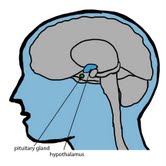
pituitary gland, hypothalamus
chemicals
oxytocin, prolactin, testosterone, vasopressin
tiny bundles
white yellow orange red
chicks being fed
The newborn pigeon chicks are being fed by their grey and black father. A few weeks ago, they were two tiny white eggs.
“They hatched!” I send a text message to my boyfriend. We take delight in this incubation-hatching-fledgling drama taking place just outside our apartment. Despite advice on the internet that pigeon birth cycle can turn into a nuisance, our curiosity wins and we allow the budding pigeon family to stay in the twigs nest they have built near our fire-escape stairs.
After the hatching, the father sits on the chicks to protect them as they grow. Sometime I see him feeding them but mostly he is a stoic silent dad, acting under the influence of his instincts. At night, the mother takes over the job of nurturing. Both parents’ brains are releasing the prolactin hormone which is secreted by the pituitary gland via instructions from the hypothalamus. In the case of birds, this chemical is released when the bird sits on an egg. Prolactin causes the secretion of milk in both pigeon parents thus the father is able to feed the chicks during the daytime and the mother at night. There is a decrease in the father’s testosterone level at this time also which is why he is able to shift from copulation to nurturing.
In humans, women start to secrete prolactin as the child is about to be born and continue to secrete it during the breast-feeding phase. Males, however, do not release prolactin nor do they show a reduction in testosterone production when the female is involved in child care. That is, unlike bird fathers, the human male does not decrease his sex-drive while his wife is rearing a new child.
In addition to prolactin, a woman’s hypothalamus also causes the release of oxytocin (via the pituitary gland) for the production of milk. Oxytocin is a catalyst in inducing labor so a female mammal can give birth. It is possible that birds also secrete oxytocin but more research has been done on rats and humans than on birds. Rats are often used in experiments because they are mammals, have a body and brain that is very similar to humans, and are much cheaper and easier to use for experiments than humans.
Beyond milk creation and inducing labor, the oxytocin neurotransmitter has the powerful affect of elucidating emotional bonding which results in the maternal drives required for child care. I suppose if we ever had a child, my boyfriend would probably help raise the newborn but he would not be producing oxytocin at the level that I am producing and would not feel the same level of chemical imperatives for nurturing.
Even though the human male’s brain keeps itself isolated from the nurturing drama by not releasing prolactin or extra oxytocin, there are other “potential” chemical activities that occur. In male voles, a rodent similar to a mouse, a hormone called vasopressin induces paternal care by the males. This study, however, has not been correlated to humans.
I watch the progress of the birds on my fire-escape and connect with the “maternal” instincts of the father pigeon. I do not see the mother much because it is too dark when she shows up. Since I am not pregnant, nor do I have a newborn, I do not have prolactin circulating in my system nor do I have an unusually high level of oxytocin. Oxytocin, however, is being released in my body consistently because I am in a committed romantic relationship (this chemical is not just for mothers, it is also released in humans when any bonding activities occur). I do not know for sure if the oxytocin in my body makes me feel more sympathetic to the pigeon parents but I suspect that it does. Either way, I am enjoying this pigeon child-care ritual.
Dr. Nicola Wolfe is a neuroscience consultant for this column. She earned her Ph.D. in Clinical Psychopharmacology from Harvard University and has taught neuroscience courses for over 20 years at various universities.
References:
1. Bridges, Robert. Neurobiology of the Parental Brain. Academic Press 2008.
2. Numan, Michael; Insel, Thomas R. The Neurobiology of Parental Behavior. Spring 2011.
The Nodding Syndrome Epidemic: An International Medical Mystery
Ugandan researchers, along with the rest of the world, tackle this unexplained syndrome through the diagnostic process of elimination.
by Cristina Deptula
From Dr. Oz to House M.D., medical mysteries fascinate us. Along with the practical need to avoid suffering and health risks, many of us seek answers to unexplained puzzles as a way to make sense of our world.
In real life, matters are often complicated, and not always solved in an hour by one charismatic, maverick researcher. Still, though, the hard work and ingenuity of a dedicated scientific team can bring positive results in tough situations.
One real-world challenge for international medical professionals is the outbreak of ‘nodding syndrome’ in eastern Africa. First documented in Tanzania in the 1960s, nodding syndrome is a debilitating and usually deadly neurological disorder currently affecting nearly 7,000 children between the ages of 5-15, causing seizures, stunted growth, and progressively worsening brain damage. Named for the distinctive nodding motion of its victims’ heads during seizures, the disease kills patients indirectly by leaving them weak and vulnerable to accidents or through malnutrition since the children experience seizures while eating.
According to Dr. Abubakar of the World Health Organization, scientists have classified nodding syndrome as a new medical condition since its etiology – how it affects patients and develops over time – differs from that of normal epilepsy or narcolepsy.
“The symptoms and signs of nodding syndrome are very unique, and cannot be linked to any other illness,” Abubakar explains. “Nodding Syndrome is believed to be different from other regular epilepsy since [the] majority of the patients are without any [congenital] brain damage or focal neurological signs.”
Formerly also called ‘nodding disease,’ the condition’s now termed ‘nodding syndrome’ since no one knows what’s causing it. Health professionals can only diagnose it by noticing the presence of certain symptoms that tend to occur together in affected patients.
As SEED Media Group science writer Tara C. Smith explains in her March 27 entry in her blog Aetiology on nodding syndrome, a ‘new’ disease does not necessarily mean that a new infectious organism or toxic substance has appeared. It could simply mean that the conditions have finally become right for something already present to affect enough people to get noticed by medical science.
Physicians and health workers in southern Sudan and northern Uganda continue to diagnose new cases of nodding syndrome, and cannot offer many treatments or preventive measures. So, the CDC, the Ugandan Ministry of Health, Gulu Hope and other private Ugandan and Western charities and nongovernmental organizations and the WHO have joined forces to carry out comprehensive medical research and to provide support to the families of sick children.
Dr. Suzanne Gazda, a physician with Gulu Hope, a large and widely recognized medical and development charity in Uganda, says that nodding syndrome seems to occur in areas already hard-hit by war. This would include the locations of the most recent observed outbreaks: Tanzania in the sixties, South Sudan during and after the civil conflict there, and now northern Uganda as people return home from refugee camps a few years after fighting raged in the region.
Gazda further points out, “According to a study by the Centers for Disease Control (CDC), we do not believe that nodding syndrome is contagious. Without any insights to the cause, however, there is no way to know if there could be worldwide implications due to other random outbreaks. Not knowing the cause of the disease poses the biggest threat at this time.”
Current Directions in Treatment
Gulu Hope is building treatment centers for children with nodding syndrome around northern Uganda, known as Havens of Hope. Currently medical treatment for the disorder is limited to antiseizure drugs, which can only treat symptoms and slow the condition’s progress, and which are often in short supply in poor rural areas. But the centers also offer food and day care for those who often cannot be left alone safely, offering some relief to impoverished farmers with sick children while collecting epidemiologic data on affected families to assist with medical research.
Community health workers survey families receiving care from the Havens, and other public and private treatment facilities, to see if any patterns emerge among the sick: similar life experiences, locations, etc that might provide a clue as to the disease’s origin. Through epidemiology – the statistical study of how medical conditions affect populations – scientists can see what groups of people seem most vulnerable to a disease and thus deduce possible risk factors.
Donations to [Havens of Hope] will provide funds towards these care centers and research efforts. Donations can be made at http://www.guluhope.org/donate/.
Uganda’s governmental Ministry of Health has also undertaken a public education campaign to teach public and private community health workers to identify and track cases of nodding syndrome. They also encourage the public to take part in the international epidemiological research studies.
Preliminary Investigations
Most diseases presently known to medical science have causes that fall into one or more major categories: infection (from a virus, bacteria, fungi or other parasite), environment (from exposure to a toxic substance), nutritional deficiency, genetic, or autoimmune (caused by the immune system’s mistakenly targeting the body’s own cells).
Researchers work through the process of elimination to uncover the cause(s) of any new conditions.
As mentioned before, researchers do not believe that nodding syndrome is contagious from person to person, making some types of infection unlikely as a cause. As for parasites, likely candidates, such as the native black fly-transmitted worm Onchocheria Volvulus, which causes river blindness, have been hypothesized, but no one has found solid evidence for a causal link to nodding syndrome. Currently the CDC, in collaboration with Ugandan authorities, is spraying to eliminate the black fly from the country’s affected northern regions to see if that produces a beneficial effect.
Dr. Abubakar explained that World Health Organization (WHO) researchers had conducted skin snips (taken skin samples) from children with nodding syndrome in three different Ugandan communities. Most affected children had antibodies for O. volvulus infection, but the worm’s prevalent in many other areas of Africa where nodding syndrome is rare or nonexistent, so the conditions could be unrelated.
A German research paper published in the December 2008 issue of the scientific journal Epilepsia discusses a prospective study of 62 children with nodding syndrome in Tanzania. Many children had signs of O.volvulus in their skin (skin PCR positivity) but did not show any of the expected diagnostic signs that the infection had spread to their brain. However, the sick children did seem to have hippocampal sclerosis (damage to certain areas of the brain) brought about by an unknown mechanism.
As for environmental or toxic exposure, a CDC study tested nodding syndrome patients through urinalysis for signs of mercury and arsenic, both of which could cause relevant symptoms. However, the urine samples from all the children in the study had low levels of these toxins. Researchers are presently testing for evidence of exposure to other damaging substances.
Some studies suggest children with nodding syndrome have low levels of vitamin b6, a substance important for many body functions, including oxygen transport, protein digestion, and immune function. However, the children’s seizures make eating difficult, so many become malnourished as a result of the disease. So it is unclear whether the vitamin deficiency functions as a cause or risk factor for developing nodding syndrome or if it is simply another symptom. The CDC will soon carry out a vitamin b6 trial to see if supplementing children’s diets in affected areas with the nutrient reduces the incidence and/or severity of the disease.
A genetic or autoimmune component to nodding syndrome could be possible, but would not explain why the condition tends to break out in small, localized regions. If this condition has nothing to do with the environment, then why does it affect many children in certain rural villages, rather than being dispersed randomly through the population? Some researchers have observed that cases of epilepsy and related conditions tend to cluster within certain families. So it could be that some people are genetically predisposed to be more vulnerable to whatever’s causing nodding syndrome.
Nodding syndrome could also arise from the interaction of multiple environmental or lifestyle risk factors. For example, children already weakened by a nutritional deficiency might be more vulnerable to a certain parasite, or vice versa. Or people whose bodies were already stressed in some way by armed conflict could be more affected by whatever causes nodding syndrome than others.
Perhaps factors associated with poverty and/or war in the affected African regions contribute to this syndrome? The disease does seem more common in poorer rural areas. However, nodding syndrome only became prevalent in northern Uganda after the nation’s civil war ended and most people left the crowded, unsanitary refugee camps and returned home to the countryside. So scientists do not believe it is directly connected to camp conditions.
World Health Organization Conference in Uganda: Time to Strategize
The World Health Organization, together with the Ugandan Ministry of Health and the CDC, just hosted the first scientific conference on nodding syndrome, in Kampala from July 30th-August 2nd, with hundreds of leading researchers in attendance.
According to Dr. Abubakar, the conference’s goal was to bring together experts, researchers, and officials from universities, the WHO, CDC, international development agency USAID, and other partners. Together, they set the agenda for future collaborative nodding syndrome research and agreed on recommended clinical definitions, procedures and treatments.
Researchers are looking into several possible factors to see if they have any relevance to nodding syndrome. These include environmental toxins, local food and imported food aid, genetics, O. volvulus infection, African swine fever virus, autoimmune reactions to O.volvulus, malnutrition and B complex vitamin deficiencies, and chronic carbon disulfate intoxication. Scientists also would like to learn more about what causes the brain atrophy of many nodding syndrome patients.
The CDC and the Ugandan Ministry of Health also will undertake a small clinical trial in the next few weeks to determine the efficacy of antiseizure medications, currently the best available treatment for the syndrome.
Various Challenges, Ways to Move Forward
So far there has not been any international organizational funding directed specifically and exclusively towards nodding syndrome treatment or research. The participating organizations have been tackling the condition out of their regular, limited budgets.
Gazda and others with Gulu Hope say one of the most challenging aspects of addressing nodding syndrome is the lack of a systematic strategy for medication distribution and patient follow-up.
Some of these difficulties stem from patients’ living in remote areas with few medical resources. Uganda’s Ministry of Health press releases highlight food, medicine and resources directed towards affected people in northern areas, but many families of children with the syndrome have said there are not enough medical supplies at their local clinics. When there are antiseizure medicines available, patients must take whatever drugs their clinic has to offer, making it difficult to track and compare the efficacy of various medications. People in remote rural areas also cannot always afford transportation to medical care, even when it is available.
Researchers hope to surmount some of these obstacles by raising worldwide awareness of the scope of nodding syndrome. Tara Smith reminds us there are already more diagnosed cases of this condition than total ever-reported incidences of Ebola virus.
Ugandan media campaigns are drawing more public attention to the matter. One member of Parliament, Beatrice Anywar, who hails from a district where the condition is prevalent, continually advocates for attention to research and patient care.
Other members of Uganda’s government have responded, although more slowly. Recently, in response to public pressure, the country’s parliament sent a fact-finding mission to affected regions to ‘determine whether nodding syndrome was really a problem.’
Most professionals working on nodding syndrome say that recruiting qualified researchers, and having a plan in place to implement their recommendations, could help ensure funds are used effectively. Dr. Abubakar considers bringing more scientific expertise to the table even more important than fundraising at this stage in the research effort.
Hope, Determination, and Dignity
Despite the scientific and logistical difficulties, researchers remain determined to develop treatments, cures, and preventive measures.
According to Dr. Gazda, “a recent [scientific] article suggests that medication, nutrition, and vitamins may help many [sick] children live more normally.” She sees this sign of hope as further motivation to continue conducting and promoting research.
After first learning of nodding syndrome in December 2011, she immediately felt compelled to help tackle the issue.
As she explains, “We are humbled by and honored to work with the Acholi people [an ethnic group affected by nodding syndrome.] By their strength, resilience, love for their families, determination to survive and will to go on. And we hope to help the children live longer and with restored dignity.”
It may not be possible to teleport famed television diagnostician Dr. Gregory House to northern Uganda, southern Sudan or Tanzania to get to the bottom of this mysterious condition. But, hopefully, harnessing the intellectual power, resources, and diagnostic procedures of the world’s medical scientists will lead to more insights into the nature of the syndrome and more effective treatments.
References:
Dr. Suzanne Gazda. Personal interview, July and August 2012.
Dr. Abdinasir Abubakar, Personal interview, July 2012.
MacKinnon, Rebecca. “Uganda: nodding syndrome Denying Children Their Future.” Global Voices,July 11, 2012. Global Voices Foundation, accessed July 2012, www.globalvoices.org
Cristina Deptula is a writer from San Leandro, California. She can be reached at cedeptula@sbcglobal.net.
Lord knows
it was hard
to do
to accept that your wings
aren’t broken
and to move my cupped hands apart
and watch you fall
fall
fall right through
the floor
But it was just an illusion
My eyes were entertaining my brain
as we wept by the river
as we kissed in the trees
as we died on the mountain
and as we were reborn
on two different roads
angling out
towards two opposite coasts
where we would ask ourselves:
is the sun rising or
is the sun setting?
Two questions
one answer
that couldn’t be found
in a million places
I let you go
And you came back
Lord knows
I wish you didn’t
I wish the river was dry
I wish the trees were dead
and the mountain flat
I wish the roads
went further
than this
And you watched me fall
fall
fall right back into
your cupped hands
as the sun was rising
and setting
in your eyes
Two roads
one destination
that we
will never reach
Sam Burks is from the San Francisco Bay Area and can be reached at srburks@gmail.com.
My radio alarm clock wakes me, blasting Hendrix’ version of All Along the Watchtower. As I sit up, the bowl rolls off my chest and the weed sprinkles my sheets.
Dammit.
I gather the weed into a single large clump and put it back in the bowl. Only a little is wasted. I smoke the bowl, then strip down to my boxers and grab the towel from my door handle.
Inside the bathroom, I lock the door. Nobody’s around to walk in on me, but it’s something I have to do. I feel the compulsion to unlock and re-lock the door, and to repeat the procedure until it’s been locked eight times. I’ve always felt compelled to ritualize the locking of doors, fearing that, were my pattern adherence be anything short of immaculate, I’d risk bringing catastrophic consequences upon myself and those closest to me. I know it’s illogical, but cognition isn’t a cure for compulsion. Weed, on the other hand—that works even better than the Prozac. Which reminds me that I haven’t yet taken my daily dose.
I unlock the door and walk back to my room. I take three capsules of Prozac from one of the bottles on my dresser and swallow them all together without any water, then walk back to the bathroom. I lock the door, again aware of that portion of my brain telling me to execute the locking/unlocking ritual.
I turn the shower nozzle to “Hot” and wait a minute before stepping in.
Once I’m showered and in front of the sink, I turn look up at the steamy mirror and wipe it with my forearm. Examining my reflection, I decide that I can go another day without shaving. I brush my teeth and go back to my room.
I dress quickly, throw on my shoes, grab my black satchel, and check the clock. 9:36. Plenty of time to make it to work by 10:00. I rumble down the stairs and throw open the front door.
On the sidewalk stands a hefty, middle-aged man dressed in black business attire (including a hands-free cell phone headset), and he’s staring at my apartment. His hand covers his mouth as he mumbles commands to whoever is on the other end of the line. He looks at me and then, as though suddenly remembering something of great importance, briskly crosses the street and walks in the direction of Davis Square, still mumbling commands into his headset.
I shake my head and think to myself, Why was he staring at my apartment? Was he waiting for me? I close the door behind me and, lighting up a cigarette, walk to Davis Square, which is almost exactly a cigarette’s duration away. I finish my cigarette and toss the butt into a trash barrel when I reach the station, then grab today’s edition of the Metro from a newspaper stand and head inside.
At the platform downstairs, I flip through the Metro to the day’s Sudoku puzzles. Then I hear the far-off sound of the train coming down the track and hear the familiar voice:
—The next Red Line train to Braintree is now arriving.
A tired-looking train comes into view down the tracks and, as it arrives, it blows warm, stale air into my face. Passengers file into the mostly-empty cars. I take a seat by the door, pull out a pen, and start working on the first Sudoku puzzle.
A dark-haired, pretty college girl enters and sits in a seat across the aisle. Our eyes meet as she settles into her seat, but then she looks away. I glance around at the other passengers. I notice several pairs of eyes on me but, when our eyes meet, they look away. They’re watching me, I know it. But the thought passes as quickly as it arives.
I pull my ear buds out of my pocket and untangle the split wires, then put the buds in my ears and turn on my IPod Shuffle®. The first song that comes up is Feel Good Hits of the Summer, by Queens of the Stone Age, which starts: “Nicotine, valium, Vicodin, marijuana, ecstasy, and alcohol…c-cocaine!” This reminds me that I haven’t yet taken my Adderall for the day, so I search around inside my satchel, looking for the bottle. I open the bottle and pull out two twenty-milligram tablets. Fly casual, but not too casual. I slip them inside my bottom lip and let them begin to dissolve. I zip up my bag just as the train enters Central Square and slows to a stop.
After hitting Starbucks and ordering my daily iced grande six-pump classic coffee, sweetened, with very little ice, I head outside, light up a cigarette, and walk to work.
***
Once in the office, I take a seat at my desk, which is strategically located right behind the door so that, even when it’s open, I can’t be seen by anyone walking down the hall. This way I can surf the net, play my simulation baseball game, do some recreational reading, or play online poker—even on my massive secondary monitor—without having to worry about being caught.
I turn on the computer and type in my password: s4Ara3HA. It’s the default password given when I started working at the video game company a year and a half ago, and I’ve been too lazy to bother changing it.
I open a browser and go to my Google Reader account. Lots of new articles. I click on my “Neuroscience” folder. I read an article entitled, “Further Developments in the Link between Madness and Creativity,” and another called “Effects of Low Latency Inhibition.”
A notification pops up, reminding me of a meeting scheduled to start in five minutes. Grabbing my pen, I walk down the hall and over to the conference room on the other side of the elevators.
***
An hour and a half later, the conference room door opens and people file out. I am one of the first. I glance up at the clock in the lobby and, seeing that it is almost 12:30 pm, decide to take my lunch break. I grab my satchel from the office and head for the elevator.
Outside, I light up a cigarette. I start walking toward Harvard Square as I put in my ear buds and push the “Play” button. First up: the Pixies’ River Euphrates. It has a driving beat and I’ve no choice but to swagger as I walk towards Harvard Square. I wonder whether my swagger, my scruff, the cigarette hanging out of my mouth, my fedora, and my black leather jacket, and the man-satchel I’m carrying over my shoulder make me look like some kind of hipster.
About halfway to Harvard Square, I see a homeless man curled up against the brick wall of a bank and holding up a Styrofoam coffee cup.
–Spare some change? the man asks.
I reach into my pocket, pull out two quarters, and put them in the cup.
Passing through Harvard Square, I find myself stopping to examine the map displayed on the wall of a kiosk, despite my thorough familiarity with the area. As I read the map, my ears begin to ring and I start to feel as though I am being studied, like a rat in a cage—aware enough to recognize the synthetic environment created for me but not enough to notice the men in white lab coats holding vials and syringes. I knowthatsomething is amiss.
Then there’s the clicking of a camera to my left. I look.
Click! Click! Click! The photographer is a young woman wearing a crimson red Harvard hoodie.
Click!
She is pointing the camera in my direction. I look back to see what she’s photographing, but behind me there’s only a bank with big glass windows, behind which is a row of ATMs. Am I the subject of her pictures? I wonder. Both flattered and anxious, I begin to regret neglecting to shave this morning.
I turn back towards the girl in the red hoodie, but she’s gone. Where did she go? I try to shake off the paranoia—the feeling of being watched—but it has nowhere to go.
Opening the door to my favorite burrito joint I’m greeted by a faceful of steam from the grill. Today the line extends nearly to the door, so I turn my attention to the music playing on my IPod®. It’s Exo-Politics by Muse, a song about a big brother government that uses satellites to track its citizens. The song drowns out the wailing of a baby who glares at me over his mother’s shoulder. I tilt my head back and eye the ceiling. Above the cash register and behind a veil of steam is a smoke detector with an illuminated red light that shines through the haze.
My eyes rest on it, and the red light turns off.
I glance around at the seating—most of which is occupied by college kids in crimson hoodies, overweight WASPy businessmen, and high school-aged kids—and then direct my gaze toward the cash register. Above it, in my peripheral vision, something grabs my attention. It is the smoke detector’s red light again.
But as soon as I look, the light turns off and remains off while I watch it. When I glance at the woman working the register, the light goes on again. Is someone fucking with me? My feeling of being watched increases. The smoke detector is has a camera watching me. No. That’s insane. You’re paranoid. But what if it’s true? It’s possible. It could happen. I need to figure this out.
Keeping my eyes down but with the smoke detector still in my peripheral vision, I silently count out fifteen seconds. The light stays on for the duration. Then I look up and, when I do, it goes off again. I keep my eye on it for five seconds, but as soon as I look away it turns on again. The paranoia intensifies. I try other lengths of time, too: seven seconds, twelve seconds, twenty seconds—but it works the same regardless of the duration of my glances. This is just like Exo-Politics—there’s an eye in the sky and it’s looking at me.
At the front of the line, I order my usual rice and bean burrito with cheese, lettuce, salsa, guacamole, and sour cream. The cashier puts the burrito in a tube-shaped paper bag, and I order a large fountain soda. I pay the bill and, instead of sitting down, take my lunch to the park across the street. I grab a copy of today’s Metro and fill in the Sudoku puzzle with one hand as I eat the burrito with the other. After annihilating the burrito with great efficacy, I walk over to the Coop, where I read Kafka’s Metamorphosis before returning to work.
Then, leaving the Coop, I pass all the people milling about around in Harvard Square.
As I pass them by, I feel slightly on edge. My spidey sense tingles. I’m being watched. I look around, but the people seem to be minding their own business. I shake off the feeling and walk down Massachusetts Avenue, back to work.
***
Back at the office, I decide it wise to do some actual work. So I do some analysis and sketch a diagram of the scope of the company’s next game and, once satisfied, estimate how many people will be needed to work on each component of the project. My work is solid but, since the department director has a fetish for appearances, I make a PowerPoint presentation with six slides: a title page, one with my diagram, and the other four outlining my rationale. Finished, I give it a cursory once-over, then email it to the department director, the managers, and all the department leads.
Now, I think, I won’t have to worry about big brother for the rest of the day.
I sign up for a 200-player online poker tournament with re-buys. The game begins, but before the third blind level I start getting bored, so I turn on my secondary monitor, which is connected to my Xbox 360, start up a first-person shooter game, and continue with one of my campaign mode files. By seven o’clock, I’ve finished the tournament in third place (with a profit of $240), and have advanced three levels in my campaign. All in a day’s work.
I check my work email, and there is a new message from my boss, applauding my promptness and thoroughness.
My mind wanders to the subject of the smoke detector in the taqueria.
Its red light reminds me of the flashing light on those old video recorders, the light that let you know whether the camera was recording.
Get over yourself. Why would anyone want to watch you? I haven’t the slightest idea. You’re attaching meaning to the inconsequential.
I doubt if any of the other customers noticed anything unusual about the smoke detector. You’re imagining things.
But even if nobody else noticed anything wrong with the smoke detector, it doesn’t make me wrong—the light had been synchronized with my glances; what I saw as cause and effect could look like stochasticity or even true randomness from another perspective.
They didn’t see what I saw.
This is how insane people sound, I think. I’m losing it.
Privately, I acknowledge that this isn’t the first time I’ve felt as though I am being observed through a thin veil: over the past few weeks, and increasingly in the past few days, a number of my favorite blogs have shown increasing interest in topics that pertain to my interests.
There had been a spike in articles about ADHD, OCD, prescription medications for each, alcohol abuse, and the use of stimulants. Prozac’s capacity to induce neurogenesis has been a frequent topic, as has the connection between mental illness and creativity. These trends have been registered somewhere in my mind and I simply wrote them off, perhaps assuming that I had subscribed to the blogs because they discussed topics relevant to me.
Now I begin to suspect something I can’t tell anyone.
Maybe, I think, the causality goes the other way. Maybe the blogs are more focused on these topics because I’ve subscribed to them.
I condemn my own egocentricity.
You’ve let your brains get to your head.
But I can’t subdue the thought, and I think back to the Abnormal Psychology class I took freshman year of college. It had a word for thought patterns like mine. Delusions of grandeur. I decide to test my suspicions about the blogs.
I sign in, open the “Neuroscience” folder, and scan the list. ADHD and OCD are the topics of several new articles apiece. Interspersed are two articles about alcohol, one about apophenia, one about bipolar disorder, and one about pronoia.
I smirk as I read about apophenia, the experience of seeing patterns or meaning in randomness—is this author referring to the smoke detector, or is the very idea that it might be such a reference an example of the topic itself?
I’m not sure how the article about bipolar can refer to me unless, of course, it is there to suggest that I have the illness.
What little I do know about bipolar disorder gives nothing to indicate that I do have it; I’ve never had a manic—or even a hypomanic—episode (unless I’m having one now), so far as I know, and I can’t even conceive of what psychosis would look or feel like. The article discusses common treatments, the genetic and environmental components of the illness, common delusions, the illness’s link to creativity, and the rate of suicidality in bipolar patients, ending with a list of famous people who suffered from the illness.
I’d never heard of pronoia, which I learn is the belief that the world is somehow conspiring in one’s favor—basically, the opposite of paranoia. I wonder whether I am meant to infer that I should appreciate this feeling of being watched. I want to write a letter telling the author to get fucked, but breathe deeply eight times instead. Because eight’s my number.
My mind races. Do I have bipolar disorder? I’ve never thought about it, not even when we discussed the illness in Abnormal Psych.
I turn on the Xbox 360 and resume my campaign, almost certain that my earlier work has earned me a pass on scrutiny from my superiors for the rest of the day.
***
At 8:30 I take the T back towards Davis, but get off a stop early at Porter Square when I feel the urge to hear some free live music at my favorite hole-in-the-wall bar. Passing through the station’s ground-level exit, I feel the warm, stale subway air give way to the cool, dry breeze of the outdoors, and I light up a cigarette.
I look through the windows as I cross the street to the joint. The bar is crowded; the tables are all taken; the standing room area, as usual, is packed. There is a line of would-be patrons formed to the right of the door, waiting to get in.
As I finish my cigarette, I chat with the doorman, Matt, asking him for his thoughts on the evening’s band: a bluegrass and folk trio from Austin, Texas.
Matt says they’re good, an impressive review given Matt’s near-pathological aversion to all things fiddle. When I put out my cigarette he opens the door and waves me through, to the chagrin of a few constituents of the queue. I nod and thank him.
I stand next to the bar, facing the long-haired, folk crooners. The lead singer sounds like the progeny of Bruce Springsteen and that guy from The Gaslight Anthem. The drummer’s rhythm and driving beat belie his folksy looks. And the girl on the fiddle—she’s easily the most beautiful girl I’ve ever seen in a flannel shirt and overalls, and her backup vocals and harmonies are stunning. As I gawk at her rustic chic charm, her eyes flit towards my end of the bar and I get butterflies.
I catch the eye of one of the bartenders, Jeremy, who nods at me and silently mouths:
–PBR?
I nod and hand over my card to start up a tab.
After finishing my PBR, I have another, followed by Bailey’s on the rocks, two more PBR’s, two long island iced teas, a White Russian, a screwdriver, and two more PBRs. The band croons a cover of Dylan’s Tangled up in Blue before setting their instruments aside and going on break to a standing ovation.
I go out for a cigarette, and the band is fast on my heels. I congratulate and chat with all three of them, but make sure to address the girl last.
I ask her about her musical roots and growing up in the Austin music scene. Soon I have her engaged in a one-on-one conversation, leaving her bandmates to chat with each other off to the side.
She asks me what I do for work, and I tell her that I’m technically a video game tester. She asks me what types of video games we make. I tell her that we make music video games.
I tell her that I also help in selecting the songs to be authored for the video games. In fact, I make sure to note, the batch of DLC to be released on Friday features songs I’ve chauffeured through the bottlenecked selection process and on to production.
I light up a second cigarette, offering her one as well. She—Diana, her name is—says something coy and evasive about not being a smoker, about only smoking when she’s drinking. Having excused herself for the forthcoming transgression, she accepts the cigarette, and I light it for her.
Her bandmates go inside to set up for their second set, but she pretends not to notice. I read that as a good sign, and ask her about her band’s near-term plans. This is their last show in Boston, she says, and they are touring upstate New York, Michigan, Oregon, and northern California over the next few weeks before heading to a week-long music festival in southern California.
I mention that there may be some weed circulating at the festival and she says that, if it’s anything like last year, there will be. I ask whether she smokes weed, and she looks at me like I’ve just asked whether she has any x chromosomes, laughing. Of course she smokes. I tell her I’ll be smoking after the show, and that she’s welcome to join me at my apartment.
She finishes her cigarette and asks if I am sticking around for the end of the show. I am.
–Well I guess I’ll see you then.
She shoots me a knee-buckling smile and disappears into the dark bar.
I finish my cigarette and go back inside, taking a seat at the bar as the band members re-tune their instruments. They start up, beginning with a few covers of Dylan, Hendrix, and Springsteen, then venture on with their own songs: songs about love, and rent, and hating your boss. They’re crowd-pleasers, to be sure.
I clap along with everyone else, watching Diana, noticing that after each song, and sometimes in the middle of a song, she looks in my direction. Sometimes our eyes meet.
The bar stays crowded right up until last call at 12:45. The band plays one last song, and the lights go up as the crowd trickles out through the front door. I sit at the bar as the band packs up.
As Diana steps off the stage with her case in one hand, I stand up and open the front door. The players load their instruments into a friend’s old rusty sedan. I want to say something to her, want someone to talk to, but she says she has to get up early tomorrow, and they drive off together, leaving me cold and alone.
I start walking back to my house (public transportation’s already stopped for the night) and light up a cigarette.
After walking by a few buildings, I turn and look at the old brick building on the left. It’s big and made of stone, and above the front door, right between two pillars, a square and compass are chiseled into the stone. So, I think, there’s a Freemason lodge in Cambridge.
When I get home, stumbling through the front door of my apartment, I put on some Wu Tang and pack a bowl, collapsing into the couch. I turn on the TV and slowly sink. I take a rip and surf the channels, settling on a highly edited-for-TV rendition of Pulp Fiction.
I finish a second bowl and, minutes later, I’m asleep.
***
Peter Lynch hails from Vermont and lists The Catcher in the Rye as his favorite book. Besides being a writer, he works as a data forecasting consultant; therefore he is able to describe his job as “predicting the future”! He can be reached at petersklynch@gmail.com.
On July 27, just a few days before the publication of this issue of Synchronized Chaos, millions of people around the world tuned in for the opening ceremony of the 30th Olympiad. Since then, Olympic fever has continued to take its characteristic grip on the popular imagination, and quite a few commentators have remarked on the intense level of dedication which it takes to participate in the Games. Olympic athletes must put their bodies at risk and devote years of their lives to rigorous physical training, yet they often receive very little recognition or financial gain for their hard work. Instead, they dedicate themselves to their sports purely for the joy of competition and the self-validation which comes from participating—and, therefore, we thought it would be appropriate to make the August issue of Synchronized Chaos a study in dedication.
As many readers of Synchronized Chaos will certainly be aware, the life of an artist often requires just as much dedication and tiring labor as that of an athlete; the hours which artists spend honing their craft might be compared to Olympian exercise regimens. In this issue, we have two pieces dealing with artists who are committed to constantly bettering themselves and their work. First is Christopher Bernard’s review of “The Vertigo of Identity,” the exhibition currently featured at the San Francisco Museum of Modern Art. For more than thirty years, the challenging pieces of photographer Cindy Sherman have divided and inspired the art world, and Christopher provides us with some very interesting thoughts on her photographs and their relation to the notion of the self.
Elsewhere in this issue, we’re presenting some of the work of Hitman and Rezrection, a young hip hop duo who have recently begun to electrify the Bay Area music scene. Rather than rapping exclusively about materialistic pursuits, they have dedicated themselves to producing songs which support more positive values, and you can hear three of their new songs in this post. Be sure to check out “Hip Hop” for some of their thoughts on the genre in song form!
Art and athleticism, of course, are not the only fields where dedication is required for success; the pursuit of scientific knowledge requires an equally heavy commitment. The latest installment of Leena Prasad’s monthly column Whose Brain Is It?takes on the topic of Attention Deficit Hyperactivity Disorder, and it describes how increased knowledge of its mechanics, combined with a dedicated focus on lifestyle improvement, can be greatly beneficial for people who suffer from the condition.
Our latest book review also deals with medical and scientific issues. In this article, Joy Ding takes a look at Dr. Loretta Breuning’s Meet Your Happy Chemicals, which describes the biological mechanisms behind the emotion of happiness and explains how humans can dedicate themselves towards understanding and increasing the pleasure they get out of life.
Regular Synchronized Chaos contributor Linda Allen has several new poems in this issue, and several of them depict their narrators’ dedicated drive to accomplish a particular objective. The goals vary from the validation of one’s existence to the provision of aid to those who have been unjustly harmed to the achievement of a break with one’s past, but they share a common sense of admirable determination.
Another of this issue’s poetic contributors is Sam Burks, who gives us a set of interconnected “road poems” whose narrator travels the highways ofAmerica. Each poem take the sights and sounds which arise from the journey as springboards for the contemplation of larger issues, and the works demonstrate two kinds of dedication: the determination to explore the nooks and crannies of the country as well as a commitment to philosophical inquiry.
Religious beliefs are another source of strong philosophical dedication, and Kim Brown expresses a sense of spiritual commitment in her poem “Jesus Insert.” The work depicts the sense of joy associated with religious devotion, and it certainly fits well among these works which examine dedication and loyalty.
Our fourth and last poet to be featured this month is Faheemah Ali. Combining a variety of memorable metaphors with an effective economy of language, her poem “Rummage” provides a snapshot of a formerly dedicated and loving romantic partnership in the midst of a process of gradual decay.
Sometimes, romantic relationships may slowly disintegrate, as the one in Faheemah’s poem does. However, there are other factors which might bring them to a chilling halt with greater speed than their participants could have imagined. Joseph Johnson’s story “Silent Requiem” features a most unusual narrator who must examine his relationships with his girlfriend and other close companions—even after his own death…
The lack of dedication can be a telling character trait as well. In this issue, we’re honored to present an excerpt from Newman-X, an as-yet-unpublished novel by Peter Lynch. Its protagonist has a worrying history of putting drugs and procrastination before necessary work—and yet there seems to be more behind his past failures than a mere lack of commitment.
We hope you enjoy this month’s issue of Synchronized Chaos Magazine! As always, feel free to leave comments for the contributors and if you’re interested in submitting to the magazine, send your work to synchchaos@gmail.com.
He that lives, is right besides me.
His name is Jesus.
In Him I can depend, and in Him I can trust.
In Him I can do all things
Through Evil, there is torment, hate, envy, and strife
These People who serve the devil, want to steal your joy.
People with small minds discuss other people in a negative fashion.
Through Christ, I can move a mountain, with the faith of a mustard seed.
I will die for God, I want to live for God right now.
There is no peace in the world; only the peace that God gives.
The flesh will fail you, strain and drain you, God never will.
God will rejuvenate and spring you up, as a bountiful diamond.
With God on my side, I am victorious, I am indeed a winner,
Jesus you are King, Master, Captain, Peace, Comfort and my Savior
I am yours and you are mine forever!
Finally,
the illusion
of freedom,
another renewal
of heart, of electricity
of the mind, neon colors
dancing behind the iris
and over
the evolving land
Finally,
another state
of convincing content
maintain the stretching
and shrinking shadows
over this landscape:
The winding veins
of America, a highway
stretching from west to east;
Flat rolling prairies with
their symphony of birds
and yellow grass rustling with
the sighs
of travel;
Little buildings popping up,
sheltered toilets and soda fountains,
nourishment for the blood
flowing through
these veins;
Brown and green signs
on either side
of our track marks
reminding us
that there is
such a thing
as somewhere
though, finally,
we are
where
we really are
Call it the road
or the way
or a dream
lost in the pages
of an unwritten diary
Call it the soul
of youth
searching, not settling,
but searching
perpetually
for settlement,
Call it the echoing of voices
from the walls
of an Arizona cave,
carried through the avenues of Albuquerque,
across the plains of North Texas,
and from there,
who knows?
This beautiful illusion,
that is life-
to solidify reality
would be a peace,
a quick peace,
a surrender
to silence,
But to fight,
dissect
the collage of noise
and color
is a long battle,
which we
can win
if we just
keep going
The Visitors Book
Listen:
The silence speaks
with a voice like thunder
lightning lambs electrifying neutrality
and every other
self-constructed image
tagged
on the wall
of silence, that ages old
visitors book
passing between hands and
in-between lands,
the words aren’t sounds
so much as sights and feelings
and memories projected
on the wall
of silence
Listen:
The conversation rolls like
rapids,
a distorted collage of
newspaper clippings,
solidified garbage decomposing neutrality
and whatever else
was left out
of the story,
the story tagged
on a wall in Nashville or New Orleans,
tales of ancient footsteps
now buried
bellow the wall
of silence
the steps aren’t movements
so much as words,
as sound images
tagged
on the wall
of silence
Sunburn
And it burns,
it kind of hurts sometimes
when we look at the sun
for answers, why and how
and then
the only answer we get is
pain
the pain we get
from asking
with our eyes
when the eyes are ears
are hands
are deep breaths
of understanding
the pain we get
is the obvious
to which we are oblivious
and that is why
it hurts,
it kind of burns me to think
that we are right up there
and blind in the wake
of infinite growth
but our eyes stay to the ground
and our hands at our sides
why?
why does it pain me so
to look to the sun
not with curiosity
but with thanks?
only to feel
the shuddering withdrawl
of ink blots dancing
back up into
the closing lids
of my eyes
from which we were born
we can never
return the love
we must settle
with the brutal hand
of guidance
and accept it
blindly
enjoy the burn
Our Atlas-Bible
We’re facing west again
as the beginning of it all
fades at the cross
and our veins pump our blood south
two white lines
in repetition
forever
One mad delusion
spanning the compass
one hand
washes the other
from the sky spicket
bearing the blood
red wine, while the hungry teeth
on our hands are so eager
to taste the madness
taste the smog
and the vapor trails instead,
eat the apple
with the serpent
still stuck inside
and look towards
the other end
with brand new eyes
perhaps there is some imprint
of that ghost
still crucified on the flowers
we picked that afternoon
in the east
Even one year later
the colors persist
an unbreakable daisy chain
blocking out the sun,
that sweet sugary white mass
dispensing water and life,
clouded
for generations to come
But we breathe it
all in,
the sweetness,
the apple,
the projected and
colorful vapor
of the awoken eye,
the shadow of that ghost
still persists
in the dried stems of
the dead flower still
sleeping ignorantly
in that vase, that old
whiskey bottle, that fresh
reminder that this vessel
was built
for a different sea
and we hung from the stem
with the vines holding our eyes
pointing to the west,
the pressure
built up in our veins,
the pull of gravity,
the fool of magnetism,
with such we danced
to the south,
the glum disappearing
like eyes of a hurricane
leaving a trail of fallen
notes of the sun
bleeding to death
on the ground
Jesus Christ,
what does it all mean?
the shifting of the moon,
the rotating of the stars,
the marching of the sun,
the falling of the cross….
Seven swastikas made of rotting wood,
minus one,
minus the twisted plot
to turn the beating of
our hearts
into a stabbing motion
wake up and
feel the pain
sucking pleasure
from the bone,
wake up
facing west,
facing
home
facing the crucifix
of the day
wake up
and say
goodnight
tomorrow is
a new day
Highway 10 (coming)
And as the sun set down
the heavens, placing infinity
at our toes
like a carpet of thorns
and dry sand,
we did tread light footed,
hugging the mountains
as much
as we could
in just two dimensions
(the to and the from,
The light coming
from the dark,
all singing and dancing
on the same stage)
the scene popped out
of the book
from which these letters
we torn,
two colors in 3D
and damn the rest
of the spectrum,
damn the dimensions
of this highway in Texas,
hugging the barbs on the wire,
sending whats left
of these pages
back west
and we caught heaven rising
again
over California,
seen in limbo
through two lenses-
the east and the west-
where somewhere
the highway ends,
the dimensions fall flat,
and the heavens are
still
on earth
Sam Burks is from the San Francisco Bay Area and can be reached at srburks@gmail.com


 The newborn pigeon chicks are being fed by their grey and black father. A few weeks ago, they were two tiny white eggs.