On South First Street in San Jose, California, there is a building that looks like most others. It has a large sign that says, “California Theatre.” However, as you walk into this unassuming building, you feel as if you are transported to another era. Lush beautiful carpeting through the entire lobby, with large ornate light fixtures; red and gold surround you. Slowly you walk toward the theatre itself and notice a beautiful melody encompassing the front lobby. A wonderful musician plays for your pleasure. While you wander along the passage and down the stairs you can feel a reverence from the theatre itself; you cannot help but expect a wonderful experience. As you head into the seating area you are assisted by staff with warm smiles and once you find your seat, you meet your welcoming fellow patrons. Suddenly, you feel as if you are a part of the theatre.
Looking up you see more beautiful light fixtures, a beautiful balcony, and just a breathtaking feeling of being back in time. The lights dim and the conductor immediately takes control of the orchestra. Slowly, the music begins to carry you away further, the curtains rise, and there is Faust. As the first few words are spoken, you see a screen above the stage; and there you see the English translation, clean, clear, and right on cue with the actors. The next thing you notice you are swept away by this well-crafted, well-organized, and extremely well presented story.
Faust is the story of a scholar who has spent his life searching for an elixir to give him eternal youth; but, to no avail. Faust summons Mephistopheles, also known as the devil, and in a fit of frustration and anger makes Mephistopheles a cursed deal. Faust will receive eternal youth while on earth, with the devil as his servant, in return Faust agrees to give up his soul to Mephistopheles and promises to be his servant in the afterlife. Once youthful again, Faust finds himself in love with a chaste and righteous young woman, Marguerite. Marguerite tries to refuse Faust, but finds herself succumbing to his advances. Some months later, we rejoin our characters and Marguerite is with child, Faust’s child, but he is gone, unaware that Marguerite carries his child. When Faust returns to win back Marguerite he is forced to duel her brother, Valentin, and, with the help of Mephistopheles, kills him. Marguerite, now unsure of what to do and having lost her sanity, kills their child and is sentenced to death. Faust requires Mephistopheles to assist him in freeing Marguerite, but as they flee she refuses to leave the city. Just as Mephistopheles is condemning their souls to himself eternally, a heavenly host appears and takes them under their protection, banishing Mephistopheles.
Opera San Jose does an amazing job of making each performance feel like a special experience that is apart from every day life, but still available to everyone. This performance was one of the most beautiful I have had the pleasure of seeing. David Rohrbaugh, conductor and Opera San Jose’s founding music director, had his orchestra completely tuned in to him. While the score is beautiful itself; the flawlessness with which it was carried out made it even more enveloping. The performance itself, the actors, the props, the sets, the lighting, the technical work, were all absolutely beautiful. All of these pieces were orchestrated by stage director Brad Dalton. He arranged such a beautiful use of minimalism. All of the backgrounds were used as actual set pieces or props in one way or another, and the combination of lighting with these backgrounds was intriguing. Each set piece or prop had a purpose, but there were so few it was almost surprising. The benefit to this was your attention was directed to exactly where it needed to be at the time. You almost didn’t notice set changes, and the lighting cues were so drastic and yet so seamless. It was a beautiful example of using everything at your fingertips to tell the story.
The cast was phenomenal. It was apparent that each of them were fully part of their characters. Ranging from Branch Fields’ mischievous and sneaky portrayal of Mephistopheles, to the full and flowing singing of Alexander Boyer as Faust and Krassen Karagiozov as Valentin. However, the ladies were not to be outdone, Jasmina Halimic’s flawless and inspiring portrayal of Marguerite, and the fun and smooth work of Tori Grayum as Marthe, Marguerite’s friend, were wonderful. The entire cast was very strong and fit together very well.
If you have been worrying that you cannot see an opera because you do not know other languages, worry no more. Opera San Jose has found a way around this dilemma. They have a screen above the stage that runs an English translation through the whole performance. It even notes that different people are speaking at the same time. It seems like Opera San Jose has a great way to open up the opera to everyone. If you get a chance to see this, or another opera, by Opera San Jose, who are in their 28th season now, I recommend it. This performance of Faust will ensure my return to Opera San Jose.
I feel certain that there is an alternate universe in which Ani DiFranco is a comedian. Her humor is one of the things I enjoy most about her live performances and why her live albums are my favorites.
Ani’s March 26th concert at the Rio Theater in Santa Cruz, CA, was a joyful return to her early concerts: just Ani with her Lee Press On Nails and her guitar. The Rio was a more intimate venue than the Civic Auditorium where we last saw Ani DiFranco. Sean Hayes opened for Ani and I was pleasantly surprised. I hadn’t listened to his music before but now I’m excited to get his next album with the songs from that night, due out this fall.
I had taken a break from seeing Ani in concert. It got to the point that her fans were so unruly that you couldn’t hear her sing over their singing and stomping, despite her admonishments. I am happy that this is no longer the case. Her fans have matured along with her for the most part, although there is still a contingent of college-age fans who mill in front of the stage in a mellow mosh pit of sorts.
“Angry Anymore” was Ani’s first song and she was dressed for work—either painting a house or singing rousing, working-class songs meant to change the world. Ani is not about the clothes although her 5-year-old daughter is. “I’m not into the princess thing,” Ani admits and her daughter knows this. “She shoos me out of the room when her [Disney] movie comes on.” Ani says her daughter knows her really well. “She tells me I don’t like pretty things.” The song was a love letter to her parents, forgiving them both for the estrangement from her father and the “cold war with quiet charm” her mother taught her to wage.
We all cheered when she launched into “Dilate,” fueling our nostalgia for concerts past. Her fierce energy still drove her guitar despite the ear infection that had caused her to cancel a recent appearance. Before she moved on to the next song, she informed the audience that she was on antibiotics and steroids because “I tried to do it with garlic cloves” but that didn’t work. At one point she had to pause and blow her nose with a tissue. “Can I have that?” one of her enthusiastic fans asked, and we all laughed as Ani said, “No, no, no, that’s not going to happen.”
She introduced the next song by saying she had ripped it off to create one of her new songs, which she just wasn’t into singing tonight. I was delighted when she sang “Modulation,” one of my favorites.
Ani moved on to material from her new album, ¿Which Side Are You On? with the song “Splinter,” which started with a jaunty guitar riff suggesting tropical islands and drinks with umbrellas. Comfort is definitely the theme—a quest for comfort so complete that we cut ourselves off completely from the natural world—“like we can’t even bring ourselves to sweat.”
My husband Dave and I exchanged smiles as Ani sang the first line of “J” while we could smell the ubiquitous concert pot smell wafting in the air. If ever there were a city that would receive that song enthusiastically, it is Santa Cruz where it is always 4:20. But the name of the song and the first line is deceptive, “J” is no pot anthem but rather a scathing indictment of the poisons we are subjected to and that destroyed Louisiana’s eco-system while the president “could be FDR right now/And instead he’s just shifting his weight.” That is also a sentiment at home in liberal Santa Cruz where progressives are disappointed with the many compromises President Obama has made with Republicans.
Ani’s guitar crashed and clanged through “Marrow” providing both melody and percussion and a break with new material. I scribbled “Where was your conscience” in my notes, a question she turns on herself later in the song, as hard on herself as on anyone. I should mention that a few times Ani had false starts with her guitar and cheerfully laughed at herself in that self-deprecating way she has, yet it never comes off as self-loathing. She seems to have accepted her imperfections over the years and has relaxed into them.
“Unworry” just sort of washed over me without leaving much of an impression, less political and more personal. It was followed by “Life Boat” which woke me up. Ani takes on the persona of a homeless woman with “red scabby hands and purple scabby feet” thinking about the child she didn’t want who ran away. There are many levels of homelessness and while that wasn’t mine, I was homeless once too and her words broke my heart. I wanted to hear more of her story. I wanted this lady to have a good meal and a safe, warm place to lay her head.
Ani turned to Little Plastic Castle for the next 2 songs: “Two Little Girls” and “As Is.” I love “Two Little Girls” so I was ecstatic and as always the live version trumps the studio version every time. Ani is one of those rare artists who is always best live.
“Albacore” was a sweet love song, an almost startled love song—what am I doing in love? Me? Really? Like anyone who’s been through relationship hell (and we’ve heard about some of these through the years) she seems to be trying to believe that it isn’t a mirage that will disappear. In the course of this song she has convinced herself at last that love is here to stay. “Mariachi” follows in the same vein, starting with their working relationship blossoming into love while Ani wonders “if it was just me?”
“Zoo” reflects Ani’s weariness, I think, as she contemplates years of singing about things that haven’t changed much. She sings about the mind-deadening effect of TV and consumerism and the effect on her mind. “I walk past my own self-loathing like I walk past animals in the zoo,” she sings. She concludes that all you can do in the end is “pour your love into your children.” The next generation can continue the struggle.
“Imagine That” struck me as a strange song and I hadn’t heard it in so long I had forgotten it. I was at a loss as to what to write down for title or even a lyric to search with at the time. As I read the lyrics I can see why—it is very stream-of-consciousness and reflects what comes to Ani’s mind as she gets ready to perform. “Imagine that i’m on stage under a watchtower of punishing light…” I do sometimes wonder what it is like to be on tour and sing mostly the same songs night after night under the spotlights.
“Present/Infant “ is a love song to her daughter, who has taught her to accept herself. If our daughters look like us and they’re beautiful then maybe we always were, too.
“If you’re not getting happier as you get older/Then you’re fuckin’ up,” Ani sings at the beginning of “If Yr Not.” It reminds me of the song “Back Back Back” from To The Teeth,< where she admonishes someone to pay attention to the language they use in their mind because in their old age they will be stuck there. I also pondered that Ani wouldn’t get away with some of the things she writes if she had gone the corporate music route all those years ago. They wouldn’t have known how to produce and market her work. I don’t know what box they would have shoved her in but I’m glad she isn’t there.
Ani remarked that in venues without a back entrance it kind of spoils the mystery of an encore as you crouch behind the curtain. So we guessed that the next song would be her last before the “surprise” encore.
The tempo and the crowd picked up with the title song , “Which Side Are You On?” A re-purposed pro-union song previously recorded by Pete Seeger, Ani calls us to decide which side we’re on and get involved if we aren’t already. Early fans often talk about which songs sound most like old Ani and it is ironic that this is one of them, even if she didn’t write the music.
Ani rounded out the show with encore performances of “Gravel,” a long time favorite, and “Hypnotized,” which soothed us into letting go of our time with Ani. “I had just enough sweetness to keep you hypnotized.” Indeed.
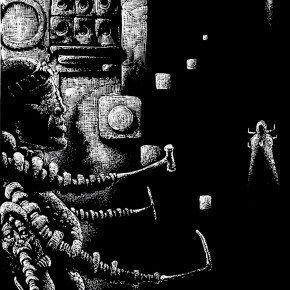
Larry Azoth focuses on drawing, painting, and photography, primarily in the areas of still life and portraits. To learn more about the artist, visit his page on artreview.com.
Tell us a little about the art styles that you use.
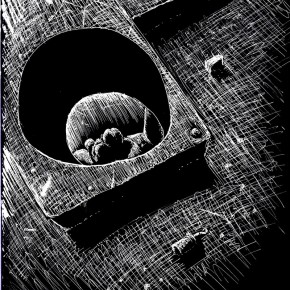
I present bodies, men, characters or mere figures, in states of mutation and landscapes that are similarly altered. In some they emerge from fields of black, others half buried in organic texture. It’s largely about decay and the breakdown of patterns. Aspects of it change all the time, but most trace back to long years of imitating Dali, Giger, or Alex Raymond. Much of my style is determined by working in pen exclusively, making any error a part of the final product.
What are your tools of trade?
Pilot G2 0.38mm, Pilot V-Ball, Sharpe Magnum, Uniball Vision, Gelly Roll gel pen, Photoshop.
Why did you choose these art styles?
Apart from my inspirations, it sort of chose me organically over a long time. I first attempted hatching because of Raymond’s use of it in early Flash Gordon comics. Everything else grew out of long drawing sessions in sketchbooks, often in cars or on buses.
What is your favorite one and why?
My favorite style at the moment is my reversed white on black pictures. For the longest time shadow had no place in my art, now it’s back with a vengeance.
What other art styles would you like to experiment with?
I’ve long wanted to be able to do the sort of thing Aubrey Beardsley did, the very stark and mannered far-out woodcut style. I’ve also long wanted to work more in other media, namely sculpture and film.
What is your favorite art movement and why?
Surrealism, easily. It is the first time art was permitted to explore the depths of the mind without having to depend on religious iconography or illustration as an excuse. Dali introduced me to it and the discoveries of de Chirico, Tanguy, and Ernst sealed my love for the movement. It’s amazing what one can find in a public library.
How can you define in your own word, surrealism?
There are many grandiose definitions for it, but I prefer simply to call it the art of dreams, or the unconscious. There’s more to it than that, but I find the best surrealist art resonates with me on that level, as if I’m visiting the dream of some long dead artist. More than 90% of the art I see I can just shrug and move along, but a de Chirico or Dali painting makes me pause, like something has imperceptibly changed.
Who is your favorite artist and how do you connect with his/her works?
It is a toss-up between Salvador Dali and H.R. Giger. The connection is, by now, historical. I have been admiring their works for roughly 19 years now, most of my life. It began, back then, with a mad and inexplicable excitement when viewing the works of these artists. Part of it has to do with the extreme technical ability of each and that it is used to convey the macabre and surreal. Each had a unique take on the body, on use of space, and each employed a recognizable visual language. I would argue that few artists have brought the viewer so thoroughly into their minds as Dali and Giger. Of course I admire others, for similar reasons: Max Ernst, Beksinski, Tanguy.
What influenced you to become an artist?
I was encouraged to be creative since early childhood, and of course all children draw. My parents owned many books on art history, and these were part of the germ of my interest in art. We visited museums as well, and that helped.
How long have you been an artist?
That really depends on one’s definition of “artist”. If it’s meant professionally, I was first paid for my art in 2008. If it’s meant seriously, I have been since around 1995. If it’s meant simply creating, I have been almost since birth.
How did your family and friends react of you being an artist?
Generally positively. My friends and teachers were always concerned whether I could make a living at it (and I never have yet). My immediate family was more concerned whether I was doing what made me happy. Some of the grandparents were a little cooler about the idea, but that may only be a generational thing.
Where do you get your inspiration from?
Almost everywhere. My dreams and imaginings make up a large part of it, but often too it’s the world and the desire to make fun of it. I spend a lot of time on public transportation and in fast food restaurants, both of which provide kinds of inspiration. I’m also an avid movie watcher, having seen a few thousand of them, so those tend to inspire as well.
What determined you to do collaborations?
Having a younger brother who also draws did. We began collaborating at a young age, probably around the time I finally got used to him.
What can you tell us about your first collaboration?
The first outside of childhood was probably an Exquisite Corpse done with Gromyko Semper 3 years ago. I was fairly disappointed with my end of it.
Can you tell us how collaborations influenced your art?
Since a large part of my art has been collage of one form or another, I tend to collaborate with some artists posthumously. Sometimes it’s like reverse engineering, learning the other artist’s process. I’m always open to another artist’s viewpoint, and a collaboration can be like a meeting of the minds. I don’t know what degree it’s all helped me, but I’m glad for the experience.
Can you tell us how collaborations influenced you?
The early stuff with my brother spoiled me a bit because we never had to communicate much, we pretty much knew what the other would do. In my adult life I find other people need a lot more input and I have trouble with that.
Do you promote/ sell/ showcase your artworks?
Deviant Art is really the only form of promotion I have going. I’ve never had an exhibition or anything like that. Many of my works are available as prints and I am open for commissions.
How the Internet did influence your art?
The internet is what ultimately got me going on really producing art, mostly because before going online I had no audience for it. I went between various sites looking for a good place to put my art, but Deviant Art proved to be the only fit. It was the first time I actually had a receptive creative outlet, so it got me making art consistently. Before DA I made probably, a hundred drawings a year. Since I’ve been on DA I do about 500 drawings a year.
Where can people see your artworks and how can they contact you?
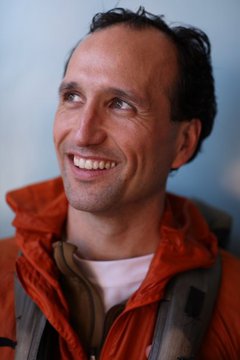
Francis Tapon used to work in Silicon Valley big business before he quit his job to become a travel writer.Francis has hiked the Continental Divide Trail, the Pacific Crest Trail, the Appalachian Trail, and has just finished his second book, called The Hidden Europe: What Eastern Europeans Can Teach Us, which covers history, culture and travel tales from every country in Eastern Europe. He also maintains a website chock-full of blog posts, podcasts, and videos, and is gearing up for a 3-year adventure in Africa.
You have so much content on your website! Including some articles that launched quite a furor…
[Laughing] There are a few articles that are controversial. I felt like this latest book is about what Americans can learn from Eastern Europeans. But of course in the process of writing about that I think about things that Europeans could learn from Americans.
In Eastern Europe, the whole concept that the CIA’s behind everything is a surprisingly prevalent notion. It surprised me when I got to Eastern Europe and all sorts of people said, “Well the CIA did that…” And I’d say, “What? CIA?” I had to explain that the CIA’s not that all knowing.
And the other one is the American smile. We are heavily, heavily criticized for our fake American smile. And I do think that there’s some justification for that but again I felt it’s not nearly as strange as you might think. But to Eastern Europeans, whenever I asked them what they thought about Americans, they mentioned the “fake smile.” Bam, over and over again. It’s a common criticism.
Can you talk about your writing process?
The traditional methodology that people tell you to do is write fast and just get all the ideas down and then edit later. I’m not very good at that. I will sometimes not let a sentence go before starting the next one.
I had two editors who gave me editorial advice—this section is kinda boring, or this needs to be explained better, whatever. But I also had something, what I called Beta readers, just like you Beta test a site. So I basically said, anybody who’s interested can sign up on a distribution list & be a Beta reader. So I would send out chapter by chapter as the book was getting written.
So that’s the best type of crowd-sourcing. The readers benefit because they’re getting a sneak peak at your work and feel like they can have an influence. It benefits me because I’m getting real input. It was super valuable because a lot of my Beta readers were Eastern Europeans, and it was very important for me to have that sanity check, to have them make sure I’m not saying something super offensive, misleading, or inaccurate.
The Hungary chapter, which is the longest chapter in the whole book, is really controversial for Hungarians to stomach. I had a lot of Hungarians read it and it was an eye-opener for them, and it was great because they challenged my thoughts and it refined the chapter. So it ended up being a stronger chapter.
It was all this informal editing that I think made the book better, and made the book, not necessarily well-received by all Eastern Europeans, but at least it was fair.
The tone of Hidden Europe and in some of your blogs is so strongly opinionated at times—did you always have that voice or did it develop over the course of your life?
I think in my 20’s, I was a sponge. And I still am a sponge. But I’ve gotten so much evidence about certain things that I feel confident enough to say okay, this particular issue, I feel strongly enough to say this is the way this is because I’ve heard both sides of the story, I’ve heard it all, I’ve seen so many different angles, and this makes sense.
At the very conclusion of the book [The Hidden Europe], there’s an Answering the Critics’ section. [He reads] “Some may say this book creates and reinforces stereotypes. Some may say, ‘I jumped to a chapter on one country and it sucked.’ Some may say, ‘Who are you to give advice to my country?’ Some may say this book is too basic for sophisticated, knowledgeable Europeans. Some may say this book isn’t scientific.”
So I address each of these at the very end. I know there’s still going to be plenty of people that’ll give me one-star reviews on Amazon and they’re going to say those same things.
But it’s interesting because even though it seems opinionated, and sometimes almost irreverent, it’s objective in an interesting way because you’re laying out every part of your logical process, transparently.
That’s right, and I was thinking recently about the whole idea of balance. In reporting, this whole idea of balance is you want to get both sides of a story, right? And sometimes people confuse balance with truth or confuse balance with reality.
For example, in my book, I sometimes point out the benefits of communism, of how there was security, everybody had a home, everybody had a job, people had social security, they had basic medical care. But there were also all sorts of horrendous problems with communism. Just huge. So in the end, my message is ‘communism sucks.’ It was a flawed system; it had all sorts of negative problems.
I’m sometimes strong on a certain issue—but if you really sit there and you have an open mind, I think it’s defensible. I don’t expect people to agree about everything I say, but I think they should read and say, ‘You know I don’t agree with all your conclusions, but I totally see how you got there.”
I’m gonna get in so much trouble for this book, I just know it! [laughs] I’m just waiting for the nationalists to come crucify me! Like, “You said that about my country?!”
The Hidden Europe offers a ton of history and context while staying entertaining. How do you incorporate historical research into your writing process?
I read a lot. I’m just an information sponge. I’ve never owned a television in my life, but reading is probably my biggest source of facts.
Now for this book, though, I talk about this whole idea of getting history through people. In other words, getting into their brains and saying, for example, You tell me what California history is like. You tell me what American history is like…
There’s an often repeated quote that victors write history. But I think that’s kind of B.S. in some ways because in the end, history lives on in people’s heads, and the victor can write whatever he wants.
I’m curious about what’s the history in people’s brains, capturing the way they see the world. And a lot of times there is a disconnect between what objective historians say. I do want to document what people on the streets say and teach their children. But at the same time, I want the reader to understand when those beliefs venture into fiction.
And it’s a tricky thing. I recognize throughout the whole time that my source may not be entirely objective either, and I may be burdened by my own bias going into it. But still I think I have a competitive advantage in writing this because I’m not Eastern European in any way. I’m a third Chilean, a third French and a third American. In my house we spoke Spanish, I went to French school for 12 years, but I grew up in America.
So as a result, I’m not terribly nationalistic or one-sided about almost anything. I see multiple perspectives all the time. So I think that I can be more objective than the typical person. That doesn’t mean I’m perfect either, so I do my best and just try to explain this is what I believe, these are the facts that I’ve read and they sound more plausible…and then occasionally use something called logic! [Laughs]
I really enjoyed the scene with the Polish man who talked with you for hours about Poland’s history.
Almost everything he said was actually factually correct, so I let him tell the story. But other times, I let people tell the story and then I point out, after or in the middle of the conversation, that they’re incorrect.
What was interesting was it also made me re-evaluate how I see American history or French history, or even Chilean history. You wonder, am I looking at these things fairly and honestly and un-biasedly? So I think it was also helpful for me on a personal level.
So with your earlier mention of the CIA theories in the Balkans, did you trace that to a deeper fear?
I did. Eastern Europeans are quick to believe conspiracy theories because they lived through communism and war. Communism restricted the information flow and an entire generation grew up with the belief that anything the media and the government tells you is a lie. That’s an axiom that they have in their brain, in their DNA, and of course they had good reason to believe that.
Furthermore, they had a double-whammy. Communism was replaced by a war-time situation. So governments always tightly control the media during times of war. Even governments with long traditions of the free press, like the U.S., clamp down on the media during intense wars.
So until the 21st century, Balkanians have always lived in a society of misinformation. The problem is, now that Communism and wars are over, Balkanians haven’t adjusted. They’ve kept the habit of doubting everything and having more confidence in whatever their drunken buddy dreamed up at the BBQ!
Can we step back and talk about your time in college & graduate school? Can you talk about why you chose to major in religion for your undergraduate degree?
I thought it was the most important question we can ask ourselves—in other words, is there a supernatural force, power, God? And if so, of all these different religions, is there one of them that is tuned into the right frequency? I came in as a Christian but I had an open mind, and so as a result, I studied Islam, Buddhism, Sufism, Taoism, and Confucianism. And the more I studied the more I saw of course the common bonds religions have between themselves, but I also found inconsistencies, things that didn’t really make sense or I didn’t agree with.
And then you moved to Harvard Business School. When you were sitting in class, did your comments, as a religion-major, differ from those of, say, economics majors?
In business school, especially in the first year, I had the reputation of being kind of a goofball. I was one of the only people in the whole class who didn’t have a study group. Everybody was quite paranoid about passing and getting good grades, and I just didn’t worry about it at all. My grades were just average, but I was hoping to be average. I just wanted to graduate and I’m happy.
It was a great experience. The best thing about it was the people you meet—from all over the world, twenty-five percent of people were foreigners. I’m a big believer that: surround yourself with people who bring you up, not bring you down. That give you energy as opposed to take your energy. And I think that’s one of the benefits of HBS [Harvard Business School] is that people really have this positive influence.
And here’s the other thing I remember is that business school is about relationships. Ultimately it’s about interpersonal relationships and walking out of school with a bunch of connections. There you could potentially argue about the fake American smile! [Laughs] People just wanting to be friends and network. I think it’s less competitive than medical school, than law school, than engineering school—it’s more about the relationships than anything.
So then you graduate and start working with major tech companies in California, but ultimately choose to leave that career for long-distance hikes across the U.S. You were hiking thousands of miles, sometimes alone. What do you think about when you’re walking for such an incredibly long period of time?
I think when you walk for a long time, your mind eventually gets into a rhythm-like, meditative state. Eventually it’s all mechanical so your brain gets fired up—not having to think about the laborious uphill climb or the bear attacking me, or the where to go on the map. Eventually you get into a groove, and so once you’ve walked for a few weeks, all of a sudden the issues disappear. You have a serenity in your brain that allows you to contemplate your life, the world, the universe, just everything in a way that I think is hard especially in the modern life of people who life in cities. With the internet, cell phones, it’s really hard to get that kind of time out.
Even on the Appalachian Trail today it’s different than when I did it ten years ago. I think there’s a lot more people using smart phones and tweeting along the way and keeping connected. I didn’t have a cell phone on any of my long hikes. So I was truly disconnected on the Continental Divide Trail. I went 2,000 miles without seeing one backpacker. It’s incredible. The whole state of New Mexico, 700 miles, I saw one guy with a dog, out for a day hike.
But you’ve also done some trips with a partner. Which do you prefer?
Having done both, I would say I enjoyed my experiences more when I was with someone. When I was traveling through Eastern Europe for three years, I was alone most of the time, but people were always around, so I would have the interaction. So it’s better to have a travel partner, but when you’re going to touristy places, outside the wilderness, the downside is that you’re less likely to interact with locals. If you and I are on the bus together, we’re gonna talk to each other. But if I’m by myself, I’m gonna look at my neighbor and start talking to him.
But overall anyway, to answer your question, it’s better to be with somebody. I don’t want to do Africa alone, that’s for sure. I will postpone my journey until I find someone who’s appropriate who’d want to go on that trip.
How will you find someone that wants to leave for Africa for 3 years? I suppose there are tons of adventurous people in the Bay Area.
All over the world, actually. But there are two levels of adventurous people. There’s adventurous and then there’s really adventurous. A lot of people say, ‘Oh I wanna travel the world,’ but then all of a sudden, when they’re faced with the reality of it, they kind of shy away. But I think as I publicize the event and plan more, more people will become aware who have serious wanderlust.
But every single time I go on a long trip—whether it’s every time I’ve walked across America, those two times I walked across Spain, or five months in Eastern Europe and then later three years in Eastern Europe—every single one of those journeys just…it changes you in some way.
For me at least, it feels like, wow, I’m really living, I’m alive! Yeah a little of it’s adrenaline but it’s just fulfilling and feels like your life has so much more meaning. You’re beyond the drudgery, beyond the kind of routine-ness that so many people have, just kind of living their programmed existence— and then all of a sudden you’re really engaged with the world, you understand the environment and it changes your perspective.
And then of course, the worst thing is you become addicted to it! (Laughs) But it’s the first leap, I think, for many people—the first initial one that seems so scary.
Do you think people get afraid that if they leave they’re giving everything up?
Of course! A lot people say, “Francis, don’t you get homesick when you’re traveling?” and I say, “No. I’m carrying home inside me.” In other words, I feel comfortable anywhere, any place, it doesn’t matter whether I’m sleeping outside or in a nice hotel, or in some strange country where I don’t even speak the language. Anything that’s important you’re taking it with you.
It’s incredible, these days we’re just completely spoiled. You can replace the physical stuff, but relationships you can actually maintain a decent amount. Free video chats, social networks, and email allow us to not completely abandon our friendships. Never before had travelers had such an ability to stay connected with their friends back home. Technology allows us to give up less than travelers in the past.
So you’re not giving up much. It’s also about what you gain. You can focus on what you lose but then you don’t think about all you’re gaining. And to me the net-net is no contest.
Synchronized Chaos Magazine – April 2012: Heavy (so to speak)
This month’s issue is loaded with poetry, artwork, timely articles, reviews, and more!
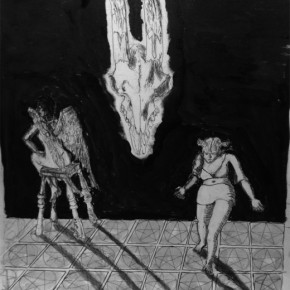
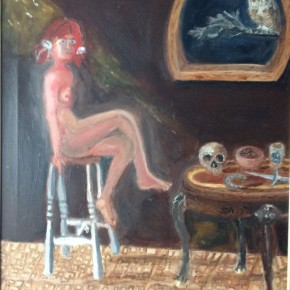
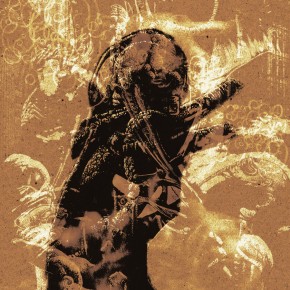
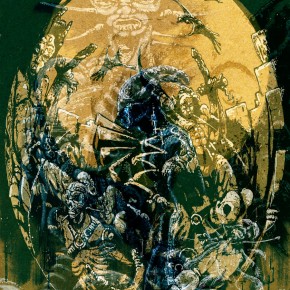
James Pollard’s dark and figurative artwork is appreciably mysterious.
The heat intensifies in Linda Allen’s descriptive poem: Just Another Day in the Life in Oklahoma.
In Heavy Red, Neil Ellman interprets the weight of the universe.
The world is full of poets, but are poets creating more “good” poetry or “bad” poetry, and where is the inspiration anymore? Check out the work of Janine Canan.
Additional poetry this month comes from returning-favorites Sam Burks and Dave Douglas. And returning neuroscience columnist Leena Prasad explores the underlying physical and cognitive bases for empathy and understanding in her piece, Whose Brain Is It.
We are also happy to feature writing from Monty J. Heying. Heying’s Birthday Cake and Baby Teeth is a highly autobiographical story based on his years in a Texas orphanage.
In interviews…
* George Teseleanu interviewed Surrealist Illustrator Marc Gosselin. This artwork is a must-see!
* Jaylan Salah interviewed Laura Weinbach of Foxtails Brigade. Weinbach started Foxtails Brigade in 2006 with Sivan Sadeh. Their third album was released last December.
In performance reviews…
* Christopher Bernard reviewed Tontlawald, at the Cutting Ball Theater in San Francisco, California, and also Voices of Light, at UC Berkeley’s Zellerbach Theater in Berkeley, California
* Jessica A. Sims reviewed The Abduction From the Seraglio (Yanked from the Harem – Mozart), presented by Pocket Opera
* Bruce Roberts reviewed Ken Ludwig’s Moon Over Buffalo, at Chanticleers Community Theater in Castro Valley, California.
For you Foodies, you’ll definitely want to check out Roberts’ other article on Seattle’s newest pub and restaurant: The Pine Box. The Pine Box officially opened on March 26th in Seattle Washington’s “Capitol Hill” neighborhood and offers a menu that focuses primarily on gourmet pizza, and of course, beer.
In other science-related interests, Suzanne Birrell reviewed a recent lecture on the topic of aging. The lecture was hosted by the Northern California Science Writers Association (NCSWA) and was given by Professor Tom Rando, MD, PhD, on March 21, 2012, at The Basque Cultural Center in San Francisco, California.
We hope you enjoy this month’s issue of Synchronized Chaos Magazine! As always, feel free to leave comments for the contributors and if you’re interested in submitting to the magazine, send your work to synchchaos@gmail.com.