The first time I realized that my Dad is a little bit racist, I was seventeen. That might seem like a relatively old age to reach that realization at, especially since all of those years were spent living with him, but all of those years were also spent with a mother who was ever vigilant in shushing Dad if he so much as grumbled something derogatory towards an ethnic group while within my earshot. I grew up a sheltered only child, even kept in the dark about Dad’s skin cancer until I noticed the skin grafts and asked about them in the 12th grade.
That evening, I had somehow become trapped on the sofa, caught between my parents and their questions – or rather, Mom’s questions and Dad’s attention – concerning my date to the senior prom.
“What’s his name?” Mom asked. “How old is he?”
I stared at the television screen and tried not to sound exasperated.
“I’m going with Brandon. He’s a sophomore.”
“Does he like you?”
“No, Mom! You know Brandon, he’s the kid Ashley and I befriended last year. We’re joking that we’ll both walk through Lead Out with him since Ashley doesn’t have a date.”
“Do you like him?”
“We’re going as friends. No, I do not. And I’ve told you all of this already, twice,” I pointed out, though I knew what she was doing. I didn’t feel very comfortable telling Dad about any plans involving boys, even boys who were friends; his responses were always grunts of varying lengths and I could see the mental inventory of his hunting arsenal going on behind the blue eyes. She was drawing out information for his benefit.
Hale Thatcher’s collected book of poems (1962-2008), including one verse play in five acts entitled Caves takes on the seemingly limitless inquiry of the natural center in each of us. At times the poems are self-dramatized and flourishing grand claims about our mythic states and new beings, but his poetic genius rests in the conversations he forms with the loud natural environment. Two words that one might use to categorize this collection: “nature poetry” undeniably stirs up a tradition of political sentiment, and throughout this collection, Thatcher does not fail in that perspective. He uses natural landscape not only as a backdrop for his writing, but as a character to develop the politics of his poetry. Oftentimes we hear the folk-like, prophetic voice given to the mountains, trees, and plants and there is no lack of heavy and obscure mystery like the one we find closing the poem “Stillness”
Vast calm envelop the stars.
Silence and calm are shields
for power resting in the deep.
This language becomes frequent, repetitive and the collection as a whole is colored by an intense, verbose and sadly, usual love of nature. Thatcher’s freak-flag flying and relentless style is bound to such rich and grand verse that page after page, a certain numbness overcomes the energy in the language. Though, on occasion, there are moments of restraint which give sharpness to this nature poet’s lyrical bathing. The poem ”The Eighth Day,” does this, approaching both elements of a candid personality and mythic questioning that dodge in and out of Music Crystals:
David Perez speaks on a wide range of prescient topics in his poetry collection aptly titled Love in a Time of Robot Apocalypse. No subject is immune to being encapsulated in a poetic plea, observation or rumination. Poems titled, “Contraband,” “Watching Fallen Bridges,” To the Lady Who Carves a Notch in Her M-16 for Every Robot She Leaves Charred and Perforated in the Ruins of Los Angeles,” and “To My Zombie Killing Ex-Boyfriend: A Break-up Letter,” piqued my interest immediately. The poems in this book are edgy, fresh and contemporary.
Perez eloquently mixes black humor, vivid imagery and existential crises inside stories with their own inside stories. Particularly poignant is “Deep Blue,” a complex poem about a competition between World Champion Grandmaster Garry Kasparov and a computer by the name of Deep Blue. “You may want to pray/to the malfunctioning synapse/that makes you believe in a God/that I never develop a taste/for self-preservation,” says the computer as he outwits Kasparov. The poem delineates each chess move as robot and human perform a dance where machine battles human nature.
Kyrsten Bean is a Staff Writer for Synchronized Chaos. She may be reached at kyrstenb@gmail.com.
May’s issue of Synchronized Chaos Magazine features a wide variety of creative talent, from free-flowing poetry by David Cicerone and Dave Douglas, to dramatic and highly imaginative children’s book illustrations by Elena Caravela. In this case, Energy in Imagination is intended to denote a vibrant spirit, boldness, and even uncertainty.
We are excited to publish the poetry of 2 new SynchChaos contributors: Stephen Labovsky and Jessi Finn. Their work is naturally curious and relatable as they present several descriptive pictures for the reader.
Check out the spiritual writing from returning contributor, Blanca E. Jones. Jones was inspired to write this piece after reading bible scripture, Matthew 26:67-68.
Book reviews this month include:
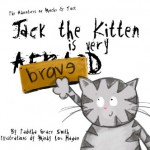
J’Rie B. Elliott on Jack the Kitten is Very Brave, a children’s book by Tabitha Smith, illustrated by Mindy Lou Hagan
Bruce Roberts on In the Time of the Butterflies, by Julia Alvarez
Kyrsten Bean on In The Spirit of We’Moon – Celebrating 30 Years – An Anthology of We’Moon Art and Writing, from Founding Editor, Musawa (and other writers)
Nicole Arocho on The Rhyme of the Ag-ed Mariness, by Lynn Lonidier
In tech news, Bart S. Alvara recaps Metaio’s corporate mixer held on March 27, 2011, in San Francisco, CA. Metaio is a growing leader in the fascinating field of visual recognition software.
Thank you for reading this month’s issue. Enjoy the last few weeks of spring and have a great Cinco De Mayo, Mother’s Day, and Memorial Day!
If the word ‘adorable’ was looked up in the dictionary, it would have a picture of Jack the pirate kitten as a definition. The children’s book, Jack the Kitten is Very Brave, written by Tabitha Smith and illustrated by Mindy Lou Hagan is a winner. The story begins with a small tabby kitten named Jack who longs to be a brave and fierce pirate. His only problem is his distinct fear of the water. How can Jack be a brave pirate and be scared of the water? His brother Machu loves the water and his brother too and while taking a bath decides to end his brother’s fear. This is a wonderful tale of courage, brotherly love and how to overcome what ever fears you are facing.
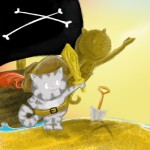
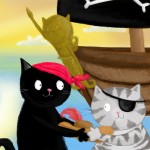
The illustrations in the book are ‘spot on’. They are detailed and colorful with a childish flair that makes children want to read the story to go along with the pictures. One picture that I found to be cleverly done is a reflection picture in the middle of the story. The reflection in the rippling water is beautiful even from an adult standpoint.
I was asked to review this book, and eagerly accepted the task. However I did not feel completely qualified to review it alone as I have not been a child for years. This being the case I shanghaied some of the intended audience to assist me in this endeavor; my own son and daughter. I gave them Jack the Kitten is Very Brave before they retired for bed and let them read it; without telling them any details or reasons why. The next day I asked “What did you think of the story?” My son–whom we call ’Professor’– began to tell me the story and how he liked the details of the illustrations within the book. He liked how the letters changed colors–half white, half black–when printed across a pirate flag. After my son’s explanation I turned to my daughter, who told me the story–again in amazing detail–and then asked me a question of her own, “Can I keep it?” From other children this may not sound like much, but she changes library books weekly and rarely wants to keep a book after she is finished with it. I asked her why she wanted this particular book. Her answer spoke volumes, “I liked it.”
The reviewer, J’Rie B. Elliott, may be reached at dixiepoet@gmail.com. Please see the below links to purchase the book.
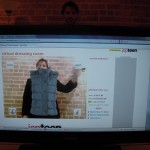
On Thursday March 27th, a bold new vision of the future was being unveiled at the staff offices at Metaio. While music played and drinks were shared visitors to the San Francisco outlet of the independent company were captivated by a new visual recognition software that may change how we view reality.
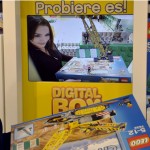
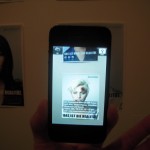
Augmented Reality combines the real and the visual world in real time 3D placing the viewer in the center of an interactive digital world. In non tech-genius speak, a camera is programmed to look only for a certain image, when this image is recognized, a stored illustration is activated and the display reflects that overlapping illustration on screen. Or as the staff at Metaio can state better, “we connect any object to additional, digital information. Our vision is the seamless and easy integration of the virtual into the real world.” Essentially it’s a private green screen, like a movie special effects studio, that can be run from an something as small as a cell phone.
While that might be hard to understand, the applications are not. Imagine if your cell phone could simply look at a product and suddenly on screen all the information relating to it popped. Or your cell phone could display whose trending on twitter or Facebook in your immediate area. This digital interactive advertising was once thought up only in sci-fi movies, yet with the technology provided by Metaio, it may become the standard for the 21st century.