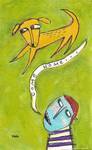
Suckerpunch What I want is your fire;
your glorious suckerpunch kisses;
and your ardent pumpjumping spirit,
standing five feet tall
Acid-wash skinny jeans
with zippyrip tatters
and spikey whiteblond hair
poured from a 500 ml bottle of transformation
with carmine beestung lips
Give me your suckerpunch kisses,
deepily deep and up and down and around
and all over again, till we wear out, you and me
You’re magical, so magical
I just wish I knew your name
and not just your face.
Boanerges
I call you Boanerges
Son of Thunder, six feet tall
Magnificent temper, crackling wit
You stand there, ordering macchiatos and lattes
(and two biscotti, I won’t forget)
Even then, you are thunderous, magnificent
(even when you’re asking for sugar)
Boanerges, Son of Thunder
If only I knew what to call you, but Boanerges.
Both pieces from Finn Gardiner, a San Francisco-based poet, writer, scholar, science lover, philosopher, and human rights activist who may be reached at sodalitas.paludis@googlemail.com
Mnemosyne, give me succour;
the present and its impulsions haunt me;
and your voice is my only friend.
Your whispers are my shelter;
your speeches my hearth;
your visions my hiding-place.
Mother Mnemosyne,
look after me; shield me from Today;
give me this day Yesterday’s truth,
and I will overlook the transgressions of the Present.
~*~
Mnemosyne, spare me;
spare me your hushed admonitions in my mind’s ear;
spare me your exhortations, your proddings and pokings;
you are air to me; invisibly cool on my tongue;
forever present; you envelop me;
I would I could escape you;
but you surround me, like a cage fashioned
of air and spirit and mystery.
Abandon your cruelties; return to me with your goldwoven tales.
— Finn Gardiner, artist, writer, science lover, scholar and human rights activist in San Francisco, California. He may be reached at sodalitas.paludis@googlemail.com
My quirky, naive style is intentionally childlike, alphabet blocks spell out heart breaking messages and words packed with emotional heat are scrawled in brightly painted backgrounds. Our relationships with one another, and with the world around us are put under the microscope and seen through a most simple eye, see here, this is who I am.
About Me
I’m a people watcher, a curious observer of life. I keep a small sketchbook with me to quickly capture my observations; usually things around me that I find funny, awkward or beautiful. I also explore the angry thoughts & absurd ideas that occur to all of us, in the privacy of our own mind. I then take my drawings and translate them into small works in acrylic and ink on heavy watercolor paper. I use both hands to draw and paint with; drawing with my left gives my work a loose feeling that’s difficult to achieve with my right hand. Because color and texture are integral to my work I start by under-painting and create by using multiple layers of jewel tone color combined with matte medium and ink. I intentionally work small because I think it captures the intimacy of the moment that I’m presenting with each piece.I also work in clay and mosaic, creating all the tiles used by hand. As far as influence I draw on elements of folk art, outsider art & children’s work. Stylistically, I aim for a cartoon-like innocence injected with a small dose of irony. While I hope people find humor in my work, or find in it something that they can personally relate to, what I’m really trying to convey is raw emotion: love, hate, joy, regret, revenge, despair, failure, rejection, but mostly hope.I went to art school & studied drawing & painting quite a few years ago. I’ve been painting for many years, but lately have committed myself to a life of just making art.I also work as a muralist and mosaic artist & have done many public works, primarily on school sites.
Keith Farrell has a Bachelors’ Degree in Architecture from the University of Southern California.
He is an active ARE candidate with the NCARB (National Council Architects Registration Board.)
Following his graduation from USC in 93′, Keith worked as an apprentice carpenter in Southern California. In 95′ Keith joined the Peace Corps in Paraguay, where he designed and administered several running water and sanitation related projects for the communities that he was assigned to. Subsequent to his role in the Peace Corps, Keith worked in Ciudad del Este and Asuncion, Paraguay contributing to the design of high rise as well as single family residential buildings through the construction of hand made architectural models for both study and presentation. For two years, Keith also served as an instructor at the Universidad Catolica in Asuncion establishing curriculum for classes in architectural modeling and furniture prototype design. In 2000, Keith moved to the bay area where he has worked for several firms in the following disciplines: semiconductor clean-room laboratories, residential, corporate office, retail, and hospitality.
Keith Farrell may be reached at sixsixfour@hotmail.com
Journey through Darkness keeps readers glancing over their shoulders, ready to crouch and duck along with the characters at the sign of any oncoming threat. Breakout author Kandake Brockington envisions this fast-paced saga as the first in an epic series inspired by ancient African tribal cultures. Although the characters and plotline stem from Brockington’s imagination, the food, clothing, climate, weaponry, and many other details reflect extensive research and draw upon what historians know of actual people groups of the time, such as the Egyptians and Sumerians. The writer packs a wealth of description and anthropology into her short sentences, building several unique, rich worlds without slowing down the tale.
The rapid action within this novel does not interfere with character development, and several complex individuals soon burst from the pages. Right away, Azende and his female cousin Saiyasha attract our sympathy, as their elephant escapes carrying the last of their food and water supply. The last of the Tamrin tribe, they search the desert for military backup, hoping to wrest their homeland back from a brutal empire. Eventually, while grappling with bandits and wild animals, they encounter Joval, a defiant, restless female general, who attacks them to assess their origins and capabilities. Through multiple, alternating points of view, we can see both how the underdog cousins view themselves, and how they come across to Joval’s warlike Medjays.
While several people’s injuries heal, Joval reluctantly invites the Tamrin pair in to discuss an alliance. The general relates her past exploits, sharing how three years ago she bonded with Kemet’s Crown Prince Tefenon as she and her fellow Medjay mercenaries guarded him and his new bride Avaris home through a wilderness of human, natural, and supernatural adversaries. Kemet, however, had become unstable after decades of misrule and rebellion, and Tefenon and others found themselves forced to make difficult and dangerous choices about how to respond and survive.
Shifting perspectives add richness throughout the novel, bringing the diverse characters and kingdoms into three-dimensional relief. Each of Journey through Darkness’ characters, including the servants, concubines, scribes, goddesses, and demons, seems to have his or her own desire and personal quest. Even ‘wallpaper characters’ attending to scrolls in countryside temples or carrying water home from the well seek to avenge themselves on old enemies or overthrow rivals for their hero’s love. And Brockington pays sensitive attention to women’s struggles in male-dominated, violent societies. We read of the Princess left out of policy discussions and forced to marry a foreigner for diplomatic purposes, the Queen afraid of losing her sons in battle, the courtesan hoping for a marriage that will ensure her economic survival, the common female traveler worried for her safety.
No one remains safe for long within these changeable societies, where any stranger could be a potential murderer or traitor, and where one may have to assassinate one’s relatives or former best friends in order to stay alive. Characters seek protection and ultimately immortality through devotion and sacrifice to a pantheon of divinities and supernatural beings, who often seem just as jealous and fickle as the mortals they offer to shield. Through the character of the Kemetite Pharaoh Apophis, the novel suggests that dedicating oneself solely to one’s own legacy and survival can become an obsession with destructive consequences for oneself and others. Other characters, including General Joval and the Queen Mother, suffer because of death-related fears: moral judgement in the afterlife, or the loss of loved ones. Perhaps, as vulnerable and imperfect creatures, we need to come to terms with change and mortality and hold onto what we love with a looser hand.
It is a little unclear how Joval can narrate three years of history, which takes place over hundreds of miles and through many secret consultations, in such a comprehensive and objective manner. Her personal account inexplicably becomes third-person omniscient, and we nearly forget about Azende and Saiyasha as the General launches into what becomes practically a whole separate novel. The novel’s large midsection offers spectacular storytelling, yet loses some cohesiveness as the new narrator takes us to vastly different places and times without giving any nod to the present day until the very end. It seems unlikely that the cousins could safely sit still long enough to hear that much of the story of Tefenon, Joval, Medja, Kemet, and Kush by the campfire, or that Joval would have the time to relate that much information in only one night.
Journey through Darkness does leave both its main story, and General Joval’s story-within-a-story, consciously unfinished, and readers will close the book intrigued and still curious. One of Brockington’s stated purposes in creating this series is to give African cultures their own historical epic, with the force and grandeur of the Iliad or the Kalevala. With this novel as her beginning, she seems likely to succeed.
Kandake E. Brockington was born in Oakland, California. She is an author, artist, and musician. She is expected to complete degrees in English: Career Writing and Anthropology: Archaeology at San Jose State University by 2010. She lives with her husband, toddler daughter, and two cats in San Jose, California. She was nine-years-old when she wrote her first short story and has been writing ever since. She has always had a fascination with mythology and ancient cultures. Her particular areas of interest are ancient Egypt, Nubia, and Greece. It has been her lifelong dream to become a professional author. Journey through Darkness: Book I of the Journey Saga will be her first published novel.
Journey through Darkness is self-published, and available through many mainstream online retailers as a paperback and digital book. More information, the author’s blog, an original soundtrack created for the novel, updates on future books in the series, and an art and writing community geared towards the joint promotion of self-published works, can be found at the website: http://www.journeysaga.com/
These art pieces are original works created by Linda Lee Smith, a mother, musician, Christian worship leader, and greeting-card and mixed media artist in California. Linda Lee-Smith has been creating art for over ten years and delivers her pieces free to many less-fortunate people.
Linda is serving a 15-year to life sentence in California state prison for failing to stop her then-boyfriend, David Foster, from beating her two-year old daughter Amy to death. Linda rushed Amy to the hospital, but she was unable to save Amy’s life. Ms. Smith’s daughter, Bethany, the only third-party eyewitness to this horrible crime, has testified at Linda’s numerous parole hearings that Linda did not participate in the beating, but rather was guilty of failing to stop Foster’s abuse. Foster had a violent, criminal background, and he abused Linda both physically and psychologically when they were living together. He was convicted of murdering Amy and remains incarcerated. Amy’s death was and will always remain a tragic event in Linda’s life. Linda still mourns the death of this dear child, and wishes she had intervened more forcefully and soon enough to make a difference.
Linda has met and exceeded all Board requirements for parole. She has remained disciplinary-free during her entire 30 years in prison, she has earned a BS degree in Psychology and is currently working towards her Master of Theology through Fuller Theological Seminary. She has been part of the prison Ministry Team for 28 years, and works as a peer helper, teacher and minister in the Mental Health Department for troubled women in the prison.
You may write to Linda at this address:
Linda Lee Smith, W-15143
CIW Miller-A 50-U
16756 Chino-Corona Road
Corona, CA 92880-9508
There is also a website set up to advocate for Linda’s release from prison, which provides some more biographical information, news updates, and pictures: http://www.lindaleesmith.net/
The earliest date for the first Cambodian King Jayavarman 1 was 657CE. His was a peaceful kingdom that lasted about thirty years. His fall during the eighth century split Cambodia. During this time period the Kmer kings saw an increase of power. These included territories of Funan. The major Hindu sects of India coexisted in Cambodia.This includes Shaivite and Vaishnava sects. These would play important parts during the Angkor period. Also important was the cult of Harahari, a form of Shiva and Vishnu combined. There was very little trace of Buddhism in this period. As to social structure maternal descent was of key importance.
After the year 706 Cambodia split into two. This occurred with the fall of Funan and the early Kingships of Chenla. Chenla then split into two parts: Land Chenla and Water Chenla. The apparent cause of this was the death of Jayavarman 1 who did not leave a male heir. Little is known about the two Chenlas.
During the eighth century Land Chenla sent out several embassies to China.Meanwhile at Water Chenla various monuments to Mahayana Buddhism were constructed.
— Reuben Rutledge, author, philosopher, photographer, and doctoral student from the San Francisco Bay Area. He may be reached at rutledreub@aol.com