A second-year student in the Astronomy program at Termiz State University
Annotation:
This article explores the internal structure of Saturn, the second-largest planet in the Solar System. It examines the composition and characteristics of its core, metallic hydrogen layer, molecular hydrogen envelope, and atmospheric features. Special attention is given to the processes influencing Saturn’s internal heat, magnetic field, and rotation. The study also discusses current scientific models and data obtained from space missions, which contribute to a deeper understanding of the planet’s formation and evolution
Kalid so’z:
Keywords: Saturn, internal structure, core composition, metallic hydrogen, planetary science, gas giants, atmosphere, magnetic field.
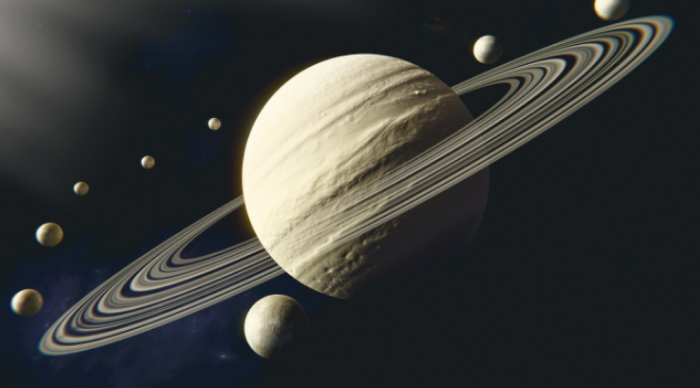
The Internal Structure of Saturn
Saturn is the second-largest planet in the Solar System, with a diameter of approximately 120,536 km and a mass about 95 times that of Earth. It belongs to the class of gas giants.
1. Core
Saturn is believed to have a solid core at its center.
Estimated diameter: around 25,000 km.
Composition: iron, nickel, oxygen, silicates, and ice mixtures.
Estimated temperature: ~11,700 °C.
2. Metallic Hydrogen Layer
Located above the core.
Under extreme pressure and temperature, hydrogen takes on a metallic form. The planet’s strong magnetic field is generated by movements within this layer.
3. Molecular Hydrogen Layer
Composed mainly of molecular hydrogen mixed with helium.
Temperature increases with depth.
4. Atmosphere
Main composition: 96% hydrogen, 3% helium, with traces of methane, ammonia, and other gases.
Cloud layers are divided into three main zones from top to bottom:
Ammonia ice clouds Ammonium hydrosulfide clouds
Water ice clouds
5. Heat Source
Saturn emits about 2.5 times more heat than it receives from the Sun.
This is due to the Kelvin–Helmholtz process (gravitational compression) and helium rain.
6. Research
Voyager 1 and Voyager 2 (1979–1981) provided the first comprehensive data about Saturn.
Cassini–Huygens (2004–2017) gathered highly detailed information about Saturn, its rings, and moons.
Saturn or Zuhal (Arabic) — one of the nine major planets of the Solar System; the sixth planet from the Sun in terms of distance. Its astronomical symbol is ♄. The average distance from the Sun is 9.58 astronomical units (1,429.3 million km). In terms of size, it ranks second after Jupiter. Due to its orbital eccentricity of 0.056, this distance decreases at perihelion and increases at aphelion. Saturn completes one full revolution around the Sun in 29 years and 167 days. Its rotation period at the equator is 10 hours 14.5 minutes, increasing toward the poles, as on Jupiter. Saturn’s average radius is 58,000 km, and at the equator it is close to 60,000 km. Its density is 0.72 g/cm³ (about 0.13 of Earth’s density), and its mass is 5.681 × 10²⁷ g (95.28 times that of Earth). It is composed mainly of hydrogen and helium. The inclination of Saturn’s equator to its orbital plane is 26°45′. Elongated dark belts along the equator and white spots can be observed on its surface.
Spectroscopic studies have shown that Saturn’s atmosphere is mainly composed of hydrogen (H₂) and methane (CH₄); later, acetylene (C₂H₂) and ethane (C₂H₆) were also discovered. Infrared observations indicate a temperature of about 95 K. Saturn emits regular radio waves and has its own magnetic field. Even at such low temperatures, methane and ammonia remain in a gaseous state in its atmosphere. Saturn was first observed by Galileo in 1610.
Saturn’s most remarkable feature is its ring system, which lies in the plane of its equator. The rings are mainly composed of three distinct concentric parts: the innermost S ring, the middle V ring, and the outer A ring. All rings are almost transparent, allowing the stars behind them to be seen. The gap between the A and V rings is called the Cassini Division. The rings are a few kilometers thick, have a diameter of about 250,000 km, and are roughly 100 million years old. As early as the beginning of the 20th century, it was established that the rings are not solid, but consist of numerous solid particles orbiting Saturn according to Kepler’s laws. Their infrared spectra are very similar to those of ice and frost.
Saturn has 22 known natural satellites. The largest among them are Mimas, Enceladus, Tethys, Dione, Rhea, Titan, Hyperion, Iapetus, Phoebe, and Janus. Titan, with a diameter of 4,850 km, is one of the largest satellites in the Solar System (larger than the Moon). Titan possesses an atmosphere composed of methane and hydrogen. Of Saturn’s moons, only Phoebe moves in a retrograde orbit relative to the others.
Saturn is the sixth planet from the Sun and the second largest in the Solar System. Along with Jupiter, Uranus, and Neptune, it belongs to the class of gas giants. It is named after the ancient Roman god Saturnus (Unicode: ♄).
Saturn is composed mainly of hydrogen, with small amounts of helium and other elements. The region near its core consists of rock and ice, surrounded by metallic hydrogen. Its outer atmosphere is generally uniform in appearance, although persistent storms sometimes occur. Winds on Saturn can reach speeds of up to 1,800 km/h, which is much faster than those on Jupiter. Saturn has a magnetosphere weaker than Earth’s but stronger than Jupiter’s.
Saturn is famous for its rings, which are made primarily of ice particles mixed with dust. Many moons orbit the planet — about sixty are currently known. Titan, Saturn’s largest moon and the second largest in the Solar System (after Ganymede), is larger than Mercury and is the only natural satellite in the Solar System known to have a dense atmosphere.
Foydalanilgan adabiyotlar:
1. Mamadazimov, M., and A. B. Narbayev. “An e-learning guide for students of the 11th grade of secondary education and secondary special, vocational education institutions.” (2018).
2. Bahramovich N. A. STRUCTURE AND DIDACTICAL POSSIBILITIES OF THE ELECTRONIC TRAINING MANUAL ON ASTRONOMY DEVELOPED FOR PUPILS OF THE 11TH GRADES OF SECONDARY SCHOOLS BASED ON MEDIA EDUCATION //Archive of Conferences. – 2020. – Т. 5. – №. 1. – С. 40-42.
3. Narbaev A. B. Advantages of using media technology in astronomy teaching //Journal of Innovations in Pedagogy and Psychology. – №. 2. 4. Narbaev A. B. METHODS OF USING MEDIA EDUCATION AND TELECOMMUNICATION TECHNOLOGIES IN TEACHING THE TOPIC” VISUAL MOTION OF THE SUN AND STARS” //Central Asian Problems of Modern Science and Education. – 2020. – Т. 2020. – №. 1. – С. 119-125.
4. Ksanfomaliti L. V., Planeti otkritie zanovo, M., 1978; Kulikovskiy P. G., Spravochnik lyubitelya astronomii, M., 1971; Silkin B.I., V mire mnojestva lun, M., 1982; Mamatazimov M., Quyosh sistemasi haqida ocherklar, T., 1984
J.J. Campbell (1976 – ?) is old enough to know better. He’s been widely published over the years, most recently at The Beatnik Cowboy, The Rye Whiskey Review, Disturb the Universe Magazine, Misfit Magazine and Mad Swirl. You can find him most days betting pennies on baseball and soccer, while taking care of his disabled mother. He still has a blog, but rarely has the time to write on it. (https://evildelights.blogspot.com)
Each person has their own favorite season. For example, my favorite season is autumn. Some people choose spring or winter, summer. Psychologists say that a person’s character chooses these seasons. Each season has its own charm and beauty, we see this beauty every 3 months because at that time the seasons change. During the change of seasons, weather changes can be a little difficult for a person, but you need to enjoy these processes, see and feel them. The change of 4 seasons during the year directly causes astronomical phenomena. For example: the movement of the earth around the sun, the tilt of the earth’s axis is one of the main factors. These four seasons bring about different phenomena.
Keywords:
Nature, change of seasons, years, weather, people, astronomical, earth’s axis, beauty, lush green, similarity.
Introduction:
As I mentioned at the beginning of my speech, these seasons that show everyone’s character, there is a season that shows my character too, this season is autumn. I like autumn because autumn reflects the happy and sad states of people. Autumn attracts with its golden leaves. Autumn neither expresses happy nor sad moments. The weather in autumn is changeable, cloudy, rainy, sunny, and sometimes even cloudy. There is another season that is similar to autumn, this is spring. In spring, the same events occur as in autumn. Spring is the opposite of autumn, while autumn shows joy and sadness, while spring often shows joyful times. Spring is the favorite season of many people. The reawakening of trees in spring makes people feel as if they are full of strength and energy.
Main part:
At the beginning of my speech, I talked about two seasons that are similar to each other. Now, after spring, we will talk about the season that brings with it heat and heat. After these words, it will be clear which season is coming, it is summer. In the heat and heat of summer, most people go to the mountains and fields to relax. Because only there can they enjoy the cool heat of summer. Another season that gives the opposite of summer is winter. If it gives bitter cold in winter, it gives hot heat in summer. Winter is also a very beautiful season. Winter has its own special charm. It is a great joy to see the trees turn a white, miraculous color in winter.
Conclusion:
Each season has its own special recipes. You just need to see these four seasons appear one after another and enjoy them. All these words are the miraculous change of seasons in the weather.
References:
1. Erkin Vohidov – Spring has come, questioning you.
The natural world becomes less natural when We leave behind our plastic past When we throw inorganic debris into its sea When we secretly dump our toxic waste in reprehensible haste When impervious politicians push back against laws To keep our flawless green spaces green and clean When we stump on the seeds of the earth by cutting down trees To make more room for the gentrification of our open spaces To the dehumanization and exclusion of “other” races The natural world becomes less natural when We don’t ardently squawk our exhortations against unnatural offences It will be more natural when it finally dawns on us that WE WILL ALL SUFFER THE CONSEQUENCES!!!
Natural Haikus
Opened eyes see cloudy skies Summer rain will fall down to earth Gives rise to the rose…
Sun shines behind shady clouds Naked trees do a grotesques winter dance Waiting for clouds to fall
Birds waggle in their nests Spring gives rise to fools for love Happily flipping off the snowflakes
The Jolly Butterfly
“Jolly Butterfly” image c/o Jacques Fleury
The jolly jolie butterfly is throwing a party It is expected to be a treat to its natural family It is staging a grand theatrical production And it’s seeking principal backers So naturally it is producing a backers’ audition Where it will beckon all their butterfly and insect ancestry To strut contentiously their intrinsic beauty and esthetic ability So that all the spectators can see All those who work tirelessly To speak up! Stand up! And own up! When it comes to circumstances Involving environmental grievances All their allies from environmental protection agencies And passionate college students from MASSPIRG Ensures that their voices are HEARD! Vociferously voice their obsecration To liberate the earth from ostracization So, the jolly jolie butterfly is throwing a party And you are naturally invited to celebrate earthly beauty That it is unstintingly striving to hold onto for posterity…
Jacques Fleury
Jacques Fleury is a Boston Globe featured Haitian American Poet, Educator, Author of four books and literary arts student at Harvard University online. His latest publication “You Are Enough: The Journey to Accepting Your Authentic Self” & other titles are available at all Boston Public Libraries, the University of Massachusetts Healey Library, University of Wyoming, Askews and Holts Library Services in the United Kingdom, The Harvard Book Store, The Grolier Poetry Bookshop, Amazon etc… He has been published in prestigious publications such as Spirit of Change Magazine, Wilderness House Literary Review, Muddy River Poetry Review, Litterateur Redefining World anthologies out of India, Poets Reading the News, the Cornell University Press anthology Class Lives: Stories from Our Economic Divide, Boston Area Small Press and Poetry Scene among others…Visit him at: http://www.authorsden.com/jacquesfleury.–
Jacques Fleury’s book You Are Enough: The Journey Towards Understanding Your Authentic Self
Abstract. This article examines the artistic interpretation of the Uzbek national character in the short story “Suv yoqalab” by the people’s writer of Uzbekistan, Erkin A’zam. The work analyzes how the national character is manifested psychologically, socially, and culturally, and how the characteristics of the national mentality are reflected through the main characters. Text analysis, comparison, and synthetic approaches are used in the research process. Also, as a result of the research, the writer effectively highlights the main features of the Uzbek national character: hard work, valuing family and generation, harmony with nature, and spiritual wealth, using the possibilities of the short story genre.
Keywords: artistic analysis of the short story “Suv yoqalab,” national values and mentality, national character, characteristics of characters, short story genre, psychological method.
Introduction
There are many unique works in world literature, but each work is distinguished from the other by its ideas, characters, author’s position, and style. Of course, the era in which the author lived, the place where he grew up, and the social environment have a great influence on this. Undoubtedly, the work clearly shows which nationality the author represents. Representatives of any nationality in the world differ sharply from each other in that they have their own national and universal values. The film “Suv yoqalab” by Erkin A’zam vividly depicts the traditional values and national character of the Uzbek nation, and we will try to shed light on them through this article.
National values are a concept that reflects the unique qualities of each nation, and they represent the contribution and place of that nation in its cultural heritage, which has been formed in the process of its development. As long as a nation exists, its national values also apply. National values are formed and improved together with the nation. National values are based on the national idea. Therefore, if a state wants to subjugate other nations, it foremost tries to deprive them of their national values. This includes the historical, cultural, religious, and spiritual heritage of the people.
In today’s era of globalization, preserving the national idea, the ideology of independence and our spiritual values, instilling them in the minds of the younger generation are becoming one of the urgent tasks. The principles put forward by our President are also starting a new stage in this direction. “If the body of society is the economy, then its soul and spirit are spirituality. Since we have decided to build a new Uzbekistan, we will rely on two strong pillars. The first is a strong economy based on market principles. The second is a strong spirituality based on the rich heritage of our ancestors and national values,” says the head of our state. Although I. Ergashev, B. Abdullayev, M. Kakharov, D. Rakhimova, Kh. Khidirov have conducted their research in this regard, the existing studies have not sufficiently analyzed the reflection of national values in our works and the main features of the Uzbek national character. Therefore, this article is aimed at highlighting these aspects, at the manifestation of national values in the work of our writers. This analysis is based on Erkin A’zam’s short story “Suv yokalab”, which won the “Serebryanniy Vityaz” award at the “Zolotoy Vityaz” international film forum (Moscow).
Literature analysis and methodology:
We used the Izoh.uz website in the article. Because this dictionary served as the main theoretical source in defining the conceptual foundations of terms such as national values, spirituality, moral principles, and national character in the article. In particular, this source was the basis for providing an understanding of the spiritual roots of the concept of “national value” and how they are formed in the public consciousness. In addition, while writing our article, we also reviewed the collection of articles “The Importance of National Values and Spiritual Heritage in the Development of Society”. This collection discusses the importance of national values and spiritual heritage in the development of society, the history of national values, the socio-political views of our thinkers, modern propaganda technologies in promoting national values and spiritual heritage, issues of covering national values in the media, and the problems of propaganda methodology. Erkin A’zam’s story “Suv Yoqalab” is the main object of artistic analysis of our article. Plot analysis, image system, character coverage, symbols, and expression of national values are written directly based on this film story.
The work was carried out using the method of text analysis, the components of the work: plot, image system were deeply analyzed. Each element of the text was considered from the point of view of the aspects in which the national character is manifested. The historical literary method was used, that is, the work was analyzed in the context of the period in which it was created, taking into account the stages of development of Uzbek literature, and, most importantly, the method of psychological analysis was used to illuminate the spiritual world of the heroes, their character traits, and their connection with the national mentality. Also, the intercultural method was used to show the national customs and traditions reflected in the work.
Analysis and result
The term “film story” began to appear in our literature from the second half of the 20th century. Writers such as Sharof Rashidov, Jamol Kamol and Usmon Azim published some of their works under this name. In particular, as a result of the creative efforts of Erkin A’zam, works of this type began to form as a separate genre and showed their own unique characteristics.
It is natural that in the literary process, signs characteristic of a certain type or genre are also found in other genres. However, when the theoretical foundations of a particular genre take precedence, these criteria determine its poetic essence. This situation is also clearly visible in the example of film stories in Erkin A’zam’s work. Although film stories meet the requirements of the prose genre in terms of their external structure, their internal pathos and artistic direction are combined with the characteristics characteristic of the dramatic genre.
In particular, in the film story “Suv yoqalab”, dramatism is manifested as the main aesthetic principle. In this work, the development of the plot, the character of the characters, and the dynamics of events are built in accordance with the criteria of spectacle. This aspect, in turn, ensures the proximity of the film story to the dramatic genre. As is known, spectacle is considered the main aesthetic requirement of the dramatic genre. Therefore, this feature is increasingly becoming legitimate in the poetic structure of the film story.
In addition, the fact that Erkin A’zam’s short stories pay special attention to the most important dramatic climaxes of events, and the concise presentation of irony and psychological analysis shows the uniqueness of his literary style. Moreover, by reflecting them in the midst of life’s trials, the writer’s artistic concept is further deepened. Thus, it shows that Erkin A’zam’s short stories are not only forming as an independent genre, but also that they are an effective example of inter-genre synthesis.
The analyzed short story “Suv yoqalab” is a work skillfully created by the author in revealing the artistic expression of national values. The short story compositionally corresponds to the Uzbek national storytelling style. The plot of the work is formed on the basis of events occurring around the main character. This developing plot reveals various aspects of the national way of life. For example, the nature of the main character reflects the traditional approach of the Uzbek people to the natural environment. Through the images in the work, national values such as family, the institution of the family and its role in society, respect for elders, support for youth, love for the Motherland, teamwork, loyalty, honor, honesty, and justice are shown. That is, we can see that the main character of the work, Bolta Mardon, intervenes when the wives of Hasan-Husan are fighting for water, stops the fighting, and makes a fair judgment, that he does not give water to a fellow villager who once robbed the state warehouse, that he is generous to his fellow villagers, that he whips his son who has chosen a dirty path to correct him, and that he lies for the peace of a family. While describing the events of the work, we can say that Erkin A’zam used new artistic conventions with great skill through Bolta Mardon’s stubborn, stubborn, intolerant, and just character. Another skill of our creator is in choosing suitable names for each of the heroes of the work. For example, if we pay attention to the name of the main character – Bolta Mardon, we see that this name was not chosen by chance. “Axe” is a sharp, cutting, powerful weapon, and the character of the character is also in harmony with this tool. Giving him the name “Axe” refers to his character, behavior, firmness in speech, and his place in society. Every word that comes out of Bolta Mardon’s mouth is like an ax – clear, sharp, and impressive. What he says “reaches the target without fail,” that is, he boldly and fearlessly expresses his opinion and is able to subordinate those around him to it. So, through the name “Axe Mardon,” the author reveals the spiritual world and social position of the hero using artistic means. In Erkin A’zam’s short stories, the plot is usually built in chronological or concentric forms. In a chronological plot, events develop in chronological order, while in a concentric plot, events develop around a center. Exposition plays an important role in the author’s works.
Through it, the characters, their environment, character and time are introduced, and the viewer or reader is immersed in the events of the work. Exposition can be in various forms – direct, reverse, mixed or delayed. This provides different ways of entering the plot. Erkin A’zam mainly uses direct and mixed expositions in his works. Through these methods, he gradually introduces the reader to the development and atmosphere of events.
The work in our analysis begins with the words “A spacious courtyard. A tall igloo in the middle of the three-sided building. Beyond the igloo is a dense, wooded garden.” At first glance, it is an exposition that begins like a typical work, but we can see symbolic meanings in it. For example, in the sentence “A three-sided building,” our writer describes a large family consisting of three small households and united by a “tall igloo.” The head of that family is Bolta Mardon. When we imagine the image of Bolta Mardon, our solid, heavy, and respected fathers or grandfathers come to mind. His stature, the way he wears a skullcap, and the way he walks with his belt tightly tied — all of these are vivid expressions of our national traditions and values. Although Bolta Mardon has left his post as chairman, his concern for the people’s suffering and his willingness to put the interests of the people above his own interests still make him a respected person among the people. These qualities, in turn, directly stem from our national upbringing, ancient traditions, and values such as humanity, solidarity, and kindness inherited from our ancestors. In the work, Bolta Mardon is depicted not only as a just leader, but also as a loving father, a patriot, and an honorable person. In his image, we see true examples of national character – patience, patriotism, honesty, and loyalty to the people. His daughter, Zulfiya, who was raised by him, also grew up with national values such as thoughtfulness, modesty, patience, and loyalty to her parents, characteristic of an Uzbek woman. She puts respect for her parents and loyalty to her family in the first place. Writing about her, the author expresses the purity and innocence inherent in the nature of an Uzbek woman in one sentence: “Zulfiya’s house. A small courtyard. A lot of greenery, a lot of greenery.”
Indeed, the writer’s works mainly illuminate the lives of ordinary people in a rural environment. They have a unique image and skillfully reveal complex but sincere feelings. The writer places special emphasis on highlighting not only everyday events, but also the inner experiences, hopes, and spiritual conflicts of the characters. For example, Bolta Mardon’s three sons seem to depict his youth. The eldest son represents his youthful energy, pride, and arrogance, the middle son represents his unfulfilled dreams and unachieved goals, and the youngest son represents his unrealized dreams and aspirations in life. “Does a father mean a prophet? I tell you not to be as vain as I am… If you marry, find a woman who will never disappoint you. Your mother is a very good woman, she has never done anything wrong to me. Moreover, she gave birth to brave sons like you. But it’s hard when your heart is not full…”, he says, advising his youngest son.
In Erkin A’zam’s work, the ideas expressed in the vernacular, the brilliance of artistic observation and means of depiction distinguish him from others.
In this work, one of the qualities inherent in humanity – to do good to people, that is, the concept of goodness, plays an important role. In the development of events, the fight against any oppression and evil is carried out not with weapons, but with the illuminating spiritual light – goodness. The images depicted in the work, especially the image of Hamro Baba, strengthen the artistic and philosophical basis of this idea. Although Hamro Baba is blind, his faith in life, humanity and the power of goodness is impressively illuminated. The wisdom that is said in his language, “He who brings water, the path of the one who sees water becomes clear,” puts forward the idea that a person who does good will definitely reach the “illuminated path.”
In conclusion, national values, national character and national spirit are among the main factors determining the content of literary and artistic works. It is through literature that writers fulfill the “mission” of transmitting the historical heritage, traditions, religious beliefs and moral principles of the people from generation to generation. Such works play an important role in the spiritual formation of the modern reader, as well as in the process of self-awareness.
In the work of Erkin A’zam, the national spirit, national character and traditional thinking have found a deep artistic expression. The heroes in his works reflect the mentality of the Uzbek people with their natural stature, complex mental state, inner experiences and relationship to the environment. Through a variety of images, the author creates life events familiar to every reader. This makes the literary work even closer to the reader. In particular, the reflection of rural life, folk thinking, kindness, patience, respect and family life are expressed in the works in a realistic and convincing way. By comparing yesterday and today, the writer analyzes the changes in the human spiritual world, how personal experiences are manifested against the background of changes in society. As a result, the literary work is not only an artistic phenomenon that gives aesthetic pleasure, but also a means of preserving and developing national identity.
References:
1. Spirituality. Dictionary of basic concepts. -Tashkent, 2021. – p. 640).
2. From the article “The issue of national values and national character” by Munisa Mavrulova, senior lecturer at the Uzbekistan State Institute of Arts and Culture, Doctor of Philosophy in Philosophy
3. Erkin A’zam. The story “Suv yoqalab” // Collection: “Jannat o ‘zi qadadir”. – “Sharq” NMAK editorial office, Tashkent – 2007
4. Rasulov, M. Spirituality and moral principles in Uzbek literature. – Tashkent, 2019.
5. Karimova, G. National character and its interpretation in literary images. – Bukhara, 2021.
6. Sobirov, R. Uzbek national mentality and its expression in literature. – Tashkent, 2018.
7. Tursunov, A. National values and modern Uzbek society. – Samarkand, 2020.
Before things turned bad, Jason’s father taught him to shave against the grain. The blade might draw blood, but the results were closer.
Jason’s stepfather shrugged. “With the grain works too.” Stepfathers could be replaced, he knew, so he went easy.
During this month’s prison visit, Jason’s father slid his son’s hand across his newly smooth skull. “Nobody can grab my hair,” he said. “You should try it.”
Jason’s stepfather drove him there every month and waited in the parking lot. It was the least he could do since the boy lost his mother in a way no one should.
INNOVATIVE APPROACHES TO ENGAGING STUDENTS IN ACTIVE LEARNING: PROJECT-BASED LEARNING AND PROBLEM-BASED TEACHING METHODS
Qodirov Farrux Ergash o‘g‘li
Head of the Department of Mathematics and Information
Technology in Education
Shahrisabz State Pedagogical Institute
Boboqulova Durdona Sanjar qizi
2nd-year student, Mathematics major
Shahrisabz State Pedagogical Institute
Abstract: This article explores innovative methods of engaging students in active learning in higher education — namely project-based learning and problem-based teaching methods. These methods are designed to foster independent thinking and the development of practical skills. Project-based learning provides opportunities to solve real-life problems, while problem-based learning enhances students’ analytical and critical thinking abilities. The study highlights the role of these approaches in improving the effectiveness of education. As a result, it is confirmed that innovative methods play an important role in improving the quality of professional training.
Keywords: Innovative pedagogical technologies, project-based learning, problem-based learning, active learning, independent thinking, practical skills, higher education, learning effectiveness, interactive learning, professional training
—
Introduction: In modern higher education, actively engaging students in the learning process is considered a crucial pedagogical task. Innovative pedagogical technologies are regarded as the main tools for improving the quality of education and for developing not only the theoretical knowledge but also the practical skills of young specialists. In particular, project-based learning and problem-based teaching methods are recognized as effective approaches to fostering independent thinking, creativity, and critical reasoning in students.
Project-based learning is a form of education that organizes students’ activities around solving real-life problems, allowing them to apply theoretical knowledge in practice. This method makes the learning process interactive, contextual, and engaging, enabling a deeper understanding of the subject. Problem-based learning, on the other hand, is a pedagogical approach that encourages students to identify, analyze, and seek solutions to problems independently. Through this method, students develop logical reasoning, decision-making, and systematic thinking skills.
Today, along with the above-mentioned approaches, digital technologies and interactive tools are widely introduced to increase the effectiveness of the learning process, which in turn contributes to raising the quality of education to a new level. Therefore, studying the pedagogical foundations, practical significance, and effectiveness of innovative approaches in engaging students in learning is considered one of the urgent issues.
Problem Statement: In modern higher education institutions, improving the quality of the learning process, ensuring high student engagement, and developing their independent thinking, creativity, and practical skills are urgent challenges. Traditional teaching methods often fail to sufficiently motivate student activity, which leads to a decrease in educational effectiveness.
For this reason, enriching the educational process with innovative pedagogical technologies — especially project-based and problem-based learning methods — is of great importance. Project-based learning directs students toward solving practical problems, increases their responsibility, and creates opportunities to apply knowledge in real-life situations. Problem-based learning, meanwhile, motivates students to develop self-management, critical, and logical thinking skills.
Therefore, identifying the effectiveness of these approaches in the learning process and examining their impact on students’ activity, academic performance, and creative potential is of both scientific and practical significance.
Research Methods: This study employed a combination of qualitative and quantitative research methods. First, to establish a theoretical foundation, scientific literature, articles, and practical manuals in the fields of pedagogy, psychology, and educational technology were analyzed.
Second, to study the implementation of project-based and problem-based teaching methods in higher education institutions, surveys, interviews, and observations were conducted. Surveys explored the attitudes of students and teachers toward the new pedagogical methods, their participation in the learning process, challenges, and successes. Interviews provided insights into teachers’ approaches and difficulties in applying these innovations in practice.
In addition, experimental learning groups were organized, in which students’ knowledge, skills, and engagement were assessed when project-based and problem-based learning methods were applied. Statistical tools — including descriptive statistics, correlation analysis, and comparative methods — were used to analyze the data. These tools ensured the objectivity and reliability of the research and allowed for the scientific evaluation of the effectiveness of innovative pedagogical approaches.
Research Results and Discussion: The results of the study showed that project-based learning and problem-based teaching methods are significantly more effective in engaging students in learning than traditional methods. In the experimental group, students’ academic performance and independent learning skills improved noticeably.
Project-based learning not only directed students toward theoretical knowledge but also enabled them to solve real-life problems, fostering their creativity and critical thinking abilities. Problem-based learning had a positive effect on the development of logical reasoning, analytical ability, and independent decision-making skills among students.
Survey and interview results confirmed that most students considered these methods interesting and motivating, and that their activity and participation in the learning process increased. Teachers also acknowledged the effectiveness of these approaches in improving educational quality, while emphasizing the need for professional development and methodological support in their implementation.
Furthermore, the study revealed that successful application of project-based and problem-based learning requires revising curricula and assessment systems, adapting learning materials, and using modern digital tools. This ensures that the educational process becomes more interactive and tailored to students’ needs.
Overall, the findings demonstrated that the widespread integration of innovative pedagogical technologies is a key factor in improving educational quality, enhancing student engagement, and developing practical skills. Therefore, systematic implementation of project-based and problem-based learning methods, along with continuous teacher training, should be a priority to make the learning process more effective.
Conclusion: The results of this study demonstrated that project-based and problem-based teaching methods are highly effective in actively engaging students in the learning process. These methods promote independent thinking, creativity, and the development of practical skills, preparing students to solve real-life problems.
Innovative pedagogical approaches play a crucial role in improving educational quality, encouraging student participation, and enhancing the interactivity of the learning process. The research also revealed that successful implementation of these methods requires revising curricula, integrating modern technologies, and improving teachers’ professional skills.
Therefore, systematically expanding the use of project-based and problem-based learning in higher education makes the learning process more effective and modern, while significantly contributing to the preparation of highly qualified professionals.
References:
Abdullayev, B. (2020). Innovative Pedagogical Technologies: Theory and Practice. Tashkent: Teacher Publishing.
Karimov, M. (2021). Project-Based Learning Methodology. Tashkent: Science.
Rasulova, N. (2019). Problem-Based Learning Methods and Their Effectiveness. Journal of Pedagogy, 3(12), 45-52.
Sobirov, T. (2022). Interactive Methods in Higher Education. Tashkent: University Press.
Tashkent State University. (2023). Innovations in the Educational Process: Scientific Collection. Tashkent.
UNESCO. (2018). Innovative Pedagogies for Powerful Learning: Toolkit for Educators. Paris: UNESCO Publishing.
Zokirov, A. (2020). Methods of Developing Critical Thinking in Education. Scientific Bulletin, 4(7), 78-85.