I am Azganush Abdulmajalova, a 10th-grade student at Secondary School No. 30 in Samarkand. I am passionate about physics, know exploring the beauty of mechanics and innovation in science.
I remember my first semester in grad school taking fifteen hours.
I remember working in a just opened pub checking proof and reading A Clockwork Orange.
I remember reading twelve hours a day with a baby and another one on the way.
I remember the job became an everyday of the week thing as the bar took off.
I remember not sleeping.
I remember how that made me feel.
I remember my draft status at that time changed from 2S to IA which meant I was Eligible.
I remember what that made me feel like.
I remember that my thoughts were becoming jumbled, hazy, mixed up in class and out.
I remember listening to the college clarion chime the early morning hours as I read another endless Victorian novel.
I remember literature into movies, my favorite class.
I remember Mixing up sentiments from Joyce’s Portrait of the Artist and Traven’s Treasure ofSierra Madre and somehow the observation about negative influence Catholicism was pertinent to both books.
I remember feeling like the two men and a woman in Jules et Jim driving off the harbor to drown together.
I remember seeing Who’s Afraid of Virgina Woolf at the Stanely Theatre in Utica.
I remember how the audience thought it was a comedy, laughing all the way to just before the end.
I remember them not getting the question and answer, Who’s Afraid of Virginia Woolf? I am.
I remember thinking I was too; afraid that is.
I remember seeing The Good, the Bad and the Ugly there as well, my first Eastwood movie.
I remember the first time I heard Warren Zevon singing Knock, Knock, Knockin’ on Heaven’s Door.
I remember the first open coffin funeral I went to.
I remember it was a Sonny Corleone experience I never wanted to relive but here I am doing it.
I remember thinking I could write books, novels in the modern Barthelme, Coover mode and make money doing it.
I remember how many years it took to disabuse myself of that absurd notion.
I remember playing The Association song, “Requiem for the Masses” and the B side, “Pandora’s Heebie Jeebies” on all the college bar jukeboxes in Utica.
I remember in grad school hearing that Kurt Vonnegut’s brother taught Physics at the State University of New York at Albany that I was attending.
I remember Bernard Vonnegut, the Physicist, was largely responsible for the theory and execution of cloud seeding.
I remember never meeting him.
I remember almost meeting Kurt but not quite.
I remember Kurt worked at GE Schenectady and lived there though not in the same neighborhood I was living in.
I remember Vonnegut’s novel, Player Piano, as a fictionalized account of working for GE.
I remember how much he hated it.
I remember how GE outsourced twenty or so thousand jobs from the plant in the 70’s and effectively killed the city.
I remember thinking Kurt would have said, “So it goes.”
I remember hearing Kubrick planned to move Australia after releasing Dr. Strangelove.
I remember Kubrick fearing for his life, career, and his family’s security after filming Clockwork Orange.
I remember the first six times I saw Strangelove in a theater.
I remember Seven Days in May.
I remember Fail Safe.
I remember the Cuban Missile Crisis.
I remember thinking I would not live to see 25 years of age.
I remember when I was 25 at The Blue Note record shop in Albany buying Vintage 45’s to put on my jukebox in the tavern I now ran two years after reading Clockwork Orange checking proof at the door.
I remember scoring a Philadelphia orchestra conducted by Ormandy version of the Star-Spangled Banner.
I remember putting it on the jukebox under the title Fear and Loathing in America.
I remember playing that every night at closing along with “moving music” Blues in F.
I remember that no one ever found it on jukebox.
I remember thinking it wasn’t really that hard to spot the ringer but no one ever did.
I remember some extremely tempting offers from sorority pledges to reveal the secret location but I never would.
I remember submitting poems and stories for three plus years while working and alternately attending and dropping out of grad school.
I remember nothing ever being accepted.
I remember how excited I was when The Iowa Review, edited by my literary hero at the time, Robert Coover accepted my story, “All the Coney Islands of the Mind.”
I remember the hand-written rejection for the Chicago Review comparing my story favorably with Samuel Beckett’s writing the same week.
I remember the handwritten not I got from Iowa Review assistant editor at the time, T.C. Boyle, regretting that the Review had to trim the acceptances for financial reasons and mine was one of those to go.
I remember keeping that note and thinking I should frame it the way Byron had a human skull on his writing desk he often drank wine from.
I remember when Woody Allen movies were funny.
I remember phone calls I got at work where I told no one ever to call me.
I remember my uncle telling me my mother was arrested.
I remember he told me in a matter of fact, composed way I could never summon under those circumstances, that she tried to kill their mother and that the hearing was later that week.
I remember that was the longest chapter, a prelude, or the hell portion, leading up to my personal book of the dead.
I remember six or seven years later the call from the New York City Police department with regards to the case of BJC.
I remember asking the detective, “What has she done now?”
I remember him telling me someone from your precinct will be by to deliver the news in person.
I remember telling him we don’t have precincts Upstate.
I remember thinking for the first time that no matter how worldly, how streetwise most NYC policemen were, they have an extremely insular frame of reference and near total ignorance of all things not immediate NYC metro area.
I remember the detective told me that someone would be by from your department then to tell me the news.
I remember I knew what that meant.
I remember the rookie, fresh faced, nervous as all hell, kid from the police department ringing my door bell and not knowing what to say.
I remember saying, “She dead, isn’t she?”
I remember how relived he was that already knew and he wouldn’t have to break the bad news.
I remember how relieved I was and that it wasn’t really bad news.
I remember thinking a few months later that you never know what troubles are until the real troubles begin.
I remember a line in my first chapter in my Books of the Dead that said, “There wasn’t enough scotch in Manhattan to completely drown that feeling (of what it was like to imagine what he life had been locked into a dismal dark hotel room in midtown Manhattan) And there never would be.
I remember when No Trump was just a bridge bid.
I remember the first time I formed an opinion about Trump was when an TV interviewer told him how beautiful his new wife, Marla Maples was and Trump replied, “You should see her naked.”
I remember high school.
I remember how much I hated remembering high school until I finally had a girlfriend my junior year.
I remember writing a poem in English class , An Ode to a Shopping Cart, as a joke and Sir Sev, Marty to his friends after graduation, allowed that it wasn’t half-bad.
I remember thinking maybe I could do better if I actually tried.
I remember of such humble beginnings an apprenticeship begins.
I remember thinking despite having hundreds of poems accepted in the early 80’s, I really had no idea what I was doing until I wrote a series of poems about seeing my mother at Pilgrim State.
I remember how those poems came, almost whole in a white-hot stream of elevated consciousness unlike anything I had ever experienced previously.
I remember the chapbook of these collected poems was first runner up in The Looking Gladd Chapbook contest and was published by Pudding Publications.
I remember the titles poem, Visiting Day on the Psychiatric Ward was the most republished poem I have ever written including in an anthology by the NIH.
I remember after a decade of frustration and book rejections publishing two chapbooks and a full-length “bar book” in consecutive months in the early 80’s.
I remember the full-length book was to be the first of a five-volume set of bar-books to be called Animal Acts after the first volume.
I remember the contract the publisher sent em, to sign for those books that he hadn’t signed yet.
I remember not thinking at the time maybe that was a bad omen.
I remember the assistant football coach who came into the tavern I was working in after a division three contest with Albany State.
I remember how he took an ungodly amount of loose change from his pocket and put it on the bar and ordered, “the cheapest draft you’ve got.”
I remember him counting out exact change in dimes and nickels for each beer.
I remember he was the only person in the bar at the time and we shot the shit.
I remember making the mistake, it’s always a mistake, of saying I wrote when I wasn’t working.
I remember he asked me if I knew T.C. Boyle who was Tom when he was an undergrad.
I remember Boyle had changed his name to T.C. to, if nothing else, to disassociate himself from the crazy over-the -top drunken drug abusing wild man that he was.
I remember telling him we had briefly corresponded when he was a grad student but I didn’t; keep it up.
I remember coach said they were good friends when they were undergrads.
I remember trying to envision what that one-sided friendship must have been like.
I remember thinking what could the enfant terrible of, rising star of the literary world have in common with this terminal jock type who had risen to the pinnacle of his career as an assistant coach at a division three school?
I remember thinking it couldn’t have been much more complicated than beer, booze, and babes.
I remember after about a dozen of exact change cheap beers, coach scooped up what remained of that ungodly pile of change and stuffed it in his pocket.
I remember he didn’t leave a tip, not even a stray penny or a lucky quarter.
I remember thinking, I bet Boyle actually does know this guy.
I remember wishing I got his name but thinking, somehow, Boyle would just know who it was if I ever got to talk to him which wasn’t likely.
VO THI NHU MAI – A QUIET FLAME AMONG FELLOW ARTISTS
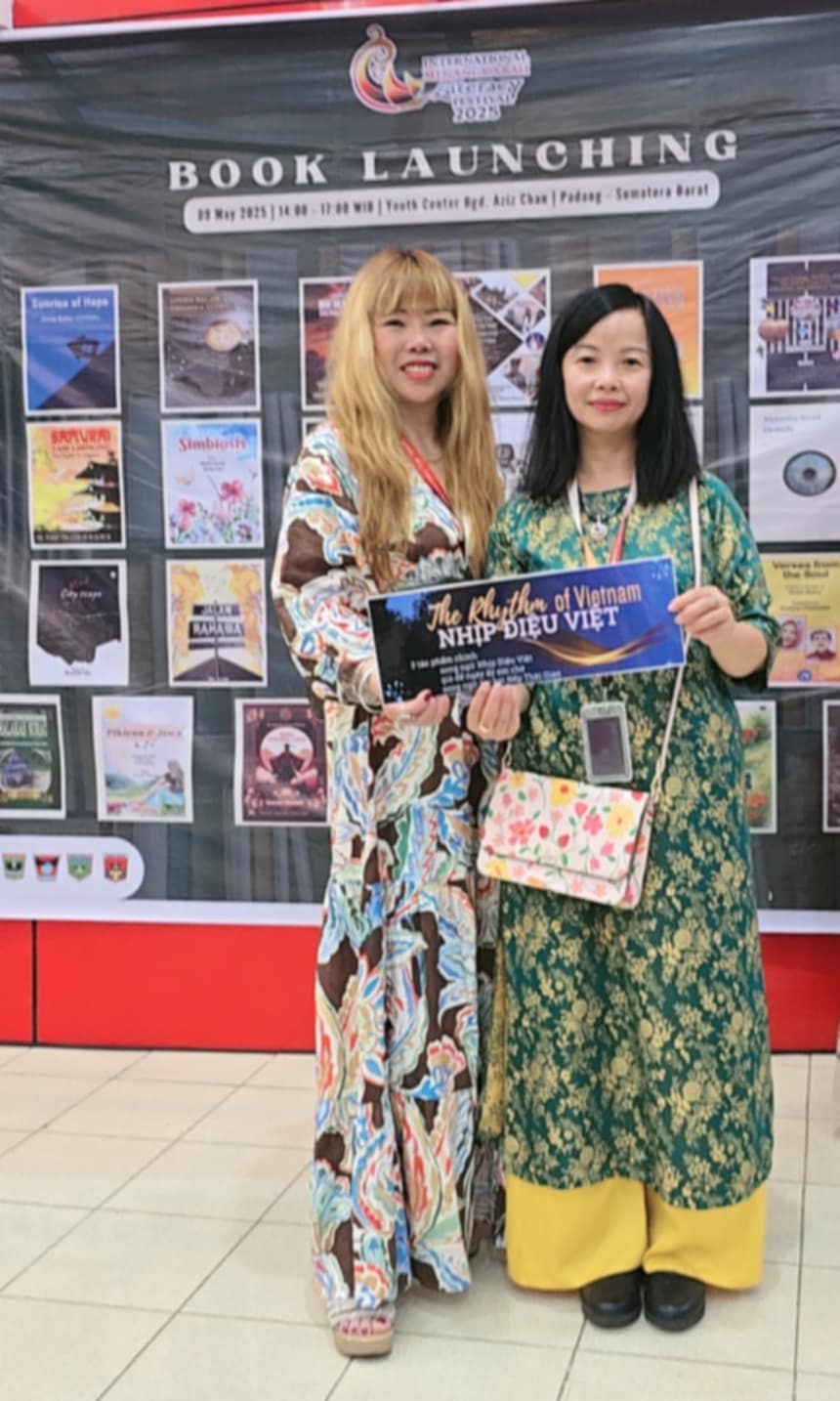
At the recent literary gathering, Vo Thi Nhu Mai made her debut appearance, not with loud declarations, but with a quiet presence that left a warm impression. As a first-time participant, she spent much of the time observing and absorbing the atmosphere around her. Though she spoke little, her attentiveness and gentle smile spoke volumes.
During the program, while others were caught in the bustle of performances and interactions, Võ Thị Như Mai moved gracefully between people, offering small yet thoughtful gestures. One such act stood out: she personally handed each participant a small card with their name written on it, a simple but touching effort to acknowledge and welcome everyone. It was a beautiful moment of connection, reminding us that care and presence can sometimes be more powerful than words.
Her demeanour was soft-spoken, but her actions carried sincerity. Many noted her warm energy, quietly friendly, respectful, and keen to understand the nuances of the gathering. In a space often vibrant with creative voices, Vo Thi Nhu Mai’s quiet kindness was like a calm note in a symphony, and her presence undoubtedly enriched the experience for all who were there.
The literary festival itself was a rich and colourful celebration of poetic voices from around the world. Held in a welcoming space filled with music, laughter, and multilingual readings, it brought together poets, translators, musicians, and friends of literature to share work, ideas, and cross-cultural conversations. Each segment of the program was crafted with care, blending each cultural literature with international voices, allowing a beautiful dialogue of language and soul.
Vo Thi Nhu Mai, though initially quiet, contributed meaningfully to this shared space. She took to the microphone and read her original poem “The Song of Life” in both Vietnamese and English, offering the audience a sincere glimpse into her poetic world. Her delivery was gentle yet confident, her words soaring with listeners across language boundaries. It was a moment of quiet power, her voice steady, her poem luminous.
In another generous act of cultural exchange, Võ Thị Như Mai also read a poem titled “Enjoy” by Greek poet Eva Lianou Petropoulou, further knitting the threads of international friendship. Her choice to present not only her own work but also honour another poet reflected the very spirit of the gathering: connection through words, across cultures, in mutual respect. For a first-time participant, Võ Thị Như Mai left a lasting impression, not just with her poems, but with her grace.
On a winter’s day, Mubina gazed out the window, lost in thought. She dreamt beautiful dreams, pondering how to achieve her aspirations. A sudden creak broke her reverie. The door opened, and her mother entered. Her mother switched off the lights, preparing for rest, and settled into bed. In the darkness, Mubina still tried to visualize the Kaaba.
It was the night between Thursday and Friday. Listlessly, she went to her place, picked up a picture of the Kaaba, and wept as she gazed at it. She yearned with all her heart to visit Allah’s house on Earth. Careful not to let her mother hear her sobs, Mubina wiped away her tears and quietly slipped into bed, closing her eyes. Sleep evaded her at first. After a while, her eyelids began to droop.
Suddenly, a light fell upon Mubina’s face. She opened her eyes to find herself in a vast expanse. The surroundings were breathtakingly beautiful. The natural phenomena were captivating. Mubina’s wonder grew, for on one side, a radiant light dazzled the eye, while on the other, rain gently fell. Curious to know where she was, she noticed something in the distance.
Mubina slowly walked towards the object visible amidst the dark clouds. As she looked, she could hardly believe her eyes. There, before her, stood the Kaaba. The immense, jet-black Kaaba, adorned with gold embroidery, was the object of her deepest desires. She circumambulated the Kaaba, and as she prayed, she suddenly awoke.
She found herself in her own bed, in her own home. Mubina realized she had been dreaming. Overcome with joy, she wept. Even in a dream, her cherished wish had come true.
Murodullayeva Makharram Rustam qizi was born on March 31,2003, in the Narpay district of the Samarkand region.