Spring is a dawn. A dawn that awakens the entire world and gifts warmth, joy, and delight to every heart. With the arrival of spring, nature revives: trees begin to bud, and the earth’s green attire refreshes the soul. New plans, dreams, and sincere intentions blossom within the human heart. One of the most beautiful aspects of spring is how its brightness manifests itself in people’s moods. Not only the world around us, but our inner selves also become lighter and more radiant. Today, every corner of our country breathes spring. Parks, gardens, and recreation areas are filled with people. Everyone rushes to enjoy the season and spend time with loved ones.
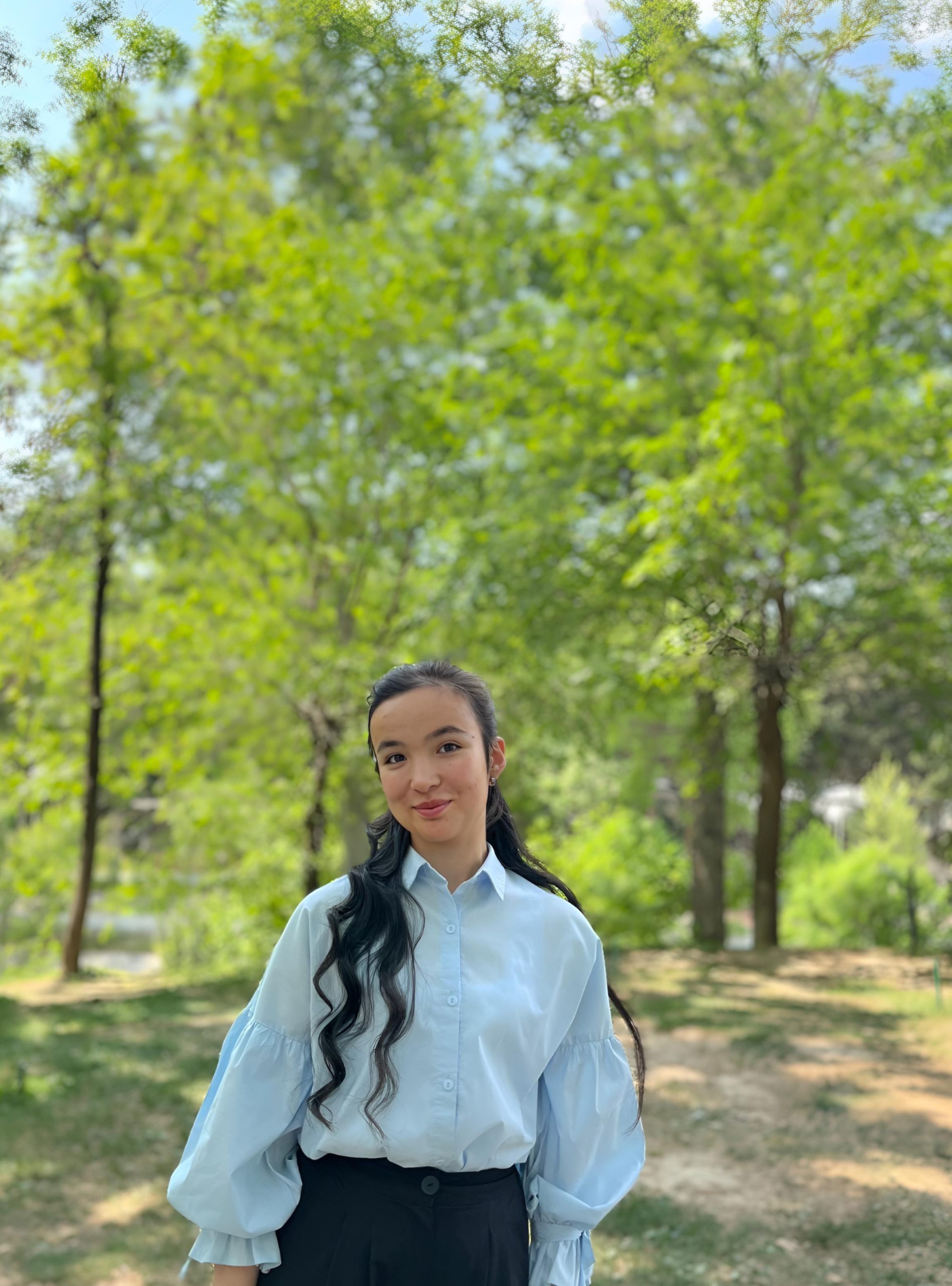
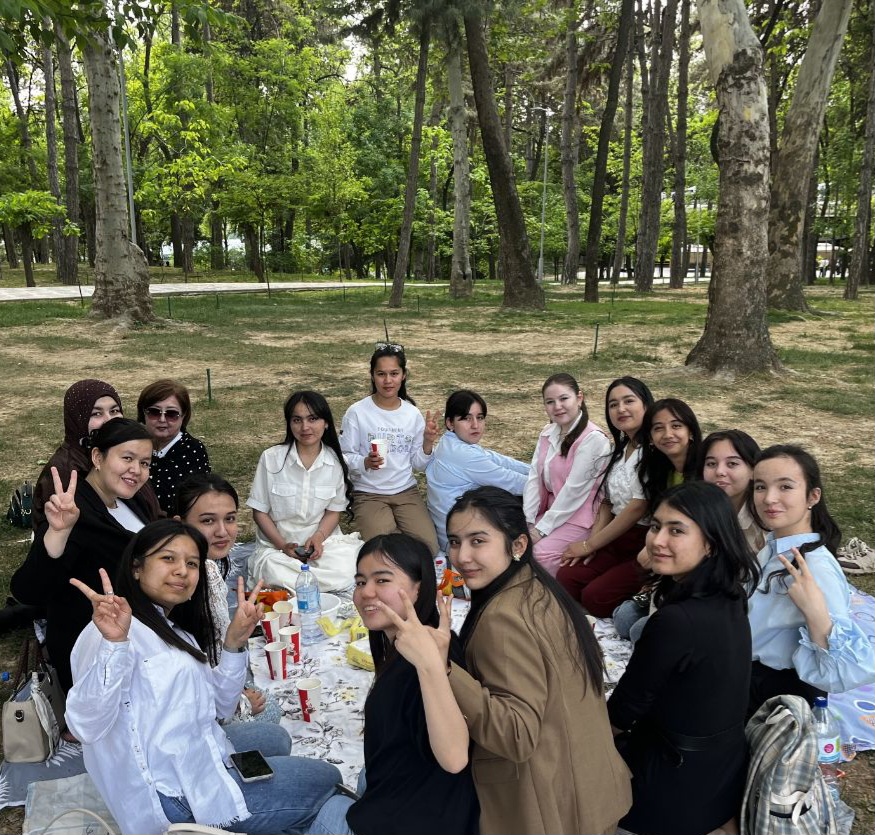
Especially the youth — they fill every green field with laughter. They eat together, play games, laugh, take photos. Such scenes inspire a deeper appreciation for life. On one such inspiring day, we — 35-24 group students , under the guidance of our teacher Ma’mura Erkinovna — set out for a picnic in Anhor Park. The warm sunlight, the fresh air infused with the spirit of spring, the presence of dear friends, and heartfelt conversations all became part of an unforgettable memory. Some unexpected moments, little mistakes and imperfections only added more color to our day. Indeed, it is such seemingly simple moments that nourish the heart and soothe the soul.
A picnic with close friends is not merely a break — it is a heartfelt ceremony that binds hearts together. Not only food is shared, but also joy, affection, and loyalty. In today’s fast-paced world, with time rushing by, we often struggle to find even a moment for ourselves or to reach out to our loved ones. But fleeting minutes on the clock ask us to appreciate them, to enjoy love and the beautiful memories it brings. Truly, in this temporary world where everything eventually fades, only emotions, inner wealth, spiritual growth, and precious memories belong to us.
And the moments spent with sincere friends seem to pause time itself. They create lasting memories that live on in the heart — becoming part of our soul’s deepest core. The picnic we had with our group of nearly twenty coursemates and our beloved teacher is one of those moments — unforgettable and forever engraved in photos and hearts. We are thankful to our teacher, Ma’mura Erkinovna, for bringing us together, encouraging unity, and helping us experience the beauty of nature in its purest form. Indeed, going out into nature with good friends is not a mere outing. That’s why many young people choose to adorn their spring days with such picnics. To some, a picnic may seem like a common activity — something anyone can plan anytime. But for me, it is a ceremony of strengthening trust, loyalty, and affection. And spring is the most exquisite season that nurtures such sincerity.
Ochildiyeva Shahnoza
1st year student at Uzbekistan Journalism and Mass Communications university
The blood always stirs with this tune of the varieties of musical tastes
The nature itself a bond for love in every opposite the male – female
Everything sings together, sings for each other, the teaching of love
As the teacher always teaches us to be sympathized with the sorrowful
And be happy to see the other’s happiness
The eyes will come to close its sight
The world may say us ‘Good Bye’
We must smile over the last thought or sigh
The view may show the glory for both of us we live in love
In cry and laugh
What’s the most feature of the reality nowadays?
There is no water to play the boat
The view, not vivid can give us relief, the foggy night
The tigers do not the matter for eating their cubs
On the other hand the view of devouring humanity
What brings up the ending?
Chapainawabganj, Bangladesh
26 April, 2025.
Md. Mahbubul Alam is from Bangladesh. His writer name is Mahbub John in Bangladesh. He is a Senior Teacher (English) of Harimohan Government High School, Chapainawabganj, Bangladesh. Chapainawabganj is a district town of Bangladesh. He is an MA in English Literature from Rajshahi College under National University. He has published three books of poems in Bangla. He writes mainly poems but other branches of literature such as prose, article, essay etc. also have been published in national and local newspapers, magazines, little magazines. He has achieved three times the Best Teacher Certificate and Crest in National Education Week in the District Wise Competition in Chapainawabganj District. He has gained many literary awards from home and abroad. His English writings have been published in Synchronized Chaos for seven years.
The world was a graveyard of metal and dust. Once, it had been a thriving ecosystem—a place of green forests, blue skies, and quiet lakes. Now, all that remained were ruins. The air was thick with the acrid scent of burning plastic and oil, and the ground was cracked, barren, like a wound that refused to heal.
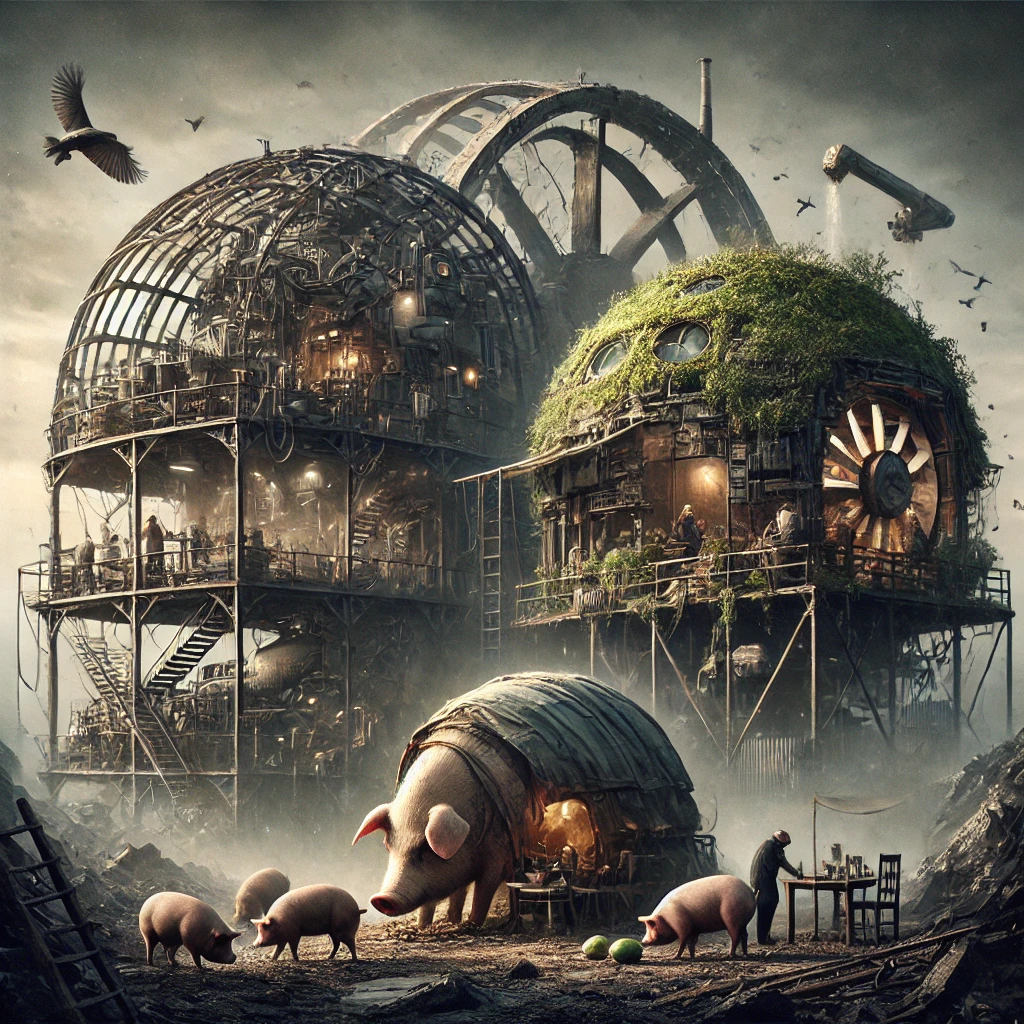
Three piglets—small and fragile in the face of this post-apocalyptic landscape—struggled to survive. Each had their vision of how life could continue in the ruins, each had their own idea of shelter, safety, and salvation. But the truth was simple: none of them were truly safe.
The first piglet, named Ironhoof, built his fortress of steel. Tall spires of metal rose like the bones of a giant, sharp and cold, stretching toward the gray sky. He filled his walls with machines—giant gears that turned without purpose, engines that roared in the silence, weapons that gleamed with dangerous promise. To Ironhoof, survival was about control, about the power of human-made structures, about making a world where nothing could touch him. But the walls of his fortress did not protect him from the constant hum of emptiness. As the wind howled outside, he sat alone in his sterile tower, staring at the screen that flickered in the dark. He wanted power, but it was the lack of meaning that gnawed at him.
The second piglet, Greenwhisk, crafted a dwelling of glass and plants. Her structure was a delicate blend of bio-tech and nature—vines curled around the frames, and bio-luminescent moss lit the pathways at night. She dreamt of a world where harmony with nature could return, where the earth could heal itself. The winds whispered through the leaves of trees that grew in the heart of her shelter, their roots entwined with the very wires that powered her home. Yet, Greenwhisk found no peace in the rustling of leaves. The gentle hum of life outside her walls was tainted by the constant reminder of the world’s decay. She wondered if she was merely hiding in a fragile illusion—a fragile dream that would wither when the last resource ran dry.
The third piglet, named Wildtail, had built his home in the ruins of nature itself. His shelter was less a building than an extension of the land—a cavernous space woven into the roots of an ancient tree, where branches reached down like veins connecting the past to the future. His philosophy was that true survival lay in returning to the land, in living as one with the forgotten world, in surrendering to the rhythms of the earth. Yet, as he lay in his shelter, he could hear the groans of the land itself, the cracking of the trees, the faint whispers of extinction in every gust of wind. How long could the earth withstand the weight of their need?
The world outside was constantly shifting—storms brewed and passed, but each one left its mark. The threats were always there—bandits who roamed the broken roads, scavengers who preyed on the weak, and the unrelenting erosion of the planet’s resources. But as each attack came, each threat loomed larger, the piglets began to see a different truth.
One evening, as the sun fell beneath a sky the color of ash, a violent storm raged over the land. Ironhoof’s fortress shook as the winds slammed against its steel walls. His machines buzzed erratically, flickering in and out of power. Greenwhisk’s plants withered under the pressure, their bioluminescent glow dimming, leaves curling in defeat. Wildtail’s tree was bent, its branches snapped like bones under the force of the storm.
The piglets emerged from their shelters and met in the middle of the ruined land. They had survived the storm, but the cost was clear. Ironhoof’s walls were battered and rusting. Greenwhisk’s glass cracked under the pressure. Wildtail’s roots had begun to decay.
“We are losing,” Ironhoof said, his voice hollow. “None of our shelters stand up to this world. We build, and it is destroyed. Over and over again.”
Greenwhisk, staring at the shattered remnants of her plants, spoke softly, “Perhaps we were never meant to fight against the world. Maybe we were meant to live with it. But even that… it’s slipping away.”
Wildtail, his eyes reflecting the dying light of the storm, whispered, “Maybe we’re not meant to survive at all. Maybe we’ve already lost.”
The three piglets stood in silence, facing the crumbling ruins of their shelters, and in that silence, they realized the true destruction was not in the storm, not in the broken world—but in themselves. They had built their shelters to protect against the world, but they had never stopped to question their own hearts, their own contradictions.
Ironhoof had sought power, but in the end, he was trapped within his own fortress of isolation. Greenwhisk had sought harmony with nature, but had she been blinded by her idealism, too fragile to withstand the world’s cruelty? Wildtail had sought surrender to the earth, but the earth was already dying, and with it, so was he.
They stood there, each lost in the ruins of their beliefs. The world was no longer something they could fight against—it was something that had already claimed them. The storm had passed, but the true storm—the one within them—raged on.
In the end, there was no answer. There was only the wind, the empty sky, and the sound of their hearts slowly breaking, one beat at a time.
Let us go, from where we have been sitting, words of abrasion, ashes of trampling. Tread this abandoned ground, only one suffers, to shatter the walls of artificiality that are supposedly closed. I am always your unqualified strength.
O muse, the festival of silence that blooms by the side of the railroad in spring. I am writing of red and yellow, those unannotated flowers. A stem from this earth. A single unannotated will. All that you do, O Muse.
I am the silent witness to the truth of the body you tell me. I must write on this paper, clutched tightly in my hand, that the supposedly closed walls of humanity are faith in a reality that has no substance to touch, that no one alone must suffer the illusion of this world.
Therefore, my footsteps since my return to the station of this land are shown by crushed rubble, and my high pressure strokes are plowed as ridges of black gloss, and here is my letter to you.
A land of white rubble. The polished iron road. A railroad that leads from you to the one who is now lost, for that very one person. Each stem that brings forth a flower, alongside the railroad that has received life, is revealed as you again, from your rough sketch.
THE LAUNDRY JUNCTION OF TIME & THE UNDER BELLY OF HUMAN EXISTENCE
Dr. Jernail S Anand
Where three rivers meet, we call it Triveni. Time, too, is a river that keeps flowing interrupted. Past, present, and future are human constructs that help us understand it better. These three rivers of time meet at a juncture called present which acts as a laundry junction where the waters after the wash, are released into the lake of the past.
We celebrate life when people are born and also the moment of marriage when they can create more life, and finally, the time when they part away from the stream. I was looking at a recently watered field from which water had evaporated, leaving the earth dry. Where is the water that has evaporated? It is in the air because air sucks the water from the earth and deposits it somewhere else. Life too is taken away from a person here, and supplied at some other unknown place. The forces which are overseeing these operations are not only precise and perfect, but also, ever present, though always invisible.
As soon as we hit the earth, the first thing that we do is to forget that we are here on an errand. He who sends us here is always watching our progress. When we go wrong, he pulls the strings and brings us to woe.
Is suffering an equalizer and a synthesizer?
When we suffer for our wrong actions, how can we presume that there is no Big Brother always watching us? It is a very uncomfortable thought to realize that we are under a CCTV camera, and all our movements are being recorded. Even when we are at our worst in our loneliness.
The only thing that off sets this adverse situation, and nearly balances it is the fact that men are given to believe that they have wits and they can use them no end. As a consequence, they make calculations, buy properties, sell shares, and when they make millions, celebrate ‘their’ success. When they lose, they curse gods. Here lies their ‘error’ [remember: to err is human] If all the losses can be ascribed to the invisible forces, why not the success?
The Underbelly of Existence
Men nurture huge reserves of hubris. Individuality is for which we wage wars. Freedom is another ornament for which young men have laid down their lives. Our only problem is, we understand these things in the context of our physical life and the political conditions. The fact is, we are much more than that. We have to understand man in his ‘viraat rupa’. We try to see him in his ‘aviraat avtara’. We try to create him into a person who looks after his family, creates wealth, raises skyscrapers, and finally like Zymandias, is reduced to dust. We never look into that stuff in man which is indestructible, of which Lord Krishna talked to Arjuna. We forget that when we die, it is not more than drying of up water from a field which stays in the air. Similarly, we too are in the air, and can be deposited back in some other place.
Man’s ‘Viraat Rupa’
What is the ‘viraat rupa’ [cosmic identity] of man? He is simultaneously connected with the entire past that stands behind him and provides him a background, like a series of mountains. In that backdrop, he is here to perform certain deeds which are already scripted for him. Here we err. We err in thinking that we are independent, we have nothing to do with the past, we have nothing to do with the future. We are present, we have a free will, and we can do what we like. This is the error mankind is prone to commit, and which we people often make, and then, it is a saga of suffering all through.
Malovian Overreach
The genesis of the error lies in the knowledge which helped to make man proud of his bearing, and think of himself as an independent entity, a demi-god who can run parallel to god’s creation. What is happening today, it is annoying to gods, because, man has distanced himself from nature, and is headed on a self-destructive march into the heart of the mystery trying to undo its mystical mechanism. In trying to prove himself equal to God in creative prowess, he has actually shrunk into a small entity, who can be upset if there is no electricity to charge his mobile and laptop. He is a laptop genii, or bottled ‘Jinn’ of Aladdin. The marvels of man’s creative power mock at reality from the ramparts of fantasy. Man is fast receding into that fantasy, that virtuality, and while he thinks he has garnered heaps of knowledge, he has failed to realize what his past holds out as a lesson of life. Ravana still remains an epitome of knowledge in its greatest perversion. The Kalyuga has failed to see a man of his stature in whom we could see wisdom gone on furlough. We have yet to see a man like Duryodhana, whose ‘wisdom’ leaves on a pilgrimage of non-sense from where, there is no return. AI cannot replace the Gita, nor can it de-arm Arjuna. Man is under grave threat because he has chosen to isolate himself from the benign powers of nature and aligned himself with the toxic universe of the laptop. AI has the potential to make man far greater than himself. But the more his size increases, the more he dwindles in his humanity as well as his divinity.
In spite of the past offering a variety of intense wisdom, and the future holding out great promise, man’s present is locked in a futile search for himself. In fact, he has opened too many windows on his physical existence, that keep him confused and confined to his physical existence. The wisdom that he used to get from proximity to nature has been replaced with knowledge-based perceptions of reality. Passion for success and pursuit of pleasure have divested the divine aura that stuck to a human being. We are now ordinary persons, a subhuman race, even below the animals and vegetation, who talks of stars but has lost touch with the ground.
Dr. Jernail Singh Anand, [the Seneca, Charter of Morava, Franz Kafka, Maxim Gorky and Signs Peace awards Laureate, with an opus of 180 books, whose name adorns the Poets’ Rock in Serbia] is a towering literary figure whose work embodies a rare fusion of creativity, intellect, and moral vision.
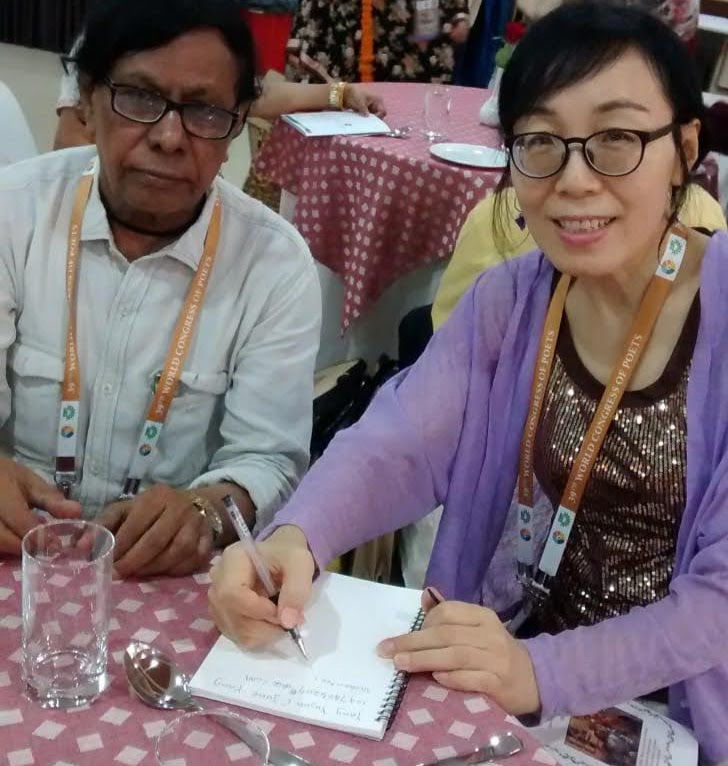
This interview with Sudhakar Gaidhani has been conducted by internationally published Chinese poetess Yang Yujun. The Chinese version of this interview has been previously published by China’s WeChat’s Poetic Platform. The world-renowned Chinese poet Yongbo Ma has taken the initiative for this interview.
Q.1). How did Devdoot the angel strike as image of your Epoch?
Sudhakar–
First of all, I would like to thank you and dear poet Yongbo Ma for arranging this interview. To answer your question, I would like to tell you something different please.
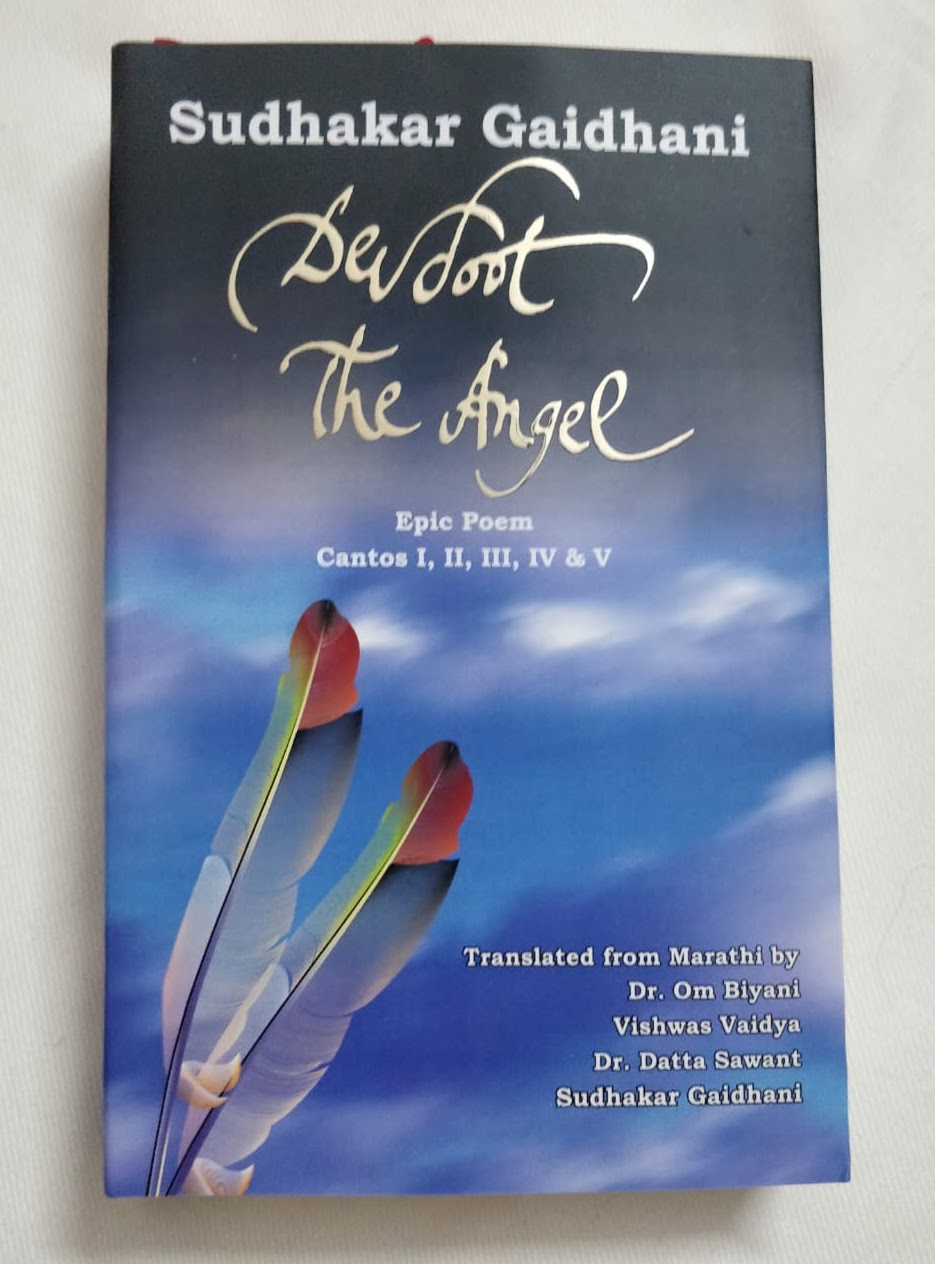
As a child, I used to dream that I was a bird and flying. As soon as the dream broke, I would often fall off the bed. Later, I depicted this bird as Devdoot in the poem “Devdoot the Angel”. There is also an idea that an angel is a messenger of God. God is also a beautiful concept created by humans. Another thing is that there is a belief that God and His angels also free people from suffering. “Devdoot” is a the main heroine image of the family of images of this epic poem. By the way, this angel is also like a hero in this epic poem. This bird, based on the wisdom of many previous lives, communicates with the people of this era and tries to show them the path to the supreme happiness of life. This giant bird also mentions that it was with them in the era of Buddha and Christ. He warns them against the so-called spiritual preachers who frighten the naive people by spreading man made religious differences among humans. Because all religions are creations of humans.
Now let me add in short about of my epic poem Devdoot. The prologue of this epic poem contains the story of the creation of Devdoot.
The first Marathi canto of this Devdoot was published in 1981. The second canto was published in 1999 and the next three together, an epic poem of 555 pages, was published in 2004.
Some Marathi critics tried to make fun of this bird by calling it surreal. But 6 years after the creation of Devdoot the angel, the American National Museum of Natural History Smithsonian Institution, Washington, discovered that a bird like this sea bird was alive on Earth. This news came in newspapers all over the world. This is the incident of November 1987.
News was like this – “A fossil excavated from a rock formation in southeastern United States has been identified as history’s largest flying seabird, an extinct and previously unknown species that has a wing span of more than 5.5 meters”. After reading this news, one of the readers of my poem Devdoot immediately wrote a letter in the same daily, saying- “I am glad to state here that a visionary Marathi poet from Nagpur-India Mr. Sudhakar Gaidhani has depicted a similar bird in his poetry book Devdoot published in 1981”. After this my enthusiasm increased. I immediately sent the translated parts of Devdoot and the prologue of the poem along with a clipping of the reader’s published letter to the Smithsonian Institute.
Then I received two positive letters from the Smithsonian Institute’s Department of Paleobiology Museum Specialist. The first letter is dated 28th March 1988.
Second letter is dated 10th June 1988. Some of its lines are like this–
It is a rare occasion when science and poetry can meet with such a magnificent blend of serendipity. Under the matter of both letters is the signature of Raymond T.Ray II.
Now what I am telling you here that is wonderful and true. After the publication of the entire Devdoot, the 16 incidents depicted in it have actually become true. This is recorded in a Marathi book published on Devdoot.
Q.2). What role should a poet play in the contemporary society? I mean, was a poet born with a mission (obligation)?
Sudhakar–
In contemporary society, the role of a poet should also be linked to the feelings of the society. Because he is an integral part of the society.
Once a poem is expressed,
it is no longer the poet’s personal matter.
Rather, it becomes a part of the collective human mind.
Because the poet is also
an integral part of the social brain.
A poet who says he writes and publishes only for his own pleasure is deceiving himself.
Poetry is also an art of communication. And the poet communicates with the society through his poetic expression. With this social consciousness, he can also communicate freely with nature.
ii – Although no poet is born with a goal, later his inner mind keeps suggesting him to take up the flag of a goal. And he can take a definite role as the need of the society, the world. Because basically a real poet is a prophet, a philosopher. Poets who perform only for stage entertainment are performing artists.
Que-3) Your poems remind me of EI viejo con las alas enormes by Gabriel Garcia Marquez (The Old Man with Enormous Wings) What do you think of this story?
Sudhakar–
Sorry, I have never read this story. My reading of English literature is limited. The relationship of the bird in my epic poem The Angel is deeply moving to me. I had listened to the entire epic Mahabharata as a child. In it, the great warrior Bhishma, who fights for the Kauravas and falls wounded on the battlefield, touches Devdoot in the first canto, that’s all. There is nothing much beyond this. Because the giant bird in Devdoot is wounded by a hunter’s arrow and falls on a deserted island.
Q.4). Numerous literary works can be traced back to the Bible, how about your poems?
Sudhakar–
I have already said that the message of compassion conveyed by the great human beings like Buddha and Christ awakens the consciousness of humanity in humans. The martyrdom of Jesus impresses me more than the Holy Bible. The Jaataka stories in Buddhist literature or the miraculous short stories in the Bible are like a crutch to help ordinary devotees understand the truth.
Since these stories are related to faith, they do not take away the faith of the devotees. I think that even a mature scholar should not snatch these faiths of ordinary naive devotees. If they do so, their ignorance will increase and they will become aggressive. Because both Buddha, who denies God, and Jesus, the only son of God, are very necessary for those who try to live a normal life happily. Most of the short stories about Jesus in my Devdoot are inventions of imagination.
Q.5). Is the identity of Character of Devdoot change with the unfolding of the five cantos?
ii – Do you yourself grow (feel elevated) with your own works in the process of writing?
Sudhakar–
Devdoot gradually reached five cantos quietly. The first canto in 1981, the second in 1999 and the other three cantos together, the entire Devdoot, was released in 2004. It is because of these five cantos that Devdoot angel’s own identity and personality have been realized.
ii—The poet’s mature poetry creation gives him the joy of inner satisfaction. As the seed of poetry blooms in his state of contemplation, he forgets the sense of his own normality and, as he unites with an extraordinary state, he himself experiences the creation of a poem. Like a pregnant woman and the fetus in her womb. This is the elevated state that the poet gains from the process of creating poetry.
Q. 6)–. How did Ramayana and Mahabharata influence you and your writing?
Sudhakar–
There is no such thing as the influence of these two mythological epics on my poetry creation. But some of the characters in my epic poem Devdoot and my second epic poem “Shadows of Yoginis’s Dreams” are useful for expressing new content and beauty of thought. That’s all.
Q.7)— It seems that your five cantos are written from God’s perspective, that view of a philosopher than simply a narrator of world events?
Sudhakar–
Your question is about the principle of God related to the human world on earth. In the fifth canto of Devdoot, the solution to this question is in the dialogue between the Awadhoot-pilgrims who has reached heaven. God himself says that I am also the caring guardian of this world on behalf of the Creator. When these Awadhoots actually come before the Creator of the world, the Creator explains to them,
O Awadhoot-pilgrims on earth, all the gods and all the religions on earth are the creation of you humans.
Even God also says that God is just a beautiful concept.
Let it be beautiful. Anyway!
In all these five cantos, Devdoot gently explains this formula to the collective consciousness of human. If materialism tries to snatch the concept of God from humans, the common people will be very hurt. The world has experienced this fact. I have used to refer some how the basic thoughts of Buddha and Jesus in connection with the previous question. Anyway, now world events, even if they are temporary, can have some impact on the world. But a poet or artist does not consider them as a means of creation, but only as an occasion, and is in the contemplation of eternal creation, taking note of them. Everyone has two minds. One is the inner mind and the other is the outer mind. The inner mind is pure, it is not muddy like the outer mind. This inner mind easily entwines the poet’s poetry in the thread of philosophy. That is why an ascetic poet is a philosopher. Poets who only entertain on stage are artists.
Q.8)— Was there a particular event/incident in your early life that motivated/triggered you to start writing or you just naturally picked up writing?
Sudhakar–
To speak in this context, this inheritance from my mother must have flowed into my genes to some extent. This arrangement exists in the genetic system. Our genomes travel through human sperm for thousands of years with the memories of past lives. During this journey, the memories of some are destroyed, while those who do not, continue to travel through the capsule of genes, taking with them new memories. It is said in Jaataka stories that Lord Buddha had the memories of five hundred such births. We bury a grain seed in the soil and see later the same seed sprouts on its grave. The formula of birth, death and rebirth is also applicable to animals, birds and plants. My insufficient practice from my past life must also be attached to this birth.
Q.9) Do you normally start writing with a plot as with a novel or you just write on pouring out what pops out from your mind?
Sudhakar–
No. Not at all like a novel. While writing Devdoot the Angel, as I mentioned earlier, I took as a basis a small story hint in my mind. Later, as the journey of contemplation began, some small mythological stories got into the poem as needed. Something similar happened in the case of my other epic poem Shadows of Yoginis’ Dreams. You yourself are a deeply contemplative poet. Therefore, I do not think it is appropriate to say anything more. Here I am giving a recent poem of mine as an example.
WHEN THE POET IS GUILTY
In the abyss of the poet’s inner self,
the seeds of memory flutter
and fly like angelic butterflies.
When they settle down peacefully,
the embryo of poetry gradually
takes shape from their divine eggs.
The poet has to wait for the natural birth
of this new creation.
But when, due to the poet’s excessive enthusiasm,
the poem is born by cesarean section
before it is mature –
The poem constantly blames the poet
for its unnatural birth.
I also agree that poetry does not come out of the inner contemplation like an object coming out of a machine. It has to be shaped in a state of contemplation. For example – even if it is a diamond, it becomes brighter and more valuable because of its shapes. Every poet must be the first reader and critic of his own poetry. It takes penance to master all the arts.
Q. 10) Is writing part of your day- to-day life or something special or a project that you focus on?
Sudhakar–
I often spend late nights thinking about what new things I can think of and in the morning it takes on the body and life of poetry. Every poem has its own personality and character. A noble poem also stand nude before her ingenious devoted reader.The needle weaves the clothes to cover the naked but it itself remains nude still no one objects it for its nudity. The poetry is also similarly.
Lately I have been more lost in poetic contemplation. Sometimes in this contemplation, the thread of new creation is found, of course this is very useful for a long-term poem. These days I am meditating more on Buddha. Mahayogi Buddha, that is, Epic Yogi Buddha.
Q. 11). Do you have much interaction with your readers?
Sudhakar –
Literature is a communicative art. There must be communication between the writer and the reader. But this is not mandatory. Still, one thing is very important. Speaking of poetry, the poet’s poem should communicate with the readers. Poem can be obscure but if it is self-obscure? Then it can be counted as mad poetry. And the self-centered poet wanders in the mist of self-sorrow searching for own tears; and beg before himself for it.
The love of the readers is a very important issue for a poet. This is the respect that the poet receives from the readers for their creation. Therefore, every poet should treat his readers with great respect. One issue is that my low budget books were released easily, but I had to wait a long time for a six hundred page book. Today, for the new edition of my “Mahavakya” i.e. the complete Devdoot the angel, my friends, Marathi poetess and writer Mrs. Dr. Manjusha Sawarkar and Mr. Sunil Sawarkar, who love my poetry, came forward. They started a publishing house in Nagpur metro city under the name ‘Kusumaee Publication International’ and made my Devdoot epic available to English and Marathi readers around the world. Because other publishers did not dare to spend 5 lakhs (0.5 million) rupees. A poem can remain in the news due to positive or negative reviews, but it survives only because of the place it has found in the hearts of the readers.
Q.12). When did you start to take writing seriously ?
Sudhakar–
I started writing since my school days. But I really started writing poetry seriously from 1968. My first collection was published in 1973, which I later had to study in the M.A. Marathi course from Nagpur University.
Q.13) What would you call your style?
Sudhakar –
For me this question is not easy to answer. In the Marathi poetry world, free verse is considered a type of style today. But in my opinion, instead of free verse, it is a type of verse free style. In my opinion, poetry is a beautiful outburst resulting out of deliberation of innermost thoughts. It becomes the nucleus of the poetry. It balances the surface, middle and bottom of the poem. I consider such an invention as an easy but free, with depth and beautiful style. In short.that style is philosophical and mystical
Q.14). Do you think the identity of a poet affects your relationship with other people, especially your family?
Sudhakar—
No, I don’t think so. But in this poetic penance, my family is a little neglected. But Mrs. Gaidhani takes care of me. A few years ago, a leading daily newspaper used to have a column of my poetry. The honorarium I received for that gave me some support. In 1991, I lost my postal job to contest the parliament elections. I was defeated in the elections. In the later days, I had the support of my wife. At that time, the writing of the next part of the epic Devdoot was delayed. My readers love me along with my poetry. In 2004, when I had two major heart attacks, these friends helped me a lot. These friends collected the subscriptions and published the Marathi version of Devdoot. My birthplace Khapa is adjacent to the metropolis Nagpur. There, with the cooperation of the people of the village and the municipal council, a public garden has been opened in my name on two and a half acres of land.
Q.15) Do you normally write on schedule or write only when you feel like writing?
Sudhakar—
I have also mentioned this earlier. However, let me mention about a farmers movement I was also part of. Three decades ago farmers in Vidarbha region (of 11 district in Maharashtra state) were committing suicide due to debt burden and poverty. And the peasant leaders were doing politics. These pictures were disturbing me. In that mindset, I started a daily poetry column on behalf of farmers in a major daily in Nagpur. That column continued for more than two years as it became a reader favorite. During that time I wrote almost 12000 lines. And an unexpected incident greatly affected my later life.
Q.16). Of course once appear in the form words, all works have broad orientations. However, do you have a particular reader in mind when you begin writing (the so- called reader consciousness)?
Sudhakar—
I do not write with a particular reader in mind. It cannot be kept in mind in the creation of poetry. We don’t say the gold is beautiful, we say the jewelery is beautiful.
Poetry is not an easy – accomplishment. It require to bear the scorching of the meditation -energy, only then the picture language of the letters(syllables) possesses the essence with immortality. Using broken bricks of words,one cannot build castles of poetry.
In case of music,sculpture, painting, dance and acting it takes a considerable time to assimilate the minute delicacies of of arts. After that the flowers of those arts blossom.But about poetry, No! It’s very easy. Something enters the mind, oozes through pen and is mixed with words. That is called poem (for some).
YANG YUJUN
Yang Yujun, born in Beijing, now lives as an English teacher in Guangdong. Her poems and prose first appeared in 1986 and her own collections of Poetry Garden In Winger and The Hand On The Mouse Is Turning Cold have been published in Chinese and English. She has translated work of more than 5 million words including collections by thirty Chinese poets and two collections of short stories by Alice Munro. Also she has translated Sudhakar Gaidhani’s entire Epic Poem “Devdoot The Angel” from English to Chinese. Her poems have been translated into English, Arabian, Spanish, Japanese, etc.