I’m 38, while Evans is 24, church member, job hunting, irreligious, not too handsome. He came in contact with my phone number after we came for a youth program in church and we were linked together for a church assignment, an assignment that involved us holding the money that was contributed to buy baby items for a pregnant woman in our group. The assignment was successful and everyone went their way. But once in a while, Evans would view my WhatsApp status. Sometimes he would comment in the brotherly-churchy way when I updated my WhatsApp status. I also viewed his status once in a while, but in a way that was detached. During the period around the presidential election we talked about what was happening in Nigeria, how we were all hopeful that change was about to happen in Nigeria, and then our hopes were torn apart when the result of the presidential election was announced. Then one day I posted that I was hiring. I was looking for someone who could help me in my finishings shop. He was the first to reply, fifty two seconds after the post uploaded.
“Do you have any experience in finishings?”
“Yes, ma. I did it for my elder brother before I started school, but he wasn’t paying me then.”
“Okay,” I said. I gave him the address of my shop, and he said “Thank you ma.”
That was how Evans became my employee. From church brother to my employee. People were often careful about church brothers and sisters, especially when it came to business, but Evans was truthful about the things he said about himself. He was very effective in handling the finishing machines. I also loved the fact that he was not one of those church people who were always preaching to people, even while at work. I’ve had one of such people in the past. She kept inviting me to see her pastor and I kept refusing till she finally left when she became pregnant. Her husband asked her to stop working, to safeguard their unborn baby. Evans carried his religion lightly, and he was a great fresh air in my workplace.
Let me stop here and say a few things about my personal life. The truth is that I’ve gone through a lot in the hands of men. In Nigeria we say Men are scum, but I don’t like using the word Scum. Not that the saying is untrue. I just don’t like the word.
When I was 25, I gathered my money and gave my boyfriend to support his business, but he ended up marrying another girl. I shrank and then allowed myself to spring back to life again. After that I’ve gone through many relationships that kept failing, but for four years, I decided to stay on my own. My sisters are all married, and everyone wonders what is wrong with me. Because I’m single, some of them call me on phone asking me to help them with one thing or the other, especially the ones who now have kids. The unspoken words are these: Because you are still single, can you please support us to raise our children while you wait for yours to come? But of course those words were never spoken out loud. They are often caged in “My children no longer have clothes o. I just hope that someone will help me out. My husband is trying, but you know men nau. They expect you to do some certain things.” Or they would say, “The children have been asking about you. You know school is about to open. They will need new exercise books.”
Sometimes I would send some money to my sisters, other times I would say that things were hard. “You know everywhere is hard in this Buhari’s regime.” And it was true. Things were hard. Buhari’s regime really dealt with my finances.
It’s been four years of staying on my own. My parents are both dead and so nobody is recommending one pastor or the other who would deliver me from the bondage of spinsterhood. This was particularly the assignment my mother kept doing until she died five years ago. I was 33 when she died. We had visited many prophets and pastors, sowed seeds of money, fasted together, so that God would give me a husband. But my good mother is now dead, and apart from attending the Sunday services of my local church, I have not gone to see any other pastor or prophet for prayers. I sincerely understood my mother’s concern about me, and sometimes I still think about her, how she would often drive our conversations towards marriage, husbands and powerful pastors. She was always on the lookout for any pastor that people say could perform miracles.
It’s been four years of being single. I kept pushing the men away who kept coming to suck from me. You would always know those kind of men. They kept coming, feeling entitled as though I should pamper them for their willingness to save me from my horrible spinsterhood. I’m still surprised about the fact that there are many jobless men in Aba looking for women who would take care of them. This is what my spinsterhood has opened my eyes to see: many jobless men who have no direction in their lives. I’m surprised because looking at them from afar, you would think they are sane and responsible. When they come close to you, that is when you would discover that they are vagabonds in good clothes.
Until Evans came to work for me. The last person who worked for me was a girl. She was 19, and she left to attend school after she got admission from Imo State University. That was why I started looking for a new worker, someone who would be efficient and fast with the finishing machines.
Evans was good, respectful, and funny. He often philosophized about life, and he was a keen follower of Nnamdi Kanu, the freedom fighter. He had worked for four months before I asked him to work overtime; I would pay him for the overtime. He agreed. After we were done with the work, late in the night, he said he would go home with me. “Won’t your parents get angry?” I asked.
“I’ve told them already. They said okay.”
I have heard of women in their late thirties or forties having sexual affairs with younger men, but I had never thought it was a rational thing to do, never thought it was something I myself was capable of doing, for whatever reason. Our bodies will always vent out what it had suppressed for a long time. Evans was also starved of affection. Both of us being in the same room that night, our flesh drew the attention of each other until they explored each other in intimacy. It happened after we have had something to eat. After some seconds, Evans leaned over and started to kiss me. It was unexpected, it was rousing, it was sweet. And I was human.
.
Evans would continue to work for me for the next one year, but I never allowed him to come to my house again. He left after a year to seek for a better paying job. He told me he was leaving, that he got a job in Umuahia, and I gave him some extra money, in addition to his salary. He was one of the most loyal people I’ve ever worked with. He was also very friendly with my customers.
I’m still friends with Evans. At least on WhatsApp. We never talked about what happened that night. We both knew why it happened. And there was no need to talk about it. On my birthday shortly after he left, he sent me a message:
Happy birthday to you ma. You are one of the kindest people I ever met. You see people for who they are, and you have a free spirit. I pray that God will send you a man that will complete you and cherish you just as you deserve.
Much love from Evans.
So Evans is just my friend now. Not my employee anymore.
Isaac Aju is a Nigerian storyteller whose works have appeared in both UK and US literary journals and publications including Poetry X Hunger, Penned In Rage Journal, Writers’ Journal – Live And Learn. His historical poems on Biafra will be published by Flapper Press at the end of the month. He lives in Nigeria where he works as a fashion designer, designing and making clothes for men.
Poet and essayist Abigail George, whom we’ve published many times, shares the fundraiser her book’s press has created for her. She’s seeking contributions for office supplies and resources to be able to serve as a speaker and advocate for others who have experienced trauma or deal with mental health issues.
Also, the Educational Bookshop in Jerusalem, a store that has the mission of peaceful dialogue and education, invites readers to donate new or gently used books (all genres) that have been meaningful to them, with a note enclosed for future readers about why the books were meaningful. (The books don’t have to be about peace or social justice or the Mideast, although they can be). Please send books here. US-based Interlink Publishing has also started a GoFundMe for the store.
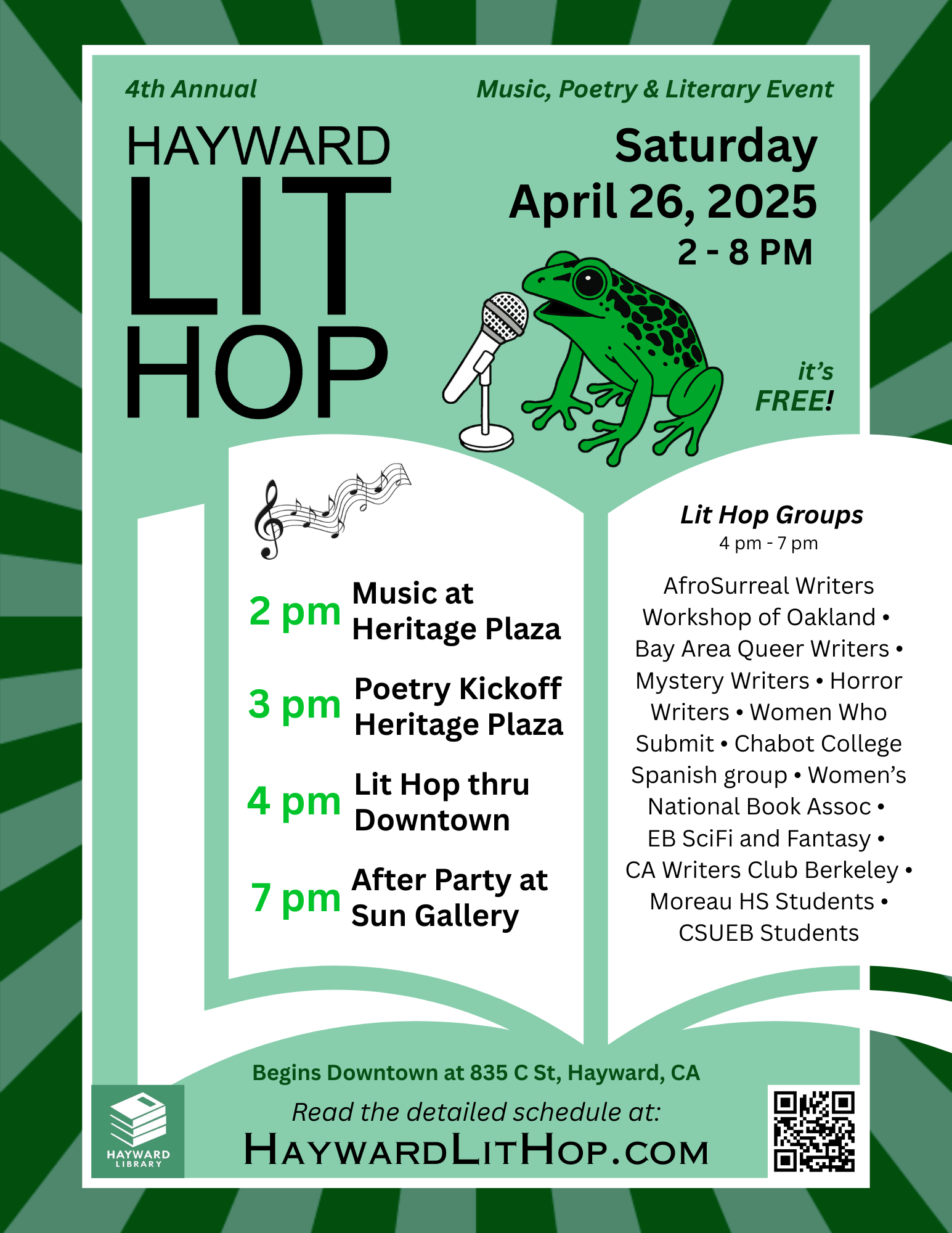
We’re also having a presence at the Hayward Lit Hop festival this year, and we encourage everyone to attend this free, all-ages event! Many local writers will share their work and we will also host an open mic.
This month’s theme is Journeying Inward.
Lidia Popa seeks her true self, believing in the value of her quest. Samira Abdullahi acknowledges her scant resources and the obstacles before her, yet bravely forges ahead towards her life’s goals. Xavier Womack expresses determination to stay free of a relationship that has turned controlling and toxic.
Maurizio Brancaleoni crafts bilingual English/Italian introspective vignettes. Philip Butera reflects on noticing different types of flowers throughout his life, paralleling his different moods. Christina Chin of Malaysia and Paul Callus of Malta collaborate on haiku resplendent with action and sensory detail about the minutiae of human life, highlighting how even smaller thoughts matter.
Charitha Jammala’s mystical poetry probes the depths of the human mind and soul, celebrating our inner essence and integrity. In elegant poetry, Haroon Rashid reminds us to look inward to find joy and peace rather than expecting it from the outside world. Alex S. Johnson revels in the dreamscape of human consciousness in his expansive poem.
Beatriz Saavedra Gastelum probes the power of dreaming to explore human consciousness in Alfonso Reyes’ writing. Christina Chin and Uchechukwu Onyedikam collaborate on haiku capturing the delicacy and deliciousness of creative tension and human spiritual journeys. Fatima Anisa Ibrahim depicts the peace she finds upon sleeping, waking, and beginning a new day.
Stephen Jarrell Williams’ poetic cycle drums up a sense of urgency, evoking human mortality and spiritual quests. Peter Cherches speaks of time and memory, incidents that make us, small puny humans as we are, question all that we remember. Mykyta Ryzhykh renders the dissolution of language and identity through creative poems. Alaina Hammond probes the effect of present experiences to shift memory and identity in her drama, set at an art opening. J.K. Durick’s poems also address identity in a way, pointing out human experiences we face individually, yet share with many around the world.
Philip Butera’s lengthy poem explores existence, seduction, and morality through a lens of mutable personal identity and the archetypes of Greek mythology. Two literary critics, Dr. Selvin Vedamanickam and Grock, explore the struggle of individual people in a world that seems indifferent in Dr. Jernail S. Anand’s epic poem Geet: The Unsung Song of Eternity.
Bhagirath Choudhary’s piece honors and includes the feminine as well as the masculine in what it means to be human, and divine. Jacques Fleury, a Black man from Haiti, asserts his belonging to the universal human family regardless of racial distinctions.
Patrick Sweeney writes disconnected short pieces with an element of whimsy that explore our curiosities and obsessions. Duane Vorhees’ poetry revels in earthy sensuality and explores questions of personal identity, reality, and fantasy.
Kylian Cubilla Gomez’ images focus on fun and imagination in his images of children’s toys. Ochilova Ozoda Zufar shares a children’s story about travel, friendship, and new experiences. Abigail George reflects on her life’s trajectory, how circumstances made her the mother of words rather than human children.
Elan Barnehama’s short story places us back in our early twenties, when many of us were still making major life decisions. Still, many people past that age express similar sentiments. Tagrid Bou Merhi affirms the drive towards personal and artistic freedom. Anna Keiko reflects on how she has followed the call of poetry in her life. Chad Norman’s brash poetry celebrates the freedom to do and say and love as he wishes in his native Canada.
Doug Hawley relates his experiences in the natural vastness of mountainous and lesser-known eastern Oregon. Maja Herman Sekulic’s speakers lay exposed in the city, under the weight of human emotion as much as the heat of the sun and the relentlessness of the rain.
J.J. Campbell conveys regret, despair, and the lingering effects of a broken past. Mark Young’s poetry presents with wry humor dreams pursued and derailed. Susie Gharib’s work reflects the anxiety and discomfort of the human condition and her desire to find and choose peace. John Dorsey’s speakers seek various forms of comfort and stability.
Brian Barbeito reflects on the life and death of his beloved dog, Tessa. Taro Hokkyo’s short poems speak to grief and loss, ending on a note of regrowth.
David Sapp speaks to the lingering psychological impact of physical and mental loss during the American Civil War. Dennis Vannatta’s essay explores the wartime inspirations for some of Chopin’s music and compares that with his own Vietnam experience.
Fadwa Attia reviews Mohamed Sobhi’s new play “Fares Reveals the Hidden” which explores identity, homeland, and belonging. Dr. Kang Byeong-Cheol speaks to loneliness, nostalgia, and empathy.
Atabayeva Gulshan examines loneliness through the lens of Chekhov’s writings. RP Verlaine’s work posits speakers surrounded by maelstroms of feeling, unable to do more than watch. Dr. Kareem Abdullah reviews poet Eva Petropoulou Lianou’s work on the power of human emotion and the power of the individual to transcend it.
Nigar Nurulla Khalilova implores deities, and her fellow humans, for compassion towards struggling people. Eva Petropoulou Lianou misses human kindness and simple pleasantries of life.
Graciela Noemi Villaverde speaks to the physical coziness of true and long-term love. Isaac Aju writes of first love between a generous young man and a strong young woman who doesn’t feel conventionally feminine. Makhmasalayeva Jasmina Makhmashukurovna encourages love and respect for the wisdom of parents.
Sayani Mukherjee rests within a Romantic poet’s verdant natural dreamscape. Bekmirzayeva Aziza’s tale reminds us not to forget as we grow up that we can find happiness through simple pleasures and days in nature. Maja Milojkovic reminds us to care for the planet, asking us some hard questions in the process. Writer and literary critic Z.I. Mahmud compares Michael Crichton’s Jurassic Park to Mary Shelley’s Frankenstein in its critique of humanity’s quest to micromanage and control nature.
Idris Sheikh looks to the awakening and rebirth of Nigeria from poverty and violence. Joseph Ogbonna mourns the Ottoman Empire’s genocide of the Armenian people. Marjona Bahodirova’s story illustrates the pain and loss many women in Central Asia endure, due to class prejudice and intimate partner violence. Bill Tope’s short story explores the evolution of a formerly open-minded person into a bigot and the long-lasting harm that does to his family and ultimately, himself. Taylor Dibbert recollects an encounter with an aggressive and clueless neighbor as Bill Tope and Doug Hawley’s collaborative short story humorously addresses social misunderstandings accentuated by our society’s prejudices. Patricia Doyne’s poem laments political aggression, power grabs, and the rise of autocracy as Daniel De Culla laments the political danger posed to democracies by a culture of brash ignorance.
Shahnoza Ochildiyeva explores the impact of literature on the lives of characters in Markus Zusak’s novel The Book Thief. Even though books cannot save them from the Nazis, they consider literature worth the risk of their lives. Lilian Dipasupil Kunimasa calls on humanity to seek knowledge and cultural advancement in the pursuit of peace.
Tarane Turan Rahimli speaks to the burgeoning literary scene and cultural heritage of her native Azerbaijan. Alex Johnson’s poem celebrates the enduring literary legacy of Patti Smith and William S. Burroughs and the Beat generation. Malika Abdusamat suggests possibilities for the role of artificial intelligence in language learning. Grock outlines the work and career of Indian poet Dr. Jernail S. Anand and considers his originality and suitability for a Nobel prize.
Dr. Andrejana Dvornic, in a presentation at the Belgrade Book Festival, explores themes of love, longing, and loneliness in the works of Umid Najjari. Teacher Liu Xingli sends in poetry from the elementary school students of the Xiaohe Poetry Society in China’s Hunan Province, which explores themes of nature and society, love and compassion, and heroism and sacrifice.
Vernon Frazer plays with splashy words and images. Rizal Tanjung situates the paintings of Anna Keiko in the developing history of world art. Scott Holstad probes Husserl’s philosophical understanding of phenomena and being.
Norman J. Olson evokes the wonderment and curiosity we can experience when we look at art and history. Isabel Gomez de Diego’s photography honors the Spanish heritage of faith and craft. Erkin Vahidov reflects on Uzbekistan’s proud cultural heritage. Toxirova Ruxshona highlights advances in modern world modern medicine in her piece on diagnostics and treatment for a variety of skin diseases.
Bangladeshi writer Mahbub Alam expresses his respect and humility before God in his Ramadan poem. Jake Sheff draws on mythology and history as he memorializes his family members and other figures from the past. Nilufar Anvarova’s poem tells the story of an elder encouraging modern people to remember the past.
Dr. Lalit Mohan Sharma reviews Dr. Jernail Anand Singh’s epic work “From Siege to Salvation,” comparing the battles of the Mahabharata with the siege of Troy and affirming commonalities of our human experience. Cristina Deptula interviews Nigerian poet Uchechukwu Onyedikam about transcending cultural barriers through his international haiku collaborations.
We hope that this issue will draw you out to peek at the world from different cultural and generational vantage points, then pull you inward to consider the value and wonder of your own thoughts and psyche.
ALLERGIC SKIN DISEASES AND STUDYING THEIR PREVALENCE
Tokhirova Rukhshona Izzatbekovna
Student of the Pediatrics Department, Andijan State Medical Institute
Relevance of the Topic:
According to the World Health Organization, the 21st century is recognized as the century of allergic diseases. These are currently the most common non-communicable diseases, affecting 35–40% of the world’s population. A concerning fact is the doubling of allergic disease cases over the past decade and the emergence of new, more severe forms. In our country, 2–3 years ago, only 50–60 types of allergies were diagnosed. However, thanks to modern technologies, it is now possible to identify more than 200 types of allergic reactions. Adhering to dietary hygiene rules and eliminating allergy-causing factors can significantly reduce the prevalence of allergic diseases.
Objective:
To study the significance of allergic skin diseases in daily life and their social risk factors.
Methods and Materials:
The results are based on a survey of 69 patients with skin diseases. The study utilized questionnaires, sociological, and statistical methods.
Results:
We conducted a sociological survey among 69 patients undergoing treatment at the private dermatology clinic “Mir-Med” in Andijan. Among the patients, 23.2% were diagnosed with psoriasis, 18.8% with vitiligo, 15.94% with acne, 30.43% with allergic skin diseases, and 11.5% with other skin conditions.
According to the survey results, rashes most frequently appear on the face and hands, often forcing patients to temporarily suspend work activities. Most patients diagnosed with psoriasis and vitiligo perceive skin rashes as an aesthetic defect that prevents them from feeling comfortable in society. Hereditary factors identified in the etiology of these diseases hinder young individuals from forming families. Allergic skin diseases are accompanied by itching, rashes, spots, and blisters, leading to increased nervousness.
Currently, allergic diseases affect about one-third of the global population. This fact is supported by our study, which found that 30.43% of patients were diagnosed with allergic skin diseases. The causes of allergic diseases include immune system disorders, improper diet, lack of daily routines, and, in general, neglecting the principles of a healthy lifestyle. Additionally, insufficient public awareness about the non-contagious nature of these diseases exacerbates the issue.
Conclusions:
In the Andijan region, psoriasis and vitiligo are the most commonly diagnosed skin diseases.
Toxirova Ruxshona Izzatbek qizi was born on July 25, 2004, in Oltinkul district, Andijan region. In 2022, she became a student at Andijan State Medical Institute. Today, she has achieved significant success, including publishing her personal book on the American Amazon platform, which is now sold in 26 countries. Additionally, she is the author of nearly 20 articles and has actively participated in numerous international conferences.
Note: Chorus roles can be divided between one or two males and one or two females.
Willa: (To audience) It was my first solo art show. I was the low man on the totem poll, so they gave me a Tuesday. The budget was small but at least I got to choose the food myself. I tried to pack as much symbolism into the hors d’oeuvres as possible.
Justin: (To audience) It was my wife who found the invitation to Willa’s art show, delivered to our home. My wife who booked the plane and the hotel.
Chorus/Wife: You haven’t seen this woman since what, high school? She always sends us thoughtful presents on Madelyn’s birthday. You’re going, game over. Wife wins fight before fight happens.
Justin: (Sigh) Yes Hon.
(to audience) Suddenly I found myself in a small downtown New York gallery, wondering exactly how I’d gotten there.
Willa: (To Justin) You want to know how you got here? How both of us did?
Justin: Um….(Implied: No, but you’re about to tell me anyway)
Willa: Justin and I—(points to him) That guy— began our adventure, winding slowly toward friendship, immediately following high school English class.
Justin: Ah, here we go. This memory.
Chorus/Teenage Willa: Hi, Justin.
Chorus/Teenage Justin: Hi…(searching for her name) Willa.
Chorus/Teenage Willa: May I speak to you?
Justin: (To Willa) Why would you ask such a silly question? We were already speaking!
Willa: Shhh. Let us talk! I mean, let teenage us talk!
Chorus/Teenage Justin: …Yes?
Chorus/Teenage Willa: I would very much like to be your friend.
Justin: (To Willa) We were about to end junior year. The timing, much like you, was odd.
Willa: I know, right? And I knew it then, too.
Chorus/Teenage Willa: I know we don’t have unlimited time.
Willa: See? I’m a genius!
Justin: Yeah yeah, be quiet. Let yourself talk.
Chorus/Teenage Willa: I was thinking…can we please spend the summer getting to know each other? And also, I’m not asking you out.
Justin: Were you reading my mind?
Willa: Sort of. I was reading your face. I’m a visual artist. That which makes me crazy also makes me psychic.
Justin: This is getting confusing, this memory within a memory. I’m no longer sure to whom it belongs. Which one of us is speaking?
Willa: Oh. Right. (To audience) He wrote down his number and gave it to me.
Chorus/Teenage Justin: I’m pretty busy this summer. But we can hang out a few times, sure.
Justin: I thought, maybe she won’t pursue this. Maybe this will just be one of those things that are hinted at, but ultimately come to nothing.
Willa: Yeah right. As if I wouldn’t spend the next decade-plus pursuing you….
Justin: Pursuing me…
Chorus/Teenage Willa: Pursuing….
Chorus/Teenage Justin: Me…
Willa: But your friendship only, nothing more than that. “Nothing more than that,” what a silly phrase, as if friendship alone weren’t worth the world entire.
Justin: And now I’m here. At your art show.
Willa: Yes, and I’m glowing. For so many reasons. (pause) No, not that. Although I suppose I am pregnant in a way….pregnant with the origins of creation.
Justin: Before you go on one of your artsy abstract meta-rants…
Willa: (to audience) Oh man, he knows me so well!
Justin: Let’s center ourselves. At your art show—which my wife made me attend—could you tell how guilty I felt?
Willa: No, I figured you were just uncomfortable for the usual reasons. Unless I’m engaged or married to you, I tend to have that effect of men. (To Chorus/Husband) I love you, Baby! Thanks for putting up with me!
Chorus/Husband: Don’t mention it.
Justin: It wasn’t you. I mean it was, but…I should have invited you to my wedding. I should have sent you a picture of Madelyn before she was a year old.
Willa: I’m not angry. I love you. I’m so glad you’re here. Listen to me, I, I, I, it’s all about me, god, artists are insufferable. Oooh, wine!
Justin: (To audience) And that’s when things begin to get weird.
Willa: “Begin to”…I’m sorry, are we still sharing the same memory?
Justin: Go away.
Willa: What?
Justin: You aren’t here for this. You and your husband—
Willa: Fiancé, at this point.
Justin: You and Theodor are in the corner drinking wine and having some dorky conversation at this point.
Willa: …Yup, that sounds like my relationship. Excuse me. (Goes to Husband/Chorus)
(Amelia enters)
Amelia: Justin?
Justin: Yes, how did you know? Are all the people at this art show obsessed me with me? (to audience) I don’t think I said that last part aloud. I really, really hope I didn’t.
Amelia: I recognized you from Willa’s portrait of you. It’s iconic, in its own right. One of her best, I would say.
Justin: Oh. Right. (To audience) Well good, then. That’s only mildly unsettling. (To Amelia) And your name is?
Amelia: Amelia Valeri.
Justin: I’ve heard of you.
(To audience)
Willa’s best friend from college. I’ve heard way too much about Amelia. And seeing her now, for the first time, there’s nothing wrong with this woman. But it was disconcerting to see, in person, someone Willa described as a saint, an angel, a goddess, her soul mate. I never imagined Amelia having actual human hair. It’s…shiny.
(To Amelia)
Don’t you and Willa sometimes chastely kiss? How could anyone kiss you and keep it chaste? You’re carnality embodied. And yet you’re…Metaphysically ethereal? Your sweat must be nectar. But harder, human. Flesh against mine is alchemy, branch against branch, we’ll make fire.
(To Willa)
Great, now I’m starting to sound like you.
Willa: Sorry.
Justin: (To audience)
No. I’m only ethereally attracted to Amelia. That’s all. She’s a painting I’m looking at too hard and my focus gets distorted. It has nothing to do with sex, I mean gender, I mean the sexuality of our genders. God, what is this, my first ever epileptic seizure?
Willa: They don’t make you so articulate.
Justin: Go back to talking to your husband.
Willa: You’re the boss. It’s only my art showing, but whatever.
Justin: Let me kiss you. Just once. Ten feet away from Willa, from her paintings, the hors d’oeuvres, and most importantly, miles away from my wife and daughter, in this safe space that can never actually exist.
Amelia: Sure, whatever, I’m like a gin and tonic past finding this weird. (They kiss, passionately)
Justin: Um….I have to go now. Willa, can you take over for awhile?
Willa: Dude, no problem, I got this.
Justin steps back into the Chorus area. Willa replaces him.
Willa: So?
Amelia: So what?
Willa: Justin! I can’t believe he came!
Amelia: Oh. Him.
Willa: Yeah. It’s seriously, I just, it’s, you know, it’s a dream come true, you two meeting.
Amelia: What a boring dream. Aim higher. Really, Willa, you have no ambition.
Willa: ….You know this is my art show, right? In New York? (pause) City?
Amelia: Certainly I do. I helped you pick the wine. Speaking of which….
(she walks back to the chorus)
Willa: (calling after her, desperately) I love you, Amelia!
(To audience) I did. And I do. There is no beginning of the end. The end has many beginnings. In hindsight, that might have been one of them. Either way, even now, it stings.
Justin: (Joining her)
I know, Willa. God. I know. (They embrace)
Willa: (still in his arms) You did not embrace me then. Not until my wedding.
Justin: I couldn’t. I was too self-conscious about the erection I’m not entirely sure I had. Bad enough as a metaphor, but god forbid you’d think it was for you.
Willa: I wouldn’t have. I knew better than that. (pause) Why didn’t you tell me?
Justin: Tell you?
Willa: That you were in love with Amelia? After knowing her a minute? It took me a full five minutes to fall so deeply in love with her. I’m impressed with how quickly you caught on.
Justin: (horrified and impressed) My god, how did you…
Willa: Since we were sixteen or seventeen, whenever we’re in the same room, I’m aware of your motion. Attuned to your heartbeat, almost.
Justin: Oh. That’s not at all disturbing.
Willa: I know, right? Sorry. I feel your emotions but I’m still oblivious to sarcasm.
Pause
Justin: I didn’t tell you, because I guess I knew how happy you’d be. And I wasn’t…ready for intimacy on that level. Not with you.
Willa: I get it, Justin. I really do. (To Justin and audience) There is an odd, distinct sorrow that accompanies the best day of your life.
My two greatest non-sexual muses, one from high school, one from college, under the same roof in a room filled with art! My art! That’ll scratch the ego’s g spot.
Chorus/Husband: (Jokingly, deadpan) You know I’m standing right here.
Willa: Quiet Theodor, being my husband doesn’t give you the right to critique my inner monologue.
Chorus/Husband: Oh my sweet baby. Read the fine print.
Willa: OK moving on. Anyway, there’s a paradox to the best day of your life. It casts a shadow, it haunts you. My wedding, in contrast to my first showing, was painted in pastels. Lovely, of course, but the climax had passed.
(Lights change slightly. Chorus and Amelia fade into background.)
Justin: I never kissed Amelia. I called my wife instead. I listened to my daughter breathe, and in doing so remembered to breathe myself.
Willa: When you came to my wedding, did you think Amelia would be there?
Justin: I did not for a moment doubt it.
Willa: Our Amelia was alive when I took my vows. She had six months left before…well, before things got bad.
Justin: Do you think that we’re glamorizing her?
Willa: Oh, certainly. That’s what living people do.
Justin: Why do I love a woman I met once, briefly? In what world does that make sense?
Willa: I’m an artist, don’t ask me for logic.
Justin: I didn’t know her.
Willa: Did you cheat on your wife?
Justin: No, and now I never will. I mean…I never would have…Fuck me, life is complicated!
Willa: Aw, baby, I’ve been saying that for years.
Justin: Did you just call me baby?
Willa: Yes, but I meant it non-sexually. I call everybody baby, or sugarcrotch, don’t overthink it. Kidding.
Justin: (pause) Yeah so life is complicated. I love my wife, but the memory of kissing my friend’s friend haunts and warms me as if it were real.
Willa: But we are friends. And you came to my wedding. And my showing.
Justin: That part, yes. That part is real.
Willa: And at the day of my showing, my happiest day….
Justin: I remember where all your art was on the wall…my visual memory’s not usually so precise…
Willa: I clasped your hand between mine and said….
Justin: Willa. It took me almost a decade to be comfortable saying your name.
Willa: …Justin.
Justin: I love my wife, my daughter, your dead friend, and you, in that order…
Willa: Justin! (Implied: Be quiet!)
Justin: What?
Willa: (Holding his hand) Thank you for coming.
END
Alaina Hammond is a poet, playwright, fiction writer, and visual artist. Her poems, plays, short stories, philosophical essays, paintings, drawings and photographs have been published both online and in print. Publications include Spinozablue, Third Wednesday Magazine, [Alternate Route], Paddler Press, Verse-Virtual, Macrame Literary Journal, Sublunary Review, Quail Bell Magazine, Superpresent, Clockwise Cat, Ranger Magazine, Fowl Feathered Review, The Ravens Perch, 10 By 10 Flash, Waffle Fried, House of Arcanum, Synchronized Chaos, Well Read Magazine, Hidden Peak Press, Third Street Review, and Litbop. @alainaheidelberger on Instagram. Playwright’s note: Memory show was first produced at Manhattan Repertory Theatre, January 2016. It starred Alaina Hammond as Willa, Michael Bordwell as Justin, London Griffith as Amelia/Female Chorus, and Dave Stishan as Male Chorus.
Playwright’s note: Memory show was first produced at Manhattan Repertory Theatre, January 2016. It starred Alaina Hammond as Willa, Michael Bordwell as Justin, London Griffith as Amelia/Female Chorus, and Dave Stishan as Male Chorus.
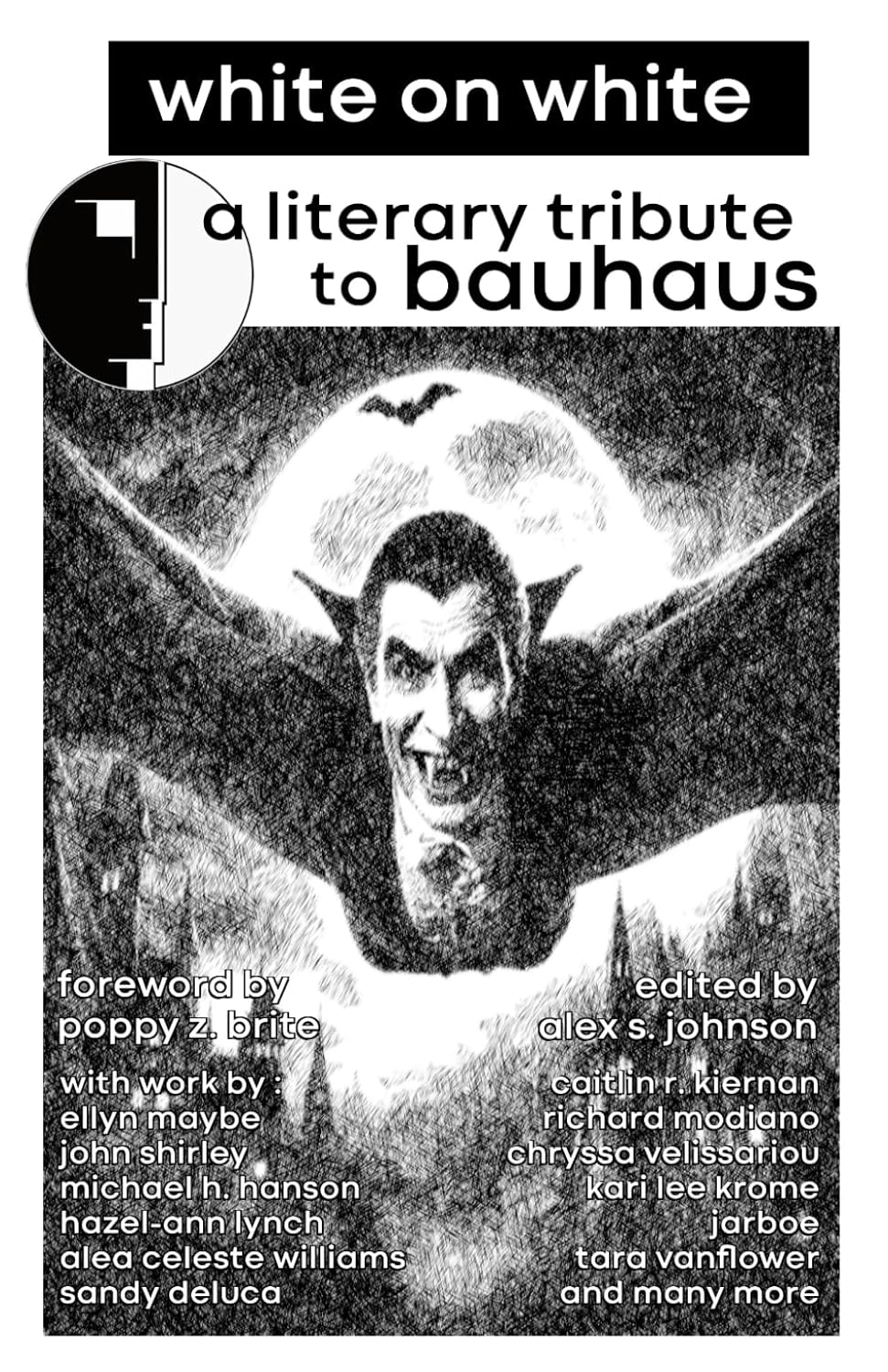
With the 1979 album “Bela Lugosi’s Dead,” British rock band Bauhaus thrust themselves firmly into the goth-rock scene. The anthology “White on White,” edited by horror writer Alex S. Johnson and released nearly 50 years after Bauhaus came together, pays homage to the spirit of the band and the broader Gothic sensibility.
“White on White” contains a mixture of poetry and prose in various styles and genres. Writers from different national backgrounds and literary traditions, including several whose work has been translated into English, contribute to a mashup of different sensibilities. Some poetry addresses the experience of listening to Bauhaus and plays off of song titles, others are more impressionistic takes on the band’s themes and aesthetic.
Common threads include shaky and fluid personal identity. In one piece, just the touch of pills on the ground obliterates and transforms a character and his dog, a young woman loses herself in her romantic obsession with a strange pale man and his diary, a man steals another’s train ticket and finds the other man’s face staring back at him through a mirror. Many characters live on the margins of their world, people who wouldn’t normally serve as main protagonists. One narrator is a groundskeeper on a historical estate of immortals, another is a lovelorn woman in her forties seeking oblivion and companionship in goth clubs, yet another has her last wishes disrespected on the day of her funeral.
The anthology probes power dynamics and the corruption that can come with extreme power imbalances. In one story, a woman with a gift for healing helps many, then carries out destruction after becoming world famous. In another, a clever grad student turns a spelunking expedition into spooky revenge on a professor who has exploited and discarded a string of women. The uncanny and supernatural sometimes become means for achieving justice, other realms where those who have been excluded or wronged can defend themselves. We see a murdered woman’s son, reincarnated through biotechnology, poetically avenging his mother, and a murderer whose goth-girl love interest sets him up to be arrested. One man seeks to destroy his own kind after realizing that he is something much scarier than the drug dealers and criminals who surround him, hoping to eliminate the threat he poses to innocent humans.
“White on White” takes place in a variety of settings. Inspired by Bauhaus’ music and the 1939 Dracula actor Bela Lugosi, we see a selection of tales within goth clubs and old buildings at night where vampires tend to lurk. Other pieces, though, are set within a biotech future where guitars and bedrooms come alive, in urban settings such as Little Italy, within caves rumored to hold Indiana Jones-style ancient relics, and an ordinary apartment building where a young female academic befriends an elderly gentleman with an active mind and tenuous grasp on reality.
These pieces blur the boundaries between the past and the present. People’s pasts catch up to them, people forget and remember who they truly are. History, memory, and decay show up as continual motifs: there’s a whole town of empty, dilapidated buildings, a dis-used broadcast tower in the midst of a shiny new city, and a radio station where a late night DJ plays Bauhaus and encounters the ghost of a guest murdered long ago in that room.
We see the interplay of past and present most clearly in a story near the end of “White on White,” where an aging actor dreams up the final performance of his career in a theater that’s now unused and decrepit. From his chair in his senior care home, this experience allows him to look back over his entire life and find meaning in all of his memories. He achieves his lifelong dream of acting where he saw his first old silent movie with his parents.
The Goth aesthetic is often linked with death in people’s minds, but this story is a celebration of life, all the more poignant by the protagonist’s acknowledging his mortality. This entire anthology embraces the grotesque, the marginal, the deathly, the traumatic, and the just plain weird with openness and curiosity. By doing this, the writers and curator point to an expansive world where there’s room for all sorts of people and where we can look beyond our fears and our pasts to fully welcome ourselves and each other.
White on White: A Literary Tribute to Bauhaus is available at your local bookstore through Bookshop.org.
It includes original pieces by such rock stars as Kari Lee Krome (The Runaways), Athan Maroulis (Spahn Ranch), Tara Vanflower (Lycia, Type O Negative), pieces by Bram Stoker Award-winning authors John Palisano and John Shirley (who also wrote The Crow screenplay and songs for Blue Oyster Cult), former Swans co-leader Jarboe, Caitlin R. Kiernan (two-time World Fantasy and Bram Stoker Award-winning author, Nebula award finalist), with a foreword by Poppy Z. Brite, the iconic author of Exquisite Corpse, and much more. The anthology is endorsed by David J. Haskins, the founding member of Bauhaus and Love and Rockets and writer of the song “Bela Lugosi’s Dead”; Haskins is also a Nocturnicon Books contributing author.