
a painting i did (not) finish

walking into my room
those i know always stare at
a girl trapped in the gray canvas
yellow bonnet covers her brown hair
that two sides show two individuals
her with a sky-blue dress
with wrinkles from the hot sun-day
but what they wonder
is why she has no face?

i tell them:
do you know about a girl
whose face a tone of mud
a neck colored with the noon sun
and white hands that
resemble caucasians?
do you know about a life
of black, of yellow, of white
intertwined
a product of differences
that belong to no home?
she has no faces
she has no races
she lives in the shade of her own
hands hugging one another
for support
for reassurance
but they are still searching for something
in this murky liquid
she is standing in the water
she is drowning

or instead, you can say
i don’t know how to draw a face
or how to finish the dress
that my little stupid story
is covering up for the lie
for why her skin has three colors

i guess you should know better
about a girl who has no face
because in real life
she has no face, either
search for her in the dark
search for her in the water
has she blended in
or is she waving in vain?


Bach Le is currently living in Hanoi, Vietnam. From young, Bach has had a deep interest in poetry, shown through his works in both written poetry and poetry slam. Through poetry, Bach unveils his insights in life, across topics from love and self-identity to grief and loss.
Category Archives: CHAOS
Essay from Dinora Amanbayeva
Mother
No matter the language, when I say “mother,” a vision of a pure angel comes to mind. In children’s upbringing, the mother’s role is paramount. A mother can take on the role of a father too, which is perhaps why paradise is said to lie beneath mothers’ feet. A mother is a noble being who sacrifices her life for us without asking for anything in return. Even in tales, when asked who should be pleased first, the answer is the mother, with the father mentioned third. A mother’s love, her embraces, and her radiant face are like the sun, her magical hugs are given without any expectation. I love my mother just as she is. My mother is unlike any other in the world. I can’t compare or describe my mother to anyone or anything. For me, she is unique; she is Mother.
You know, a mother raises her child with such upbringing, nurturing them to be knowledgeable and well-mannered. This is primarily due to the mother. If every woman and girl is educated and becomes knowledgeable, it benefits the entire nation and ensures their children are also educated, develop, and see the world. Mothers are extraordinary beings, with pure and radiant faces, which is why they are called “heavenly jasmine” and “angels of paradise.”
Mothers have a unique feeling that no one else has, the feeling of motherhood. Even when their child has grown up, to a mother, the child always seems small. She advises, “Be careful,” and prays with open palms, “Oh Allah, please protect my beloved child.” Even if we unintentionally speak harshly, a mother remains silent, swallowing her pain and wiping her tears with her scarf. Despite this, she still worries and cares for her child. A mother is incredibly strong and patient. She raises her children, ensuring they become scholars without letting them toil in the fields. A mother’s prayer is a miracle; only she can perform this miracle. Do you know? Many mothers lie, saying, “My child, I’m fine. Yes, I have everything. Don’t worry, I haven’t struggled; my stomach is full; I’m fine,” to soothe their child’s heart. Yet, the child senses something is wrong, abandons everything, and goes to see their mother, receiving her prayers. Such children are the happiest because their mother is alive, and they always receive her blessings.
You may have respected friends, partners, many employees, cars, wealth, and a house, but if you don’t visit your mother and receive her blessings, what kind of child are you?! Mother, I have shared my thoughts with you, but I have never asked how you feel. I have been too busy with my own affairs and friends to have a conversation with you. Please forgive your daughter who has begrudged you for even two minutes while talking to friends for hours! If you said something, I would respond, “Mom, I’m not a child,” hurting your feelings. Forgive your daughter who has grown up but still needs your love.
A mother always helps others, with a pure heart and a kind soul. However, a mother also wants to share her pain with a close child, to talk, to spend time together, to eat together, to go on a trip together. In a family, a mother and father might love a child differently, often spoiling them more. For example, in families, the youngest children or the only son or daughter might be spoiled. However, the eldest child usually carries more responsibility. As the youngest in my family, my parents’ love for me was different. A mother is the only being on Earth who embodies the love we see and feel.
I read an interesting story about Thomas Edison and his mother. When moving to his new home, Thomas carefully inspected every inch of his childhood home and asked the servants to carefully load the belongings into the truck. From the top of the closet where his childhood clothes were stored, he found his mother’s favorite red-covered suitcase. Thomas carefully placed it on the table and opened it. Among his mother’s belongings, he found a yellowing paper. This letter, signed by his teacher, reminded him of a memory involving his mother. At that time, Thomas was in first grade. That day, he brought home a letter from his teacher, who had instructed him to give it to his mother. Tears welled up in his mother’s sorrowful eyes as she read the letter, then she hugged her son. “What did my teacher write?” the curious boy asked his mother. “She wrote that you are extremely capable and that this school is not suitable for you, so she asked me to transfer you to a prestigious school,” his mother replied, trying to smile.
Thomas read the timeworn letter found in the suitcase and was astonished. It said, “Your son is mentally ill. Please enroll him in a specialized school.” Signed by the teacher. This story shows that every mother is her child’s hero. A mother always wants her child to be happy. The nights spent without sleep, nurturing and raising the child, are all due to the mother’s efforts. A child can never repay the debt to their mother. Only a mother can make life feel different. When a child doesn’t want to talk to anyone else, they can talk to their mother for hours because she understands them. Mothers deserve to be happy! The feeling of missing a mother is well-known to children living far from their mothers. Even if she is not with me, I remember her words and miss her love. I love you very much, mother. They say that the gates of paradise are open to parents who educate three daughters. Educating one daughter is like educating the entire nation. Mother, I owe you everything, and no matter how many times I say thank you, I can never repay this debt.
In the book about the mothers of great scholars, it is mentioned that the mothers of these scholars, even after the fathers’ death, took care of both financial support and the upbringing of their children. As a result of years of hardship, Imam Ahmad, Imam Bukhari, and many other great individuals emerged. This book tells the stories of how these noble individuals’ mothers raised their children. In a family, the mother’s unique role cannot be replaced by anything else. Every mother should spend her time and efforts raising her children to be great individuals for the future. The great Uzbek poet Abdurauf Fitrat emphasized the importance of family in the development of society and the prosperity of the nation in his work “Family.” He stated that the happiness and honor of every nation depend on the internal discipline and harmony of its people. Wherever family relations are strong, the country and the nation are equally strong and magnificent. Therefore, family tranquility is linked to maternal upbringing. Alisher Navoi, another great poet, emphasized that respecting parents is a form of upbringing. He said, “Sacrifice your head for your father, and give your entire body for your mother’s head. If you want both of your worlds to be prosperous, obtain the satisfaction of these two people. Consider one as the moon and the other as the sun, lighting up your day and night.” A child’s growth into a healthy, knowledgeable, and courageous person depends on the family environment and the mother’s influence.
Mother! A mother in the world makes life different. Her warmth and love make life special. Even if I reach ninety or a hundred years, living in a world with a mother is different. Mothers live thinking about their children, praying day and night for their happiness. Those without mothers cannot stop crying. Having a mother in life makes everything different. Having a mother by your side is different.
As I read this poem, I realized that a mother’s prayer is always accepted. A mother is unique and cannot be compared to anyone else. There are different kinds of children; some are indifferent to their mothers, some carry their mothers on their heads and receive their blessings, while some long for a mother’s love. So always remember, you grew up knowledgeable and well-mannered because of your mother. A mother’s love never fades. It shines like the sun, always radiating light. Thanks to such wonderful women, mothers, and daughters, life is even more beautiful.
In conclusion, wealth, friends, and success can be found, but if you hurt your mother’s heart and cannot give her love, what kind of child are you? A mother thinks of you while not eating herself. Go visit your parents, bring them two pieces of bread, and see how happy your mother will be. You will understand the sleepless nights and the difficulties your mother faced only when you become a mother yourself. You will realize how important a child is and how much you need their love. Never sigh or get angry at them; you will regret it when you grow up. The first place of education is the family. A child learns everything from their mother first. A mother’s upbringing is crucial for every child, especially for daughters. A mother’s love, her advice, and upbringing are vital in the family.
Amanbayeva Dinora Botirbek qizi resides in Gurlan district, Xorazm region. Her creative works have been published in Alanya, Turkey, and in a Moldovan publishing house in Europe.
Poetry from Zarina Rizoqulova
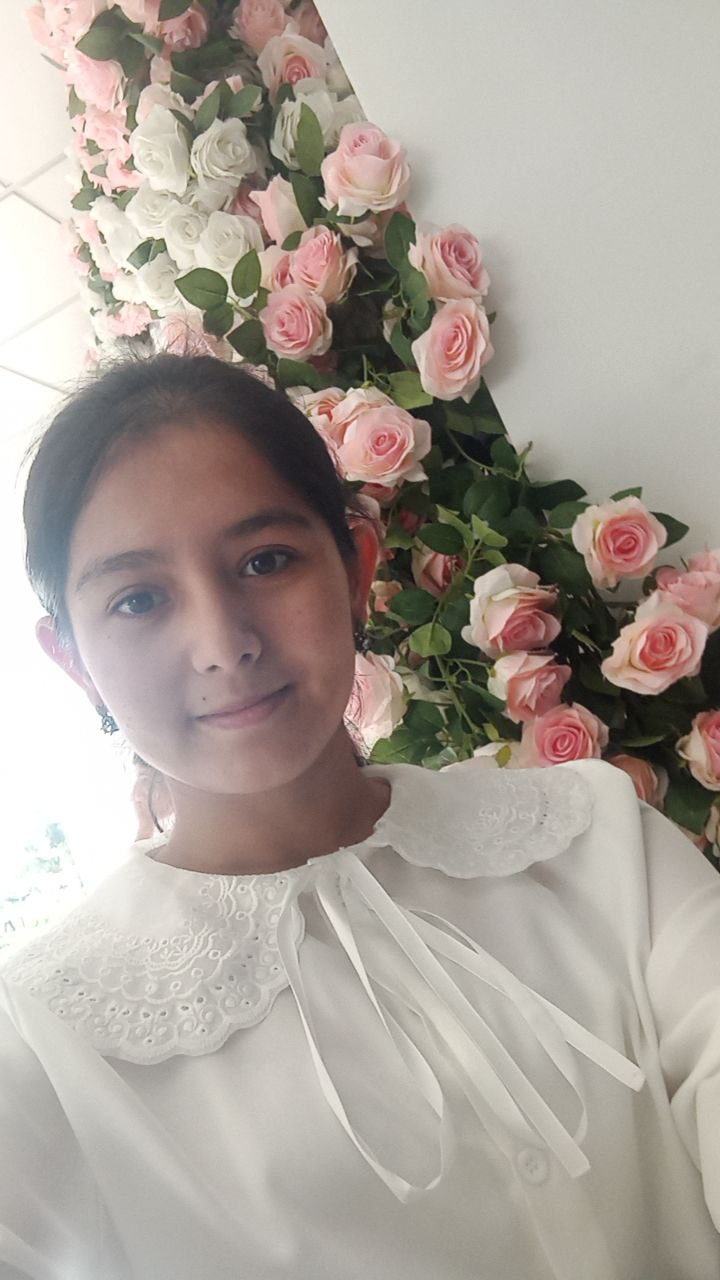
In the Heart of Tradition
In the heart of Central Asia’s gleam,
An Uzbek woman, like a dream,
Grace and strength in every stride,
In her eyes, traditions reside.
Her silken dress, adorned with care,
Reflects a history rich and rare,
Patterns woven through time’s thread,
In each design, stories spread.
She dances with the winds of time,
Her laughter, like a bell’s sweet chime,
From dawn’s first light to evening’s shade,
In her hands, the world is made.
With a heart both fierce and kind,
She holds the wisdom of her kind,
Her spirit, like the mountains strong,
In her love, we all belong.
Through fields of cotton, sunlit bright,
She works with passion, day to night,
Nurturing the land and kin,
In her toil, life’s rhythms spin.
Her voice, a soothing lullaby,
Whispers secrets of the sky,
Legends of the ancient past,
In her words, they ever last.
An Uzbek woman, proud and free,
A symbol of resilience, she,
In every heart, her story flows,
A timeless tale that always grows.
From the city’s bustling markets wide,
To the tranquil village’s side,
Her presence, like a guiding star,
Shows us who we truly are.
Zarina Rizoqulova was born on August 31st, 2004, in Bukhara region. She is currently a student at the Pedagogical Institute of Bukhara State University. She is very passionate about creative pursuits. In her free time, she enjoys writing poetry, short stories, and articles.
Essay from Ismoilova Sevinchoy
A dream and a goal
Many people think that a dream and a goal are the same thing. But they are wrong! The dream is different, the goal is different. Let me explain to you about dreams and goals.
Dreams are wonderful things that fit our imaginations but don’t come true! A goal is something that will definitely come true after a little effort.
A dream will not come true whether it is tried or not, it will remain as a dream in its own name.
Some of our goals remain only in our imaginations. And you may be wondering why?
Because unwritten goals remain dreams. This is because the human mind has 70,000, 80,000 and even 100,000 thoughts. That’s why you should write down your goals in a notebook. Goals written in the notebook can be achieved. But don’t think that I wrote in the notebook and now it will come true!
In order to realize our goals, we will have to make some effort, work on ourselves, and get new knowledge. Writing a goal has its own rules, let me tell you about it!
First:
Too many people are afraid of setting big goals and dreaming. In fact, we should set big goals without fear at all. Because God does not imagine what He does not give!
The second:
Overcome lust, egoism, envy and arrogance!
Know that you cannot achieve your goals if you do not overcome your ego.
And the third:
Get rid of hatred, revenge, anger and loss!
Why do you say?
Because if you have feelings of hatred, revenge, anger, jealousy towards someone, these goals will not be yours and you will achieve them with difficulty.
What I listed above were the 3 most important rules for goal setting and goal writing.
Do you know why we set goals?
Because the money that comes to us also comes based on a specific goal, in accordance with our goals!
My advice to you is to never stop working towards your goals! Believe in yourself because you can do it all.
Poetry from Taylor Dibbert
Fort Safeway
The Safeway
Near his apartment
Now has
Several kinds of barriers
Inside the store,
He’s learned that
This has been done
To make it harder
For people
To shoplift,
A sign
Of the times.
Taylor Dibbert is a writer, journalist, and poet in Washington, DC. “Rescue Dog,” his fifth book, was published in May.
Poetry from Sadoqatxon Ahmadaliyeva
Ode to Parents
In the dawn of life’s first breath,
With love as deep as ocean’s depth,
Stand our parents, strong and true,
Guiding paths for me and you.
Father’s hands, worn and wise,
Hold the stars in endless skies,
Teaching strength, instilling pride,
With gentle words and a steadfast stride.
Mother’s heart, a beacon bright,
Glows with love, purest light,
Her tender care, a soft embrace,
A sacred bond time can’t erase.
Through the storms and sunny days,
In their gaze, a timeless blaze,
They nurture dreams, dispel our fears,
With whispered hopes and silent tears.
In their laughter, warmth we find,
In their patience, hearts aligned,
Their sacrifices, vast and grand,
Shape the future with a loving hand.
For every night, they stayed awake,
For every tear, they chose to break,
Their selfless love, a boundless sea,
An endless source of strength for me.
So here’s to parents, pillars strong,
In our hearts, where they belong,
Eternal guardians, steadfast, near,
Their love, a treasure, everclear.
Sadoqatxon Sabirjon qizi Ahmadaliyeva was born on January 12, 2008, in Uzbekistan. She is currently an 11th-grade student at School №32. She is learning English and Arabic. She has a passion for history and has read many books on the subject. This year, she received a certificate for successfully participating in the pilot testing process for the PISA international research.
Poetry from Sobirjonov Dilmurod Toymurodovich

A Mother’s Eternal Embrace
In the cradle of the dawn’s soft light,
Where dreams are woven through the night,
There lies a love, both pure and deep,
A mother’s heart where angels sleep.
Her hands are gentle, yet so strong,
A balm for sorrows, a soothing song,
In every touch, a world is found,
Her love, the ever-constant ground.
Through sleepless nights and days so long,
She carries burdens, sings a song,
Her whispers calm the storms inside,
In her embrace, the world’s at guide.
Her eyes, a mirror of the skies,
Reflecting hope, where sorrow flies,
With every tear, a lesson shared,
In every laugh, a heart repaired.
She builds a haven, warm and bright,
A beacon through the darkest night,
Her love, a fire that ever burns,
A light for every heart that yearns.
In every word, a promise true,
Of dreams fulfilled and skies of blue,
A mother’s love, so vast, so grand,
A timeless touch, a guiding hand.
So here’s to her, both near and far,
The quiet strength, the shining star,
In every heart, her love does grow,
A mother’s love, forever aglow.
Sobirjonov Dilmurod Toymurodovich was born into an intellectual family in Vobkent district, Bukhara region. He has a strong passion for creativity and is constantly supported by his parents. He enjoys writing poetry, short stories, and ghazals. His works have been published in numerous newspapers and magazines. He has participated in countless competitions and won many prestigious awards.
He is growing up to be a dedicated individual ready to sacrifice his life for his homeland. He will raise the name of his nation, Uzbekistan, to new heights, as it is his duty. The blood of his homeland flows in his veins. He aspires to be a soldier and grow into a brave and courageous son who will make the glory of Uzbekistan a legendary tale.