Water As a Gift to Life

Water as a ritual symbol of baptism,
A man plunges into the river, vows to the priest to leave his old habits
And emerges sanctified with a prayer
Water as the source of life,
The first morning bath and salutation to the Sun,
The first glass of water as the most precious drink,
And the last meeting with ritual water when a person dies,
He leaves bathed to return to the beginning of this story...
A soul is born into a new body,
While the doctor after the birth of the mother bathes the child
And congratulates the mother who drinks a glass of water with a smile on her face.

Lesson

Everything in life is like a wheel of fortune and misfortune.
Everything changes and is not permanent, our inner attitude is important,
That it is a show for our eyes,
A test for the mind and heart
And above all a great lesson.


Maja Milojković was born in 1975 in Zaječar, Serbia.
She is a person to whom from an early age, Leonardo da Vinci's statement "Painting is poetry that can be seen, and poetry is painting that can be heard" is circulating through the blood.
That's why she started to use feathers and a brush and began to reveal the world and herself to them.
As a poet, she is represented in numerous domestic and foreign literary newspapers, anthologies and electronic media, and some of her poems can be found on YouTube.
Many of her poems have been translated into English, Hungarian, Bengali and Bulgarian due to the need of foreign readers.
She is the recipient of many international awards.
"Trees of Desire" is her second collection of poems in preparation, which is preceded by the book of poems "Moon Circle".
She is a member of the International Society of Writers and Artists "Mountain Views" in Montenegro,and shealso is a member of the Poetry club "Area Felix" in Serbia.
My home has mastered the act of wearing the devil as a character
Everything here is a shadow of another body
                                                                                 even the night  comes in the mask of hell at the sight of dawn
we mastered saying goodbye faster than
                                                                                        living my father is a chapter of a grieving testament where everything
darkens so we'll we mold ashes out of ourselves.
                                                                           The news headlines flaunts a girls who crawls slowly into dust.
I fear I might be after her. My mum says much about
                                                  contentment so I teach myself how to love my country. Suddenly I remember

broken things doesn't love. I have thought myself how
                                                                       to crawl into love by spelling it backwards. On the highway a young boy teach
me how to pray before his body kiss the soil but I fear
                                                                          that a prayer is a torture to my tongue, I do not wish to trade my words for                            emptiness.
Faith

We are here to believe
To share our dreams
To share our verses
Our beautiful soul

We are here to cooperate
To feel
And bring happiness
Security

We are here to make our dreams in reality
We Are here to respect
The nature

We are here
We follow our intuition

We are here for a better world

Wishing all
To love themselves first
To love each other
To give

Better give than receive

That makes us better person


Peace

I like the colour of the nature
Is pink and green and blue

I like the dreams that comes to my sleep
Smiles at children's faces

I like the creativity that brings me so much hapinnes
Poems and stories travel like birds

Feel like a child
Feel free

I like the colours of the rainbow
I like the rain
I like the sea

This is the  peace for me
People from so many different countries
That became my brother and sister...


A book

A book open his pages
A boy start to read
And heroes come out of the chapter

Weapons start to make a noise
Bombs Was coming down to buildings
School were vanished

The boy start to cry....
Nobody could hear it

They were all occupied to count their small green and blue papers. .
So much paper
So many bombs
So many people occupied from the nothing ...
That comes and destroy
Everything...

The boy closed the book...

He took another one
And he starts looking the beautiful illustrations
So Many flowers
And strange fruits
And a lot of animals that were sitting
 just around a big lake.

There was a forest also with big trees
And a big mountain

The chapter had a title:

_The peaceful world of
Olivia_

The boy continue to read
and that afternoon was the most amazing time in the world..


Biography

Eva Lianou Petropoulou is an awarded author and poet from Greece
with more than 25 years in the literary field who has published more than 10 books. Her poems are translated into more than 15 languages.

Eva Lianou Petropoulou is President of of Mil Mentes Por Mexico Association represent Greece.

She is a member of the International Association of Authors and Artists in Greece, a member of the Association of Korinthian Authors and a member of the Association of Authors and Artists in
Pireas.

She is the President of Global UHE Peru for Greece, the World Ambassador of the University of Ethics in India, a Member of the
Academy of Farsala, a literary agent in several magazines, a member of the editorial board of Olas de l arte Magazine, an Ambassador of Namaste Magazine in India, representing Greece.
Welcome New World!

The most innocent emotions belong to humans,
But why did Adam's children change?
They gather and fill their treasures,
Their greed and stubbornness never fade!
The desire to be more prosperous, greater,
Their lofty ideals are empty illusions!
They shed no tears for the limits of competition,
A diffusion towards the end of mankind!
Every side, every corner is filled with sin,
Deadly diseases, epidemics prevail,
Disgrace does not bring honor,
Let drug addiction be eradicated!

 Let peace and justice be our future's name,
Let us maintain balance on the scales,
Where do millions and billions go,
Let us account for and scrutinize each expenditure!
Awaken, put an end to this ignorance,
Perhaps the bud will wither before it blooms,
Greedy ones, put an end to this insatiable hunger,
 Everything will be inherited by this world!
Place yourselves in the shoes of the poor,
See how it feels to be without support,
Learn the pain of impossibility,
To be denied everything you witness!

The genes of food and fruits are manipulated,
Animals are injected with harmful substances,
Infants are born sick, abnormal,
They suffer the horrors of life!
Nature lovingly caresses us,
As a sole consolation to humanity,
Let us not distance ourselves like ungrateful children,
This opportunity will not be given to us again!
Let us gift the world a radiant smile,
Let us say no to war together!

May the innocent faces of children shine,
Let the earth not be left to wickedness.
Let us say to the world, with laughter,
That no one is afraid anymore,
We will not surrender the world to the headless tyrant,
Let his vile desires remain in his heart!
In this world, there are countless nations, peoples,
Each has its own native language,
In every language, there are countless words,
With deep meaning and profound wisdom.
Words cannot be measured,
Each one is like a unique pearl,
There is no equal in the world,
The elixir of kind words soothes the soul!

Let us write melodies with honeyed words,
Far from hatred, anger, and rage,
Let us erase fearful dreams with benevolence,
And create smiles and joy on faces!
Come, masters of words, army of poets,
Let us create a brand-new world once again!
May the fragrance of peace spread everywhere,
Together, let us compose the anthem of the world.
The world does not belong to you,
Nor does it belong to me,
The world belongs to each and every one of us!
 Let us live with conscience,
With love, with respect,
Let the world revolve,
With faith in the future!
Welcome New World!

07.07.2023.


Elmaya Jabbarova - was born in Azerbaijan. She is a poet, writer, reciter, and translator.
Her poems were published in the regional newspapers «Shargin sesi», «Ziya», «Hekari», literary collections «Turan», «Karabakh is Azerbaijan!», «Zafar», «Buta», foreign Anthologies «Silk Road Arabian Nights», «Nano poem for Africa», «Juntos por las Letras 1;2», «Kafiye.net» in Turkey, in the African's CAJ magazine, Bangladesh's Red Times magazine, «Prodigy Published» magazine. She performed her poems live on Bangladesh Uddan TV, at the II Spain Book Fair 1ra Feria Virtual del Libro Panama, Bolivia, Uruguay, France, Portugal, USA.
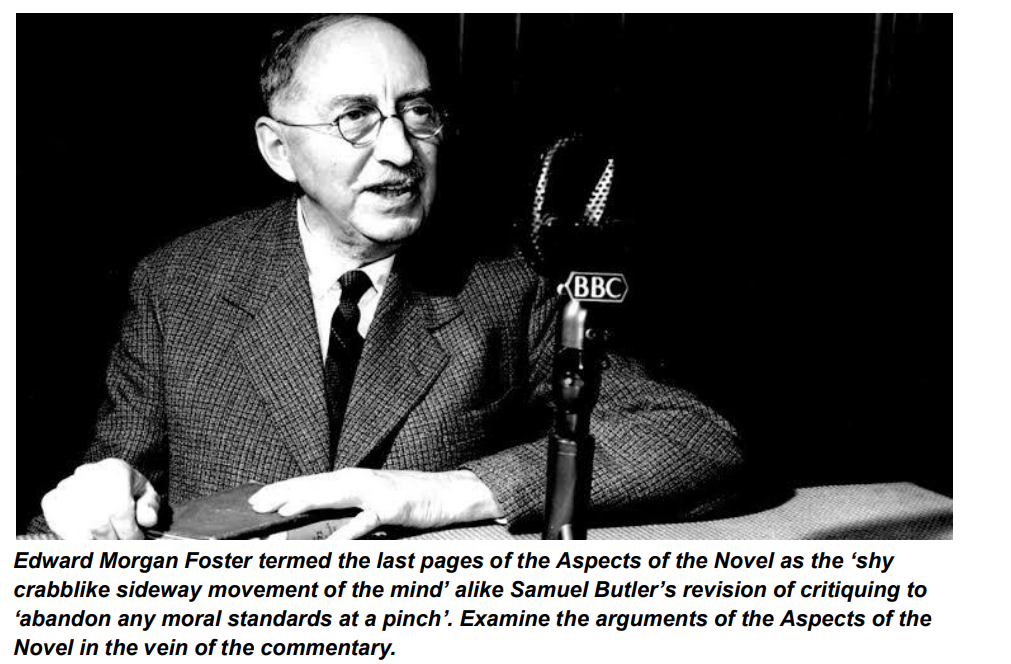
Forster was a story teller of diminuendos and anticlimaxes, as pointed out by Katherine Mansfield in the lines, “Forster never gets any further than warming the teapot.”
EM Forster highlights the radiant grandeur and majestic wonder of the Greek literature that tends to be both aesthetic and ethical and imitative in the mimetic of both individual and social realities which blends a combination of beauty and depth, wit and wisdom, gaiety and insight, speculation and ecstasy, carnality and spirit.
EM Forster’s crucial crux of characterization and incidents are touchstones in the arrangement of plots as sequences of events in their time sequence bereft of spatiotemporality, periodization or historicity. In fact, Aspects of the Novel, is the critical examination of the eclectic literary critic in the immersive objectivity and sympathy of the narratives’ dramatis persona and the narrative multiplicities featuring those timeless classic masterpieces or avant gardes that encompasses and engenders architectural unity and preordained form.
The self confessed literary critic expostulate nineteenth century romanticism, aestheticism, symbolism, impressionism in the humanistic and liberal attitudes in the late world war I and the aftermath of the early world war II decades. Forster asserts the significances of a central theme or idea in the literature as evidenced in the passage: “When a book is written round a central idea, it gains unity that is denied to its more discursive brethren, and this Norwegian novel stands out among its English contemporaries much as a man that has something to say stands out in a crowd of chatterers. Its characters are sketches, and the plot does not exist, but the central theme gripped by the author, grips the reader and leaves a profound impression behind.”
EM Forster critiques Sir Walter Scott as idiosyncratic and wayward more than order because of moral and commercial tastes contrarieties in the 1980s art for an art’s sake movement. On the contrary, Virginia Woolf, triumphs from the distortion effects of aestheticism owing to her comical sense and creative zest. Poetry is enchanted garden much more like the spiritual armory in the words of Mathew Arnold as eternal engravings in the creator, spectator and readers alike, resonating Shelley’s commentary, “beautiful idealisms of moral excellence.”
Emily Dickinson’s poetic verses and musical lyrics in the prose works contrasts with Austenean realists fiction in the literary imaginative landscapes of the readers’ mindscapes and the momentary transformative external environment of the appreciative individual. Forster was also undoubtedly thinking of Dickinson when he viewed Dickinson as one who loved the Ariel world of the spiritual repose and aesthetic emotion but cannot remain in it because Caliban had to be tamed, Antonio reformed and Prospero restored to his rule. ‘A true novelist observes the realities and describes them dispassionately.”
In ‘Anonymity’ Forster expresses that literature not only lectures the outward and rational but also the subconscious, the reality that lies within the center of the individual personality. In this sense, social and political realities should be lesser important than the aesthetic effectiveness. Forster deplored the fascist Nazi censorship since the epoch resulted in ‘uniformity’, ‘monotony’ and ‘spiritual death’.
Nonetheless, Forster tells us of the literary tradition to be the borderline between history and literature in the Aspects of the Novel. To him, the best critic will have spent much time exploring that territory in order to augment his knowledge of literature. Leo Tolstoy’s novels are an omnibus of complex plot intricacies and characters of psychological complexities that for subtlety were ambiguous because of inconsistencies and violation of the probability to Forster.
Fantasy is the featured as alternative to realism in fiction and upholds resemblances to the symbolic alternatives to desires and identities———-metonymic for orgasmic terms such as choking or thrilling readers even to this degree of maturity in accord with obscenities, oddities and queerness. Fantasy is a doubled natured and gendered beast expression some of the alternative interpretations to realities in the vein of supernaturalism and mysticism that can take the androgynous guise.
The Edwardian epoch heralded the familiarity and popularity of fantasy fiction from folklores and folktales and folk fables or fantasy tales inhabited by satyrs and nymphs of the magical woods. Fantasy and prophecy are together diametrically polaroids of alternative interpretations to realities. In this sense, fantasy and prophecy are illuminators and intensifiers of the material world, sedulously dusted by the hands of common sense, manipulated by the beam light in the more vividness than mediocrity and domesticity by the fantasist and the prophet. For instance, Tristram Shandy and Moby Dick are diametric axis of fantasy and prophecy. Northrope Frye claims that “fictions in the last generation or so has turned increasing from realism to fantasy, partly because fantasy is the normal technique for the modern fiction writers who do not believe in the permanence or continuity of the societies they belong to.”