“If you aren’t outraged, you aren’t paying attention!” – Anonymous
Many a bumper-sticker, t-shirt and poster have been emblazoned with the above statement, and many poets, pundits and politicians have used the expression to embody their ideal of the way the world should be, in some way or another – but in reading Dee Allen’s “Unwritten Law”, I see something more than just a glib reference to that aforementioned outrage. I see its very embodiment, sincere and unflinching, in this collection of extremely provocative and well-written poems.
The introduction by the writer describes the first-hand corruption and racism Mr. Allen experienced from early childhood through adulthood, in Atlanta and San Francisco, and doesn’t shy away from making his opinions on law enforcement clear, even before the title poem, “Unwritten Law” makes that abundantly clear, with such openly aggressive lines as “The only good cop that lives is/a bad cop who keeps his mouth shut.” Though my initial reaction to this particular piece was one of anger and discomfort (as I have known several police officers personally), I also tried to keep an open mind, realizing that this level of anger and distrust was a result of a life experience much different than my own, and that such heated bursts of emotion may be exactly the call to attention the writer is trying to create. Such words don’t just entice, but outright demand the eyes and ears of those who would rather look away from the darker deeds of those in power than face the dirtier, uglier side of life that the disenfranchised and marginalized members of our society have no choice but to face head-on, on a daily level. He writes of wrongs in not just our own still-evolving society, but in other parts of the world as well – from North Africa to Wisconsin, Egypt to a Georgia prison cell, never shying away from calling out the unjust treatment of others, nor the indifference of those with the power to rise to their aid.
Then, somewhere in the midst of all this anger and outrage, there is a gratitude and love of life peeking through, like momentary pauses of sunlight in a dark and turbulent storm. In “Downpour”, he laments the suffering of the urban homeless in the storm, yet remembers to feel the appreciation of a dry blanket and a hot tea in his hands. In his poem “Rustwalker”, you see how the power of art can bring forth a sense of admiration and awe, though it’s left to the reader to decide whether such admiration was for the statue itself, or the city surrounding her. In “Game” he dares those suffering injustice to take an active part in fighting against oppression, and recognizes the latent power of the individual against seemingly insurmountable odds. While the aggression in some of his poems can be disquieting to say the least, the undeniable assertion that EVERY person deserves to have their basic needs met and their human dignity intact should (hopefully) be something that everyone can agree with.
These thought-provoking portrayals of corruption, struggle, rebellion, perseverance, and yes, even the scattered glints of hope, are presented in a simply-bound publication by POOR Press, a non-profit arts organization that provides media access to low and no-income adults in the Bay Area. For more information on this collection, Dee Allen, or Poor Press in general, you can visit them on the web at www.poormagazine.org. Allen’s previous book, “Boneyard” can also be purchased there.
After my first article, a lot of you want to know: how exactly do you follow your life’s passion? So, over the next few months we will cover every step you need to make it happen. Some steps will be simple, others will require a life time of practice, but they will get you results.
We know that we want to create this dream job, but beyond that we want to create a dream career, something sustainable long-term. We know that this creative force is what will drive the American economy into a new era of innovation; the overall happiness of the workforce will make growth and ingenuity a permanent state, and by carving out new niches in existing and emerging markets we create stability for the country as a whole. This is the theory behind our drive. It is the ground below the house we are building. It is not the reason you personally want to achieve your goals, but it will affect your process. You, building in it, will change it, and it will change the way you build.
So, in building a house, the first thing you need is an idea. Great, we have that already! Now it is time to draw up the blueprints. In making blueprints, you must be perfectly clear in what you want. How many rooms, doors, walls, floors, and windows will there be? What shape will the structure be? Where will everything go? How big will everything be? What will it be made out of? You must address these questions as they apply to your goals as well.
First, create the most detail you can in your picture. Where are you, how do you feel, who else is there? Do you own something or are you working for someone else? Are you an employer? How many employees do you have? Do you have regular, flexible, or variable hours? How much money are you making? Do you work independently, collectively, or collaboratively with peers and coworkers?
This can seem like a very daunting task at first. There are a lot of questions to be answered. Start with the big ones and work your way to the little ones. Remember to put yourself in a world without restrictions! Write down your answers in a new book or keep documentation on your computer. You will probably need a folder or a three ring binder for reference materials too. Make sure you can edit past accounts and include references and visual aids when necessary. You will use this documentation to brainstorm, hold yourself accountable, and make plans. As with any big process it is important to stay organized. You will probably do a lot of reflection and research over the next few months and it is important to have ideas and information handy. The closer you get to achieving your goals, the more important this will be.
As an example of what to do, I will state my dream and refer to it in my articles.
“I want to perform for a living. I have been belly dancing for six years and now perform burlesque, aerial silks, and fire eating as well. I also have an interest in health, wellness, and fitness. I want to marry my interests in a beautiful, creative space. I want to create a place where people can explore a multitude of performance arts and fitness activities. I see this place as bringing physical, mental, emotional, and spiritual wellness together. I will make it a place where energy is tangible and change happens all the time. I will have employees that teach various circus arts, yoga, meditation, healing practices, massage, fitness classes, nutritional wellness, and more. I will provide products and classes at a reasonable rate so that the people who need these outlets most can afford them. I will shine in my own artistic endeavors and encourage students and professionals alike to express their true selves through performance. I will run a full time professional performance group. The performers will also teach in the facility. All of the performers will be well versed in at least two arts and be driven to expand on their talents endlessly. We will create and choreograph performances collaboratively and travel the world performing incredible works of art. This is my complete dream.”
The first question you should address is “what.” I stated my dream; that is exactly what I want. It is big, it is everything I want. Forget the fact that there are not enough hours in the day to teach, manage, practice, train, and perform; that does not matter. Define everything you want! This will be your house, the walls, floors, windows, and doors. I like to start here because it is the easiest thing to picture and will help develop the answers to the next questions.
Next, address the why. My “why” is because I want to live passionately, with no regrets. I want to honor the hard work of my immigrant grandparents by truly achieving the American Dream. I will achieve this goal because I believe that it is my way of giving back to the world, that I can make a lasting change through performance, that I can express myself and change people’s attitudes and lives by teaching and performing. I want to work hard because that will make achieving my goal worth the effort. I want to train hard to change my body and be the best I can in everything I chose to dedicate myself to. I want to feel good about myself and help others feel that way too. I want to empower people to make changes in themselves and the world around them. I want to say a lot of things through my work.
Your “why” is the foundation for your house. No one will see it, but without it the whole thing will fall to the ground. At a personal level, “why” is how you get through the hard times, the mornings you do not want to get out of bed, the afternoons when television sounds like a much better option than doing more work, the weeks that never end, the months when nothing seems to pan out, and the years when it seems the world has turned its back on you. “Why” is what not only gets you through it, but keeps you moving in a positive direction, keeps you on track to achieving your goals. When addressing why, keep how you feel now and how you want that to change in mind.
Now ask, who? Who is building your house and who is living in your house? My dream is about me achieving something. I am building it, but I am not alone in my dream. I have employees, are they people I already know? Is my family involved in my dream? Who is my audience? Who would I trust while I was performing to run the studio? Do I want to have business partners to help me build? Who are my students? Who performs with me or for me?
Next tackle where. Where are you building? Where does not matter much to me geographically, but the space I intend to create does. That is my way of answering where. Your whole goal might be centered around a ‘where’. Another answer to where for me is that I want to perform internationally. That leads to other questions, who is taking care of my space when I am gone, who comes with me? Do not be afraid to revisit questions and expand on them.
Next up is when. When do I want to accomplish my overall goal? Every good contractor has a realistic timeline. I want to be performing/teaching full time within five years and want to own my space within ten. This is a long-term answer. As we create more specific steps in our journey we will create shorter more manageable time lines. For now, be generous, there will be hiccups in your plans so give yourself a lot of wiggle room. If you do not have an exact time frame in mind you can create a more relative ‘when’; such as, “when the kids are grown and on their own”, “when I can replace my current income”, or “when I finish my degree”. These can be harder to stick to but can be refined down the road.
Finally, how? How will you build your house? What resources will it require? This is often the hardest question to answer and will be broken down into a million pieces along our journey. For now, try to make a general statement of “how,” something like, “By building a reliable network of performers, maintaining an exciting website, having dazzling promotional materials, and booking paid performances as a group and solo act I will achieve the ability to sustain myself and my group.”
You may not be sure of some answers, and other answers might not even seem like answers at all. Sometimes, the answer is, “That does not matter to me” or “I do not know yet”. That is OK. Remember, this is a process. Be sure to write things down so that as you develop more answers and questions you can keep track.
You have a whole month to think about these questions. You can answer them all at once or take them on slowly, whichever feels best to you. Just be sure to answer them authentically, do not sell yourself short because you think something is unrealistic, and do not rush through your questions. The more precise your blueprints, the faster you can start building. Keep your questions and answers handy next month when we will take stock of our reality and set our first concrete goals.
What death or sudden
stop of the tides
could feel worse than this?
Moment-to-moment
and back again,
eternity in a man’s body
hanging from the sun
the sun doesn’t move much anymore.
Nothing moves
except cargo trains
like endless vipers
carrying away my belongings
and the homeless ghosts
of my friends.
Our shadows remain behind
in a swarm of locust
eating the buildings of our city.
Nothing lasts forever
except for this
Autumn in the Winter
From atop the hill
over my house
I watched the summer
fade into winter.
There was no fall,
except for the sensation
in my stomach
where I felt it all
fall away, towards somewhere
deep and foreboding
inside of myself.
A whole season
no one noticed,
no one saw or felt
the hot air
turning the trees
into skeletons,
no one caught the sound
of windows shuttering
against the cold.
No one
was prepared
to bundle up.
We would all soon
be wrapping ourselves
in an early twilight,
deaf to the season
that we were too blind
to see
Look now:
the geese fading
into auburn sunsets,
the sweet rotting flesh
of jack-o-lantern faces,
the limbo between summer
and winter
has found a place
in the dried leaves
Poker
Cold and calculated,
a flick of the wrist executed,
a sleight of hand
and all the cards
on the table
have been taken off
and pinned
to the ceiling
from across the table
behind a thick veil of smoke
two sets of eyes
stare away
from the prize;
a new and different
treasure is sought
I make a move
among the statues
and granite pillars
juxtaposing a movement
without heartbeat
cheating, killing, stealing,
in the name of
my profit
A cold and calculated move
winning only to lose
a tact of mind
leaving only the heart
on the table
Sam Burks is from the San Francisco Bay Area, in California, and can be reached at srburks@gmail.com
Despite my childhood fancies, black holes aren’t about to scoop up the entire universe, or even everything in their paths. Dr. Jason Dexter of UC Berkeley demolished some common myths and provided some information about the mysterious objects during his volunteer enrichment talk at Oakland’s Chabot Space and Science Center.
Deep within the redwood forests of the Oakland Hills, the Chabot Space and Science Center welcomes museum guests and viewers for free Friday and Saturday night viewings through its three large telescopes. Used by professional astronomers, the two refracting and one reflecting scopes search out Mars, Venus, Saturn, and star clusters on the edge of our galaxy.
Chabot volunteers are encouraged to attend free science lectures, such as November 13th’s lecture from Dr. Dexter.
A black hole, according to Dexter, is simply an object in space so dense that even light that hits it cannot move fast enough to escape the pull of its gravity. Hence their name, since light does not reflect back to our eyes from black holes to allow us to see them. If our Sun became denser and exerted more gravity on our solar system, we wouldn’t necessarily get pulled inside it – just drawn closer. So, in the same way, plenty of black holes have stars stably orbiting them, at far enough distances not to be sucked inside.
Black holes result from the collapse of large stars, those greater than 25 times the mass of our sun. Stars 10-25 the sun’s mass become neutron stars, and those under ten times its mass turn into white dwarves. Also, giant black holes exist at the center of many galaxies, up to millions or billions the mass of the Sun. No one knows how or why these formed.
Astronomers and cosmologists can observe black holes by watching for changes in the velocities, orbits and accelerations of nearby stars. Also, material falling into a black hole forms a disc that gets very hot and glows as it crosses the edge, or event horizon. This enables us to ‘see’ black holes.
According to Dexter, “Black holes power the brightest objects in our universe. They’re extremely efficient at generating energy.”
For the rest of his talk, Dr. Dexter discussed current enhancements in our ability to observe black holes’ event horizons. Right now we view the effects of black holes through combined data from a global array of radio telescopes (California’s CARMA and observatories in Arizona and Hawaii). This group of scopes is known together as the Event Horizon Telescope. Researchers are building more telescopes around the world to add to this array, aiming to create sharper, higher-resolution images.
Scientists can locate black holes by noticing the Doppler Effect, where light appears to bend as it moves due to a large object’s gravity. Also, sometimes plasma jets of superheated matter escape from the glowing discs of particles about to enter a black hole. The Event Horizon Telescope has recently detected plasma jets from the area around the black hole at the center of the M87 galaxy, more than 50 million light years away from us. We had to look so far because the black hole at the center of our own galaxy appears too small to incite the formation of these plasma jets.
Dr. Dexter encouraged us to visit the website for the Event Horizon Telescope (eventhorizontelescope.org) to learn more about how we observe these objects, and to see some unique photos and animations.
This enrichment brought out a larger crowd, and everyone seemed engaged, peppering the speaker with plenty of questions. Afterwards, people stayed to discuss what had been quite a valuable and informative experience for those with all levels of background in astronomy.
Cristina Deptula is a writer from San Leandro, California. She can be reached at cedeptula@sbcglobal.net.
Loretta Siegel may be reached at 510-582-1717 and lives in Hayward, California. She encourages readers to attend the Hayward City Library’s book clubs and writers’ groups.
Presented within the flow of the lives of real people and fictional characters, this is a monthly exploration of how some parts of the brain work.
Becoming someone else…
by Leena Prasad
topic
neuroplasticity, i.e., brain’s ability to change
region
orbital frontal cortex, cingulate gyrus,caudate nucleus
Dear Doctor Neurostein,
When my 18-year-old daughter was home from college recently, I noticed that she has become extremely germophobic. This makes sense, given that she is currently studying microbiology and is more aware of the ubiquity of microbes in the environment. But her behavior seems excessive. She washes her hands frequently, which is not such a bad thing, but she is doing this as much as 10-15 times in an hour and she also showers three times a day. She wears a mask while holding her year old baby brother (okay, I’m not too concerned about this because it’s probably a good safety measure) and when she does any cleaning at all around the house. Even for common activities like using the television remote control or opening the front door, she uses disposable gloves.
I’m worried that my daughter has or is at risk of developing OCD. Can you please explain how OCD works and what are my options in terms of helping her live a normal life?
Sincerely,
Concerned Mother
Dear Concerned Mother,
This may be a temporary reaction to her new knowledge of germs, but if the behavior persists please consult a therapist for professional diagnosis and discuss the options for treatment.
I will explain the mechanics of Obsessive Compulsive Disorder (OCD) and one potential treatment based on studies conducted by the University of California Los Angeles psychiatrist Jeffrey M. Schwartz.
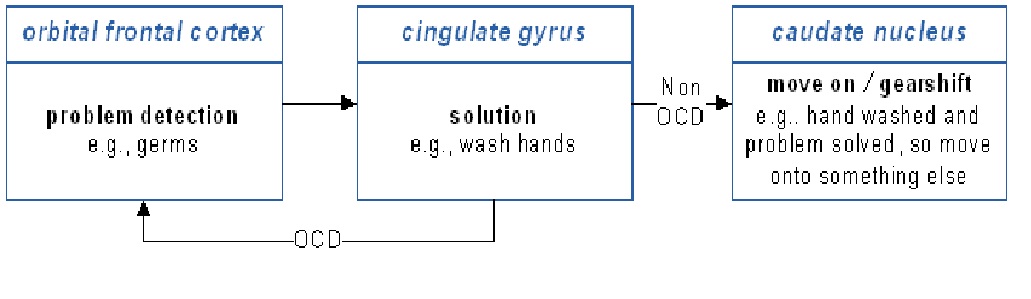
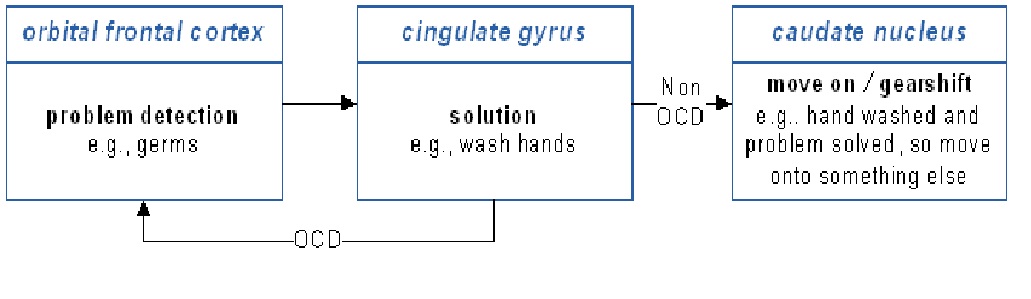
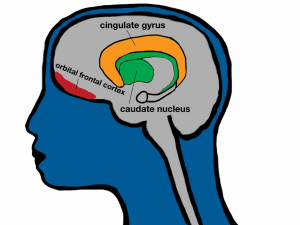
As per Dr. Schwartz, OCD occurs when there is a problem in the region of the brain that is responsible for steering a person from one thought topic to another. In people with OCD, the caudate nucleus, also referred to as the “automatic gearshift” of the brain, gets jammed.
Before the caudate nucleus gets the signal to move on, however, there are a few other things that happen:
The orbital frontal cortex detects a problem. The problem can be anything that is out of the ordinary. In your daughter’s case, it’s the existence of germs in anything that she might breathe in or touch.
The orbital frontal cortex sends a message to the cingulate gyrus. The cingulate gyrus is the panic center. It triggers physical reactions in the body to perform actions to alleviate the anxiety caused by the “problem”, i.e., washing to eliminate germs.
Once the person corrects the problem (e.g., by washing hands), the caudate nucleus is activated and moves the brain to a different thought. At this point, the orbital frontal cortex (1) and the cingulate gyrus (2) return to their normal state and the problem detection is inactivated since it’s no longer a concern.
In someone with OCD, step #3 does not occur, so steps #1 and #2 continue to occur in an infinite loop. In a non-OCD brain, all three steps occur and the brain’s organs return to their normal state.
Dr. Schwartz has developed a system which helps an OCD patient to break out of the infinite loop by causing step #3 to occur. His treatment encourages the caudate nucleus to move the person onto a different thought so that they break out of the compulsive cycle. His cure uses the theory of neuroplasticity. Neuroplasticity refers to the brain’s ability to weaken old neural circuits and develop new ones. It is similar to un-learning a behavior and learning a new one. In this case, the behavior applies to the neural synapses in the brain, that is, the brain circuitry forgets an old pattern of behavior and learns a new one.
The way that the treatment works is this:
The patient is taught to become more aware of her OCD behavior such that when it happens, she can identify it as such. In your daughter’s case, if she gets the urge to wash her hands without any reason to do so, she can identify it as OCD behavior.
Once the patient acknowledges that there is no real problem but an OCD reaction, she consciously tries to avoid her normal panic-avoidance reaction, and switches to a task that gives her pleasure. This may be difficult for some patients at first and may create anxiety. Patients use medication or yoga or other methodologies to mange this anxiety. Perhaps you can try this with your daughter if you feel that she might be ready to talk about her problem. If this forced change in behavior causes panic, she can try some anxiety releasing techniques likes walking or listening to music, or mediation. Any of these techniques will also fulfill the role of the next step, step c.
When the patient switches to a pleasant task, her brain secretes chemicals to reward her behavior. This reinforces the new behavior and it eventually becomes much easier for patients to practice this auto-switch and cause a mental gearshift.
As the patient repeats these steps, new connection form between the brain synapses and the old ones weaken and the brain does not get stuck in the infinite loops of steps 1-2.
In many ways, the concept of neuroplasticity is similar to unlearning bad habits and learning new ones, just a new spin on the concept of practice makes perfect. Neuroplasticity is not just about unlearning but it’s also about learning, i.e., creating new neural circuits. Thus it can be used to not just cure problems but also to learn new concepts regardless of the age of the brain.
It is possible that your daughter is already aware of her compulsive behavior. If not, I hope you are able to make her aware of her issues by pointing out the behavioral examples that you have given to me. Once she acknowledges her problem, you can show her this column to help her understand what is happening in her mind and one possible solution. Ultimately, however, a diagnosis and treatment should occur under the care of a professional therapist.
Dr. Neurostein
Upcoming…
January: what exactly does alcohol do to your brain?
Dr. Nicola Wolfe is a neuroscience consultant for this column. She earned her Ph.D. in Clinical Psychopharmacology fromHarvardUniversityand has taught neuroscience courses for over 20 years at various universities.
References:
Doidge, Norman. The Brain That Changes Itself: Stories of Personal Triumph from the Frontiers of Brain Science. Penguin Group.


 erms.
erms.