Achieving my dreams step by step is the result of my self-confidence, determination, and continuous hard work. I move toward every goal I set with a clear plan and strive to fulfill my responsibilities with a strong sense of accountability. The field of business deeply interests me. By improving my knowledge and experience in this area, I aim to become a successful, initiative-driven, and socially beneficial businesswoman in the future. For me, business is not only a source of income, but also a means of creating innovation and development.
Success is measured not only by the final result, but also by the knowledge, experience, and lessons gained along the journey toward it. I firmly believe that every honest and determined step taken toward a goal will surely lead to worthy results.
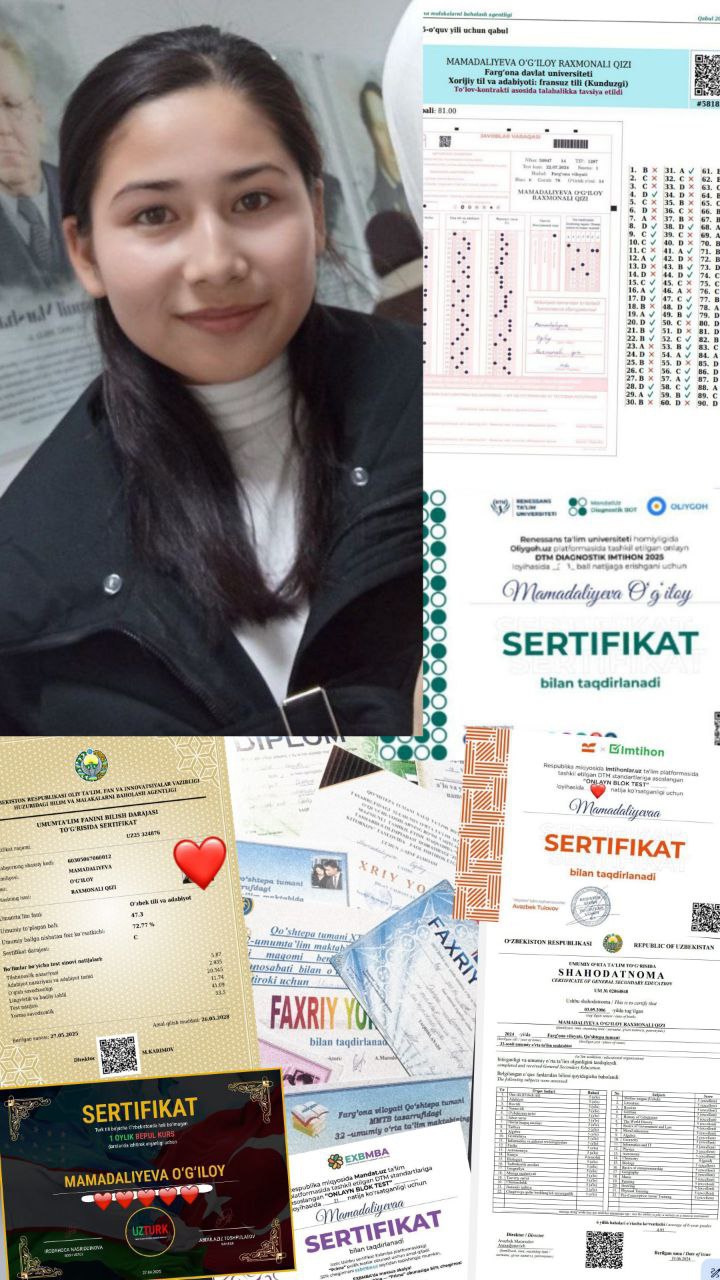
Mamadaliyeva O‘giloy is a first-year student of Group 25.38 in the Primary Education program at the Faculty of Pedagogy, Psychology, and Art Studies of Fergana State University.
In the past, governance based on violence was understood as a regime where people were intimidated, arrested, and their freedoms revoked. Today, this form of control has evolved. Now, people are monitored through mobile applications, internet pages, and smart computer programs.
The most alarming part is that people are consenting to this themselves. No one is forcing them. They are submitting to this surveillance of their own free will. In today’s world, our lives are increasingly tied to the internet. Whom we talk to, what we see, what we hear, where we go—everything is recorded. With our own hands, we are providing governments and tech giants with information about ourselves that previously only secret services could access.
People perceive this not as a danger, but as a convenience. In reality, it is this very convenience that is the greatest threat. Because behind these comforts lies a hidden power of control—a power capable of manipulating people without them even noticing. In such a situation, an individual believes they are making their own choices. But in truth, the paths are shown to them by the system. This is control in the guise of freedom. On the internet, we express ourselves and voice our opinions. Yet, at the same time, we internally contemplate how we should present ourselves. This leads everyone to think alike and to behave not freely, but in a conformist manner.
Political control has also taken on a new form. It is no longer necessary to arrest someone; it is enough to make them invisible on the internet. Their written thoughts are pushed so far down that people never see them. Today, freedom of speech is restricted not through punishment, but through indifference.
In such conditions, what does freedom mean? Is it expressing an opinion? Speaking out? Or gaining people’s attention?
In today’s environment, freedom is defining who you are yourself, not fully submitting to computer programs, and understanding the nature of surveillance. This requires not only technical knowledge but also a courageous civic stance.
We have rights, but the culture of understanding and exercising them is weakening. Democracy does not just mean elections—it means conscious participation every single day. Therefore, every time we download an app, every time we give consent on a webpage, and with every action we take, we must ask ourselves: Is this action serving me, or is it controlling me?
Today, we are silent. We are saying nothing. But this consent is not eternal. It can change with an awakening.
My name is Ro‘ziboyeva Asilakhon. I was born on September 17, 2013, in Nishon District of Qashqadaryo Region. One of my main hobbies is reading books; I also enjoy writing articles and poetry. My dream is to become a cardiologist.
Spring. So much beauty, so much elegance, so much innocence – all this is embodied in spring. Spring. Grasses rise from the ground, branches grow like necks, the sun increases its temperature, mothers prepare sumalak and halim in pots, grandfather farmer takes a hoe and goes to the field, girls wear a wreath of willow leaves in their hair and look for chochmoma all this is embodied in my mind.
Spring. Children throwing leaves into the sky, flying kites, wrestlers going to the wrestling ground to knock each other’s swords on the ground, girls with caps on their heads and eyebrow growths singing songs with handsome guys, cooking kok somsa and dumplings for the bodies tired of winter and in need of vitamins. incarnate in the spring.
Spring. Kindness, people asking each other about each other, giving helping hands to the disabled, widows, asking about the elderly – all this is embodied in spring.
Imagination is a gift given to man by God.
Just thinking about spring brings peace and dreams to the human heart.
Our hearts flutter when we think of spring. Spring renewal, making new dreams, we think of it as stepping forward into life, making new plans. Spring brings with it a world of news. As you imagine, the peach blossoms in the fields and the scent of the tulips on the mountain come to your eyes. Spring is beyond our imagination. We cannot imagine spring without our national games.
I compare the spring season to rejuvenation and renewal, a new era. As soon as spring comes, it begins to spread its blue-blue dress around. The surroundings become more and more beautiful and reflect elegance. She is also compared to a bride. The reason is that a woman’s heart is elegant, delicate, demanding, and can attract any man. Spring is the percentage of seasons.
Spring is as durable as women, patient and tenacious like rocks. No matter how much it rains and winds, it retains its beauty. This is why spring inspires me…
Kucharova Ugiloy Utkir qizi is a student at Samarkand State University in the Sharof Rashidov Faculty of Law.
In societies where public reputation and social prestige are prioritized over the future of young women, endurance becomes not a choice but a destiny imposed upon them. In his short story “Yesterday Is Already Past,” Shukur Kholmirzaev presents the character of Sobirova as a woman trapped in ideological nostalgia, whose unwavering concern for social recognition prevents her from confronting present realities. It would not be an exaggeration to argue that her moral vision is clouded by ambition. By surrendering her daughter’s life to social judgment, she allows collective opinion to dictate a deeply personal fate. Her persistent attachment to outdated political ideals—most notably her obsession with Communist Party membership—along with her indulgence in hollow aspirations, gradually leads her into profound psychological and ethical torment.
Had Sobirova been capable of interpreting Unsinova’s post-dismissal visits with greater awareness, she might have recognized the validity of her son Kamol’s warnings. Unrestrained ambition, as the narrative suggests, inevitably draws individuals into the quagmire of remorse. However, the story transcends the personal tragedy of a single mother and daughter. At its core, it offers a critical examination of society’s treatment of women. What is destroyed is not merely a young woman’s emotional state, but the totality of her existence. Her happiness is subordinated to social gossip and moral surveillance, leaving her deprived of agency, autonomy, and the right to choose her own life path.
Through this narrative, Kholmirzaev exposes how the relentless pursuit of fame, status, and ideological legitimacy gradually erodes fundamental human values and dignity. Parents may reassure themselves that their actions are justified, yet the pain suppressed within, the tears shed in isolation, and the silence stretched across a lifetime remain unarticulated. This silence, the author suggests, constitutes the most devastating form of tragedy.
Most importantly, the relevance of this narrative is not confined to the past. Similar patterns of control, judgment, and sacrifice persist in contemporary societies. Therefore, “Yesterday Is Already Past” should be read not merely as a historical reflection, but as a timeless social critique that continues to resonate today.
In conclusion, fame and social recognition—however fiercely contested—must never be elevated above human dignity. When societies sacrifice the futures of young women in the name of reputation, the moral failures of the past are inevitably reproduced in the present. Human worth, personal freedom, and emotional integrity are far more valuable than any form of social prestige.
Xasanova Aziza Kumushbek qizi. Born on October 1, 2004, in Chirchik, Tashkent Region. Currently a student at Tashkent University of Economics and Pedagogy. On March 1, 2025, she received the title of “Faculty Zulfiya” in a competition held by the university. She has published several scientific articles. Her poems and stories have been published in many newspapers, magazines, and websites around the world. Her poems, stories, and works are constantly published in countries such as Albania, Pakistan, Italy, America, Great Britain, Germany, India, Argentina, Turkey, Arabia and Uzbekistan, Kenya, Africa, Korea.
THE IMPORTANCE OF TEACHER SPEECH CULTURE AND CONDUCTING WORK IN THE STATE LANGUAGE
Mengboyeva Baxtiniso Mamatqobilovna
First-year student, Faculty of Philology,
Uzbek Language and Literature Department,
Denov Institute of Entrepreneurship and Pedagogy
Email: @meliqulovabarno3gmail.com
TEACHER SPEECH CULTURE AND THE IMPORTANCE OF WORKING IN THE STATE LANGUAGE.
Abstract: This article analyzes the relationship between the culture of teacher speech and working in the state language. It also highlights the role of speech culture in the professional activity of a teacher, its impact and significance in the educational process. It is shown that ensuring the accuracy, fluency and standardization of speech in the process of working in the state language is one of the main duties of a teacher.
The culture of a teacher’s speech is one of the most important factors determining the effectiveness of the educational process. This is because a teacher’s ability to express ideas clearly, fluently, and understandably creates a solid foundation for students to master knowledge thoroughly. Conducting activities in the state language not only ensures the correct management of official documents, but also guarantees unity and discipline within an educational institution. Therefore, a teacher’s speech culture and literacy in the state language become an integral part of their professional competence. This article highlights the significance of these processes and their impact on the quality of education.
1. The essence of a teacher’s speech culture and its role in the pedagogical process
A teacher’s speech is one of the main tools of the educational process and is a key factor in influencing students’ minds, providing knowledge, and ensuring the effectiveness of education and upbringing. Speech culture includes not only correct, fluent, and clear speaking, but also the ability to express ideas in an expressive, logical, and comprehensible manner. In addition, a teacher’s speech shapes the psychological environment of the learning process and fosters students’ interest, confidence, and motivation toward the subject.
The effectiveness of a teacher’s speech determines the overall success of the lesson. A teacher with a high level of speech culture is able to capture students’ attention, explain topics fluently, and present complex concepts in a simple and concise way.Especially in the modern educational process, a teacher not only provides knowledge, but also acts as a communicator, educator, and moral leader, guiding, motivating, and evaluating students through their speech.
2. The main characteristics of a teacher’s speech: clarity, fluency, logic, and expressiveness
A teacher’s speech is distinguished by the following qualities:
Clarity. Clarity in pedagogical speech means delivering information without confusion, in a clear and understandable manner, using precise terminology. Clarity helps prevent unnecessary questions, misunderstandings, and ambiguities during the lesson. The correct use of scientific concepts, definitions, and examples is an important manifestation of clarity.
Fluency. A teacher’s fluent speech determines the rhythm of the lesson. Proper use of pauses, logical stress, and speaking at a moderate pace ensure fluency. Fluent speech also helps develop students’ listening culture.
Expressiveness. Expressive speech enriches students’ imagination and actively engages them in the learning process. Intonation, stress, pauses, and emotions create memorable impressions for students. Especially in subjects such as literature, art, and history, expressive speech becomes one of the teacher’s main tools.
Logic. Logical speech is reflected in the consistency of ideas, cause-and-effect relationships between concepts, and the sequential presentation of thoughts. A logically structured speech helps students develop critical and systematic thinking.
3. Speech culture as a teacher’s professional competence
A teacher’s speech culture is a core component of their professional mastery and pedagogical competence. The modern education system requires teachers to possess the following speech competencies:
adherence to the norms of the literary language;
deep knowledge of the grammatical, phonetic, and lexical rules of the state language;
control of diction;
observance of speech etiquette rules;
ability to communicate effectively with an audience;
correct use of communication genres (lecture, explanation, question-and-answer, discussion).
A teacher with rich speech and the ability to think scientifically forms a positive image in students’ minds. Such a teacher not only provides knowledge, but also serves as a role model of speech culture for learners.
4. The content and significance of conducting documentation in the state language
In the Republic of Uzbekistan, conducting documentation in the state language implies maintaining official documents in Uzbek across public administration, education, healthcare, the judicial system, the economy, and other sectors. This process plays an important role in strengthening political independence, enhancing national identity, and ensuring clarity within the legal system.Conducting documentation in the state language serves to:
ensure documents are maintained in a clear and unified standard;
observe literary norms in official communication;
promote effective communication between state institutions;
enable citizens to clearly understand their rights and obligations;
support the development of national culture;
enhance the prestige and status of the language.Proper organization of documentation in the state language ensures order, consistency, and legality in social life.
5. Conducting documentation in the state language in a teacher’s professional activity. In the education system, a teacher is not only an instructor, but also a record keeper. In this process, the teacher must correctly and appropriately prepare official documents in the state language, such as class registers, curricula, electronic diaries, orders and directives, reports, and official records.This process depends on the teacher’s knowledge of the official style, ability to distinguish document types, strict adherence to language norms, literacy in spelling and punctuation, as well as responsibility and accuracy. Proper documentation in the state language by teachers directly affects the legal functioning, discipline, and overall effectiveness of an educational institution.
6. The interconnection between a teacher’s speech and the culture of the state language
Speech culture and the culture of record-keeping are complementary processes. The richer and more fluent a teacher’s oral speech is, the more precise and compliant with official standards their written speech becomes. Proficiency in conducting documentation in the state language enhances a teacher’s communicative literacy. These two processes also have a strong impact on students’ education and upbringing. A teacher’s speech model helps shape students’:
culture of thinking,
writing skills,
respect for the literary language,
sense of national identity,
readiness for official communication.
7. Speech technologies and electronic documentation in the state language in modern education
In today’s digital era, teachers are required not only to have clear and accurate speech, but also to use information technologies effectively. Electronic diaries, online platforms, official emails, and reports must be maintained in the state language. This requires not only linguistic literacy, but also technical competence.
A teacher’s electronic communication is based on:
concise and clear style in official correspondence,
adherence to spelling rules,
avoidance of unnecessary words,
logically structured content,
observance of official etiquette.
Conclusion
A teacher’s speech culture is one of the key factors determining the quality of the educational process. Fluency, clarity, and expressiveness of speech directly influence students’ comprehension of knowledge, interest in lessons, and the effectiveness of communication. Conducting documentation in the state language ensures that official documents are prepared correctly and in accordance with established standards, and it enhances the culture of official communication. Therefore, a teacher must be knowledgeable, responsible, and possess a high level of speech culture in both areas.
References:
Law of the Republic of Uzbekistan “On the State Language”.
Toxliyev B., Fundamentals of Speech Culture, Tashkent.
G‘ulomov A., Conducting Documentation in the State Language, учебное пособие.
Qosimov B., Language and Speech Culture, textbook.
Official documents of the Cabinet of Ministers of the Republic of Uzbekistan on record-keeping procedures.
Mengboyeva Baxtiniso Mamatqobilovna was born on April 1, 2007, in Denov District, Surkhandarya Region. She graduated from General Secondary School No. 73 located in Denov District. Currently, she is a first-year student at the Faculty of Philology, majoring in Uzbek Language and Literature, at the Denov Institute of Entrepreneurship and Pedagogy in Denov District, Surkhandarya Region. She has earned nearly 50 international certificates.
She is a participant in the project “The First Step Towards a Scholarship – Season 1”, created by Dilshoda Akhadova. In addition, she serves as the coordinator of the “Eco Call” movement council at the Denov Institute of Entrepreneurship and Pedagogy. At the same time, she is a member of the Argentine Association of Science and Writers, holding an official membership certificate.
Introduction This article analyzes the impact of migration on culture from the perspectives of personal identity, cultural adaptation, and transformation. Migration is not only a geographical phenomenon but also a process that leads to significant changes in cultural space. This research examines cultural hybridity and individuals’ understanding of their cultural identity within the context of migration.
The article is based on a theoretical analysis conducted at the intersection of cultural studies and the social sciences. In today’s technology-driven world, migration has become a global tendency. Economic inequality, political instability, and opportunities for education and employment are among the main factors that motivate people to move from one region to another. When migrants settle in a new place, they bring their traditional customs, language, and mentality with them. As a result, intercultural interaction and mutual cultural influence increase.
Sociological and Cultural Background In sociology and cultural studies, migration is defined as the permanent or temporary relocation of people. Culture encompasses historical experience, customs, language, art, and other social conditions of a society. Therefore, migration is an indispensable part of social life and cultural development. Cultural scholars argue that migrants initially attempt to preserve their original culture; however, over time, they gradually adopt elements of the host culture. Migration also influences individuals’ self- perception. Migrants living in a new cultural environment often face the question, “Who am I?” This situation triggers the reconstruction of cultural identity.
Cultural Adaptation and Identity
Migrants are required to adapt to new cultural norms while simultaneously striving to preserve their traditional, religious, or linguistic identities. This dual process contributes to cultural development and transformation. As a result of migration, cultural hybridity emerges. Cultural hybridity manifests itself in language use, clothing styles, and everyday practices. For example, in regions with migrant populations, new festivals, as well as literary and musical forms, may develop. Traditional values are often reinterpreted within the context of migration.
Globalization andMigration Globalization is one of the main factors that accelerates migration. Advances in information technologies and transportation systems strengthen intercultural connections. Globalization provides practical conditions for migration; however, a major challenge in the globalized world is the preservation of cultural identity.
Conclusion Migration is a process that exerts a profound and multifaceted influence on culture in contemporary society. It leads to the reshaping of personal identity as well as to cultural hybridity and transformation. While migration intensifies intercultural interaction and enriches societies culturally, it also creates challenges related to cultural adaptation and identity preservation. Therefore, a thorough examination of these issues is essential for ensuring intercultural harmony in the future.
ANALYSIS OF THE RESULTS OF COMPARING FRENCH PROVERBS WITH UZBEK PROVERBS
Masharipova Sayyora
Samarkand State Institute or Foreign language.
Romance and Germanic Languages
3rd year student or Philology and
Language Teaching (French)
Annotation: this article will talk about the analysis of the results of comparing French proverbs to Uzbek proverbs, the formulation of Proverbs, the content of the essence. Also, its role in the culture of our people is analyzed on the example of Proverbs. The translation of Proverbs of another nation is a meditation on the important importance of friendship between peoples.
Keywords: qavlun, friendship, social, psychological, moral education,
INTRODUCTION
Friendship is a socio – moral and psychological concept. Mutual respect represents a form of human interaction based on liking, generality of interests, intimacy, mutual understanding. As a form of human communication, friendship is close to the concepts of brotherhood, comradeship, and brotherhood, but from a psychological point of view, it differs from them in its uniqueness, selectivity, and emotionality. Friendship, as an ethical psychological phenomenon and personal trait, changes with a person’s age (friendship in childhood, adolescence), with the formation of the individual (friendship at school, during student years, in the army).
RESEARCH METHODOLOGY
A proverb is a short, but meaningful and often wise saying that expresses the experience, moral values, and life lessons of a people. Proverbs are often used in oral literature, in the educational process, or in everyday life. They are used for the following purposes:
1.Expressing experience and wisdom: Proverbs often embody the long-standing experience of a people and provide life lessons.
2. Moral education: when they explain moral values, correct and inappropriate behavior helps.
3. Enriching communication: Proverbs make speech colorful and interesting, adding depth to communication.
4. Learning and remembering: Because proverbs are short and easy to remember, they can be useful in the learning process.
5. Preservation of Culture: Proverbs play an important role in preserving the cultural heritage of a nation as they are passed down from generation to generation. Therefore, proverbs are important not only in language and literature, but also in various aspects of our lives.
REVIEW OF USED LITERATURE
Friendship, as an ethical psychological phenomenon and personal trait, changes with a person’s age (friendship in childhood, adolescence), with the formation of the individual (friendship at school, during student years, in the army). The social moral environment, the way of life of people determine the meaning and essence of friendship. Noble behavior brings friendship, bad behavior brings hostility. Friendship is an invaluable beauty of human morality, a gem of positive qualities. If all the beautiful qualities in a person are like a string of pearls, the pearl of them is friendship based on true human love. Thanks to friendship, our homes are prosperous, peace reigns in the world, and abundance is on our tables. That is why wise people have always praised and valued friendship in all societies and encouraged people to always be friends and make more friends.
Amir Temur says: “I did good to the good, and I left the bad to their own bad deeds.” Whoever made a friendship for me, I did not forget the value of his friendship and showed him grace, donation, izzatu.””While my friend is friendly to my enemy, I don’t count him as a friend. Beware of sugar added to poison ” – Abu Ali Ibn Sino. “Live like this with your friends. Have no words to speak about you when they are enemies. Live with your enemies so that your face does not blush when you are friends.”- Jalalidin Rumiy.
ANALYSIS AND RESULTS
French articles about friends and their Uzbek equivalents
Un veritable ami est le plus rare que l’or et l’argent – a true friend is more rare than gold and silver
Prefer wealth.
The meaning of this phrase is that true friends, that is, loyal, reliable, and sincere people, are more important than financial or material wealth.
Friends support each other, help each other in difficult times, and spend happy moments together.
L’amitie ne saurait exister entre deux etres parfaitement identiques – two perfect strangers cannot be friends.
This proverb generally means that a friendship or relationship between two people is unreliable or negative. The word haramza refers to a person who is malicious, treacherous, or unreliable. Overall, this article highlights the importance of trust and sincerity in friendship.
True friendship thinks high, always speaks the truth, and never holds a grudge – a friend does not harm, a harmful friend does not harm.
This proverb has a deep meaning about friendship and relationships between people. This proverb emphasizes that true friendship must have trust, loyalty, and sincerity. If a friend is harmful, meaning he is malicious or harmful, then he is not considered a true friend.
Mille connaissances ne valent pas un veritable ami-good friend face
better than a relative.
This proverb emphasizes the importance of friendship and the value of a real friend.
Among people, dostship is often deeper than kinship, and
may be more sincere. Relationships with relatives are sometimes based on obligation or blood – kinship, but friendship is based more on trust and mutual respect.
Adversity is the touchstone of friendship – a friend is known in a time of trouble.
The meaning of this proverb is that true friends show themselves in difficult and difficult times, that is, during times of problems, difficulties, or trials. In such situations, the authenticity and loyalty of friendship are tested. On the other hand, this proverb emphasizes how important relationships between people are and how important friendship is in difficult times. Qui s’aime trop n’a point d’amis – not having friends is a bad thing. This article suggests that a person who has no friends may experience a change in his or her mental state, feelings, and character in a negative direction. Friends play an important role in a person’s life, serving as a source of help, support, and positive energy. Aime l’ami tien, avec le defaut sien – A friend who seeks a friend without fault will be left friendless. This proverb emphasizes the complexity of true friendship and the need to accept people’s shortcomings. This proverb means that everyone has flaws, so looking for a friend without flaws can ultimately lead to being friendless. In friendship, it is important to understand, understand each other’s shortcomings, be patient and accept each other.
Vieille amitie ne craint pas la rouille-ancient friendship stainless. This proverb emphasizes the stability of friendship and its importance over time.This proverb means that true friendship does not lose its value over time, but rather becomes stronger.This article also encourages us to appreciate the value of friendship, maintain and develop relationships with old friends.
Qui met des restrictions A L’amitie what La connait pas-store sweeper said killer.
This goal emphasizes the importance of friendship and the wrongs and harms that naturally come with its loss. This proverb means that losing a friendship or breaking it is a very painful and sad situation, even comparable to murder. Overall, this article encourages us to understand the value of friendship and to cherish it.
Dis-moi, qui tu frequentes je te dirai qui tu es-tell me your friend, I’ll tell you who you are.
This phrase emphasizes the connection between friendship and the character of a person. Whoever people make friends with can know a lot about their personality, interests and values. For example, if your friends value loving, sincere qualities and strive to develop them in yourself. Thus, we can better understand ourselves through our friends.
Un ami est un tresor-your friend’s fortune.
This phrase emphasizes the value of friendship, its importance in life, and the connections between people. Friends not only help each other in difficult times, but also share happy moments, support each other, and experience life’s various experiences together.
Thus, our friends are our most valuable wealth, because they make our lives more meaningful and happy.
Les bons comptes font les bons amis – the reckoned friend is inseparable.
This proverb expresses the need for understanding, respect, and helping each other in order for a friendship to be true and lasting. This means that when there is knowledge and sincerity of each other’s value in friendship, their relationship will be strong and lasting.
Amitie passe le gand-test a friendly friend in a climax.
This proverb emphasizes the authenticity of friendship and its importance in times of difficulty. This phrase means that true friends support each other in difficult situations and overcome trials. Friendship shows itself not only in good times, but also in difficult times.
A proverb is a genre of oral folk art, a short and concise, figurative and non-figurative, grammatically and logically complete meaningful expression, with deep meaning. It has a specific, clear form. Proverbs embody the life experiences, attitudes towards society, history, mental state, ethical and aesthetic feelings, and positive qualities of the ancestors. It has been polished among the people for centuries and has come into a compact and simple poetic form. The term “proverb” comes from the Arabic word qavlun – to speak, to say. The history of the study of the genre of the article dates back to Mahmud Kashgari. In his work “Devonu lexicat turk”, about 400 proverbs and sayings are included, Beyond which we can see that proverbs are given special attention in the work of Alisher Navoi, Sultan of the word estate, Zahiriddin Muhammad Babur and others.
The proverbs are extremely rich and diverse in subject matter. A variety of proverbs have been created on topics such as homeland, labor, crafts, friendship, harmony, wisdom, vigilance, language and speech culture, love and affection, as well as negative traits. The dialectical unity of content and form, rhyme in many cases, sometimes polysemy, and richness of figurative meanings are characteristic of the article. The phenomenon of antithesis is often found in proverbs (Respect the elder, honor the younger).
Proverbs are used in various situations and contexts. They are used in the following cases.
1. In presenting life lessons:
Proverbs are usually used to express important lessons or experiences in life. For example, to remind caution before doing something.
2. In counseling: one can strengthen one’s thoughts by saying Proverbs when people advise one another. This is seen, for example, in the article “Think before you start.”
3. In moral education: Proverbs are used as an important tool in explaining and teaching moral values, such as “Do good and you will see good.”
4. In communication: during a conversation, proverbs are used to enrich and make communication interesting. They help to express thoughts briefly and clearly.
5. When making jokes or jokes: Some proverbs can be funny or humorous, so they are used among friends or in informal settings.
6. At events and celebrations: Proverbs are often used in speeches or wishes at celebrations, weddings, or other events.
Thus, proverbs can be used in different situations and for different purposes, while their purpose is often to express life experiences in a concise and precise manner.
CONCLUSION
In short, people’s lifestyle, thinking, and environment also play an important role in the formation of proverbs. This article expresses how important friendship is.
Shunday qilib, maqollar turli vaziyatlarda va maqsadlarda ishlatilishi mumkin, ularning maqsadi esa ko’pincha hayotiy tajribalarni qisqa va aniq ifodalashdir.
FOYDALANILGAN ADABIYOTLAR ROʻYXATI
1. Abdullayeva, N. U. q. (2021). O‘zbek va ingliz xalq maqollarida do‘stlik tushunchasi masalalari. Scientific Progress, 2(1), 377.
2. Mirzayev, T., Musoqulov, A., & Sarimsoqov, B. (Tuzuvchilar). (2005). O‘zbek xalq maqollari. Toshkent: Sharq nashriyot-matbaa aksiyadorlik kompaniyasi.
3. Rajabova, Z. I., & Ikromova, L. B. (2024). Education proverbs in French and their equivalents in Uzbek. American Journal of Language, Literacy and Learning in STEM Education, 28, 241. https://www.grajournalus
4. Salimova, M. J., & Yakubov, J. A. (2021). Fransuz va o‘zbek maqollarining lingvokulturologik xususiyatlari. Nauki, 108.
5. Назарян, А. Г. (1987). Фразеология современного французского языка (2-е изд., перераб. и доп., с. 215). Москва: Высшая школа.