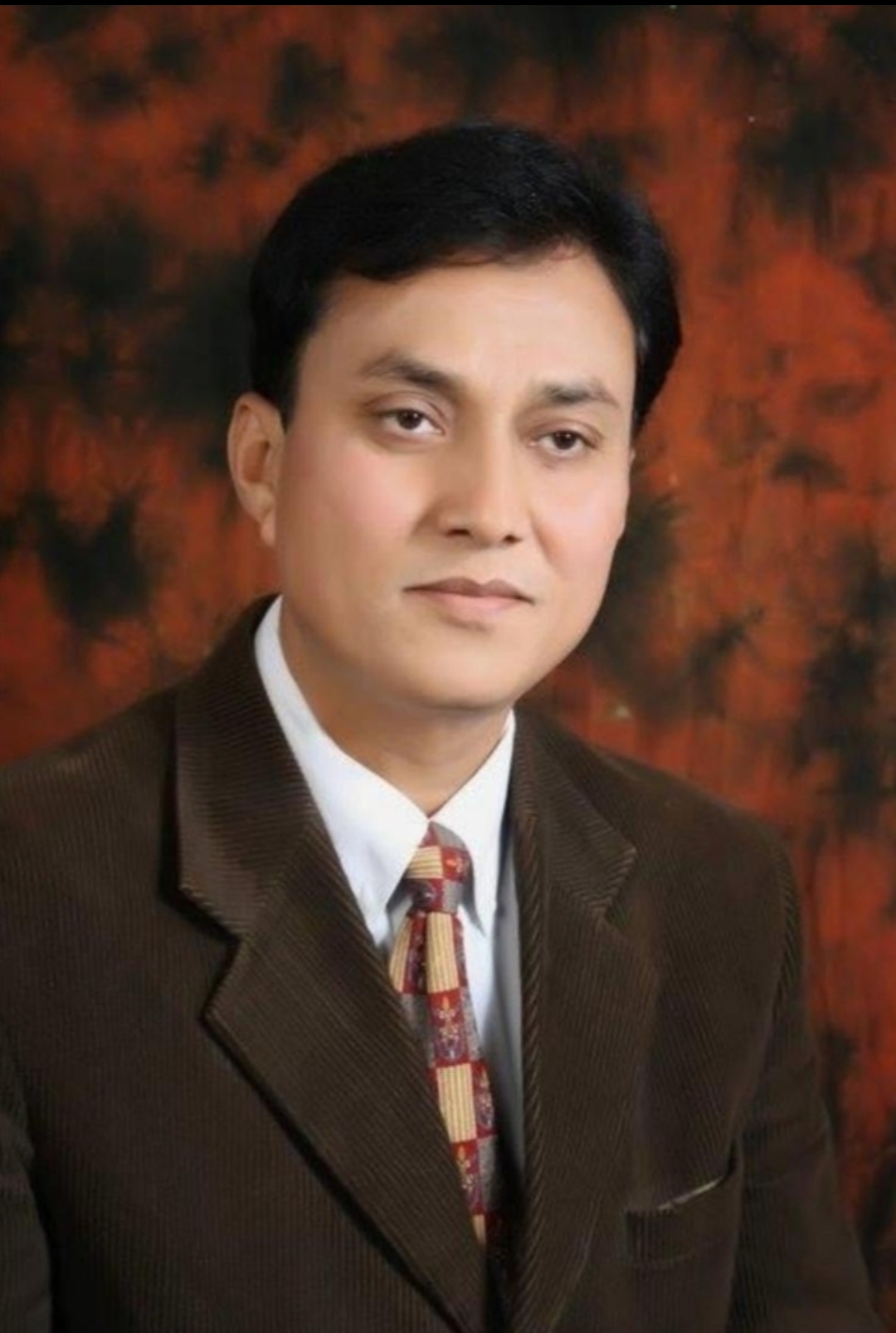
John Dorsey is the former Poet Laureate of Belle, MO. He is the author of several collections of poetry, including Which Way to the River: Selected Poems: 2016-2020 (OAC Books, 2020), Pocatello Wildflower, (Crisis Chronicles Press, 2023), 100 Mornings, (Sacred Parasite, 2025), and Trump Stamp, (Crisis Chronicles Press, 2026).
Luke Howard, you were right! We’ve lost a big God- the Messiah, the one who led us along the way. He disappeared in front of us like an absurdity or our invention, like an illusion. Not daring to control us He left us, pure and free. Only a little God remained, the God of each of us. He’s simple and clear, but small and invisible, like the truth in your musical works, Luke. People want another God who will match their vanity and wealth. But they do not find Him. And the little god laughs at them and points to a simple essence of things. He is quiet and wise.
I got up in the morning and wished with all my heart not to lose the little god, who curled up in a fluffy lump under the heart of mine. I suddenly remembered that I had finally heard Him … After all, even stones can hear! It’s like hearing your small, limpid and clear motives, Luke.
I blessed the sunrise and the new day to enter me with the truth. Then I made and hung up a new birdhouse, and put some grain into it. And right then the birds from all over the world came and sat down onto my arms. They sang their psalms for me until the lunchtime.
I melted the stove and saw my reflection and the mission of mine in a piece of simple birch bark. The fire rose up with thousands of sparks of desires and hopes. Yesterday’s newspaper burned well. The fire consumed it at once and did not leave any opportunity to it to go down in history as something eternal. So it is. Then I hit the road and met a wanderer who gave me a new sense when I handed him a piece of bread, that was better than building temples in which no one comes for praying.
I’ll be back at sunset. I left here to find the small meanings of little and joyful gods. You were right, Luke. I tell you that again and again. A little God … don’t scare him away! He does not need rending ideas and global upheavals. You know it is not necessary even the lilacs under your window and the birds that’s sitting on your hands, Luke, while you’re playing for them.
Every creation is looking for a little god now, Luke. For a simple god that’s nestled close to us and is so warm and kind, like a memory of Mom, her arms and hugs, and a woolen shawl of hers…
2023, 2024, 2025 — participant and speaker at the International Gorky Literary Festival. 2025 — speaker at the first conference of literary cities of Russia within the framework of the International exhibition‑forum of regional hospitality “Intourmarket” (Nizhny Novgorod). 2025 — recipient of honorary diplomas from Serbia and Indonesia for achievements in art and pedagogy and for work on the project “Third International Poetic Competition: V. M. Terekhov Memorial‑2024”. 2025 — Coordinator from Russia for the literary and pedagogical project “Balakavi Poets” (India. Kerala). 2025. Author of the scientific article “The V. M. Terekhov Memorial in India.” The academic supervisor was Jerneil Singh Anand, President of the International Academy of Ethics and Professor at the Institute of European Studies. 2025 – Member of the jury of the International Awards “Arina gold-2025” and “Arina silver- 2025” 2026 -Deputy Editor-in-Chief for External and internal Communications of the literary magazine “Arina –NN”.
2026 — Winner of the “Art Expo‑2026” competition (vocal), (creative project) — in Abu Dhabi.
2026 — Winner of the World Expo‑2026 within the framework of intercultural exchange and gaining knowledge in the field of education and creativity.
2026 — Received a certificate confirming the highest qualification of a teacher at the Congress of Progressive Sciences and Creative Initiatives (UAE) from the European Association of Culture.
2026 – Special Diploma “For Preserving Women’s Folk Wisdom” in the “Short Prose” category of the International Literary Competition “Slavic Word‑2026” (Bulgaria)
Love, Honour, and the Hand of Fate: Reading the Knight’s Tale
There are stories in which love brings two people together. In The Knight’s Tale, love first divides. Geoffrey Chaucer places two imprisoned knights, Palamon and Arcite, before the same vision: Emily walking in a garden below. Companionship quickly becomes rivalry, and both men are prepared to suffer—and eventually fight—for the woman they desire.
What draws me to the tale is the question beneath its armour, ceremony, and courtly language: When two men fight over a woman they scarcely know, are they fighting for love—or for the idea of winning her?
Beyond the Romance
Geoffrey Chaucer, one of the foundational figures of English literature, understood human contradiction. In The Canterbury Tales, different voices reveal different faces of love, morality, faith, desire, and weakness.
The Knight’s story reflects his world: honour, combat, order, and destiny. Yet beneath its noble surface, The Knight’s Tale is also a story about power.
Palamon and Arcite barely know Emily, yet each claims profound love for her. Their intensity is undeniable, but intensity is not necessarily intimacy. Emily becomes the centre of their world before either man has truly entered hers.
And Emily has a desire of her own: she would rather remain unmarried.
That changes the question. It is no longer simply which knight deserves her, but whether either man has truly considered what she wants.
Honour, Desire, and Fate
In Chaucer’s world, love and combat easily share a language. Men fight to prove devotion and risk death to defend honour. A tournament is created to settle the rivalry, turning Emily’s future into part of a public contest.
Yet Chaucer does not simply condemn chivalry. Honour, courage, and loyalty have genuine value in this world. The complication begins when ideals become entangled with jealousy and possession.
And above both knights stands a power neither can command: fate.
Arcite wins the tournament, but victory cannot secure his future. His death overturns the apparent conclusion, and Palamon ultimately receives what force could not win for him.
A man may win the battle and lose the future.
Another may lose the battle and inherit what remains.
Emily and the Modern Reader
For contemporary readers, Emily may be one of the tale’s most thought-provoking figures. She is admired before she is known, fought over before she has chosen, and surrounded by structures that largely determine her future.
Her prayer, however, reveals another story beneath the romance: a woman whose own desire does not correspond with the desires surrounding her.
Reading a medieval work today does not require us to judge it entirely by modern assumptions. But historical distance should not prevent us from asking questions.
Good classics survive those questions.
Great ones become more interesting because of them.
From the Knight to the Miller
Reading The Knight’s Tale beside The Miller’s Tale reveals Chaucer’s remarkable range.
The Knight gives us temples, honour, combat, ceremony, and elevated love. The Miller gives us bodies, deception, adultery, and laughter.
One raises love toward the heavens.
The other pulls it into the bedroom.
Yet both ultimately ask whether human beings truly understand what they call love.
Final Assessment
The Knight’s Tale endures because beneath its medieval world lies a conflict that remains familiar: love and possession, honour and jealousy, choice and destiny.
We still confuse intensity with intimacy.
We still sometimes call desire love.
We still imagine that winning something means we can keep it.
And we still discover that life does not always honour the victories we carefully arrange.
Palamon and Arcite believe they are fighting each other.
In the end, neither is powerful enough to fight fate.
Perhaps the greatest contest in Chaucer’s tale was never between two knights at all
A Book Review by Raida Jirjees
Book: The Canterbury Tales
Author: Geoffrey Chaucer
Translator: Nevill Coghill
Edition: Penguin Classics
Publisher: Penguin Classics
Publication Year: 2003
Pages: 528
ISBN: 9780140424386
Raida Jarjes is an Iraqi poet, visual artist, and Founder and President of The Leading Word Humanitarian and Cultural Organization. She holds degrees in Law and English Literature and lives in the United States. Her published poetry collections in Arabic have been translated into English and featured in international anthologies. Known for her lyrical voice, she writes about identity, memory, love, and displacement. She also works in acrylic painting, wood burning, and collage, exploring symbolic imagery. Her organization supports orphans, widows, and displaced people, and promotes culture and human connection through creative and humanitarian projects. She continues to create and inspire.
HUMAN CAPITAL AND ITS RELATIONSHIP WITH ECONOMIC GROWTH
Annotation — O‘zbek tilida
Annotatsiya. Ushbu maqolada inson kapitalining iqtisodiy o‘sishga ta’siri, uning milliy iqtisodiyot raqobatbardoshligini oshirishdagi o‘rni hamda ta’lim, malaka, sog‘liqni saqlash va innovatsion salohiyat bilan bog‘liqligi tahlil qilinadi. Zamonaviy iqtisodiyot sharoitida inson kapitali mamlakatning uzoq muddatli iqtisodiy rivojlanishini ta’minlovchi asosiy omillardan biri sifatida qaraladi. Tadqiqotda inson kapitaliga investitsiyalarni ko‘paytirish mehnat unumdorligini oshirish, yangi ish o‘rinlarini yaratish, innovatsiyalarni rivojlantirish va aholi daromadlarini ko‘paytirishga xizmat qilishi asoslab beriladi. Shuningdek, O‘zbekistonda inson kapitalini rivojlantirishning ustuvor yo‘nalishlari ko‘rib chiqiladi.
Kalit so‘zlar: inson kapitali, iqtisodiy o‘sish, ta’lim, mehnat unumdorligi, investitsiya, innovatsiya, bandlik, iqtisodiy rivojlanish.
Аннотация — Русский язык
Аннотация. В статье анализируется влияние человеческого капитала на экономический рост, его роль в повышении конкурентоспособности национальной экономики, а также взаимосвязь с образованием, профессиональными навыками, здравоохранением и инновационным потенциалом. В условиях современной экономики человеческий капитал рассматривается как один из ключевых факторов долгосрочного экономического развития страны. Обосновывается, что увеличение инвестиций в человеческий капитал способствует повышению производительности труда, созданию новых рабочих мест, развитию инноваций и росту доходов населения. Также рассматриваются приоритетные направления развития человеческого капитала в Узбекистане.
Abstract. This article examines the impact of human capital on economic growth and its role in improving the competitiveness of the national economy. Particular attention is paid to the relationship between human capital, education, professional skills, healthcare, labor productivity, and innovation capacity. In the modern economy, human capital is considered one of the key factors supporting sustainable and long-term economic development. The study emphasizes that increasing investment in human capital can contribute to higher labor productivity, employment creation, technological development, innovation, and growth in household incomes. The article also considers the main priorities for developing human capital in Uzbekistan and highlights the importance of improving the quality of education, professional training, and opportunities for lifelong learning.
Human capital has become one of the most important factors of economic development in the modern global economy. Traditional factors of production, including physical capital, natural resources, and labor, remain important; however, their economic effectiveness increasingly depends on the knowledge, skills, creativity, and professional abilities of individuals.
The development of human capital directly affects labor productivity, innovation, competitiveness, employment, and income levels. Countries that invest systematically in education, healthcare, professional development, and research are generally better positioned to adapt to technological and structural changes in the global economy.
For developing economies, including Uzbekistan, strengthening human capital is particularly important. The transformation toward a knowledge-based and digital economy requires a workforce capable of applying modern technologies, generating innovative solutions, and responding effectively to changing market conditions.
2. Theoretical Foundations of Human Capital
The concept of human capital is based on the idea that knowledge, education, skills, experience, and health represent productive assets that generate economic value. Investment in these areas increases the productive capacity of individuals and, consequently, contributes to the development of the entire economy.
Education is one of the most important components of human capital. A high-quality education system provides individuals with the knowledge and competencies necessary to participate effectively in economic activities. Professional training and lifelong learning are also becoming increasingly important because technological changes continuously transform labor-market requirements.
Healthcare is another essential component of human capital. A healthy workforce is generally more productive, has fewer interruptions in employment, and is better able to contribute to economic activity.
3. Human Capital and Economic Growth
The relationship between human capital and economic growth can be observed through several major mechanisms. First, higher levels of education and professional skills increase labor productivity. Skilled employees can use technologies more efficiently, solve complex problems, and introduce improvements into production processes.
Second, human capital promotes innovation. Researchers, engineers, entrepreneurs, and highly qualified specialists contribute to the development and implementation of new technologies, products, and business models.
Third, human capital supports structural transformation. As economies move from resource-intensive activities toward manufacturing and knowledge-intensive services, the demand for highly qualified workers increases.
Therefore, investment in human capital should not be viewed only as social expenditure. It is also a strategic economic investment that can generate long-term returns through productivity growth, higher employment, innovation, and increased competitiveness.
4. Human Capital Development in Uzbekistan
For Uzbekistan, the development of human capital is becoming increasingly important in the context of economic modernization and digital transformation. The country has a large and relatively young population, which creates significant potential for economic development if appropriate investments are made in education, professional skills, entrepreneurship, and innovation.
The development of digital competencies is particularly important. Modern enterprises increasingly require employees who can work with digital platforms, data, information technologies, and automated systems. Therefore, educational institutions and professional training centers need to adapt their programs to the changing requirements of the labor market.
Another important direction is the development of entrepreneurship. Supporting entrepreneurial skills among young people can contribute to the creation of new businesses, employment opportunities, and innovative products.
5. Recommendations
1. Improving the quality and accessibility of education. 2. Expanding professional and technical training programs. 3. Developing digital and technological competencies. 4. Increasing investment in scientific research and innovation. 5. Strengthening cooperation between universities and businesses. 6. Promoting lifelong learning and professional retraining. 7. Supporting youth entrepreneurship and innovative startups. 8. Improving healthcare and creating favorable conditions for a productive workforce.
6. Conclusion
Human capital is one of the fundamental determinants of sustainable economic growth. Education, professional skills, health, experience, and innovation capacity directly influence labor productivity and the competitiveness of national economies.
For Uzbekistan, investment in human capital can become an important source of long-term economic development. Improving education, expanding professional training, developing digital skills, supporting innovation, and strengthening cooperation between educational institutions and businesses can increase the country’s economic potential.
Consequently, human capital development should be considered not only as a social policy priority but also as a strategic component of national economic policy. Effective investment in people can create the conditions for higher productivity, innovation, employment, income growth, and sustainable economic development.
References
1. Becker, G. S. (1993). Human Capital: A Theoretical and Empirical Analysis, with Special Reference to Education. University of Chicago Press. 2. Schultz, T. W. (1961). Investment in Human Capital. The American Economic Review, 51(1), 1–17. 3. Mincer, J. (1974). Schooling, Experience, and Earnings. Columbia University Press. 4. Lucas, R. E. (1988). On the Mechanics of Economic Development. Journal of Monetary Economics, 22(1), 3–42. 5. Romer, P. M. (1990). Endogenous Technological Change. Journal of Political Economy, 98(5), S71–S102. 6. World Bank. (2019). World Development Report 2019: The Changing Nature of Work. World Bank. 7. OECD. (2019). OECD Skills Strategy 2019: Skills to Shape a Better Future. OECD Publishing.
And it was not fitting for them, unsuitable for immoral and ungrateful people.
But I would always have a good reason, which they proclaimed within themselves as a given.
But the worst and most unjust thing was
Not for me simply and naturally
But for those who wanted to crawl
To accept and accept foreign inhospitable layers.
Now I knew, I suffered, I learned and above all
For my own good, I would never be a giver
Where it was not worth it and more, where it caused them
Fear, terror, insecurity and imperative, removal.
No matter if they wanted me according to their own standards and measures
I chose my own bar
Without regretting it at all
And to finally face that view.
Which does not come from riches and palaces
Parents’ parchments and not only
Despite life’s narrow streets and its steep sides.
I deal with all types of poetry. My writing has been awarded and has participated in various anthologies. I have published four poetry collections and a short story and am a radio producer.
only to bounce from insignificance to indifference.
Then there is that laughter.
That laughter that never leaves the head.
The rotting but never dying words that paralyze
because the gentleness on the landscape
is violated with either expectation or regret.
There is that gloomy, ragged carnival
that travels the mind where amusements are not amusing.
They are perilous, broken or still.
Gamblers with a fear of value
with a fear of shadows
ignore invitations and despise appeals
and the rejection from the mirror’s reflection is agonizing.
But what is worse is the truth it exposes.
The wind hisses when moving up a mournful stream.
The smell of adaptation never generates into translation,
and what is sought lies in a casket cascading over a waterfall.
Revel in absurdity,
the reality that holds existence a thought above quicksand.
Once I whirled on saffron and evening primrose
not believing that self-destruction is outwitted by distance.
How absurd that the deadliest of all serpents claws within us.
It thickens from the wealth of realism consumed from absent encounters.
The rendering becomes not a warning but a persistent signal
from a lighthouse on trial for the emptiness that never goes away.
Life denies its oppressiveness,
while living lies open to misfortune.
There are roads,
paths can never discover.
The relentless insistence to possess comfort,
and the noose attached that scars with hooks.
When venturing blindly,
any misshapen key to heartbreak becomes heartbreak itself.
The faucet drips, another birth, summing up nothing.
Nothing, without boundaries.
Modeled with proper etiquette and a maze of identical circumstances.
You see there is no mystery,
Yet,
yet
a mask is worn to unveil the self
seeking what is fortunate, never believing in the curse of wide-eyed sadness.
Then what is identity?
A third-rate character in a dimly lit discussion of future tragedies.
Remember there are no mysteries.
Only thoughts.
Only thoughts on why pure imagination through a sieve
produces
something as incomplete
as life.
Philip received his Master of Arts in Psychology from Simon Fraser University, Vancouver, Canada. He has published six poetry books, with another forthcoming. Three novels and two plays. He has a column in the magazine Per Niente. He enjoys all things artistic.