[Excerpt from Fleury’s Boston Globe featured poetry book Sparks in the Dark: A Lighter Shade of Blue,
A Poetic Memoir archived permanently at the University of Massachusetts’s Healey Research Library]
The night is like a whimper whistling
sweet sounds of the Caribbean dawning
tense taunted memories supple coconut leaves
longing rustling uneasily singing their hissing history
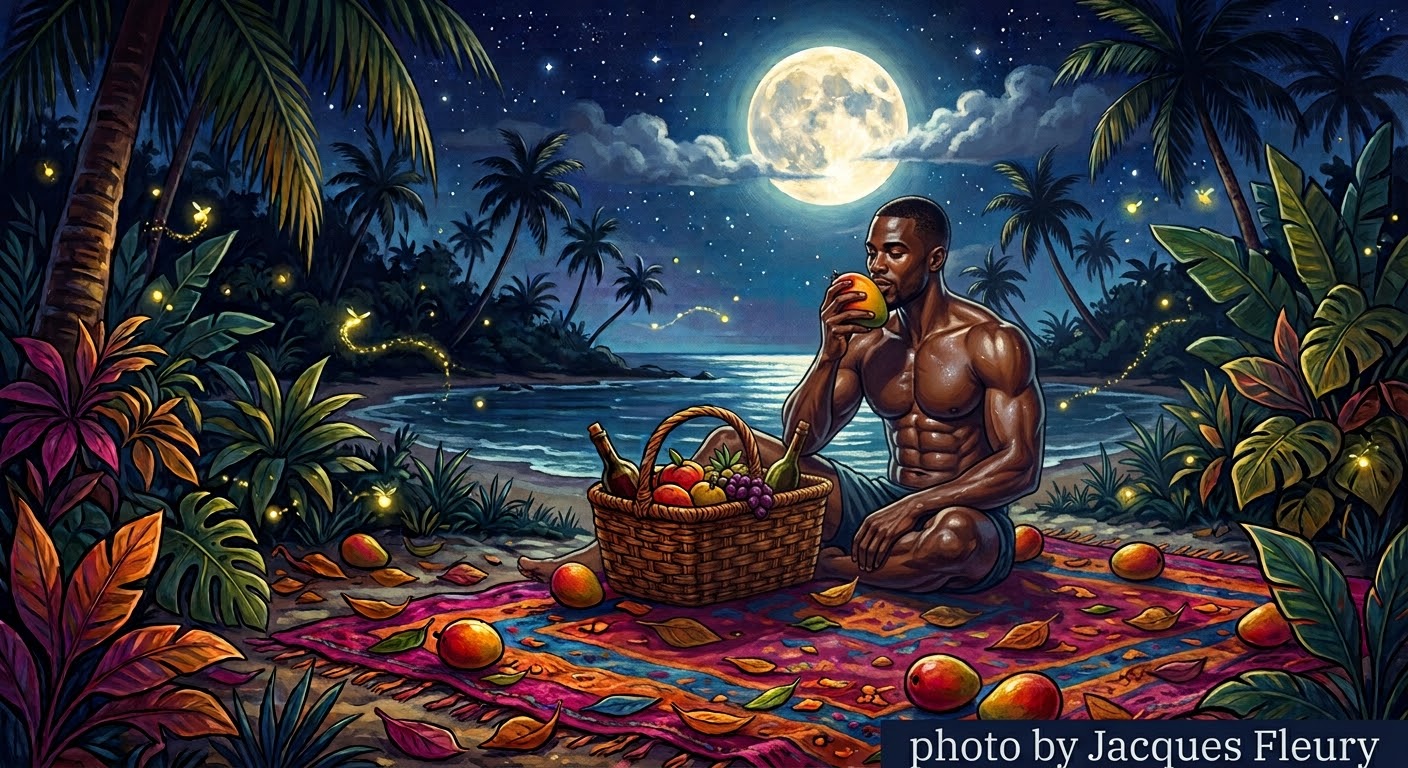
The moon smiling a single icy eye under warm Caribbean skies watching dancing fireflies
Against the starry sky staring soundly shining as if
waiting for a shindig for brave night birds to fly sound is silenced noise needs defiance
fall leaves layer upon layer interwoven to make a motley leafy magenta blanket above the
dirt you walk in like a frumpy flirt picnic basket brimming in big Haitian hands
singing a tune like you in a calypso band
bruised burnished back against the moon I emerge like a boasting butterfly from the cocoon
to see your gesture jesting me than you kneel dumb down by me leaning closer learning me
you placed your lips perched planting a putrid punch-drunk kiss upon me
I could smell your taste like garnished waste tepid against my lucid lanky cheeks
Cheeks as daunting and dazzling as the moon itself than I bury my bumbling quivering hands
Into your buxom basket winced and wrench out a near perfect pound of reddish round mango treat
“go ahead, bite me!”
I hear it sing your beat jesting me testing me vesting me
I look up as if to say to see your burning eyes beaming looking back at me like the moon mauled against
the aching sky you see still staring back at me as if crouching to flee I tilt my head
hanging to the right then I tilt my head hanging to the left
watching your blood bleeding red swollen mango beauty erected!
basking in your basket black memory detected than most carefully
I slant tauntingly toward this your gallant gaudy fruit
rowdy rueful having lost its roots perch and peck
my lips than sank my bucking beak beneath the stuffy skin your juicy fruit dangling drooling
down my chin than I lay my back buried down wincing waiting quietly to hear your
queer croaking rooster sound staring happily into the glare of sensual satiable
Caribbean skies while watching fireflies stock full of colonial flare flying hovering
tired hanging onto the tarry air autumn stifled squirming to breath beneath heavy hung Haitian thighs
You could almost hear its sweaty seethe that I should sing release all Haitian flies!
Oppression deflates exhausted satisfaction sighs…finally anxious desire daring to escape
You’ll find it squandered and spent along the cape then laying back secretly satiated under this tree your ruby red
mangoes falling like loads of glory! raining down on me like a fetish fantasy
And for a second forgetting my wanton woe laying low under your shadow’s fro
Ooooh yes you please me like a pro! i say islander scavenger
feed me your juicy mango flow
As I lay back to bask while your
wise fluid moon glow sow…–
Jacques Fleury
Jacques Fleury is a Haitian American poet, novelist, educator, essayist, arts critic, author, and Harvard University literary arts scholar whose internationally published voice spans continents. The recipient of the 2026 International Naji Naaman Literary Prize for Creativity—chosen from over 4100 global competitors from 83 countries—he holds prestigious memberships in France’s La Fenêtre de Paris and Lebanon’s Maison Naaman pour la Culture. His celebrated books, among them his opus Chain Letter To America: The One Thing You Can Do To End Racism… is held globally from Massachusetts libraries to the UK’s Askews and Holts, and historic sanctuaries like the Harvard Bookstore & Grolier Poetry Book Shop. Discover more of his Boston Globe-featured work at Authorsden/JacquesFleury.
When Laughter Reveals the Truth: Reading The Miller’s Tale
A Book Review by Raida Jirjees
Book: The Canterbury Tales
Author: Geoffrey Chaucer
Translator: Nevill Coghill
Edition: Penguin Classics
Publisher: Penguin Classics
Publication Year: 2003
Pages: 528
ISBN: 9780140424386
There are books we approach because their reputation precedes them, and others that remain alive because they continue to recognise something in us. The Canterbury Tales belongs to both.
What draws me to Chaucer’s work is its extraordinary gathering of human voices. Pilgrims of different professions, social positions, desires, virtues, and weaknesses travel together and tell stories. Through this simple framework, the road to Canterbury becomes a road through human nature itself.
Among those voices, the Miller’s is impossible to ignore.
His tale does not enter politely.
It arrives laughing.
And behind that laughter, it watches us.
Chaucer and the Human Comedy
Geoffrey Chaucer, one of the defining voices of medieval English literature, possessed a remarkable ability to observe human contradiction. His humour can be ironic, playful, earthy, and deliberately crude, yet beneath it lies an understanding of vanity, desire, fear, and weakness.
The Miller’s Tale is a striking example.
John, an older carpenter, is married to the young Alison. Nicholas, a clever student, desires her, while Absolon pursues her with theatrical romantic devotion. Desire, jealousy, deception, and revenge soon turn their lives into farce.
Each character enters the tale carrying an illusion.
Chaucer gradually turns those illusions against them.
Intelligence, Fear, and Desire
Nicholas believes intelligence gives him control. Educated and resourceful, he uses his knowledge to manipulate John, convincing him that another catastrophic flood is coming.
But Chaucer does not allow the clever man to remain safely above the joke.
The deceiver eventually becomes part of it.
John is jealous and possessive, but he is also afraid. Nicholas succeeds because his lie speaks directly to that fear. There is something timeless here: we do not always believe what is most reasonable; sometimes we believe what most effectively confirms what we already fear.
Alison, meanwhile, is not merely a passive object of male desire. She participates in the deception and exercises her own will, though Chaucer does not turn her into a moral heroine. Like the others, she belongs to a world where desire repeatedly outruns responsibility.
Absolon offers another kind of illusion. He performs the role of the refined lover through appearance, song, and courtship, only to have his romantic self-image transformed into humiliation.
Here lies one of the tale’s sharpest contrasts:
the language of romance exists beside the physical reality of desire.
Why Does Chaucer Make Us Laugh?
Laughter in The Miller’s Tale does more than entertain. It strips away appearances.
Education does not guarantee wisdom. Age does not guarantee judgment. Romantic language does not guarantee love. Cleverness does not guarantee escape from humiliation.
Everyone believes, for a moment, that someone else is the fool.
Eventually, almost everyone becomes one.
Nicholas is educated but manipulative. John has experience but lacks discernment. Absolon has polish but little self-awareness. Alison understands the game but cannot stand outside its consequences.
Each character knows something.
None understands enough.
That distinction feels remarkably modern.
The costumes change.
Human vanity does not.
Reading Chaucer Today
A contemporary reader may find the tale’s bawdy humour excessive or uncomfortable, but its earthiness has a purpose. Chaucer deliberately sets the physical body against idealised notions of romance.
Modern readers may also question its treatment of marriage, gender, age, consent, and power, particularly Alison’s position as a young woman married to an older, jealous husband.
Such questions do not weaken a classic. They keep our conversation with it alive.
The Miller After the Knight
The position of The Miller’s Tale after The Knight’s Tale makes its comedy even sharper.
The Knight gives us chivalry, honour, ceremony, and elevated love. The Miller answers with bodies, tricks, adultery, and laughter.
One raises love toward the heavens.
The other pulls it into the bedroom.
Yet both ask whether human beings truly understand what they call love.
Final Assessment
I no longer see The Miller’s Tale simply as a collection of medieval jokes. I see laughter being used as a mirror.
Its comedy exposes weaknesses that time has not erased: vanity, jealousy, self-deception, desire, and misplaced confidence.
For the modern reader, the tale is also a reminder that a classic need not be solemn to be profound. Literature can reveal human nature through tragedy and beauty—but also through absurdity and an indecent joke.
Perhaps this is Chaucer’s quiet achievement.
He lets us laugh at his foolish characters long enough to realise that some part of their foolishness may belong to us as well.
Human Skills in the Age of Artificial Intelligence
Five Key Human Activities That Computers Can Never Replace
By Nilufar G’ulomjon qizi Hamroqulova Born in 2011 in Qorako’l District, Bukhara Region, Uzbekistan. Three-time participant in the national “Young Reader” competition and finalist in the Republic stage of the “Tamaddun Reader” contest. Founder of the “Zukko Kitobxon” (Smart Reader) Book Club.
ABSTRACT Artificial intelligence plays an unprecedented role in today’s digital era. Its capability has grown so immensely that it can already substitute for human labor across various traditional professions and work side-by-side as a digital colleague. This article examines the evolving dynamics of the future job market and highlights core human competencies that remain irreplaceable by automation.
Keywords: Artificial Intelligence, Automation, Future of Work, Labor Market, Human Capital, Emotional Intelligence, Human Skills.
Artificial intelligence and technological automation are rapidly transforming the global labor market. However, an analysis of the future of work demonstrates that computers, complex algorithms, and automated systems cannot displace human professionals in domains that rely heavily on deep-seated human qualities and interpersonal skills.
FIVE ESSENTIAL DOMAINS BEYOND AI’S REACH
1. Pedagogy and Mentorship: Teaching is fundamentally more than the simple transmission of data to students. True education involves mentorship, inspiration, and individual guidance. According to research by UNESCO, personalized instruction tailored to a learner’s individual needs increases academic mastery and achievement by up to 40%.
2. Psychology and Healthcare: Clinical care and patient support demand profound empathy, genuine warmth, and psychological sensitivity. Studies conducted by Harvard Medical School reveal that compassionate interaction and attentive care from nurses contribute to more than a 30% positive boost in a patient’s recovery process.
3. Genuine Creativity and Conceptual Innovation: While AI tools can generate images, write code, and compose stylistic text, artificial systems cannot express authentic human experience, emotional depth, or unique conceptual originalities born from lived personal history.
4. High-Precision Physical & Adaptive Labor: Unstructured physical work—such as complex agricultural tasks, specialized farming, and real-time troubleshooting or repair during unpredictable field breakdowns—requires physical adaptability and tactile intuition that AI and robotics cannot match.
5. Emotional and Ethical Communication: Navigating complex ethical dilemmas, building deep human trust, and leading with emotional intelligence require a moral framework and nuanced social reasoning that algorithms inherently lack.
CONCLUSION
In conclusion, although artificial intelligence and automation excel at performing repetitive technical tasks and processing immense data streams, they cannot replace fundamental human abilities: empathetic communication, personal connection, ethics, genuine creativity, and emotionally grounded decision-making. In the future labor market, leadership will belong to professionals who skillfully leverage technology while fully realizing and projecting their unique human potential.
starves the sleepy face of the decrepit old man with freshness?
It’s not that it only carries pollen
and sprinkles the fertile earth with seeds,
nor does it play with the waves,
to wake up the lulled fisherman,
it’s just…
It also brings the aromas of youth
that make the latter’s sad eyes water with nostalgia.
Images and scents of the most beautiful times
that he is dreaming of right now.
So he wonders,
whether time really exists,
or is it just a
stretched canvas of a painter,
on which colors flow and mix
with the scent of oil, seaweed and lavender…
Or does it connect the horizons beneath the
Stribor forest
with the murmuring mountain stream,
announcing the dawn…
While in the night sky he discerns
the last sketches of shooting stars,
which have already written the destinies of many,
including this one, whose simple life
has been struggling from the burden since time immemorial,
with great difficulty,
and without any particular meaning…
While his last wishes sink like a stone
through the whirlpools of ignorance,
and now, as if in a delirium,
in the middle of the abyss between sleep and reality
he tries to discern,
not even knowing why,
and again without meaning,
why tonight
this breeze is rustling
so strangely…
Zlatan Demirović is originally from Croatia. Currently lives and works in America. He is a poet, essayist, publisher. He is the founder and Editor-in-Chief of PRODIGY MAGAZINE USA, PRODIGY PUBLISHED USA and PRODIGY LIFE ACADEMY USA. He is the author of many works.
He organizes and manages the free publication of the works of creative people from different countries so that they can be recognized worldwide. He is a promoter of Peace, Friendship and Culture in the World. He is the founder of the NOBLE LAUREATE AWARD for 2026.
Molly Marie Kent is quite simply one of the most electrifying creators in the rising metal underground. Onstage she is The Supreme, the Witch Queen architect behind Nashville’s rising Doom Stoner metal phenomenon Omenbringer, a band designed to seduce visually and devastate sonically.” She has built Omenbringer as a witch-coated, sex-positive, fantasy-driven metal coven, a project where spectacle and substance coexist, a band that looks like a ritual and sounds like a thunderstorm.
From the moment she appeared in my virtual studio, I felt that unmistakable charge—the recognition of someone operating from sovereignty, not performance.
I began with lineage. “You’ve talked about your inspiration coming from your background in performance, in burlesque,” I said, “and also Tolkien, Bettie Page… Frank Frazetta…the thiccness, right?”
“That’s right,” she said.
I told her how my collaborator Lee Bailes (screenwriter, director, author/poet) and I had been talking about writing a movie called Big Titty Goth Girlfriend, and how uncanny it was when her song appeared.
“It’s almost like your song manifested,” I said. “We were both like, whoa, dude. There it is.”
She laughed, delighted by the synchronicity.
I told her how performances like “Stir the Cauldron” strike me as “next level… really, really amazing when you have a woman who’s not afraid of being both sovereign and sexual.” She nodded, fully inhabiting that duality.
When I asked about her female musical inspirations, she didn’t hesitate. “Cherie Currie, amazing, I love The Runaways and Joan Jett, I love the raw sexual energy of that band.”
But she gravitates toward artists with their own worlds: “Amy Winehouse is an enormous influence… her voice, her raw realness in her lyrics.” She added Alison Krauss for “beautiful singing,” and then pivoted to the frontmen who shaped her: “Phil Lynott is the greatest frontman of all time. And I’ll stand on that. I’ll die on that hill.” Ozzy Osbourne follows immediately.
She loves Black Sabbath for their paradox: “They are perceived as this dark and evil band, but really a lot of their lyrics are very, very positive… almost like spells and witchcraft of positivity.” Iron Maiden is another pillar: “I love storytelling… I like Marty Robbins… I like all kinds of music that tells stories.” Her heart, she said, “is definitely living all the time” in classic rock.
What fascinates me most is how she threads classical music into doom metal. “A lot of our influence… is actually from classical music,” she said. “Distinctly and very obviously would be A Night on Bald Mountain by Mussorgsky. There are multiple themes within Thicc Darkness(Omenbringer’s debut full-length) that come directly from that piece of music.”
She wants her music to “seem vaguely familiar… likened to the greats… but fresh.”
Fantasia was her gateway drug. “I was very, very much into Fantasia,” she said. “The devil comes to earth and is having a crazy party… that animation sequence is incredible… it gives me chills. It has titties in it, you know? Like, it is epic.”
When we talked about the Omenbringer song Big Tiddy Goth Girlfriend, she revealed the deeper spellwork behind the camp. “Part of our mission as a band is to diversify the metal scene… to make women feel empowered and comfortable to come and have their tits out at our shows.”
She calls her fanbase “our coven of kindness.” And she emphasized the importance of trans fans: “Especially our trans Big Titty goth girlfriends… we want them to feel comfortable, seen, safe… their lives are hard enough already.”
Safety is ritual. “At any time… if you feel uncomfortable, there’s one of five of our band members, or 500 of our actual coven members, that are gonna make sure that you get to your vehicle safely.”
The song itself was a manifestation spell. “It was actually about two of my muses… I wanted to befriend them… my spell has come true. They are both very good friends of mine now.”
She added, “We do real magic when we’re writing our songs… manifesting real and powerful wishes.”
We drifted into literature—Baudelaire, Whitman, Stoker, Tolkien—because that’s where both our hearts live. She told me about “Chevalure,” her Baudelaire‑inspired song: “This poem… describes the fascination I have with this very particular type of woman… long, black, flowing hair… perfumed with cigarettes and roses.” She studied French in college: “I do speak French.” I told her I majored in Comparative Literature and have translated Baudelaire.
Her second album, A Night on Black Mountain, is a concept album: “laying siege to an evil witch’s castle… failing miserably… shipwrecking on her castle… being tortured in the dungeon… having to fight a dragon… narrowly escaping through a trap door.”
She’s pushing herself to write “as beautifully as possible… with as much literary nods as possible.” She loves hymnal language—“ye this, ye that”—and avoids repetitive choruses: “I want people to have a hard time remembering the lyrics… it’s tricky on purpose.”
When I asked about her occult origins, she went straight to childhood. “I was leaning into the occult as a young person… doing spells with my other witchy friends in middle school.”
Church repelled her: “I hated going to church… big ugly megachurch ones.” Fantasia seduced her. As she matured, she embraced her true persona: “If you’re fortunate and brave, you can lean fully into your true self… The Supreme is not a character. It is me at my most fancy, exuberant, wild side.”
She quoted Whitman unknowingly—“we all contain multitudes”—and I pointed it out. She laughed: “I didn’t know that came from him.”
Her spiritual path moved from Christianity to atheism to Satanism to something fluid. “Whatever I feel like at the time,” she said. She identifies with Satan partly because “I really love trolling the Christians.”
Mushrooms became medicine. “Every time I buy mushrooms, I can feel that very distinctly.” She keeps a tin labeled “souvenirs from my mushroom trip,” filled with handwritten revelations. One lesson: “I don’t have to love someone… I can love someone from afar.”
Her future album Sinister Trip will be “a dark mushroom trip… exploring death as a theme.”
When I asked about her persona, she said it’s “an amalgamation of Maleficent… Elvira… Dolly Parton… and Bettie Page.” She wants to be “everybody in the South’s honorary goth auntie… very campy, very sexy… but also very generous, very giving.”
Her ambitions are colossal. “We’re gonna be the next legacy band… the next Black Sabbath… Kiss meets Black Sabbath.” She imagines playing the Sphere in Las Vegas: “They turn the Sphere into a giant orb with my eyes… flying over the audience on my broom… we’re gonna be the biggest band in the world.”
I told her, “Yeah, you are.”
She laughed and said she wants a statue downtown: “Just like Bettie Page… I’ll be the third witch downtown.”
We closed with gratitude. “Thank you so much for having me,” she said. “Thoughtful questions.”
“Thank you so much, Molly.”
“Have a great day.”
“You too.”
Dubbed “the Baudelaire of our time” by The Crow (1994) screenwriter John Shirley, Alex S. Johnson is a transfemme polymath spoken word performer/author/editor and publisher with Nocturnicorn Books. His 18 published books include two archived at Harvard’s Widener Library for their cultural significance by senior cataloguer Craig K. Thomas, the brother of New Weird legend Jeffrey Thomas. He has been endorsed by the likes of Mort Castle, Caitlin R. Kiernan, Marleen S. Barr, R.U. Sirius, Jarboe and Jeffrey Thomas and has had work appear in such prestigious outlets as Rolling Stone magazine. He has made publishing co-appearances with Allen Ginsberg, Jack Micheline, Ramsey Campbell, Charles Bukowski, Kate Bornstein, Susie Bright, Patrick Califia and Neeli Cherkovski and performed with Iris Berry, Danielle Willis, K.R. Morrison, Puma Perl, Tricia Warden, Loren Rhoads, Ellyn Maybe and Richard Modiano. Johnson lives with his family in Carmichael, California.
Bio: Sushant Thapa is a Nepalese poet and fiction writer from Biratnagar-13, Nepal, with ten books of poems to his credit and two books of short stories. The books of poems are: The Poetic Burden and Other Poems (Authorspress, New Delhi, 2020), Abstraction and Other Poems (impspired, UK, 2021), Minutes of Merit (Haoajan Publishers, Kolkata, 2021), Love’s Cradle (World Inkers Printing and Publishing, New York, New York, Dakar, Senegal, 2023), Spontaneity: A New Name of Rhyme (Ambar Publication House, New Delhi, 2023), Chorus of Simplicity and Other New Poems (Ukiyoto Publishing, Philippines, India, USA, 2024), Finding My Soul in Kathmandu (Ukiyoto Publishing, Philippines, India, USA, 2024), My Grandfather Had Been a Cowboy (Ukiyoto Publishing, Philippines, India, USA, 2025), The Walking Rebel (Transcendent Zero Press, Houston, Texas, USA, 2025) and When I Desire and Other Poems (Ukiyoto Publishing, Philippines, India, USA, 2026).
His first collection of flash fiction and short stories is titled “The One Rupee Taker and Other Stories from Nepal” published by Ukiyoto Publishing in 2024. His second collection of short stories is titled “The White Dot and Other Stories” published by Transcendent Zero Press based in Houston, Texas, USA in 2026.