
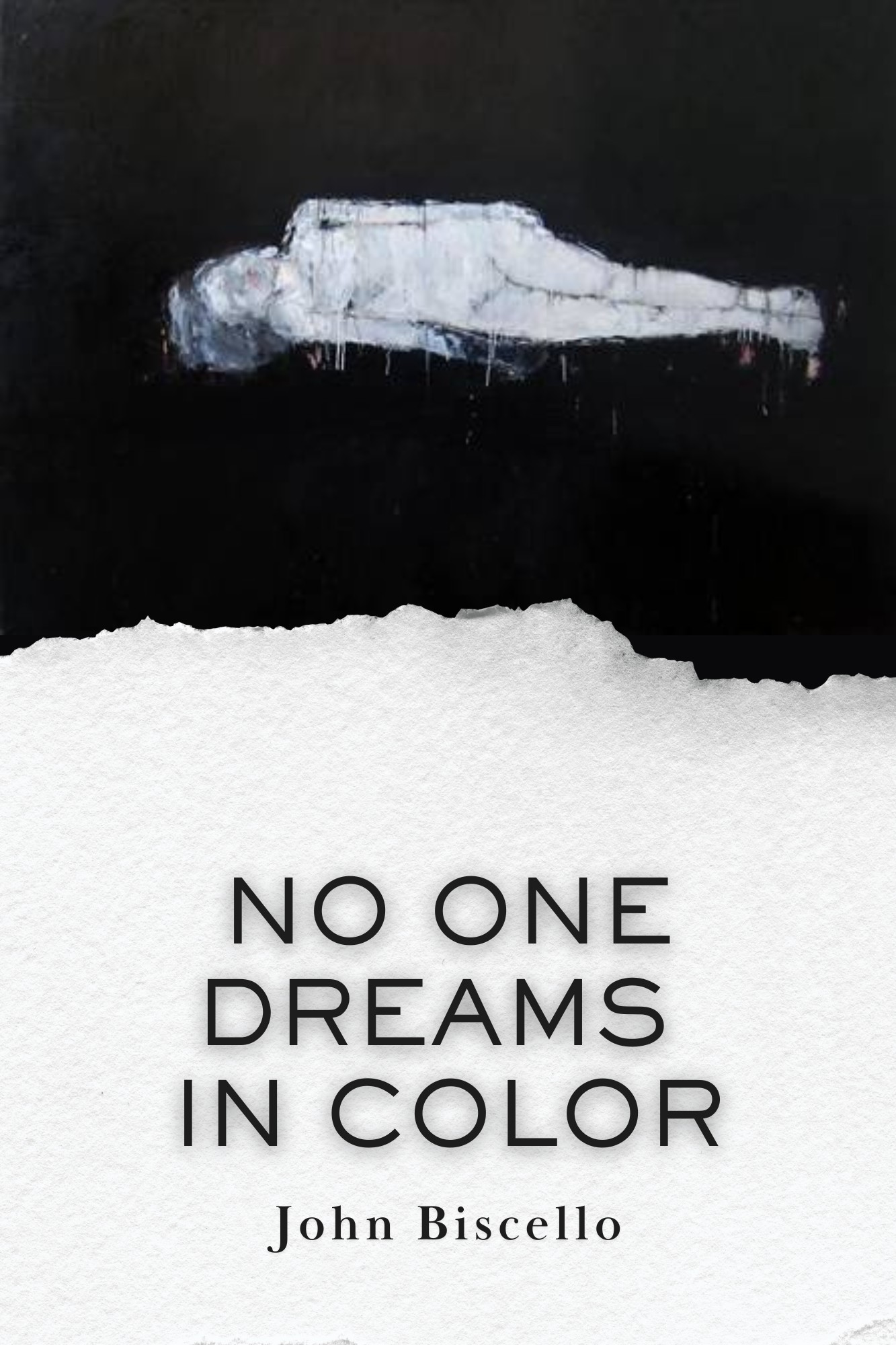
John Biscello’s No One Dreams in Color begins as an artistic mystery and gradually morphs into a tone poem. The novel speculates on the nature of dreams and reality, the psychological effects of loss and grief, and the creative, and destructive, power of stepping out of consensus reality into the surreal.
Loss provides an emotional backdrop to the narrative. The main character finds himself strangely comforted by an indie film entitled Wendigo after the loss of his mother and his first girlfriend, then travels from Brooklyn to a small New Mexico town to find out what happened to the filmmaker, who has gone missing. He interviews an eclectic assortment of characters, including past girlfriends and artistic collaborators of the filmmaker, finding himself immersed in the town’s culture and mysteries. One mystery is that many other people have strangely gone missing throughout the town’s history.
Gradually, the story becomes less and less linear and more focused on images: a dancer in a torn leotard, a young teen on her bike with her face painted like her favorite fantasy character, a woman from imperial Russia perennially dancing in a disused ballroom. Time itself becomes fluid, shown through a bar’s clock that never tells the right time and by the main character completely forgetting a large part of his year. This reflects the way grief and loss warp our experience of time and memory, but also suggests that delving deeply into the surreal, into one’s own psyche and creative process, can cause you to “disappear” into your own world, away from those who love and need you.
Dreams, and the motif of sleeping and waking, play a major role in the tale. They are the first clue this novel is something more than realistic fiction: a woman and her boyfriend work at a facility dedicated to recording and analyzing dreams. The woman suffers from insomnia and can’t dream, while her daughter moonlights as a superhero while sleepwalking. Her boyfriend, a higher-level researcher, is privileged to be able to observe some of the recorded dreams, and observes that they might involve some of the same cinematic features as early film. We see dreams linked to art, amid an atmosphere heady with wine, weed, and talk of Borges, Jung, Bob Dylan, and the Beastie Boys.
The woman’s daughter loves comic books, which the book suggests may be our modern version of a cultural mythos. Her dreams are often nightmares of werewolves: not all dreams are sweet. Near the end, she sneaks out at night and burns down the dream laboratory, believing she’s acting at the request of a figure in the dreams. This highlights the destructive potential of losing control of oneself in the dream world, but could also suggest that dreams and the subconscious resist full, rational explanations.
Yet, the dream researcher’s character seems positive and thoughtful, not a stereotypical “mad scientist” or someone depleting dreams of their magic through over-analysis. He shows sincere compassion for his girlfriend, even when she wants to end the relationship, and is motivated to study dreams because of his genuine belief in their importance and beauty. He makes one of the most powerful statements about the dream-world in the entire novel, that perhaps when we go to sleep, we should shrug off our waking world as “just a dream.” His scientific study and other characters’ artistic endeavors and deep personal experiences seem to all have value in helping us understand ourselves and our world.
Children, and relics of childhood, recur throughout the story. Wendigo’s major scene consists of a man looking at photos of a little girl, and in later scenes, a boy in a party hat celebrates his birthday and another girl plays a fanciful game of hopscotch. The main character connects with his own childhood in ways both endearing and off-kilter. He eats peanut butter sandwiches in his hotel room as he did while a boy, writes a horror story about children playing hide-and-seek, and wakes up sucking his thumb after dreaming of a sexual encounter. No One Dreams in Color suggests through this motif that keeping some of one’s childhood imagination may make you as strange and unpredictable as charming, but that it may be essential to artistic creation.
A legendary monster in the tales of some of America’s Indigenous people, the Wendigo is linked to desolate winter landscapes, destruction and cannibalism, and being lost and isolated. In the imaginary film within this novel, a woman is slowly consumed by a winter landscape, while the male lead also loses himself to confusion and perhaps grief. This is perhaps a dramatization of the risks of entering into the level of private, sustained thought needed to create original art.
Yet, the novel still points to the vast power of the personal and shared cultural subconscious to create beauty from raw materials. The title, No One Dreams in Color, reflects the dream analysis lab’s observation that dreams appear black and white on their screens while dreamers can remember vivid colors. Our imaginations fill in much of the richness and texture of our dreams, creating the reality that we see around us. Through the continual motifs of philosophy, art, literature, mythology, and music, Biscello suggests that this may be as true of our waking as of our sleeping hours.
No One Dreams in Color was a rich, textured, and thoughtful read!
It’s out April 14, 2026 from Portland, OR’s Unsolicited Press.