
BEKHBUDIY: CALL OF ONE HEART, ONE IDEA, ONE CENTURY
“Turon, what is your state, vying with the stars?
Thousands of separate heads—Freedom, why not come?
Find your own opportunity—Nation, why not rise?
Time will not wait. Will the heart not beat?
It is a companion to fear… Should I live like this?
Your death is nigh.”
(Najmiddin Ermatov)
Uzbekistan, my radiant land, the home of the golden cradle generation where the sun sleeps in your veranda when you sing a “alla”, where white “to’n and “adras” robes suit well, adorned with silk belts; the land of Mahmudkhoja Bekhbudiy, Fitrat, and Chulpan; a bright nation where faith and Islam are perpetual companions! My dearest sun-filled land, an oasis where the architect of the Taj
Mahal, the engineer of the Nile, and the Imam Bukhariys originated; where spring whispers in winter, and gold blossoms in the soil! My heavenly nation, a pearl of the East, that has captured the morning shimmer of the sun in its orbits, a stellar land that has made both the sun and the stars fall in love with it!
My chest is full of pride that the great Turkistan enlighteners, who endured all hardships for the happiness and prosperity of this country and sacrificed their lives to lead the homeland from darkness to light, are my ancestors. The feeling and glorification of the homeland are inherent in the heart of every person who grew up on the soil of Mulki Turon. When talking about the brave sons ready to give their lives for their country, the difficult lives of our Venerable Jadids, who raised them in the spirit of the homeland, and simultaneously the dawn suns who opened the eyes of our nation, serve as an example for everyone.
“If we, the Turanians, spend the money we use for weddings and funerals on the path of science and religion, we will soon progress like the Europeans, and both we and our religion will gain prestige and development. If we continue in our current state, we will have nothing but humiliation and misery in religion and the world.”
The people were in a deep sleep of negligence. Yes, these were the words of Bekhbudiy spoken at a time when other intellectuals were bursting forth from within, like a volcano, with the cry of “freedom”… The more we study the history, life, and activities of these national luminaries, the more they remain alive, and the unfulfilled desires scratching a corner of our hearts are reincarnated. They are
rivers that have overflowed their banks and flowed backwards, untamable stallions restless in chains, the frothing blood of the nation, the life of enlightenment that has reached the throat in the face of ignorance. The Jadids are the new echo of the questions sought from the essence of the homeland, the tears that flowed behind the eyes of Mother Turkestan, whose heart was filled with lamentation; they are the very identity of this country, the root veins of New Uzbekistan.
They were lessons incarnate, brought into the world to explain the value of the gift called life, the honor and respect of a human being, and what it means to be worthy of one’s nation and homeland. The goal of these innovators, who did not fit into the despotic system and had their own new world and ideology, was the noble pursuit
of opening the nation’s eyes, achieving the days of progress for the people of Turkestan, reaching the world through educated national cadres, and building a free civil society on the foundation of enlightenment and culture.
Striving to reform and renew a backward country, its education system, Bekhbudiy despaired with the “needs of the nation” in his heart, saying, “This path leads to a bad end; we must learn and teach,” and never lost hope for our present day until his
execution.
Have you seen the softly rustling, burning candles in the dark night? They flicker faintly, continuously and orderly spreading light. This light has the power to illuminate the entire night. Mahmudkhoja Bekhbudiy was such a candle of light. He selflessly sacrificed himself, like a shieldless victim, to return the sun to the dark, unattended heart of a slumbering nation. It was exactly Behbudiy who launched the wingless birds of the darkness of illiteracy into the sky of science,
“drowned” the thirsty fish in the ocean of endless books, and acted as the rider for the unsaddled horses.
Mahmudkhoja dreamed of seeing the Uzbek people on equal footing with developed nations, and he stood out among the mature Jadids of the period of intellectual awakening with his worldview and activities. In his view, the school alone was not enough for enlightenment. It was necessary to keep up with the times and world events, to be aware of the condition, and daily life, of the nation and homeland. Therefore, society needed a mirror in which it could see both its ugliness and its beauty. This need and necessity led Bekhbudiy to theater and the press.
“Padarkush” came into existence during this period. The author called this work a “national tragedy,” and it tells the story of ignorance and folly, where an uneducated child falls into corrupt ways and kills his own parents. Despite its small size, the lesson to be learned from it is extremely important. The life path and scientific and social activities of this enlightener, who tried his best to light the candle of the future in people’s hearts, are an endless example for us, as are his works and instructive ideas.
In particular, there is a lesson in Behbudiy’s attitude towards world phenomena. His discretion in distinguishing between friend and foe is immaculate. The evidence he provided to prove his views is strong. The weights of his balance scale are not hollow inside. That is why dozens of names of Eastern scholars and titles of works appear in the content of his articles. Since he knew Russian perfectly, he
referred to Russian books and the ideas of Russian scientists. There is great pain, a great dream, and meaning embodied in the communication, awareness, and cry of His Holiness Bekhbudiy with world civilization, world scientists, and world-famous books. For instance, in his article “Islahi Tahsil” (Reform of Education), he
wrote, “We should send students to Egypt to systematically study general religious and Arabic literature and learn the methods of education there.” In this regard, he freely expressed his recommendation.
Bekhbudiy is the star that defines the nation’s new path! Bekhbudiy is the gazelle staring into the far distance, trying to save its herd from predators! Bekhbudiy is the rope that fell into the hands of executioners and is preventing the innocent from perishing! Bekhbudiy is the compassionate soul worried about the lifeless, impoverished people, astonished by the populace that has even forgotten religion! Bekhbudiy is the love whose heart is burning while looking at those smiling as they die! Bekhbudiy is the tightrope walker carefully passing the pearl of knowledge from one heart to another above those silently watching! What an honor that Mahmudkhoja was born like the sun, with such dedication fixed in his
body and soul.
Indeed, the Jadids were not ordinary people. They opened new method schools and created textbooks. They enriched our language with writing and linguistic units. They worked tirelessly, like swallows trying to awaken the sleep in people’s eyes. They went from village to village, knocking on doors saying, “We have brought knowledge, please accept it.” The pen was their sword, every letter put on
paper served them like a soldier. They published newspapers and magazines, wanting to awaken the nation with only one thing—the truth. Prison chains, years of exile, and even the executioner’s sword could not stop them. All of them sacrificed their lives on the path of their sweet dreams. Is there a greater, more magnificent deed than this for a nation?
True, this enlightenment movement, which urged the future towards light and stirred Turkestan, encountered great obstacles, was erased from the pages of history, the national leaders were branded as
“nationalists,” and the bright faces were blackened. However, neither chained legs nor bound hands could turn the Jadids, who have taken an eternal place in the consciousness of the young generation, away from the path of enlightenment. The secret of eternity lies precisely in this commitment and self-sacrifice.
“Oh Turkistan, did you manage to preserve the second pearls emerging from the shells? Did you not accept with a torn and patched shroud those who honored you with poems that sang of your love in every line? Oh Turkistan, did you stand by silently when the riders galloping in the field of literature were whipped on the head? Did you not share sustenance from your fields and dastarkhans, becoming a ready meal for those who trampled your sacred soil? Oh Turkistan, did you ever throw the stones that muddled the water back at them? Even if evil deeds and the most sordid events occurred in your past, could you loudly proclaim the thousands of treasures
of enlightenment, the priceless jewels of knowledge within your chest?
Turkistan, every dream of yours has a unique secret, every night of yours is adorned with divine inspiration. Turkistan, we bow to every wind of yours, we cherish every flower of yours. We will shine as stars in your sky, we will pay our debts as children on your lands, we will be the generation that preserves your power!
In conclusion, our ancestors, who dreamed of seeing their colonized homeland among the world’s developed countries by fighting against ignorance and defending the nation’s honor, have achieved their goals today. Now, we, the owners of today, have a strong duty not to forget that we must realize the centuries-old dreams of our ancestors, preserve the land where peace reigns, and
make the youth understand whose descendants we are through our aspirations, participation in reforms, and initiatives.
Indeed, the future of New Uzbekistan is a glorious responsibility entrusted to our shoulders. As Bekhbudiy emphasized: “Oh
zealous youth! The time is yours. Unite with each other, build societies, and serve the nation’s cause.”
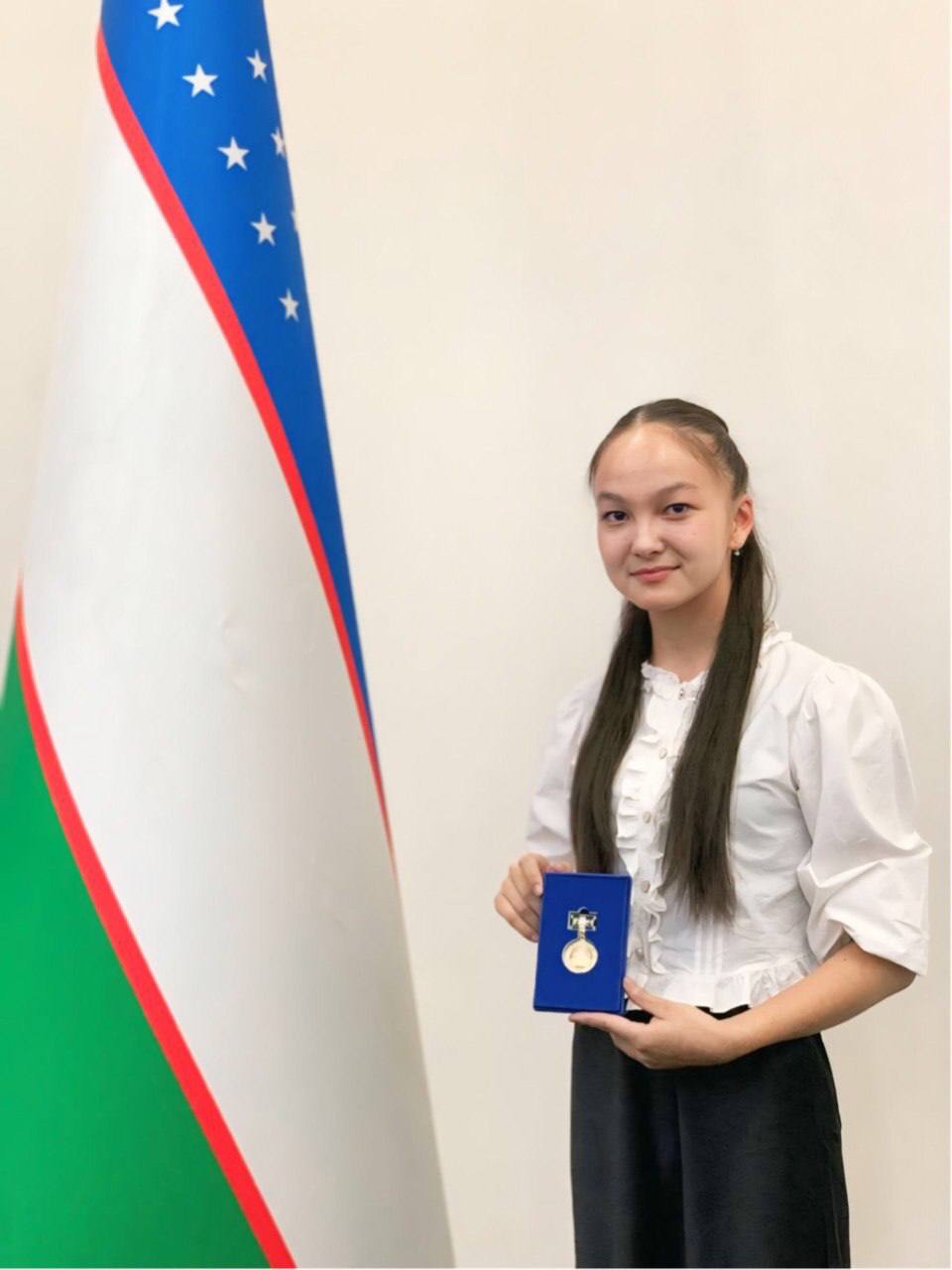
Mukhammadjonova Dilafruz was born in Andijan, Uzbekistan. She is 19 years old. She is a second year student of the National pedagogical university of Uzbekistan. She gained a lot of achievements. For instance, a national certificate from Mother tongue and literature, again from English and Turkish. She owns more projects in her study.