
THE FALL OF THE PHILOSOPHER
When we look back at the turn of the 20th century, we are flooded with a general feeling that the old times were good. The people were good, and its reason too was obvious, they were God-fearing, believed in goodness, visited holy places, undertook pilgrimages, and, it was joint family system, which was helpful in nurturing fellow feeling, empathy and compassion.
As the time passed, modernism took over, which meant the fall of the agrarian life, and the onset of the mechanical age. The peace of the village life was lost to the lure of the market town. As the times moved forward, the village was discarded and the people started migrating to the city. Villages were left barren and this process has kept pace even today. Migration from the villages to the cities is still going on unchecked.
What I am going to focus here is how the quality of man has dwindled over time, as machination has increased. Prosperity appears to have grown but along with it, men who enjoy thousands of amenities, have lost something very precious. I can draw a line too, with which many perceptive readers may not be in agreement. There was a generation which started working during the seventies. Before them, there was a generation of great scholars who inhabited the universities. The 2nd generation starts with seventies, in which the young men who joined services, were still touched with some sort of idealism. Actually, sixties and seventies were the times when in our country the socialist movement was in full swing, and reading Russian literature was in vogue. These young men found idealism injected into their blood and their thought too.
The generation which took to work in eighties too was touched by that idealism. They had a feeling of being true to their profession. These were the times when people felt that copying was a moral aberration. Teachers still believed in teaching the students most of the times without getting any remuneration. Morality was still a subject of debate in Colleges and Universities.
However, nineties saw an abrupt change in the sensibility of the people, and it transformed the sensibility of the time as well. This was the moment when ultra-modern times had set in. Desktop had given way to the laptop, mobiles to smart phone. These were the times when people realized there was a city called Kota in Rajasthan. Now, the race was between money and success. The more the money, the greater the success. The students were after packages. Teachers were after tuitions. It was a world of the go-getters. Those who had money could get seats in medical colleges.
It was here that the growing civilization completely shed its idealistic credentials. Now, the teachers, the students and even parents had only one passion. Job. Money was no consideration. And during these times, we gave legitimacy to a thousand things which were considered taboo in previous times. The most important thing were money and success, followed by a sense of freedom, which shook the family from its foundations.
Today, the teachers have lost all idealistic orientation. Religiosity has increased, though its internal content is missing. There is more and more knowledge and great and great success, yet students and even teachers lack basics of human behaviour. In other words, knowledge has given them fat marks sheets, top positions, without bringing to them the most precious virtue which was essential to make life meaningful: wisdom.
Today, we have a generation which has no faith in wisdom. We have administrators who have no faith in creativity. Paperwork, data, and keeping the teachers busy is the basic framework of educational policies. We know a thousand things, without understanding the basics of human character. The electronic revolution and now the AI have further reduced the man-hours which man could use for himself. The great issue today, in my opinion is, man has no time for himself, for his family, and for his mind. It is the phase when philosophy is dead, the philosopher is dead. The academic has been reduced to a paper tiger. He is forced to become a scholar where his only job is to cut and paste the available knowledge, which makes no sense to the man in the street.
We are passing through the worst phase of human development where facilities have increased, but man’s humanity is in decline. We need to arrest this fall. We need to return to a routine where we have free time for ourselves. Where we could slow down the pace of time. We need to revert back and retrieve the values we have lost in our passion for growth.
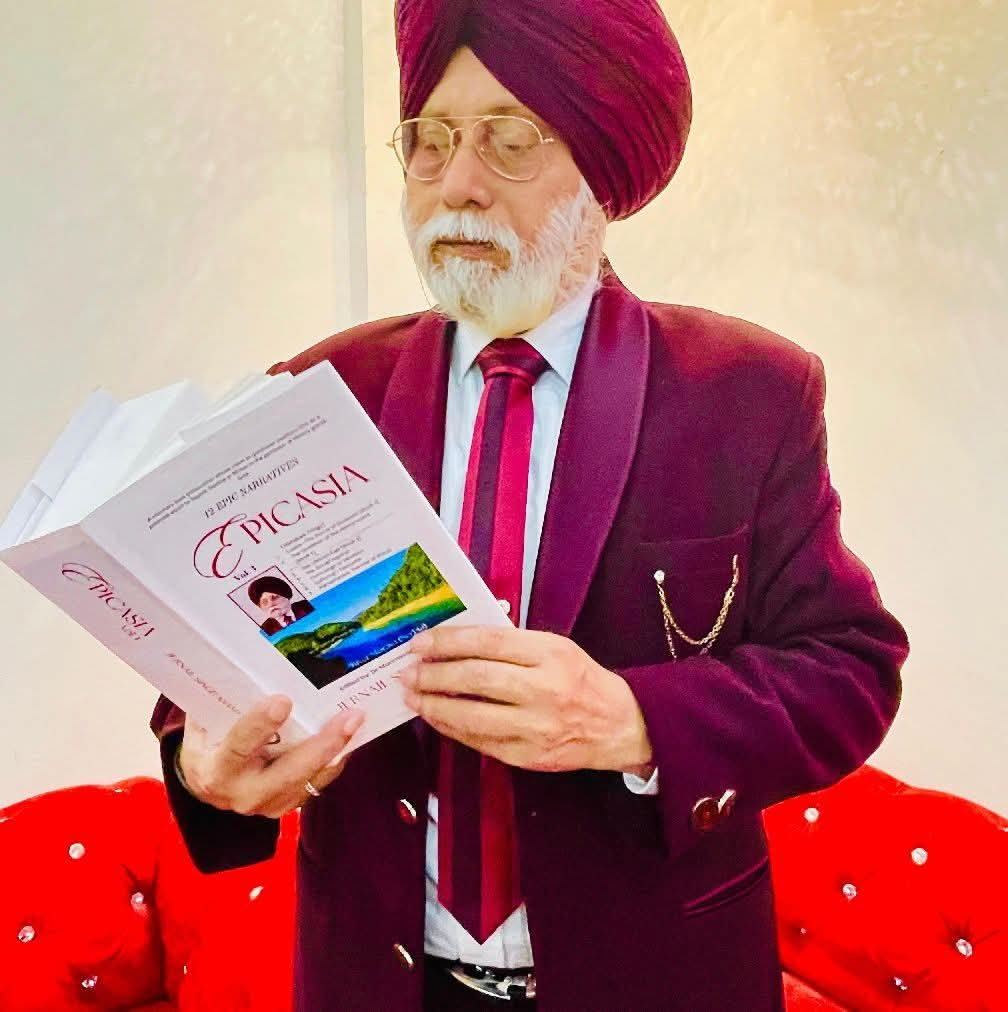
Dr. Jernail Singh Anand, with an opus of 180 plus books, is Laureate of the Seneca, Charter of Morava, Franz Kafka and Maxim Gorky awards. His name adorns the Poets’ Rock in Serbia. Anand is a towering literary figure whose work embodies a rare fusion of creativity, intellect, and moral vision.
Pingback: Synchronized Chaos First of January 2026: What Makes Us Human | SYNCHRONIZED CHAOS