

Blended Learning vs Traditional Learning: Which is more effective for ESL Students?
Qobiljonova Hurixon 2nd year student of English philology faculty Uzbekistan State University of World Languages
Scientific adviser: R. Murodova, Teacher of English philology faculty, Uzbekistan State University of World Languages
Abstract: This article investigates the effectiveness of blended learning compared to traditional learning methods for English as a Second Language (ESL) students. Blended learning combines online digital resources with face-to-face instruction, potentially offering a more engaging and personalized educational experience. In contrast, traditional learning focuses on direct classroom interaction and structured teaching methods. By reviewing existing literature and analyzing case studies, the study explores key aspects such as language acquisition, student engagement, and overall educational outcomes. The findings suggest that while both approaches have their advantages, blended learning often provides greater flexibility and adaptability to individual learning needs, making it a more effective option for ESL education. This article aims to guide educators and policymakers in understanding the implications of these findings for curriculum design and teaching strategies in ESL settings.
Keywords: Blended Learning, traditional learning, ESL (English as a second language), language acquisition, student engagement, educational outcomes, teaching strategies
Смешанное обучение против традиционного обучения: что более эффективно для студентов, изучающих английский как второй язык?
Кабилжанова Хурихон 2 курса факультета английской филологии Узбекского государственного университета мировых языков.
Научный руководитель: Р.Муродова, преподаватель факультета английской
филологии Узбекского государственного университета
Аннотация: В этой статье исследуется эффективность смешанного обучения по сравнению с традиционными методами обучения для студентов, изучающих английский как второй язык (ESL). Смешанное обучение сочетает онлайн-ресурсы с лицом к лицу, что может предложить более увлекательный и персонализированный образовательный опыт. В отличие от этого, традиционное обучение акцентирует внимание на непосредственном взаимодействии в классе и структурированных методах преподавания. Путем обзора существующей литературы и анализа кейс-стадий исследование изучает ключевые аспекты, такие как овладение языком, вовлеченность студентов и общие образовательные результаты. Результаты показывают, что, хотя у обоих подходов есть свои преимущества, смешанное обучение часто обеспечивает большую гибкость и адаптивность к индивидуальным потребностям обучения, что делает его более эффективным вариантом для ESL-образования. Эта статья нацелена на то, чтобы помочь педагогам и политикам понять последствия этих результатов для разработки учебных планов и стратегий преподавания в контексте ESL.
Ключевые слова: Смешанное обучение, традиционное обучение, ESL (английский как второй язык), овладение языком, вовлеченность студентов, образовательные результаты, стратегии преподавания
Aralash o‘qitish va an’anaviy o‘qitish: ESL talabalari uchun qaysi biri samaraliroq?
Qobiljonova Hurixon: Ingliz filologiyasi fakultetining 2- kurs talabasi,
O’zbekiston Davlat Jahon Tillari Universiteti.
Ilmiy rahbari: R.Murodova, Ingliz filologiyasi fakulteti o’qituvchisi,
O’zbekiston Davlat Jahon Tilleri Universiteti.
Annotatsiya: Ushbu maqola ingliz tilini ikkinchi til sifatida o‘qitish (ESL) talabalar uchun aralash o‘qitish va an’anaviy o‘qitish usullari samaradorligini o‘rganadi. Aralash o‘qitish onlayn raqamli resurslarni to‘g‘ridan-to‘g‘ri dars o‘tish bilan birlashtiradi, bu esa yanada qiziqarli va shaxsiylashtirilgan ta’lim tajribasini taqdim etadi. An’anaviy o‘qitish esa dars davomida to‘g‘ridan-to‘g‘ri muloqot va tizimli o‘qitish usullariga e’tibor qaratadi. Mavjud adabiyotlarni ko‘rib chiqish va tadqiqotlardan olingan ma’lumotlarni tahlil qilish orqali ushbu tadqiqot til egallash, talabani jalb etish va umumiy ta’lim natijalari kabi asosiy jihatlarni o‘rganadi. Topilmalar shuni ko‘rsatadiki, har ikki usulning o‘z afzalliklari bo‘lsa-da, aralash o‘qitish moslashuvchanlik va mustaqil o’rganishdagi qulayliklarni taqdim etadi va bu uni Ingliz tilini ikkinchi til sifatida o’rganish uchun samaraliroq variantga aylantiradi.
Kalit so`zlar: Aralash o‘qitish, an’anaviy o‘qitish, ESL (ingliz tilini ikkinchi til sifatida o‘qitish), til egallash, talaba jalb etish, ta’lim natijalari, o‘qitish strategiyalari.
Introduction. In the rapidly evolving landscape of education, the effectiveness of teaching methodologies is a critical area of research, particularly for English as a Second Language (ESL) students. Traditional learning, characterized by face-to-face instruction and structured classroom environments, has long been the standard approach in language education. However, the advent of digital technology has paved the way for blended learning, which combines online resources with in-person teaching. This hybrid model aims to enhance student engagement and provide a more personalized learning experience. Blended learning offers unique advantages, such as flexibility in learning pace and accessibility to diverse educational materials, which can be particularly beneficial for ESL students who often face varying levels of language proficiency. Conversely, traditional learning emphasizes direct interaction between students and instructors, fostering a sense of community and immediate feedback that can be essential for language acquisition.
This article seeks to explore the comparative effectiveness of blended learning and traditional learning for ESL students. By examining existing research and analyzing key factors such as language acquisition, student engagement, and educational outcomes, we aim to provide insights that can inform educators and policymakers. Ultimately, understanding which method proves more effective can lead to improved teaching strategies and enhanced learning experiences for ESL learners.
What is Traditional Learning?
Traditional learning involves the direct interaction of the teacher with students. It includes oral recitation of the subject to be studied by a student while the other students sit there quietly and listen. This tactic is still used widely in schools and is also known as conventional education. Traditional learning does not support remote learning and is forced to be in a specific fixed time. It elaborates learning and opting for new skills while sharing space with different students with different interests and passions.
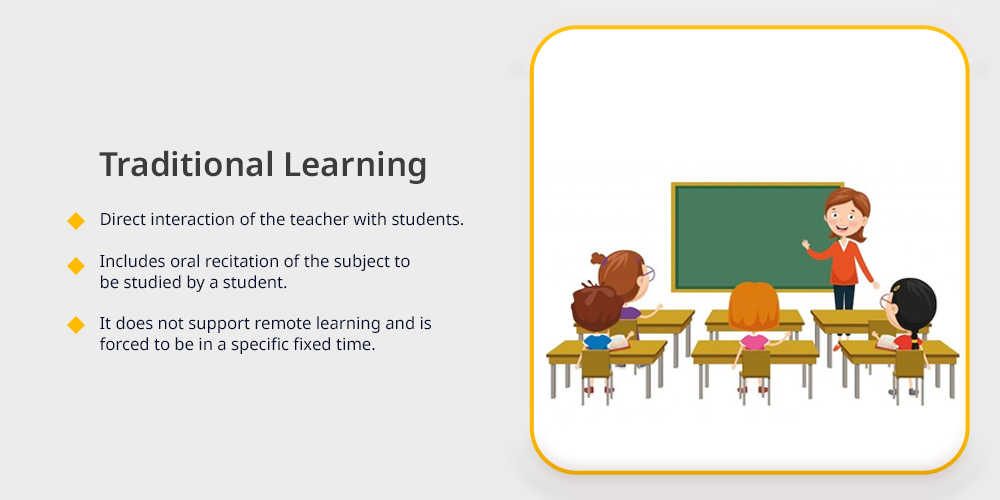
Traditional learning in ESL education offers several benefits that can significantly enhance language acquisition. One of the primary advantages is the direct interaction between students and instructors. This face-to-face communication fosters an environment where learners can engage in real-time discussions, ask questions, and receive immediate feedback. Such interaction is crucial for developing speaking and listening skills, as students can practice pronunciation and conversational techniques with their peers and teachers.
Another benefit of traditional learning is the structured classroom environment. This setting provides a routine and discipline that can help ESL students focus on their studies. The physical presence of a teacher can motivate students to participate actively and commit to their learning. Furthermore, traditional classrooms often foster a sense of community, allowing students to build relationships with their peers, which can enhance their language skills through collaborative learning.
In terms of teaching strategies, traditional learning can incorporate various methods to cater to different learning styles. For instance, teachers can use group activities, role-playing, and interactive discussions to engage students and encourage participation. Additionally, the use of visual aids, such as charts and flashcards, can help reinforce vocabulary and grammar concepts.
Assessment in traditional settings also allows for comprehensive evaluation of student progress. Instructors can conduct regular quizzes, oral presentations, and group projects to gauge understanding and provide personalized feedback. This direct assessment can lead to more tailored instructional approaches, addressing the specific needs of each student.
Overall, traditional learning in ESL education emphasizes interaction, structure, and personalized feedback, making it a valuable approach for language acquisition. By employing diverse teaching strategies and fostering a sense of community, educators can create an effective learning environment that supports ESL students in their journey to language proficiency.
Effectiveness of Blended Learning for ESL students
The rapid development of technology has transformed the field of education, providing new opportunities to improve teaching and learning processes. Blended learning, which integrates online and offline instructional methods, has gained prominence in ESL education. This approach allows learners to develop language skills in a more flexible, interactive, and personalized environment. The purpose of this paper is to analyze the impact of blended learning in ESL instruction and suggest best practices for its implementation.
Different Models of Blended Learning
Blended learning is not a one-size-fits-all approach; it encompasses various models that can be adapted to different educational contexts. Key models include:
The Flipped Classroom: In this model, traditional learning structures are inverted. Students engage with new content online at home, typically through video lectures or readings, and use classroom time for interactive activities, discussions, and applied learning exercises (Horn & Staker, 2015).
Rotation Model: This approach involves students rotating through different learning stations or activities, including online learning stations, traditional classroom activities, and group work. The rotation can be fixed (pre-scheduled) or flexible (adjusted based on students’ needs) (Bonk & Graham, 2012).
Flex Model: Predominantly online, the flex model provides students with a personalized pathway through a curriculum. While most content delivery and practice happen online, teachers offer on-site support and tutoring as needed (Garrison & Vaughan, 2008).
A La Carte Model: Students take one or more courses entirely online while continuing to attend traditional classes. This model allows for greater flexibility and customization of the learning experience (Horn & Staker, 2015).
Enriched Virtual Model: Combining elements of the fully online and traditional classroom environments, this model offers students the option to complete coursework online while attending occasional in-person sessions for hands-on activities and face-to-face interactions (Graham, 2013).
Benefits of Blended Learning in ESL
1. Increased Engagement and Motivation: Interactive digital tools, such as language learning apps, multimedia content, and gamification, enhance student motivation and participation.
2. Personalized Learning Experience: Blended learning allows students to learn at their own pace, revisiting online materials and practicing language skills as needed.
3. Flexibility and Accessibility: Online resources make learning accessible anytime and anywhere, accommodating different learning styles and schedules.
4. Immediate Feedback and Assessment: Digital platforms provide instant feedback, enabling learners to monitor their progress and identify areas for improvement.
5. Collaborative Learning: Virtual discussion forums, video conferencing, and group projects foster communication skills and peer interaction.
Challenges of Blended Learning in ESL Despite its advantages, blended learning presents certain challenges:
•Technological Barriers: Limited access to technology or internet connectivity may hinder some students from fully participating.
•Teacher Training and Adaptation: Educators need professional development to effectively integrate digital tools into their teaching methodologies.
•Student Self-Discipline: Online learning requires students to be self-motivated and disciplined, which can be challenging for some learners.
•Quality of Online Content: Ensuring that digital materials are pedagogically sound and aligned with learning objectives is essential for effective blended learning.
Effective Strategies for Implementing Blended Learning in ESL
1. Selecting Appropriate Digital Tools: Educators should choose interactive platforms, such as Duolingo, Kahoot, or Google Classroom, to support language learning.
2. Balancing Online and Offline Activities: A well-structured curriculum should integrate classroom instruction with digital assignments and activities.
3. Providing Guidance and Support: Teachers should offer clear instructions, monitor progress, and provide personalized feedback to help students succeed.
4. Encouraging Student Interaction: Online discussion forums, collaborative tasks, and virtual speaking exercises can enhance communication skills.
5. Continuous Assessment and Improvement: Regularly evaluating the effectiveness of blended learning strategies and making necessary adjustments is crucial for success.
The future of blended learning in ESL education looks promising, with emerging technologies and methodologies paving the way for more personalized, interactive, and effective learning experiences. These advancements will not only enhance the quality of language education but also make it more inclusive and accessible for learners worldwide.
Conclusion
In summary, blended learning represents a powerful approach to EFL/ESL education, combining the strengths of traditional classroom instruction with the flexibility and interactivity of digital tools. By enhancing student engagement, providing personalized learning experiences, and offering greater flexibility and accessibility, blended learning has shown its potential to significantly improve learning outcomes and retention rates. Various models, such as the flipped classroom, rotation model, and enriched virtual model, demonstrate the versatility of blended learning in catering to different educational contexts and learner needs.
The benefits of blended learning are evident in successful case studies from institutions around the world, where programs have reported improved language proficiency, higher student satisfaction, and increased motivation. The integration of emerging technologies like AI, VR, and mobile learning further enhances the potential of blended learning to create more personalized, immersive, and effective educational experiences.
As we look to the future, it is clear that blended learning will continue to play a critical role in ESL education. Its ability to adapt to individual learners’ needs and integrate seamlessly with evolving technological advancements makes it a vital component of modern education.
Educators and institutions are encouraged to embrace and invest in blended learning strategies. By doing so, they can provide more engaging, flexible, and effective learning environments that cater to the diverse needs of their students. Professional development for teachers, equitable access to technology, and continuous support for both educators and students are essential to the successful implementation of blended learning. Together, these efforts can help unlock the full potential of blended learning, transforming language education and empowering learners to achieve their goals.
REFERENCES:
- Bonk, C. J., & Graham, C. R. (2012). The Handbook of Blended Learning: Global Perspectives, Local Designs. Wiley.
- Garrison, D. R., & Vaughan, N. D. (2008). Blended Learning in Higher Education: Framework, Principles, and Guidelines. Jossey-Bass. Thorne, K. (2003).
- (Horn & Staker, 2015).
- (Graham, 2013).
- Blended Learning: How to Integrate Online and Traditional Learning. Kogan Page.
- 21K School India (https://www.21kschool.com/in/blog/traditional-learning-vs-hybrid-learning/) Traditional Learning vs Hybrid Learning: Which Is Better?
- eflcafe.net(https://eflcafe.net/blended-learning-strategies-in-efl-esl-education/) Blended Learning Strategies in EFL/ESL Education
- BLENDED LEARNING IN TEACHING ENGLISH AS A SECOND LANGUAGE https://doi.org/10.5281/zenodo.15001959
Qobiljonova Hurixon Jahongir qizi is a second-year undergraduate student of English Philology at Uzbekistan State World Languages University. Her academic interests include English language studies and linguistics. She has participated in international academic conferences and is a recipient of the Kelajak Bunyodkorlari commemorative badge.
Pingback: Synchronized Chaos’ Second February Issue: Sound and Fury, Signifying Everything | SYNCHRONIZED CHAOS