
GASTROINTESTINAL CANCER: THE IMPORTANCE OF EARLY DIAGNOSIS AND SCREENING
Yunusova Sarvigul Siroj qizi
2nd year student at Bukhara Medical Institute
Annotation Gastrointestinal cancers are one of the urgent problems in modern medicine, and their detection at late stages is the cause of high mortality rates. This article extensively covers the epidemiology, risk factors, clinical symptoms, and the importance of early diagnosis and screening programs for gastrointestinal cancers. It also analyzes the possibilities of modern screening methods – endoscopic examinations, laboratory and molecular diagnostics. Based on the article, it is possible to significantly increase the survival rate of patients through early detection of the disease.
Keywords: stomach cancer, colon cancer, colorectal cancer, screening, early diagnosis, endoscopy, biopsy, oncology, risk factors, prevention.
Introduction
Gastrointestinal cancers include tumors of the stomach, colon and rectum, esophagus, small intestine and other digestive organs. Among them, gastric cancer and colorectal cancer are especially common oncological diseases worldwide. According to World Health Organization data, colorectal cancer occupies one of the leading positions in terms of morbidity and mortality.
The main problem of gastrointestinal cancers is that the disease is often asymptomatic or has vague symptoms in the early stages. As a result, patients seek medical attention at a late stage. Therefore, early diagnosis and screening programs are of great importance in preventing the disease and reducing mortality.
Main part
1. Etiology and risk factors of gastrointestinal cancers
The following factors play an important role in the development of gastrointestinal cancers:
- Unhealthy diet (salted, smoked products, low-fiber foods)
- Chronic inflammatory diseases
- Hereditary predisposition
- Smoking and alcohol consumption
- Obesity and sedentary lifestyle
- Chronic infections (e.g. Helicobacter pylori)
- In particular, Helicobacter pylori infection can cause a long-term inflammatory process in the gastric mucosa, leading to dysplasia and subsequent malignant transformation.
2. Clinical signs and problems
In the early stages, patients experience the following common symptoms:
- Loss of appetite
- Weight loss
- Abdominal pain
- Bleeding (occult or overt)
- Anemia
However, these symptoms are often confused with simple gastritis or colitis. As a result, an accurate diagnosis is delayed.
3. Early diagnostic methods
Early diagnosis is a set of measures aimed at detecting the disease before the clinical symptoms become obvious.
Main diagnostic methods:
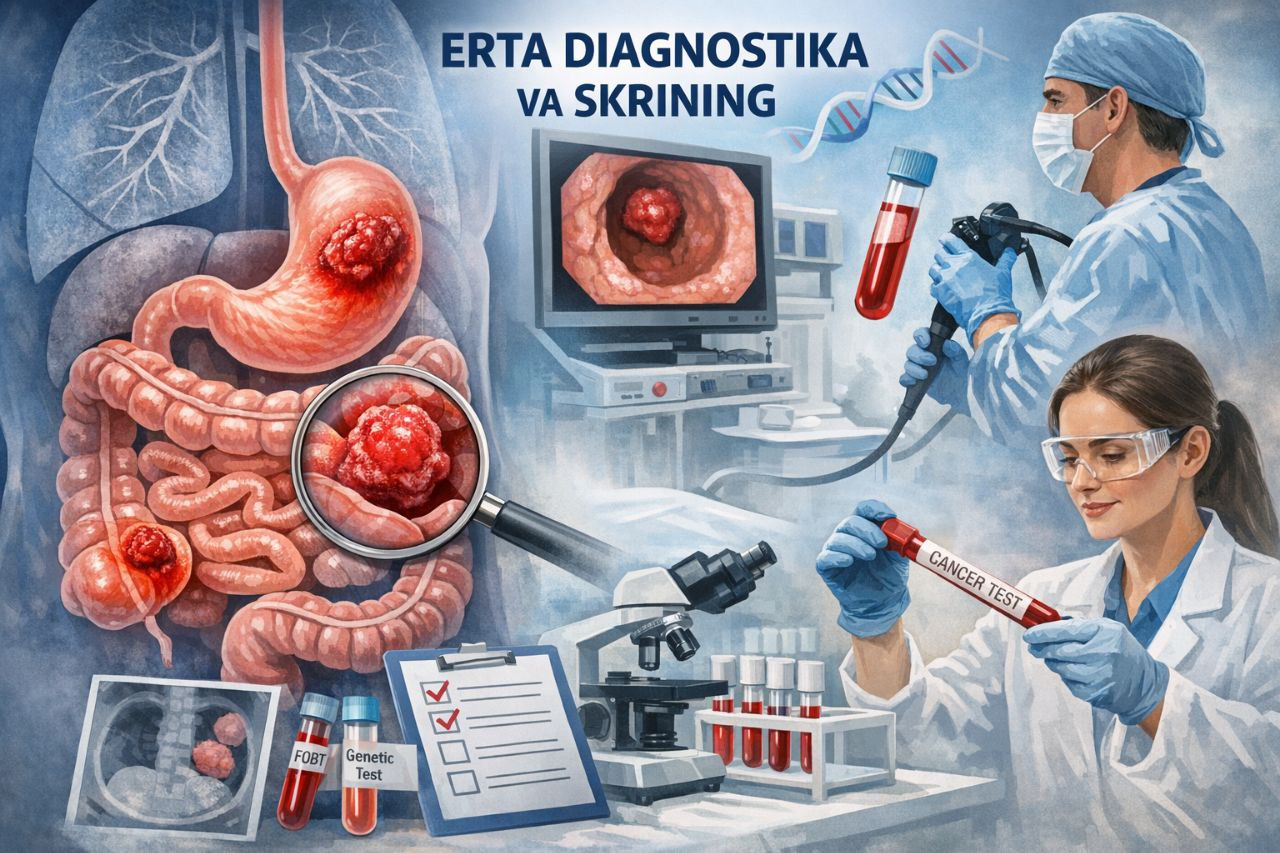
Endoscopy (FGDS, colonoscopy) – allows for visual detection of tumors and biopsy.
Biopsy and histological examination – the “gold standard” for making an accurate diagnosis.
Immunochemical tests – detect occult blood.
CT and MRI – determine the extent of tumor spread.
Molecular genetic tests – are important for determining the risk group.
Regular screening examinations are recommended for people over 50 years of age for colorectal cancer. In developed countries, screening programs have increased the rate of early detection of the disease.
4. The importance of screening programs
Screening is a screening system aimed at detecting the disease in a population without clinical symptoms.
Advantages of screening:
Detection of cancer at stages 0–I
Reduction in mortality
Increasing the effectiveness of treatment
Economic efficiency
For example, early detection and removal of colon polyps can prevent the development of cancer in the future. Therefore, screening is not only diagnostic but also has a preventive value.
Conclusion
Gastrointestinal cancers are a global health problem, and their late detection is the cause of high mortality. The widespread implementation of early diagnosis and screening programs allows for early detection of the disease, effective treatment, and increased survival rates. Promoting a healthy lifestyle among the population, reducing risk factors, and undergoing regular medical examinations are important areas of cancer prevention.
Used literature
1. Bray F., Ferlay J., Soerjomataram I., Siegel R.L., Torre L.A., Jemal A. Global cancer statistics 2020: GLOBOCAN estimates of incidence and mortality worldwide for 36 cancers in 185 countries // CA: A Cancer Journal for Clinicians. – 2020.
2. Sung H., Ferlay J., Siegel R.L., Laversanne M., Soerjomataram I., Jemal A., Bray F. Global cancer statistics 2020: Worldwide burden of cancer // CA: A Cancer Journal for Clinicians. – 2021.
3. World Health Organization (WHO). Cancer fact sheets: Colorectal and gastric cancer. – Geneva: WHO Press, 2023.
4. International Agency for Research on Cancer (IARC). World Cancer Report: Cancer Research for Cancer Prevention. – Lyon: IARC Publications, 2020.
5. DeVita VT, Lawrence TS, Rosenberg SA. Cancer: Principles & Practice of Oncology. – 11th ed. – Philadelphia: Wolters Kluwer, 2019.
6. Jameson J.L., Fauci A.S., Casper D.L., Hauser S.L., Longo D.L., Loscalzo J. Harrison’s Principles of Internal Medicine. – 21st ed. – New York: McGraw-Hill Education, 2022.
7. Feldman M., Friedman L.S., Brandt L.J. Sleisenger and Fordtran’s Gastrointestinal and Liver Disease. – 11th ed. – Philadelphia: Elsevier, 2020.
8. National Comprehensive Cancer Network (NCCN). Clinical Practice Guidelines in Oncology: Colon Cancer and Gastric Cancer. – Version 2023. – Plymouth Meeting, PA, USA.
9. Rustamov Sh.A. Fundamentals of Oncology. – Tashkent: Abu Ali ibn Sino Medical Publishing House, 2020.
10. Ministry of Health of the Republic of Uzbekistan. Clinical protocols for stomach and colon cancer. – Tashkent, 2022.