Poetry from Joan Beebe

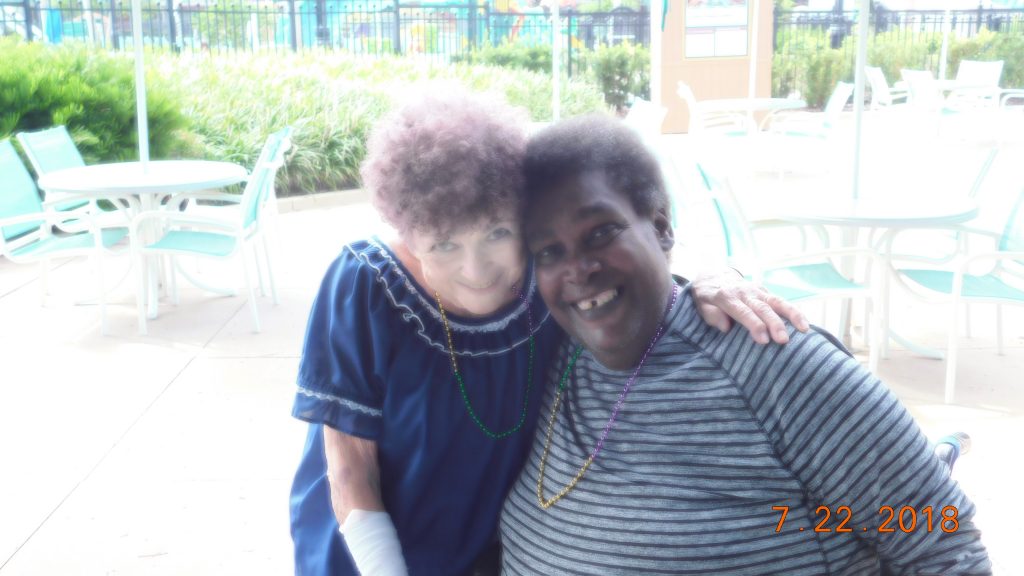
Elderly white woman in a blue dress next to an older middle aged Black man in a striped tee shirt, hugging in a pool lounge area.
Joan Beebe, left, with fellow contributor Michael Robinson
A Time of Stillness

Neat nice homes standing side by side.
Where there used to be neighbors mowing the lawn,
Resting quietly in the shade of an old maple tree,
Waving to neighbors who are also in their yard and
some taking walks through the neighborhood.

The area now seems like a ghost town.  A few cars 
sit idle in driveways and no one visible through
windows of the homes.  Arising in the middle of the 
night and looking through your window is sad and 
disturbing.  The quiet of the night seems like you 
are alone in a field of grass with the light from
a shadowy moon enveloping you in a time of yesteryear.

It is taking you back to a time of youth, laughter and 
living a family life of love.

The present is now when we hope and pray that the 
dangerous and fearful virus of COVID19 will be erased 
from every part of this world. 


Poetry from D.S. Maolalai

The kite

and this was toronto.

somewhere: a tuesday.

one of those dull

and hot days in late

summer. I wasn’t working.

I was sitting in the park

near my apartment,

reading a book

from my pocket.

and there were squirrels, employed

in their running about –

there were squirrels

all over toronto –

and then there was also

a hawk. it was flapping,

its wings making holes

in the grass, hurried along

like a fast escaped kite.

it didn’t get any of them;

just blew about, a little breeze-caught,

right in front of me

looking huffy and somewhat

embarrassed. I could have

touched it, if I’d put down

my book. the dark feathers,

the fast moving head

and the eyes. then it was gone

and the day was quite warm

and there was traffic moving

and a streetcar going up bathurst,

the colour of an old

can of cola.

and people were yelling

from the park’s public

swimming pool

and people were yelling

on the street.

we were somewhere,

and something

had happened.

The sort of thing that happens

4pm. Sunday

in the Phoenix Park back

and the north and a pub

called The Hole

in the Wall. drinking

a warm can of Guinness

like coffee. watching the deer

as they run between cars.

this is the thing –

what you see in the park

on a sunday. energy springing –

anxiety given

a shape. and we’re by

the back garden

to Áras an Uachtaráin

(that’s the seat of the president

for American readers)

the sort of thing that happens

in Ireland sometimes.

Stripping the kitchen.

like a lizard

scraping skin

over gravel,

or like peeling

a difficult orange,

I cut through linoleum,

dragging the knife

along down the edges

of cabinets.

this is a saturday,

eight months in a rented

apartment – we weren’t quite sure

what the contract allowed us

to do, but messaged the landlord

and hated the kitchen.

his easy response

with the usual english: I could not

give much less of

a fuck. I finish the trim

and call over my girlfriend

to help me in drawing

from body. it comes up

with an ease

which surprises the both of us,

upsetting my coffee

and bucking like water at stones.

frees with a scrape

and a sickening sucking

sensation, but the tiles

underneath are well-

cared for, and this

is a good afternoon.

the corners are stained

and discoloured by glue,

though the centre

is clean and bright yellow,

solid as surface, with some

minor cracking,

like a bone when it breaks

through the skin.

The houseplant

I slept late then

often, woke up

and made kitchen-

coal coffee. walked

to the bedroom,

useless and dry

as a plant. there was

something growing.

something awful

was growing. my girlfriend

had work and my friends

were all working; the dog

just as tired as I was.

I checked messages,

job listings, made

another coffee.

sent applications

and didn’t hear back. there was

something growing. a seed

in a shed in a garden,

on a dusty wood shelf

by some gloves.

summers would come –

I did know that.

and winters – and I

knew that too.

In India.

he took a room

in an apartment building

in the vaguely spaced out

no-man’s land

somewhere south of Smithfield,

past the Liffey,

near the Liberties. a hillside

which lurched on, downward

toward the river

like a mildly drunken misstep

on a badly levelled street.

and he overlooked

the brewery

and the clearly stretching

sunlight, which fell out

from his window

toward the northside

of the town. no shadows

but his own, marking time

and getting longer, like a toddler

slowly growing

until 10.

and he’d dearly

loved the dog – he had gave it

to his sister – but he’d left the plants

and bookshelves

and goldfish with a note;

perhaps the landlord

wanted them. and occasionally

a message: she was doing well

in India – could probably pay

his passage, if he’d maybe like

to come? inspired by the light

which struck the buildings opposite

he took to painting pictures:

his girlfriend, still in India,

and writing him

short messages.

Poetry from John Most

I’ve heard that a nurse will sing Amazing Grace on inauguration day for Biden and Harris.
I understand Donald Trump may sing his own version for his departure:
“Amazing Base” (with apologies to the composer/lyricist of Amazing Grace)

Amazing base, how sweet their sound
To praise a kvetch like me
Dems claim I lost, (fake votes they found)
They’re blind – just wait – they’ll see!

‘Twas Race I used to stoke such fear
And Race the nation cleaved
How sharp my ugly tweets appeared
My smitten base believed

Through Mueller, and impeachments’ tar
We have already come
The base has stuck with me so far
My base will lead us home

My reign should last ten thousand years
Bright, shining as the sun
With all those days to sing Trump’s praise
We’ve only just begun

Amazing base, how sweet their sound
That loves a kvetch like me
I’ve never lost: Fake votes were found!
Stand strong, just wait – THEY’LL SEE!

Elizabeth Hughes’ Book Periscope

Middle aged white woman with glasses, a smile and blonde bangs
Elizabeth Hughes

Tropical Doubts by David Miles Robinson

Tropical Doubts is part of the Pancho McMartin series. The series is a legal thriller. Pancho McMartin is a criminal defense attorney, one of the best in the Hawaiian Islands. Until, that is, he loses three trials in a row.

His very good friend, Manny, comes to him after his wife, Giselle, dies after surgery. Then with a twist, Pancho is then defending his friend Manny when the lead surgeon is murdered and Manny is accused of his murder. Tropical Doubts is a fast paced novel with an abundance of suspense that will keep you intrigued until the very end.

David Myles Robinson’s Tropical Doubts can be ordered here from the author’s website.

Poetry from Ike Boat

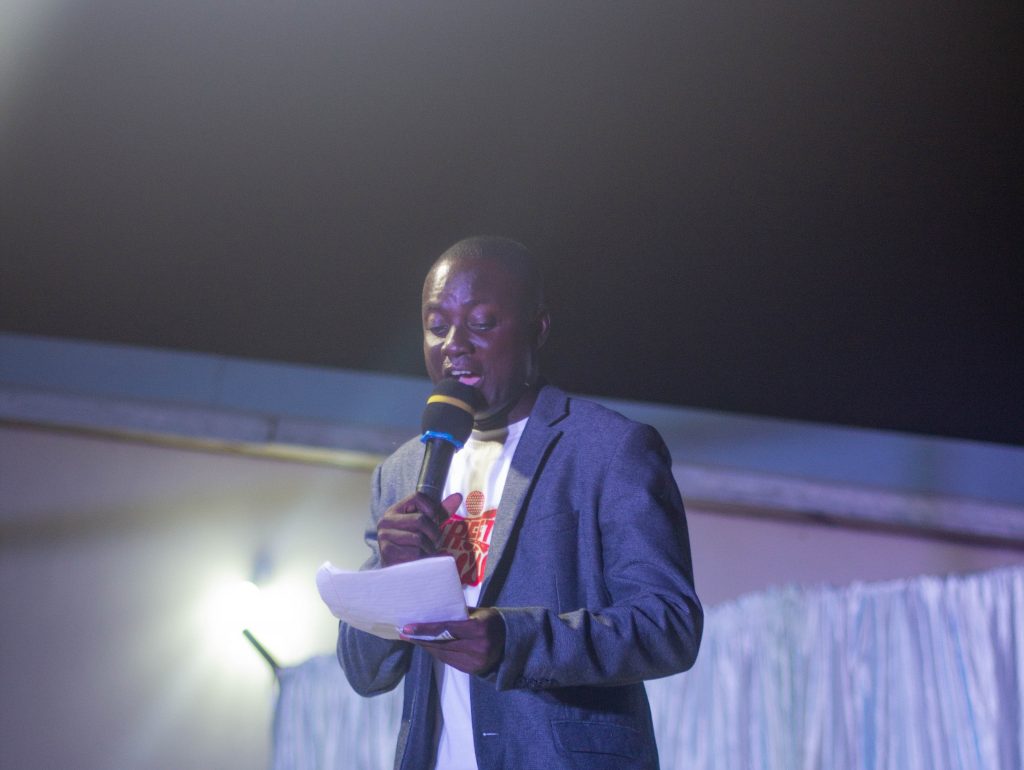
Young Black man in a dark jacket reading on stage at night under a bright light.
Poetrician Ike Boat

The Cocoa Tree

The cocoa tree,

Beautifully, planted in the fertile soils of Africa

Where the process of photosynthesis makes it free

In order to germinate in the farmlands of Auntie Rebecca

As she often addresses the folks about the need to become cocoa farmer.

The cocoa tree,

Nicely, go through the watering routine to grow every stage

Thus, it becomes attractive for the eyes to see

Just like how a man develop at individual age

So as to nourish even in the season of summer.

The cocoa tree,

Unfortunately, can’t mature at the sea-breeze atmosphere

As I was told long ago by one teacher Lee

Who once upon a time taught is there and here

And introduced us to the usage of a hammer.

The cocoa tree,

Produces the tasty little seeds like fruit

Which sometimes become the friends of a flying bee

Thus, when it’s cracked open and sweet to suit

Under the Sun when it changes colour so fine.

The cocoa tree,

Develops the pods from greenish to yellowish

Amidst climatic conditions enjoyed without any fee

Which makes it huge and flourish

It’s sometimes support the other tree with a vine.

The cocoa tree,

Helps the certainty to ensure production of the divine chocolate

As I was informed by the Brit friend known as Gee

How lovely to lick and such during a family dinner date

In fact, it’s like the beauty of all things combine.

Rhythms Of Waterfalls

Rhythms of waterfall,

As the liquid she’s carrying drops and splutter.

It’s within the yard and not the hall

So, this piece of writing hit the mind to utter.

Rhythms of waterfall,

As some sight it in Boti, somewhere in the nation.

Where the mountains are so tall

Thus, it beautifies what lies in nature’s creation.

Rhythms of waterfall,

As it turns to meander and flows.

Like a stream which doesn’t touch the wall

Not even the air or wind which blows.

Rhythms of waterfall,

As outstanding as aircraft landing.

With passengers on-board making last minute phone-call

To bring their partners and lovers, welcoming and embracing.

Rhythms of waterfall,

As pieces of Niagara is far away Canada.

Where no child dares to play the ball

Like those living on the fertile lands of Grenada.

Shadow

Shadow,

You’re associated with nature

Aside, becomes visible in the reflection of a picture,

Which is taken today and tomorrow.

Shadow,

You’re often seen in the night

When there’s availability of light,

In the storeroom or bedroom with your mattress and pillow.

Shadow,

You’re close friend to all races even though your colour is dark

It doesn’t matter if a person is called Mark,

But, it depends on the direction which you naturally follow.

Shadow,

You’re like the stranger to an innocent one unknown

So, it’s a wonder to the kids who’re not grown,

Yet, night by night you pursue in the motion so slow.

Shadow,

You’re made from what’s solid

And sometimes appear to be rigid and not vivid,

Well, that’s how to end your descriptive now.

Synchronized Chaos January 2021: Loss and Resurrection

Dream states, meditation, closing your eyes – all darkness. The child in the womb, the stars, the vast universe – all in darkness. Seeds planted in the ground – in darkness. Darkness is the breeding ground for all life. Who taught you to fear it? — social media wisdom

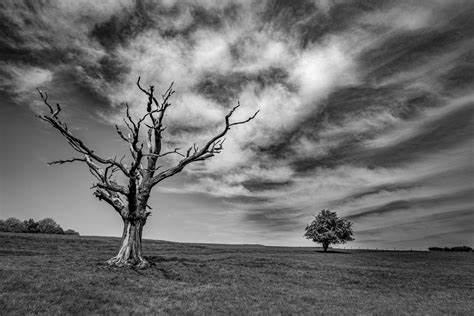
Black and white photo of two trees in a field. The one in the foreground is dead with twisted empty branches and the one to the right in the background is full of leaves.

In this month’s issue, Patricia Doyne urges us to drop-kick 2020 to the curb. As she mentions in her second piece, illness and death from the global pandemic, along with ruptures caused by underlying social inequities, played a large role in the past year.

Bruce Roberts also writes of the pandemic, and also compares the departing US president to Shakespeare’s King Lear.

Ahmad Al-Khatat mourns the loss of a life to political violence, while Santiago Burdon explores the mental state of addiction, the loops of need and desire. Jack Galmitz’ speaker lies awake at night, missing and wondering about someone not present.

J.J. Campbell writes of our human frailty in plague times, mixing a bit more havoc and chaos in with his usual loneliness and pain.

Chimezie Ihekuna writes of love lost and found amid our human physical and psychological weaknesses and social injustices.

Other authors contribute thoughts and ruminations, exhalations of the subconscious in one form or another.

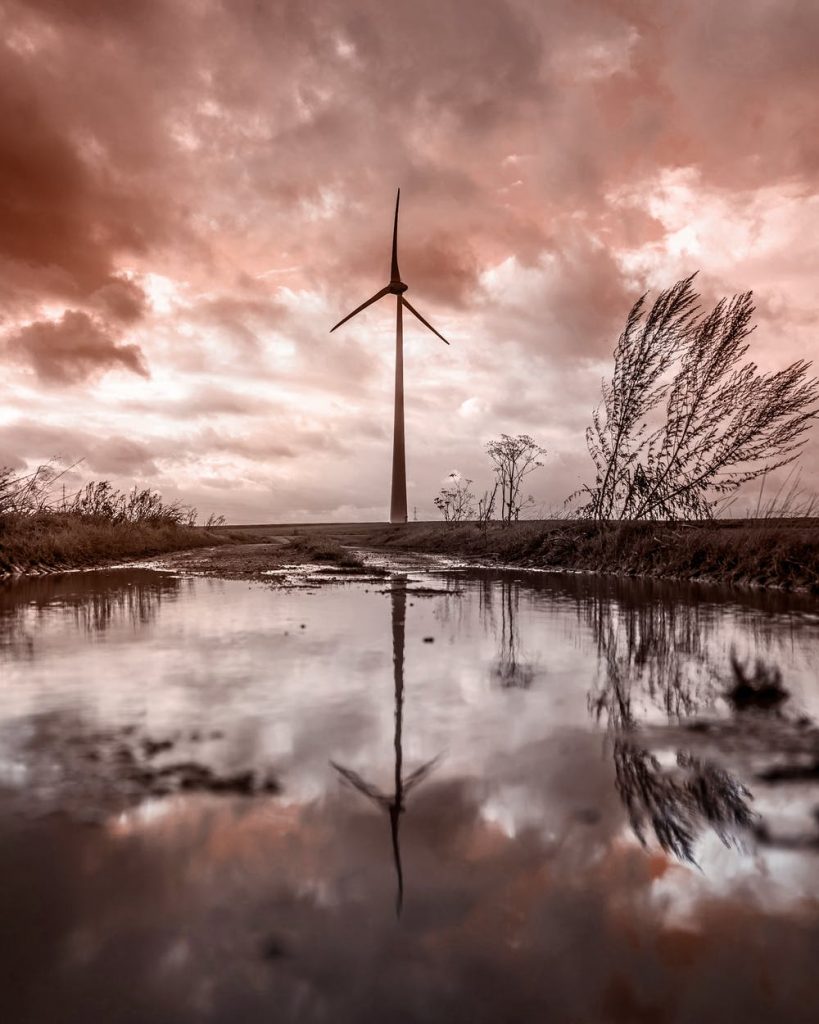
Single windmill in a wet marsh area with water and some windswept grassy plants, clouds overhead and a pink/purple sunset or sunrise color.

Daniel DeCulla poetizes on the human body through random whimsy, comparing his large male belly to his pregnant daughter’s. A. Iwasa reflects on the random day-jobs he held on his pathway to artistic creativity and social activism.

Jaylan Salah identifies and explores queer male visions and intimacy within current Egyptian cinema.

Dan Raphael starts his meditative pieces with ordinary life – weather, food, hikes, the calendar – and goes deeper through steady thought. Ferris Jones’ poems convey the fluid nature of many of our childhood memories and the different ways our mind can perceive time and space.

Norman J. Olson reflects on decades of his own personal history, following many Americans of his generation from the ‘farm to the city to the suburbs.’

Mark Murphy also probes history and memory through a poetic rendering of a painting of Renaissance political leaders and explorers.

Joan Beebe offers up a compassionate prayer for healing while R.S. Mengert reflects on death, grief, and renewal in pieces reminiscent of medieval mystics.

In Sheryl Bize-Boutte’s short piece, a teacher reaches out for comfort after her loved one suffers racially motivated violence.

Mahbub and John Culp both turn to nature to find reminders of renewal. Butterflies in early spring and a lemon tree in winter suggest to Mahbub that he can, as John Culp affirms, find strength through letting go and accepting the natural passage of seasons.

Ike Boateng showcases an annual masquerade parade in his home country, Ghana.

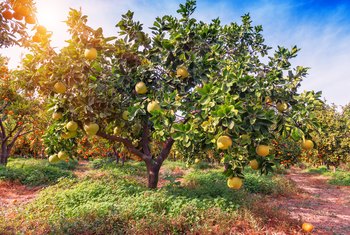
Large fruiting lemon tree planted in red-brown soil near some grass and other lemon trees.

Mark Young’s poems speak to us of delicate moments, little interruptions, while Hongri Yuan’s writing, translated from Mandarin into English by Manu Mangattu, celebrates instances of spiritual transcendence.

We invite you to reach for moments of that nature as you read this month’s issue, and we hope that you find grace and inspiration even in these global circumstances.

Short story from Sheryl Bize-Boutte

PLATEAU

Miss Pennwender was late. 

The five of us in her first period American Government class were not particularly worried at first.  After all, she was a total flower girl hippie, the young white woman icon of that day in 1968, and we knew she liked to smoke a bit.  Sometimes we could smell it on her clothes or in her hair. We all loved her in our own ways. We all knew she loved us and wanted the best for us.  She came prepared each day to make sure we had everything we needed to excel in her class and to ace our college entrance exams. She didn’t just teach us the basic elements of American Government, she taught us the background and history and atmosphere of it all. She was unlike any teacher we had ever had and our bonds with her and hers with us, although never verbally expressed, were strong.

So, on this day, it was just not right that she was not standing in her usual place at the door when we arrived. Things felt tilted and out of balance as we took our usual seats in the portable classroom. Maybe she was just held up in traffic or had overslept, we reasoned with each other. In the beginnings of her lateness, we didn’t entertain any other options.

We sat there just waiting, not speaking as five minutes passed and too quickly became ten.  And even at that mark of time, in our know- everything- overconfident youthfulness we remained certain in our assumptions about her not being on time. After all, we were the “smart” kids, the “gifted” students who had been specifically chosen to be in Miss P’s accelerated college prep twelfth grade class at our Oakland, California high school.  This was no small accomplishment in our white flight neighborhood where being deemed as smart or gifted was a designation bestowed on students at our school less and less.  

While old yearbooks would reveal that almost half of the student body had been inducted into the National Honor Society, and two-thirds were enrolled in special college preparatory classes, this year, only the five of us out of twelve hundred students at our now mixed-race school, had “tested” smart enough to be placed in Miss P’s and other such courses.  We had been hastily assembled in the principal’s office at the beginning of our senior year and without looking directly at us, he mumbled to us that we had “fallen” into the “genius” category on our intelligence testing from the year before and would be taking “special” courses designed for “high achievers” like us.  It all seemed fairly messy and felt as if we had been notified at the last minute, and unwillingly.

We were an interesting group, to say the least. There were the Japanese twins, tall and angular Steve and Mark Tanuki; red-haired and introverted white girl Adelaide Morrison; blond and overly muscular football star Jimmy Fargo; and me, the talkative sandy-haired Black girl.  Sometimes there were four of us who wondered why and how Jimmy got into the class, but we didn’t dwell on it.

Soon enough, the ten minutes became fifteen, the universal cutoff for waiting for a teacher.  For some reason, we didn’t budge. We didn’t even look at each other.  We knew something unsaid. The tilt became more pronounced as we struggled to remain patient.  We knew things did not feel exactly right this day, the discomfort prompting nervous chatter.

“She will be here soon,” Steve said.

“Yes, any minute,” I said.

Adelaide began pacing the floor in the back of the classroom.

“Will you please stop that walking, Adelaide?” Jimmy said a little too loudly, making us all look over at him. “Your footsteps are driving me…”

Before he could finish his sentence, Miss P burst through the door, all shawls and straight middle-parted long brown hair, red-faced, sweaty and looking a bit crazed. In her right hand was set of Volkswagen bus keys.

 In her left hand was an 18-inch-long metal pipe.

“Guys and girls, get your things!” She said breathlessly, a small bit of spittle spray escaping her thin, dry lips. “We are going on a field trip!”

Without a second thought, we gathered our bags and books and followed her down the hall and out to her VW bus, haphazardly parked right in front of our classroom building.  Somehow, she had driven past the gated and fenced teacher’s parking lot and through the school grounds to pick us up.  We were so excited to be doing something out of the ordinary with our freewheeling teacher and going on what we thought was a field trip, it would only seem out of character when we looked back.

We happily piled into the VW. 

“Don’t worry,” Miss P said.  “I will have you all back by the 3:05 bell.”

Off we went.  Miss P’s VW bus allowed us a comfortable and scenic ride. The 580 freeway took us through town and then on to other cities along the way.  We talked, laughed and pointed out familiar landmarks as they passed.  I even showed everyone the exit my family took to get to my grandmother’s house in Richmond.  By the time we passed that landmark, everything else was new territory to all of us except Miss P and Jimmy, both of whom seemed to know much more about places further north from Oakland.

Soon we reached the San Rafael bridge.  It would be the first time I; the twins or Adelaide had crossed it and we paid attention to every bump and window view. After a little more than an hour of driving, we finally reached our destination, Point Reyes National Seashore.

We all disembarked from the VW bus, looking at each other quizzically.  Was this some kind of nature lesson? And if so, what did it have to do with American Government?  Her keys secured into her macrame shoulder bag, lead pipe in her right hand, Miss P turned to look back at us briefly and began swiftly walking toward an incline. We could clearly see the plateau near the top. Like sheep, we followed her.  We climbed along with her and didn’t say a word until we reached the grassy top.

The view of the ocean was magnificent.  It took what little breath we had left away and then its stunning beauty gave it back to us full force.  The waves were calm and dancing against the shore like ballerinas in a choreographed line.  It was a special place.  We knew we were here for a significant reason.

“Come and sit with me,” Miss P. said.  Her brown hair was glinting in the sun, pushed back the slight breeze with rhythmic timing. Her face was drained of color.  Her eyes seemed vacant.

“He hit him with the pipe,” she said as she held it up to the sunlight.

“That pipe?” I asked.

“Yes.”

 We all really looked at the pipe then.  There was a red stain on one end we had not noticed before.

“Where, when?” Steve and Mark asked in unison.

Below, even though we could no longer see them from where we sat, we knew the waves were silently breaking against the rocks. Surely, they would soften and cleanse everything we were about to hear.

“At the club last night.” Miss P had her head in her hands and began to moan as she rocked back and forth.  We instinctively drew closer and surrounded her.  We didn’t know yet what had happened, but we did know it was hurting Miss P and that she needed us. We didn’t know what to say to her, so we just closed in on her so she could feel us there.  After a while she raised her head and looked at each of us.  Her eyes were filled with tears. Her voice was weak and thready when she spoke.

“His name is Lamont.  He is the love of my life. That man hit him with the pipe.  He said to me white girl why are you with that spook? He said I have been watching you come in here with him.  Then he hit him with the pipe and dropped it where Lamont fell. He said you won’t be with him again bitch.

I don’t know why I picked it up. I don’t remember much except leaving the hospital this morning.”

She looked up at the sky.  She let go of the pipe and let it settle in the deep grass.

“Well, how is Lamont?” I asked.

Miss P just looked at me and dropped her head.  Then she walked slowly to the edge of the plateau.  We followed.  I grabbed her hand.  Jimmy took her other hand.  The rest joined hands and we just stood there together looking at the waves kiss the shore. They were gray and silty now.

Now we knew why she had brought us here. Of all the people she could have chosen for this moment when she needed someone the most, she had chosen us.

And as we stood there, afraid and worried for a man we had never even met, we felt Miss P’s palatable love for Lamont.  Although in different ways, and for different reasons, on that day we all felt the ugliness, bigotry, tragedy and horrid meaning of what had been done to him.

We heard the roar before we saw it. The waves had become all foam and fierceness. They hit the rocks below with such force the plateau seemed to move backward.

When the spray hit us as we stood there together, we all knew Lamont was gone.

“Well, I said I would have you back by the 3:05 bell,” Miss P said as she disengaged from our hands.

We walked back to the VW bus.  We rode back full of our own thoughts about what had happened. Everyone was sad.  Miss P was silent.  I was angry.  So, so angry.

We reached the school at 3:00 and stepped out of the VW bus.  Miss P hugged and kissed us all.

When the 3:05 bell rang out with a screeching finality, we watched as Miss P turned from us and walked slowly away, climbing into and starting up the VW.  

And with what would be her final wave to us, and ours to her, we watched wordlessly as Miss Pennwender drove away.

Pushcart Prize nominee Sheryl J. Bize-Boutte is an Oakland multidisciplinary writer whose autobiographical and fictional short story collections, along with her lyrical and stunning poetry, artfully succeed in getting across deeper meanings about the politics of race and economics without breaking out of the narrative.  Her writing has been variously described as “rich in vivid imagery,” “incredible,” and “great contributions to literature.” Her first novel, “Betrayal on the Bayou,” was published in June 2020 and a poetry collection she has written with her daughter Dr. Angela M. Boutte, titled “No Poetry No Peace,” was published in August 2020.  She is also a popular literary reader, presenter, storyteller, curator and emcee for local events.