The markets, held on
the
second day after Saturday,
gave the city its name. Was
once called Stalinabad, &
the trolleybuses, with their
livery of the national colors
still carry Stalinist slogans.
Passengers wait for their
buses outside the markets;
& even though Stalin is no
longer alive & today is Thurs-
day, there is no confusion.
Coney
Island
A
fundamental characteristic
of
the scientific & operational
principles
underlying leger-
demain
is that not all Ferris
wheels
are created equal.
Tromsø
The subset A of
a top-
ological space X is
the set-off point for so
many claims & cross
claims. Plus, each party
can be both a party
attacking & a party de-
fending so the activity
has the potential to
increase quite drama-
tically. & given that the
parties in question are
a narwhal & the aurora
borealis, both of whom
have lived here for many
centuries, there are a lot
of other parties making
claims & counter claims.
Stellenbosch
The Red Ants are demolishing
trauma counseling, replacing
it with nativity sculptures in
recycled paper & precious Italian
marble. Nobody else gets a look
in, except for a boy playing with
his ball, & an oxygen mask that
is also used as a sharpening tool.
Joe Balaz writes in Hawaiian Islands Pidgin (Hawai’i Creole English). He is theauthor of Pidgin Eye and the editor of Ho’omanoa: An Anthology of Contemporary Hawaiian Literature. He presently lives in Cleveland, Ohio.
J.J. Campbell (1976 – ?) is old enough to know better. He’s been widely published over the last quarter century, most recently at Under The Bleachers, Misfit Magazine, Horror Sleaze Trash, Raw Dog Press and Red Eft Review. You can find him most days on his mildly entertaining blog, evil delights. (https://evildelights.blogspot.com)
————————————————————————————————————————the alcohol works better these days
another rainy afternoon
another shot of bourbon
for the pain
they tell me to stretch, do
a little light exercising, go
for a walk
that always makes me laugh
these “experts” don’t have
a bad back and arthritis
head to toe the alcohol works better
these days
they worry about my liver i don’t i’ve lived over a decade
The
silence seemed delicious. No one would have thought
the
streets could be so still.
The
whiplash hum of the cables,
slapping
and whining in the slots
or
clashing, electrically, above the streets,
the
moaning and whimper of the busses,
the
gnarled complaints of cars,
the
arthritic squeal of a truck,
vanished,
like the crumpled quiet of barroom talk.
The
barroom talk, too, silenced,
with
the garrulous, loud Pandora,
the
restaurant ramage quietened
to a
held breath by the cashiers.
The
tap-tap of a single pedestrian.
The
whisper of the wind in your ear.
The
buzzing of a heavy bumble bee.
The
full-throated aria of a mockingbird,
blithely ignoring
sheltering in place,
singing
his heart out at the top of a tree.
Under
the silence, a trembling,
the
lifting of a finger
turning
in the wind,
like
a cock on a weather vane.
West.
South. East. North. East.
South.
East. South. West. North.
_____
Christopher
Bernard is co-editor and poetry editor of the webzine Caveat Lector. His new novel, Meditations
on Love and Catastrophe at The Liars’ Café, appeared in January 2020. His
third collection of poetry, The Socialist’ Garden of Verses, is slated
to appear later this year.
Eunice
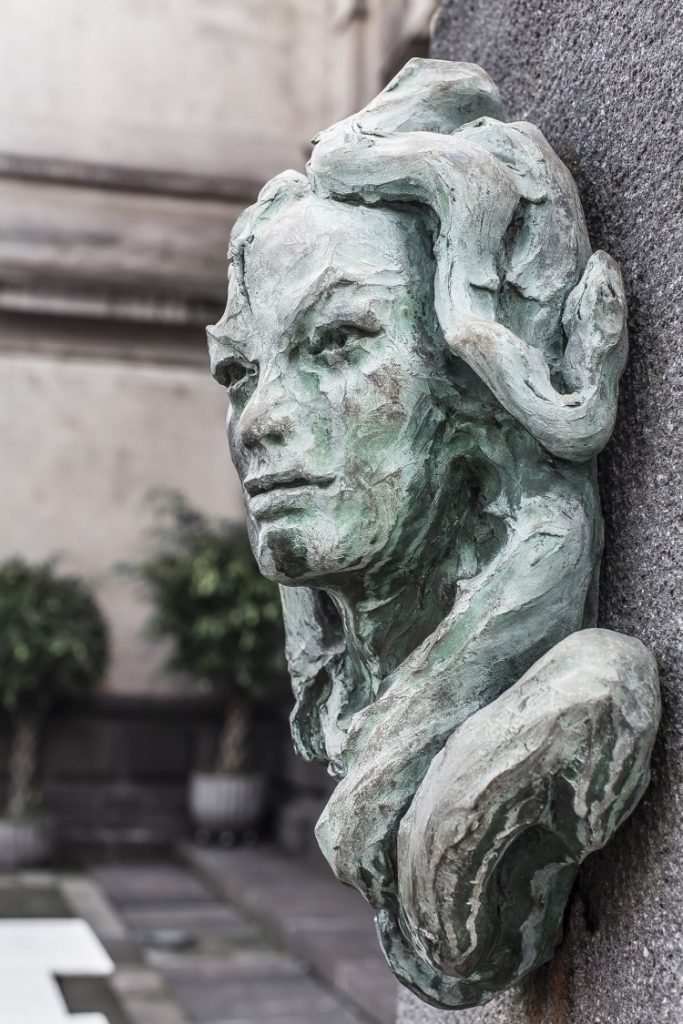
Odio (sculpture by Marisel Jiménez; image from Oregon Arts Watch)
AT JOURNEY’S END
The Fire’s Journey
Part IV: The Return
Eunice Odio
Translated by Keith Ekiss with Sonia P.
Ticas and Mauricio Espinosa
Tavern Books
A review by Christopher Bernard
“2ND
MAN
Where,
where is the house of your words?
ION
Behind your
heart.”
—The
Fire’s Journey, Part IV: The Return
Eunice Odio, considered
by many the greatest Costa Rican poet of the twentieth century, wrote what we
can now see is one of that century’s most remarkable poems – her complex,
elusive, deeply imagined epic of creation, The Fire’s Journey. It has
taken several generations for Anglophones to be introduced to this extraordinary
poem; with the publication of this translation of the epic’s concluding
section, we are finally able to get a sense of the full magnitude of Odio’s
accomplishment.
To briefly recap: the
first three parts of this epic depict, and in some ways enact, the creation of
the world from primordial chaos, and of both the poet narrating the epic
(introduced in part two) and of the world’s poet-creator, Ion, named after a
central character in Plato’s dialogue of the same name in which the philosopher
presents his understanding of poetry as a kind of inspired madness and the role
of the poet as a necromantic artificer and a tutor, wise in his madness and mad
in his wisdom, of the ways of the gods.
The third, hitherto
longest, section depicted the heroic making and remaking by Ion and his
faithful servant, Dedalus, with the help of a host of gods, of a great
cathedral, an edifice against the void that threatens creation at every instant
of its existence.
The fourth part depicts
the return of Ion and Dedalus and the other creator gods and goddesses (Om,
Tiara, Thauma, Efrit, Demon) to the city of humanity to celebrate the creation
of the world after a great victory has been achieved (it is not entirely clear
what this “victory” is of, or against what, though it may be the victory of
creation itself against chaos and nothingess). On their way to the city, they
meet a group of men carrying an angel who seems, somewhat ominously, to have
been killed by the masters of the city. In a Lazarus-like act, or an allusion
to Jesus, they resurrect him:
He is a crippled
angel, he is a man;
not a whole man,
but broken in pieces;
half a man that
rage spun cut by cut,
large in wounds
and small in hope . . .
Ion, returning to his
human form, hopes to be recognized by his mother, his uncle, and his brothers
(curiously, Ion’s father is never referred to directly, though an ultimate
being irregularly appearing, called “The Guardian,” may be him), but even his
family does not see him for what and who he is (the second brother speaks):
You’re
left, mother, with the son
who
disturbs you piece by piece;
you’re
left with your recovered son
in
whom you never rest
the
one you love in secret
without
joy and without pause;
in
whom you whirl, crying in pain.
In consequence, Ion, who,
as a creator of the universe, is also the creator of himself, must now reject his
family:
Mother, . . .
. . .
Stay in your place,
Stay there, living, besieged by the dead.
Stay there, kissing me from within.
A new word annihilates me,
another sets me free
another one is born in me, allowing a new birthing;
I am become birth-light once again.
I emerge.
. . .
I keep on until the end,
journeying in rapture.
But on their way to the
city, the creators make a harsh discovery: though those they meet are eagerly
awaiting the coming of the creators to celebrate them and all of creation, Ion
and Dedalus are not recognized; they are spurned, laughed at, denied. They then
discover the harshest reality of all. The city of men where they hoped to
celebrate, and justly be celebrated, has been conquered by an oligarchy of
demons: god of the dead Erebos, three-headed Cerberus, Syriac devil Beherit,
and Hybris, named not coincidentally for the Greek word for the overweening
arrogance that leads to catastrophe. Humanity has been corrupted, and the euphoria
of creation is poisoned by the reign of evil.
Ion and Dedalus are cast
out of the city. After their long labor creating the universe, they are stripped
of joy and pride, mocked, and left destitute in the wilderness:
DEDALUS
Lord,
you are sad. You have nothing left
nothing
but
your solitude.
. . .
ION
You, my populous solitude
my
soul’s pluranimous movement,
the
thirst that sustains me,
mother,
child, my brother pulse,
the
bread’s skeleton,
an
unbroken visitor
. . .
Guarding
keeping
watch
at
the gates of the earth.
“The return” of the title
means different things: Ion’s return to the city of men, his return to human
form from his time as spiritual creator, the return to “reality” from the
inspired insanity of the rhapsode, a return to darkness after the blazing light
of creation. It is also a kind of return
to the primordial questions of existence, to void and chaos confronting the
painful articulations of reality, to the adventure of being that is always
about to begin.
Thanks to Keith Ekiss and
his associates, Anglophone readers now have a chance to be enriched by this strange
and challenging poem, Blakean (as the great Mexican poet Octavio Paz
recognized) in its range and originality, a myth of origin of endlessly
ramifying depth, a spiritual and verbal journey rich with promises of discovery,
and a look into human and ahuman reality depicted in a masterpiece that
deserves a wide readership in any language. One can only wonder why it has
taken so long for us to learn about it. But surely it has been worth the wait,
since the result is this masterly translation.
____
Christopher Bernard is co-editor and poetry
editor of the webzine Caveat Lector.
His new novel, Meditations on Love and
Catastrophe at The Liars’ Café, appeared in January 2020. His third
collection of poetry, The Socialist’ Garden of Verses, is slated to
appear later this year.