Poetry by John Grochalski
the movie ticket cashier has a window
into the deepest fears resting in my soul
the movie ticket cashier
sells me a senior citizen ticket
at the age of forty-four
this chipper grim reaper
senses the stench of death on me
and all it’s worth to him
is his cheap smile
and a six-dollar discount.
the bather
he flushes the toilet
in the public men’s room
more than a dozen times
he’s usually in there
a good forty minutes
there is generally a line by then
an angry-faced mob of men
checking their watches
and doing their pee-pee dance
when he finally comes out
his long hair is slicked back
and the beard is gleaming
a layer of new york city dirt
is gone from his chapped face
the crowd parts for him like the red sea
they let him walk back out
into the glare of the sun and the street
before turning back to each other
like red-faced idiots
with no clue
who was supposed
to get to use the restroom next.
the bottle collectors
are outside my window
riffling through the garbage
as i sit in this chair with a hangover
they rattle their treasures unmercifully
they’re loud enough to wake the dead
i think of all of the years of drinking
all of the bottles and cans that i emptied
and threw away like they were nothing
hangovers that have become
a goldmine for someone else
then i fart loudly into the void
and stumble off
to get my broke ass
ready for work.
from near the verrazzano-narrows bridge,
jogging, a complaint about the weather, etc.
i’m still doing this, why?
dragging myself out of the door at seven in the morning
to face the calamity of cars
and high school students
and parents and wailing babies
smiling, waxen fellow joggers who feel compelled to wave
and dogs who’d rip me apart like captured carrion
should i stumble before their wooly, jagged muzzles
what should i think?
that vanity must be the last refuge of a scoundrel
i feel scandalous
in an ill-fitting t-shirt
my booze belly hanging over ill-fitting shorts
sweat pouring off of me
sore knees and sore shoulder
dying unnaturally in the unnatural heat of april
for that matter
where has the spring gone?
it comes for a week now
spreads its allergic seeds
and then the summer chases it out of the house
as if it were a philandering prick
even the tulips bend under the burden of the sun
and the verrazzano-narrows bridge
looks molten in the blood-red haze
like it too wants
to give up the game
collapse into the cold belly of the atlantic ocean
and drift away as if a dried leaf
leftover from an autumn
that last winter was unable to swallow.
thinking about mt. washington (pittsburgh)
been a long time
since i thought about cruising mt. washington
young, blurry nights behind the wheel
with calvin and steve and colby
reckless with cheap beer and cigarettes
and the immortality of a fool
as pittsburgh glowed below us
spent from our revelry on humid summer nights
chasing women with stale inuendo
then going home alone to porn magazines
drunken, horny lotharios with nothing to show for it
but sore wrists and tissue paper
before passing out
then hours later
leaning over a toilet bowl
convulsing with the morning’s vomitous hangover
memory’s cheap regret
and the body’s rancor making us shiver
yet planning on calling all of the fellows later
to trade war stories over the evening’s first pint
and do it all again.
I am a published writer whose poetry has appeared your journal as well as in several online and print publications including: Red Fez, Rusty Truck, Outsider Writers Collective, Underground Voices, The Lilliput Review, The Main Street Rag, Zygote In My Coffee, The Camel Saloon, and Bartleby Snopes. I am the author four books of poetry The Noose Doesn’t Get Any Looser After You Punch (Six Gallery Press, 2008), Glass City (Low Ghost Press, 2010), Starting with the Last Name Grochalski (Coleridge Street Press, 2014), and The Philosopher’s Ship (Alien Buddha Press, 2018). I am also the author of the novels, The Librarian (Six Gallery Press, 2013) and Wine Clerk (Six Gallery Press, 2016).

Poetry from Denis Emorine
I beg your pardon Carmen
for crying more and more
remembering your pain
after his death.
22 y.o.
You were so young Carmen
and so pretty
but you are dead
while I try to stay alive
with your ghosts
they are mine now
forever and ever
till my death
but you are not guilty
please believe me
I would like to remain your
little boy
nestled in your arms
like a born kitten
covered in blood
your blood
*
Carmen
I am your motherless child
give me your sorrow one more time
Please try again
I (just?) want to be strong for you
only for you Carmen
don’t look at my face now
never
I want to be stronger
even if I am a weak person
as you probably know
Carmen
Carmen
give me your sorrow
nothing else
I beg you
on bended knee
*
Beloved Carmen
life is a black hole
without you
I would like to hear your voice again
closer to me
and your blow on my cheeks
and on my lips
I would like to forget your name
and my pain
I have loved you for a long time
in vain
today
I can’t reach you any more
with my tenderness
Beloved Carmen
the piano is dead
gone
definitely gone
*
Too often
the sky is grey inside me
closer to my heart
beating too fast
I was born on a windy day
the snow was falling in high flakes
inside my head
I always have a headache
thinking of the past
Time goes by
life is a clepsydra
*
Carmen
is so difficult
but I can’t forget you
Facing your grave
makes me cry
Give me your arms again!
I don’t want to be a wise man
just follow your steps
right till the end
*I wish I were dead
could you understand
but
I don’t want to upset you
What to do?
*
Carmen
my sweet fairy
I remember your words in English
my mother’s tongue
the music of my childhood
that I both hate and love
Sometimes I should love
to lose the French tongue
keeping you closer to me
but this is an illusion
It’s so hard loving you now
crossing the beyond
*
Living with you
was a fairy tale sometimes
Now
I can’t reach you
my arms are too weak
and evanescent
is your shadow
*
Carmen
so difficult
to find the rights words
to remember you
even in French
Doors are double-locked
Sweet Lady
I need your arms
to live a little bit
please don’t abandon me!
*
Words
only words
that’s all
Words
only words
nothing else
but
believe me
silence is better
silence
and your smile forever
*
I would like
to have
a heart of gold
or
preferably
I would have liked
to have one
but it’s too late
I am now living
with fear
with
…
fear
*
Carmen
how deep
was your pain
how deep
is mine
thinking of you
Carmen
you are my love
but
you are dead
d
e
a
d
….
*
Give me your arms again
to fight against death
your death
*
Carmen
sweet Carmen
give me your Cross again
I know it’s useless
but who cares?
this is a pact between
you and me
Sometimes
I feel misunderstood
since you’ve been gone
*
February, 28, 2018
Today
I’m 62 y.o.
Nothing else
White my hair
and my heart
I try to live as well
oh yes
I would like
to be stronger
with death in my sights
*
Hold me tight
sweet Lady
my life
is hanging into the balance
I’m always complaining
since you are dead
I am unable to
put one foot in front of the other
my life sways
and sways
*
I stay
your dreamy boy
at least I try
in memory of you
but
it’s over
life fled
*
Carmen
What could I add to my pain?
I have nothing to say
I’m unable to shout
neither in French
nor in English
Sadness has no language
you probably know
Give me your own words
to fight again!
*
I’m shivering
because I’m coward
I beg your pardon
Mother
Is it enough?
Obviously not
I was expecting you
Maman
*
Sweet Maman
my love remains the same
but
this is a song of death
how could I express
my pain?
Carmen
I want to forget your name
because I’m facing the past
but
whatever happens
I can’t
I can’t…
Day is over
night is over
and
the world is closed
*
Où es-tu Carmen
où te caches-tu?
Il y a si longtemps
que je suis à ta recherche
Il y a eu trop de sang dans ta vie
et trop de douleur aussi
tu ne m’entends pas hurler
depuis que tu es morte
je ne retrouve plus
le chemin de ta tombe
je suis démembré
I don’t want to play hide and seek anymore
I miss you sweet Lady
*
Denis Emorine is a French writer. He was born in 1956 in Paris. He has an emotional attachment to English because his mother was an English teacher. He is of Russian ancestry on his father’s side. Writing, for Emorine, is a way of harnessing time in its incessant flight. Themes that re-occur throughout his writing include the Doppelgänger, lost or shattered identity, and mythical Venice (a place that truly fascinates him). He also has a great interest for Eastern Europe.
His theatrical output has been staged in France, Canada (Quebec) and Russia. Many of his books (short stories, plays, poetry) have been published in Greece, Hungary, Romania, South Africa, and the United States.
His first novel La mort en berne , 5 Sens éditions, was published in Switzerland, in 2017.
An English translation Death at Half-Mast is forhcoming in the USA https://www.experimentalfiction.com/
In 2015, Denis Emorine was awarded the Naji Naaman Literary Prize Lebanon (honor prize for complete work)
For more informations, go on his website http://denis.emorine.free.fr/ul/english/accueil.htm
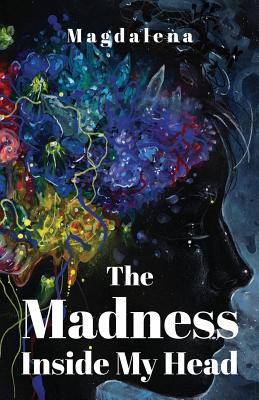
Cristina Deptula reviews Magdalena Garcia’s poetry collection ‘The Madness Inside My Head’
The Good, the Bad, and the Ugly: Magdalena Garcia’s The Madness Inside My Head
Magdalena Garcia is complex. Her new collection The Madness Inside my Head celebrates romantic love and raw sensuality while confronting us with the domestic violence and cruelty she has endured. She’s got determination to live and to care for her children, whom she makes a definite priority and refers to as ‘kings and queens.’ For their sake, and her own, she speaks out about child abuse and intimate violence, about looking to men hoping for the care and love she never found from her father as a child.
As many people may ask, ‘why didn’t she just leave?’ she replies, tellingly, in a poem: ‘bad love was better than no love at all.’
She encourages and patiently waits for loved ones to get help with their substance abuse problems and criticizes the damage she sees drug and alcohol abuse doing to those around her. Yet she acknowledges that she herself has struggled with an addiction – sex. Perhaps this shared experience is a source of compassion for her, helps her to love those around her who are addicted while still hoping that they get the help they need to change their behaviors.
Also, a poem in the ‘Bad’ section suggests that she herself has not always been entirely honest with everyone in her dating life, and she can now own up to that without hiding it. That is courage – that she’s no longer afraid, not of the brutal men who have hurt her, or of being alone, or even of owning up to her own past. She can now revel in beauty and strength, her own, and that of her mixed Puerto Rican-Black heritage.
The Madness Inside My Head is conversational, with punctuation and varying sentence lengths. Garcia’s writing expands to reveals the depth of her pain and solitude when she’s got nothing but uncomfortable time to think, and bursts forth in staccato exclamations to highlight the urgency of her survival instinct during immediate danger. At other times, particularly in the first section, her rich, flowing language revels in passion and pride. She now knows the difference between an abusive situation and a mutually consensual, caring relationship, and has the resources to be able to choose the latter with joy.
There’s a trajectory towards hope in Garcia’s story: she leaves, or throws out, the men who harm her, realizes ‘there’s therapy in her future’ and becomes okay with that, sets up a safe and caring home for herself and her children, and gets the medical help she needs to live a healthier life. Yet, not every poem reflects that movement towards hope. At times, several poems in a row convey nothing but fear, rage, and graphic images of violence. This is realistic in that there are moments in life when we feel hopeless, and Garcia lets us sit with that.
And, Garcia honors the struggle of her fellow domestic violence survivors by refusing to allow her story to seem a simple and straightforward path towards healing. It’s not always so easy to ‘just leave,’ and she isn’t putting out a step by step guide for everyone, because that doesn’t exist. The book isn’t organized as a chronological memoir, but rather in sections: the good, the bad, and the ugly. So, rather than leaving on a note of definite, prescriptive, expected triumph, we see the hope at the beginning, which draws us into the story and makes the book more approachable. Then the book reveals the life Garcia has survived, making her joy and pride all the more compelling.
The collection ends, as indicated, with the ugliest, most brutal parts of her story, leaving readers uneasy in a way that echoes the lived experience of many survivors. Overcoming domestic violence isn’t always a linear journey, but can involve making many attempts to finally end a recurring cycle of mistreatment.
I recommend this collection for all adults, not just survivors of abuse, but those who wish to deepen their empathy for those who have survived challenges of all sorts. Magdalena Garcia has a rich, thoughtful, and strong voice and is capable of deft writing on a wide range of moods and themes, and I would love to see more from her.
Poetry from Diarmuid o Maolalai
Primary colours.
the mountains
were blue all over
and the grass was green
and white clouds
cast without shadow;
this picture
so simple, like a child
with poster paint, and sometimes
there really
are no words for the countryside
beyond speaking slowly
in primary colours.
we sat together
on the sheet
wooden pine, unvarnished since winter
and staining
with sunlight,
drinking our coffee
and eating
oatmeal toast
and marmalade. looking down,
across the hill
which made a lawn
and on which the grass flowed
windblown,
like the surface
of a rolling sea. one car, a silver fin,
patrolled the roadline, gifting us
with easy demarcation;
a way to decide
the end of land
and the beginning
of landscape
you can’t touch.
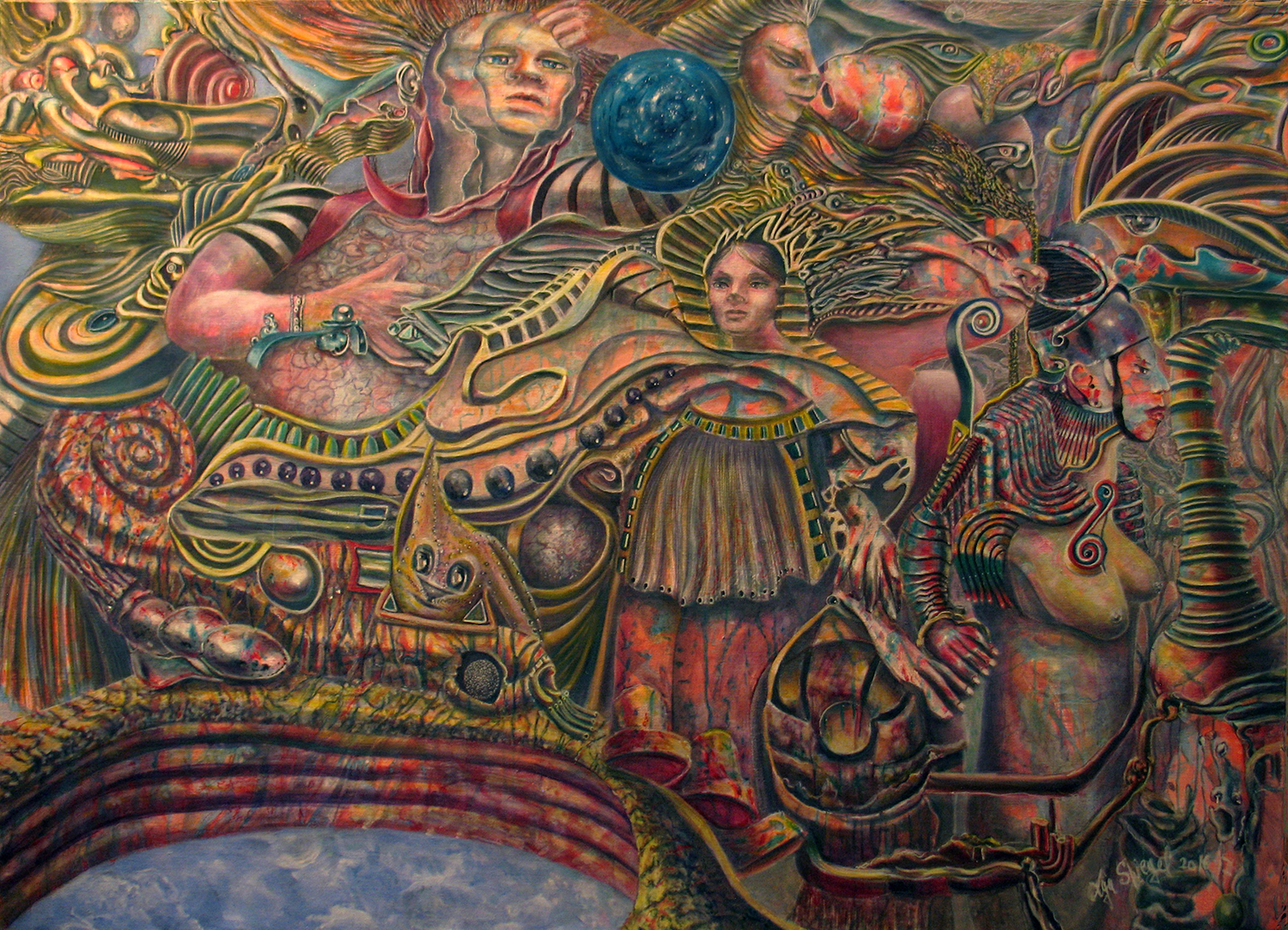
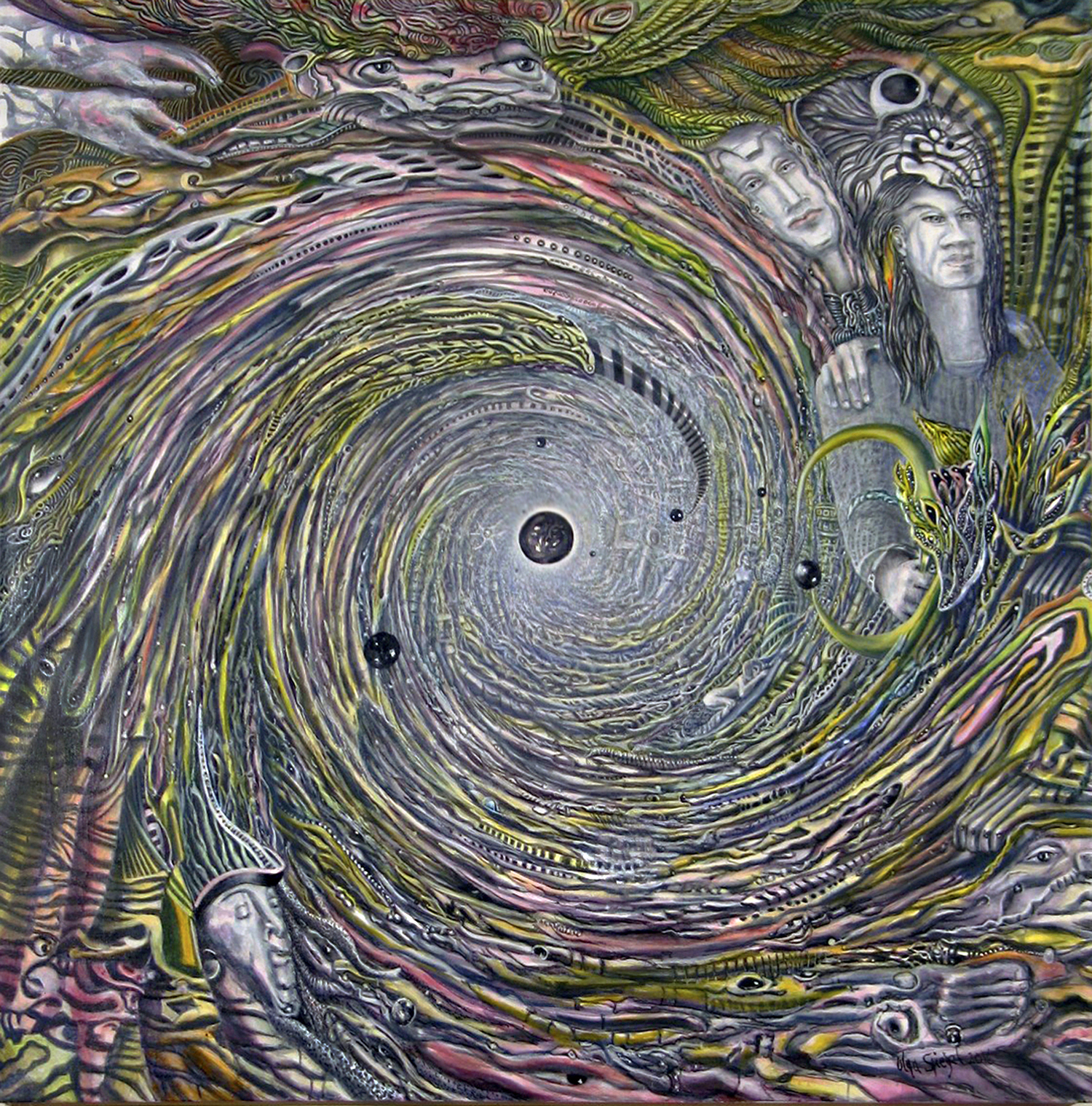
Artwork from Olga Spiegel
Poetry from Bethany Pope
Some people never leave their own backyards,
not really, not in any way that matters.
Even if they get the visa, get on the plane,
they land in Nanchang airport with a year’s worth
of purified water and dehydrated
North American-style macaroni;
fifty aluminium packets of fake cheese.
This kind of person only sees the cracks
in the cement, only notices flaws,
blind to all but the myth of their own country —
a dream of some imagined, singular greatness.
I’d offer to take them out for breakfast
porridge: ground rice, spiced beef, tender slices
of peanut and garlic, served out of
a terracotta urn the height of a child,
but they’d never agree to it and I
lack the patience. Besides, they never last,
not for long, and I’m enjoying my time.
The Undiscovered Country
There’s an unbroken blue sky underneath
the weak-plated shell of my cranium.
Lying on my stomach, beneath that sky
(those skies)
hooking my fingers into the scree
of loose, golden sandstone at the edge of a cliff,
I can peer down into the rotting green breath of the earth
which seeps up from between the fat, dry lips of the crevice.
Tree-tips, curling, fern-like and ancient,
push themselves up from their secret, fertile roots
— just within brushing-reach of my fingers.
This forest has been growing in me for a very long time.
I cannot trace the trunks to the bottom of the loam.
There are animals, possibly monsters, moving,
down there in the dark.
Millions of them, swarming.
Occasionally, I’ll glimpse a flash of bright fur, or
the spark of a scale. I can hear them,
circling the branch-strained remnants of light,
calling,
calling to me,
‘Come home! Come home! Come home!’
and I grip the parched, craving lips of the earth,
until my nails tear and bleed,
clinging to this sunlit, imaginary safety,
to keep myself from jumping.
It gets harder, every day,
to resist.
Bethany W Pope has won many literary awards and published several novels and collections of poetry. Nicholas Lezard, writing for The Guardian, described Bethany’s latest book as ‘poetry as salvation’…..’This harrowing collection drawn from a youth spent in an orphanage delights in language as a place of private escape.’ She currently lives and works in China.