Christopher Bernard reviews Mary Mackey’s novel The Village of Bones: Sabalah’s Tale

Mary Mackey

Femina Potens

The Village of Bones: Sabalah’s Tale

A novel by Mary Mackey

Published by the author in association with Lowenstein Associates

280 pages

A review by Christopher Bernard

villageofbones

Mary Mackey’s new book is a prequel to Earth Song, a highly praised series of novels set in a speculative world in the millennia before the blossoming of the ancient civilizations of Mesopotamia. Earth Song, beginning with The Year the Horses Came, follows the epic story of Marrah, the “savior of her people” and later princess-queen of Shara, a settlement sacred to Mother Earth, and of her daughter Luma, who carries on Marrah’s tradition of leadership and heroism.

The prequel takes us back a generation – to 4387 B.C.E. – to tell the story of Marrah’s own mother, Sabalah, Daughter of Lalah, and of Marrah’s birth and the dramatic, celestial, and nearly fatal events surrounding it.

Continue reading

Christopher Bernard reviews the Curran Theater’s ‘Fun Home’

photobernardfunhomereview

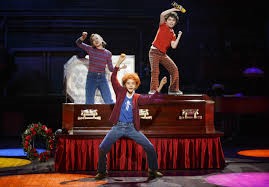
Alessandra Baldacchino, Pierson Salvador and Lennon Nate Hammond advertise their family’s funeral home in “Fun Home.” © Joan Marcus


GROWING UP GAY IN A FUNERAL HOME IN THE STICKS—REALLY!


Fun Home

Music by Jeanine Tesori

Book and Lyrics by Lisa Kron

Based on a graphic novel by Alison Bechdel


The Curran Theater, after a two-year makeover, reopened in January with the Tony Award–winning musical “Fun Home,” based on the controversial graphic novel of the same name by Alison Bechdel. The novel caused some controversy several years ago when it was placed on the syllabus of a public school English class and objected to by a few parents. A San Francisco audience will probably wonder what the fuss was all about.

The novel is presented as a memoir of the author’s childhood, growing up in a small town in Pennsylvania as the daughter of two school teachers. Her father’s hobby is fixing up the old family home, returning it to what he sees as its original elegance. The father also runs the family business, on the side. This happens to be a funeral home—referred to by the children with insouciant sangfroid as “fun home.”

The father has a secret; so does the daughter, which, she discovers, under macabre and tragic circumstances, is in exact parallel to her father’s. They are both gay. Later (no spoiler here, as the show lets us know early on exactly where we are headed) the father is killed in a road accident not long after his daughter tells him she is a lesbian, and there is some question whether or not his death was a suicide. The story takes a few weak stabs, none convincing, at exploring whether or not it was.

From this not always sharply focused material (there are at least three storylines that clash as often as they cohere), a musical has been made that is about what one might expect: a sometimes strained attempt to find a universal core in a sometimes distractingly bizarre complex of situations by forcing perfectly nice people to break into soaring if sometimes shapeless melodies, boisterous but sometimes unconvincing ensembles, set pieces that come out of nowhere and then return there, scenes of revelation, love and despair (and vice versa), and question-begging speeches and storylines that can only be based on fact as no fiction writer would have left us caught so inescapably in reality’s stubborn refusal to make sense.

Yet the show is more than worth a visit, if only because the situation it depicts, as messy as reality, is close to what many gays in this country have had to confront for a very long time indeed, even as homosexuality has become more accepted as a natural and valuable part of the human condition. This musical helps mark how far at least our urban culture has come over the last generation, and as a moral, if not always artistic, triumph, it is to be encouraged and its creators and performers applauded.

The daughter, Alison, is performed by three “actors.” (May I interrupt our show at this point to make a plea that we call female actors actresses once again? Calling women by masculine cognomens is, I submit, sexist; speaking personally, I disapprove of any form of sexism, including feminist sexism. Differences, I believe, should be honored and not erased, but they can only be honored if they are named.) These are Grown-up Alison, a cartoon artist who narrates the story, played persuasively by Kate Shindle; Youngest Alison, played (on the evening I saw the show) with bouncy vim by Alessandra Baldacchino; and College Girl Alison, played, in the best performance of the night, by a pitch-perfect Abby Corrigan, who looks like she walked out of an updated Archie comic with wondering eyebrows and an expression of perpetual innocent shock. These three share one of the show’s best moments, in a trio near the end that nicely captures the confusion of identities that lies at the heart of being human at the best of times.

One other performer was especially impressive, though her part is comparatively small and she is spared having to break into song. This was Karen Eilbacher, who plays Joan, revealer to the sexually uncertain Alison of her own gayness in a sweet and funny scene with Abby that is one of the show’s loveliest and most touching moments.  Eilbacher does a great deal with a cool mien and perfectly gauged body language, to say nothing of a killing Mohawk.

The weakest link in the story is the depiction of the father (played by a game Robert Petkoff), who is never explored in sufficient depth by the script; he is kept at a distance as a nerdy, controlling, self-deceiving, closeted Log Cabin Republican−type gay man who we remain maddeningly outside of; a shell without an interior, unless the over-controlled, airless, funereal tastelessness of his home (revealed in a brilliant move of stagecraft in the middle of the show) is in fact his interior. The glasses he wears are both a sign of his inability to see the world on his own, and of our inability to see him, read his face and thus the man. Keeping him hidden behind his prosthesis for most of two hours hobbles an actor’s ability to give his expressions much nuance. (The same might be said of Grownup Alison, though to less untoward effect.)

Alison’s mother is played by Susan Moniz; it is a bit of a thankless role, as the mother’s motivations for staying with Alison’s father remain as murky as the man himself is. Alison’s younger brothers are played with energy and charm by Pierson Salvador and Lennon Nate Hammond, and with Baldacchino have one of the show’s best moments: a whacky ensemble in which they act out a make-believe TV commercial for their “fun home.” Too bad I couldn’t hear all the lyrics in an otherwise well-mic’d show; the ones I could hear were some of the show’s funniest lines.

The objects of the father’s interest down the years are nicely played by Robert Hager.

The instrumentals were performed onstage by the Fun Home Orchestra; John Doing’s percussion and Philip Varricchio’s clarinet made especially memorable contributions.

_____

Christopher Bernard is co-editor of the webzine Caveat Lector. His novel Voyage to a Phantom City came out in 2016; his new book—a collection of poetry called Chien Lunatique—will be published in May.


 

Poetry from Joan Beebe

A New Year’s Purpose
 
At the start of the New Year,
 
My purpose is clear –
 
To fly a mighty jet through skies of blue,
 
I toss and turn as a storm approaches
 
I’m up and I’m down and sideways too.
 
But my struggle is a test
 
And my training prevails.
 
Once again all is calm
 
As I race through the skies
 
To a faraway home, where my heart and soul lie.     
 
But as I look at my soft, comfy bed,
 
I still dream of blue skies waiting for me.
 
There are no boundaries in that vast space
 
And my plane and I are flying free.
 
(dedicated to Kyle by Joan)

Christopher Bernard: Trumplandia

The News from Trumplandia

(Adapted from the Work of Basho, John Milton, Emily Dickinson, and T. S. Eliot)

Mauled, marred, and mutilated by Christopher Bernard


Mr. Trumpollinax

When Mr. Trumpollinax walked across the United States

His laughter fell like a bull’s cock among the teacups.

I thought of W., now a shy figure in the manzanita,

And of H.W. in the shrubbery

Slobbering over the hottie on the swing.

In the palace of Mrs. Flaccus at Professor Ernest Doolittle’s

He laughed like a psychotic poodle.

His laughter was quite subversive, though renowned,

Like the old man’s demented tittering

Hidden under the dying coral reefs.

I looked for the head of Mr. Trumpollinax rolling under his limo,

Or grinning on a screen

Of a topless bar in Dubuque or Sioux Falls,

With tar sand in its hair.

I heard the beat of a satyr’s goat-like hooves over Manhattan cement

As his acrid insults devoured the afternoon.

“He is a charming man, when you get to know him.” “But after all what did he mean?”

“His pointed ears, his half-eaten eyes . . . he must be unbalanced.”

“There was something he said I might have challenged—

A thousand things, but now—”

Of the dowager Mrs. Flaccus and Professor and Mrs. Doolittle

I remember only this: a piece of toast.

And of Mr. Trumpollinax his smiling, munching teeth.

Continue reading

Poetry from J.J. Campbell

12 hours of bliss
 
another drunken night
of loneliness scribbling
down the first words
that come to mind
insanity never tasted as
good as you did on our
last night together
12 hours of bliss
in hindsight
i should have known
it would never get any
better
only the lucky ones
get to leave on top

Continue reading

Essay from Donal Mahoney

A Shining Star at Every Wake
 
Bill hates to go to parties but he loves to go to wakes. One of the advantages of being old, he says, is that there are fewer parties to go to but a lot more wakes. 
 
At parties he finds a distant corner, stands there like a sentinel and watches the young folks have fun. 
 
“At parties the young move among each other like bees among flowers,” Bill says. “When I was young I tried to find the right flower and hover there, if you know what I mean.”
 
Although he doesn’t approach anyone to start a conversation, Bill’s not upset when people approach him. Some young folks want to know why is the old guy standing in the corner. And he doesn’t hesitate to tell them. 
 
“I came with my wife,” he says. “She’s out on the floor somewhere having a good time.”
 
Moments later, he adds the obvious: “She’s an extrovert and I’m not.”
 
At parties Bill and his wife always slow dance at least once even though he says he has two left feet. He says that after 50 years of marriage, his wife’s used to having her feet under his. He says she never complains. She loves parties and is happy that he’s willing to come along, even if it’s only to stand in a corner. 
 
At wakes, however, Bill comes out of his shell. He’s in his element at wakes.
 
“I’m the life of the party at a wake,” Bill says, “if you’ll excuse the expression.” 
 
His modus operandi at a wake isn’t complex. First he consoles the bereaved and then talks to anyone and everyone who has come to the wake. When Bill has finished his rounds, everyone, even the dead person’s kin, feel a little better. 
 
“Bill should have been an undertaker,” his wife says, coming back from the dance floor.
 
Bill says he would have been an undertaker but in most states you have to be an embalmer to qualify as an undertaker. 
 
“Embalming is not a trade I ever wanted to learn,” Bill says. “But I don’t have to be an embalmer to help people feel a little better at a wake.”
 
Several years ago, a friend of Bill’s lost his wife and Bill, of course, went to the wake. 
 
He was talking to the widower when a lady walked up, interrupted them and said to the widower, 
 
“I know you’re not ready to date, but when you are so inclined, I would like to throw my hat in the ring.” 
 
Bill and the widower were shocked, but later the widower dated the woman and married her. In a relatively short time, she spent most of his money and then divorced him when he got sick. He died a year later very much alone. 
 
Had Bill known his friend was sick, he would have tried to supply him with support. He has great empathy for the dying as well as for those mourning the dead. 
 
Going to wakes reminds Bill that some day he will be the guest of honor at his own wake. He has mixed feelings about that. 
 
“I don’t know if there is ever a perfect person for someone,” Bill says, “but my wife is the only one for me.” 
 
He thinks it’s selfish to want to die first but that is his wish. He doesn’t want to live without his wife by his side.
 
“She’s my North Star….my compass,” he says. “I wouldn’t want to dance on anyone else’s feet.
—————————————————————————
Donal Mahoney, a product of Chicago, lives in exile now in St. Louis, Missouri. His fiction and poetry have appeared in various publications, including The Wisconsin Review, The Kansas Quarterly, The South Carolina Review, The Christian Science Monitor, The Chicago Tribune and  Commonweal.

Poetry from Mahbub


Despair

Once I was suddenly attacked in my heart

I tried to speak loudly but failed

I tried again but failed

As I spoke from heart and belly

Once I suddenly got struck

How should I stand before

My students are my audience

I am on the stage

I lectured with full of my voice

Suddenly it was stopped by fear or despair

Now after thirteen years the condition is better

But I faint often

When it rises in my thought

It can’t be exposed

But the fire burned in my heart

Make me cry silent

My breath stops

Life is too short

I think and again despair.

Continue reading