The World in the Palm of Your Hand
By Christopher Bernard
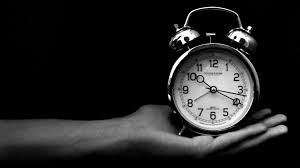
Image from Alarm Clock Wallpaper
As my eyes opened
the sun struck the clock –
a little plastic thing
with a face, round, plain,
given for Christmas by my closest friend.
I moaned a little. “Mmm—let me
sleep a little longer….” It said a minute
or two, but not enough, before seven.
There was nothing special about the clock:
small, functional, foldable, accurate,
it could be slipped into a pocket and carried
easily enough
to the farthest ends of the small blue planet.
It had a delicate but curiously penetrating alarm.
My friend had bought it at a little store
in Chinatown from a teenage gamine-like girl
named Mary Chew, who had a mole
on her chin, perfectly shaped eyes, and a stutter.
Usually she worked only weekends, but
that day had been the first of winter vacation,
and she wanted to earn some extra money
to buy a motorcycle helmet (a surprise)
for her 20-year-old boyfriend, Daniel Chan,
whom no one in her family liked.
“His family is not from Guangzhou,” complained her mother.
Mary’s employer, Charles “Charlie” Wang,
was a little wiry man, all abrupt manner
to his workers, all unctuous simpering
for his customers. He usually paced
the back of the store looking at all
the clocks, but could never remember the time.
He had purchased the clock
as part of a consignment from a saleswoman
named Kelly Smithfield, a tall, big redhead,
born in Modesto, a graduate of Davis,
who had brought it in a case of samples
she showed him one day at the end of October
on a cold call at the Golden Mountain Happy Clock Store.
Kelly was twenty-seven, vaguely desperate –
she waved her hands a lot and laughed too often –
still on probation with the company,
she hadn’t sold a single clock since August,
and nearly fell over when Charlie Wang
bought her entire case. When Charlie
invited her to lunch at the Dragon Palace of Dim Sum –
“You will love their chicken feet!” – well, how could she refuse?
Kelly had been given the clock
by her assistant, Amanda Clark,
at the home office in Sacramento.
Amanda was twenty-three,
petite, blond, scattered,
with two years of community college
and aspirations to become a real estate agent,
though she was afraid she may have missed
the height of the market
by a decade or two.
Amanda had gotten the clock
in a case with other clocks –
small-traveling, silent-alarm, valedictory, vanity-table,
of all shapes and designs, from the plainest, like mine,
to luxury, to joke and variety designs:
Dooby-Doo, Bart Simpson, Princess Elsa, Shrek –
a case she had gotten
from the office delivery clerk, Steve Butts,
a middle-aged man who had been downsized
by a local insurance company at the age of 55
and was taken in out of compassion
by the office manager, who knew him
during his glory years as a claims adjuster.
Steve had gotten the case from a warehouse clerk,
José Parra, thirty-two, prematurely balding,
undocumented, who lived in a trailer park
with several men from his village in Guatemala.
He sent half his minimum wage to his family
and sold clocks he had filched from the warehouse
late at night on eBay.
A young warehouse worker named Minh Vuh,
a Vietnamese whose parents had been boat people
when they were children, had placed the clock
carefully in the case, with a handful of confetti. Minh
was engaged to a sweet young Laotian
who lived three blocks from his family home.
Their parents were not too happy about that,
so they had to meet secretly after school
and on his work breaks when she was in the neighborhood.
It all felt very romantic. “Like Romeo and Juliet!”
his girlfriend said, giggling. Minh kissed her on her tiny nose.
Minh didn’t remember (he had no reason to), but
he had put that very clock on the
second shelf from the top in column 37 of aisle C
last September
after receiving it in a shipment of similar clocks
off a truck driven by an ageing Filipino
named “Jack” (he had rejected his original name when a young man –
he said he wanted to be “100% American!”
and that meant having a name like Bob or Joe or Bill,
and he thought “Jack” sounded sexy and macho).
Jack had picked up the shipment from a Sacramento wharf
where it had been unpacked from a container
by a young African-American
named Obadiah Washington,
who was in fact a rap artist (the day job was a secret)
and performed at local clubs at night under the name
Dr. Sling.
The container had been hauled off the ship Flower of Seoul
by Ted Anderson, of old Swedish stock, on his last day
before retiring. The container was his last but one.
When he hauled the final container of his career,
his fellow longshoremen smashed a champagne bottle against it
and made a party of it for the next hour on the wharf.
The container with the clocks inside got a splash of the champagne,
but was otherwise undamaged by the festivities.
The Flower of Seoul had carried the container
across the Pacific the week before.
The ship was manned by a small crew,
most of them young Indonesians, and piloted
by a Taiwanese captain named Jiang-Ji Li,
forty-five, with a family of six girls at home
and a nagging wife who made the boredom of sea life
seem like an endless vacation by contrast.
Getting his girls married, however,
was another matter: the eldest
had been poisoned by “women’s liberation”
(as he still called it) and wanted to become a captain
like her father. Why couldn’t she have been a boy?
These thoughts had made the crossing
an onerous one for Captain Li,
especially the prospect of going back:
the Flower of Seoul would be making a week-long stop,
after picking up timber in Portland,
at Taipei.
The clock had sat for the entire trip,
unseen in its dark container,
its hands set at the traditional 10:10.
n the port city of Busan, South Korea,
the container with my clock in it
(though, of course, it was not yet my clock –
would it ever be, really? Is ownership
of anything, let alone a clock,
time’s strict and impartial measurer,
by a limited and mortal being like man
even possible? That is a delicate
philosophical question
that we can not, alas, pursue here),
that container had been placed on the deck
of the Flower of Seoul
with two dozen other similar containers
of different colors and sidings –
some corrugated, some smooth –
with the result that the ship looked like a father
so overburdened with packages
he was likely to fall down,
by a longshoreman named Kim Dong-hyun,
twenty-eight (a little fat fellow
who loved dakon kim-chi so much
his mother gave him a case every year
for Gujeong),
using a crane
to lift it from a semi driven by a driver
named Kim Ji-hoon (no relation), a tall, skinny fellow
of thirty-three,
who still lived with his parents
and played computer games on the weekends,
driving his mother to despair about ever having
grandchildren.
He had driven the truck
from a small factory outside Seoul,
where he had stopped by for the clock consignment,
up near the border
(it was a long drive not helped
by the bad heat wave and the endless traffic –
the highway was becoming a continuous traffic jam,
but no one in Seoul wanted to pay for improvements,
so Ji-hoon just growled and daydreamed about the next version
of WarCraft, supposed to be coming out in August).
A young woman – a sixteen-year-old named Song-hi
with long hair and fat cheeks and a pert expression –
had packed the clock in the consignment box
after taking it from the end of the assembly line
where it had been checked for quality by a grim matron
named Yun, who had a drunken husband,
two ungrateful children and a spoiled cat,
the only creature in the world she felt understood her.
The clock had been assembled
by half a dozen other girls, all wearing the same uniform.
Chimin, whose face was a perfectly flat oval
and always rode her bike to work,
added the swivel stands to the clocks.
Soyon, who was always sad
and never talked about her home life,
put in the inner workings of the clocks
and the battery receivers:
the little drawer that poked out of
the clock’s plastic case.
Subin, who liked to clown and make practical jokes,
attached the minute and hour hands, and “sweeps”
(i.e., second hands), when they had them, to the clocks.
Hayun, who was very tall and very proud
(actually, her unusual height made her painfully self-conscious),
added the white face to each clock. Once,
she had been so distracted,
she had put the faces in upside down
for more than 20 clocks.
Nobody down the line noticed until Mrs. Yun, of quality control,
saw them and had a meltdown,
and threatened to fire everybody.
That was a bad day for Hayun!
Chi’u, who was so short she
disappeared under the assembly line
when she stepped off her stool,
put in the oscillating mechanism
that ran the clock.
Hyechin, who, for some reason,
no one liked and everyone made fun of,
put in the alarm.
The girls got the parts from the other side of the factory,
where they were made by two men and a woman:
Chunyong, fifty-five, who dyed his hair,
was the lead craftsman
amd made the clock oscillators.
Songmin, his first assistant,
a stiff young man – the first of his family
not to have to work in the fields –
crafted the cases.
Yuchin was the first woman in the factory
to have made it into “craft”: she had a small tattoo
of a periwinkle on her left inner wrist,
and was considered quite wild,
but that was all right by Chunyong,
her manager,
because she was so talented.
She crafted the clock faces,
arms and sweeps,
based on her own designs.
(These were first OK’d by upper management, of course –
that was one of the reasons they had hired her:
design and craft in one person, with only one salary!
The clocks sold consistently, especially in the American market,
so “UM” was content.)
Songmin and Yuchin got the polystyrene they used
from bins of plastic parts
that had been delivered by
Kwon Young-sik, who had only one eye,
from a bad accident on his last
delivery job (it had not been his fault;
he had left because he thought that it would bring even worse bad luck,
after his accident, to stay).
The parts had been made in the big
National Plastic Co. Ltd. plant
on the other side of Seoul.
Much of the plastic was recycled
from toys, hardware tools, and other clocks.
Chunyong had gotten the quartz for the
oscillator crystal that runs my clock
(I guess I can call it mine, now)
from a bin where the crystals were packed
in small boxes
after delivery by Park Ye-jun,
a short, fiery man with bad breath
(he lived on garlic for breakfast, lunch and dinner),
from the mines of Tae Wha,
near Chungju, half way between Seoul and Busan.
The quartz from which the mechanism of my clock was made
had been mined from the earth there
by a very young man named Ahn Min-kyu,
eighteen years old, just out of school.
His family had been fishermen from time immemorial,
and he had planned on being a fisherman too,
when the fish stocks of his seashore village
disappeared one day –
it was thought because of pollution from the North –
so he had to change plans and, instead of probing the ocean
for a living, probed the earth, as there were jobs
at the booming Tae Wha Mine.
So he left his village
and went to Chungju
and learned to dig the earth
for minerals. Then one day,
in a poorly lit tunnel,
smelling of sulfur and damp,
he dug out, with his pick
(the machinery was down, as so often),
a clump of quartz – several million years old,
formed by magma thrusting
from deep within the earth –
the mine was along the rim of fire that followed
the edge of the northern Pacific
from America to Asia,
and made volcanoes erupt
and quakes shake the earth
(a smaller quake had woken me
not long after I was given the clock) –
a clump of quartz that had been deposited
in milky white crystals
with other rocks, from fire and river and wind,
in the dark earth.
He placed it, using his shovel, into the cart,
and the cart rolled away to the surface
and the sunlight,
then he turned back to the wall of rock
with his pick, and swung.
And that is the list of people to whom I am indebted
for the appearance on my bed table of the little alarm clock.
The list could go on –
there is really no reason to stop here:
What about the parents, and the grandparents, on and on,
of all those people who at one point or another
touched or handled or carried the clock, or
what would later become the clock?
What about their siblings, uncles, aunts,
cousins, teachers, friends?
What about the original inventor of the very first clock?
And who, or what, invented him?
One could go on and on. And on and on,
without end.
And that is just for the clock I looked at
when I woke up that morning.
What if I had to do the same thing
for everything else in my life?
The mind suddenly flies off
like a flock of startled crows,
shredding the air with caws . . .
I woke.
It was the alarm,
its shriek
telling me “get up! get up!”
_____
Christopher Bernard is author of A Spy in the Ruins, In the American Night, and The Rose Shipwreck. He is also co-editor of Caveat Lector. His poetry can be found at his blog, “The Bog of St. Philinte.”
Image from: Alarm Clock Wallpaper