Christopher Bernard reviews Philip Fried’s poetry collection Angry Love


philipfried

Philip Fried


With Angry Love


Interrogating Water and other poems

Philip Fried

Salmon Poetry

112 pages

€12.00


A review by Christopher Bernard


New York poet Philip Fried’s new book of poems has a bitter humor, an angry sarcasm just this side of despair:


The multi-chemical Lethal is a classic

And one of America’s best-loved cocktails, due

To its featured role on cable’s Death Row show

With a hey, and a ho, and a hey nonino

—Mixology, a Madrigal


But the bitterness is well earned, as every day – and, with the multiversal bedlam of the internet, sometimes every minute – we are granted yet another example of our continuing descent into barbarism and moral chaos.

Fried’s poems often use a device that has become increasingly common in modern culture, both American and European: they take on “the voice of the devil” in an attempt to shake the reader out of their usual passiveness:


Galloping with his drum, the singer

Rides in a split second over

Plains that outdistance their tympanum sky,

And all by the song’s power.

Ideology gallops the story.

What values spur the teller?

—Ballad


Fried’s poems work their angle and edge from the insanity of our gun-worship:


O portable and concealed god, barely visible

As a bulge, yet guardian of halcyon skies

And mountain majesties from your home in a pocket-,

Pancake-style-belt, or shoulder-holster.

—Prayer to the Small-Arms Deity


to our national narcissism:


First, assemble the Manifest Destiny engine,

Fasten the Shining City to the Hill,

… With the Leveraged Capital

Rubberband, stretch an elastic liberty

Until it nearly snaps, from sea to sea.

—Grammar as Glue


to our infatuation with technology, our paranoias over transgressed borders, our feverish materialism, our dehumescent humanism – but above all, to our scattering moral obeisance to the gods of war, our morphing into the labile dictatorship of terror:


We are soliciting bids from a divine

entity for a Full-Protection Covenant,

with renewal options in perpetuity,

to shield the homeland and its future seed.

—The Department of Defense (DoD) Request

for a Covenant (RfC)


The language of these poems blends the schizoid paranoia of military officialdom and the meretricious smarminess of corporate diction with the majestic cadences of the King James Version of the Bible (frequently quoted) and the sleek, solemn latin of the Vulgate, in a mashup of dictions meant to shock with awe at the “sinister giddiness” of our official culture.


Have you brought forth the Predator Drones? Have you armed them with

Hellfire missiles and fledged them with glycol-weeping wings?

….

Does the Killer Bee fly by your wisdom and initialize its missiles? Does

the DarkStar launch at your command, deployed from invisible havens?

Whatsoever is under the whole of heaven is mine.

—On the Record


Who is this that comes from the wilderness like pillars of smoke,

perfumed with lambskin and burnt gunpowder?

His legs are as pillars of marble, clad in flame-resistant trousers. His head,

crowned with bulletproof Kevlar, is as a watchtower looking toward

Kandahar.

—Canticles


Shimmering with anorexic allure,

these supermodels have learned to stroll with intent,

reinventing themselves up from the balls of their feet.

The Lil Saunder Voluminous Total Jacket

seamlessly encloses a lead core,

including the base, in brass or a suitable metal.

—Catwalk


Other poems combine street-vetted vernacular with quotes from Thoreau and Emerson, museum-ese with the disingenuous customer-friendliness of instruction cards, Victorian-esque translations from the Greek tragedians with the utterances of a Siri app named Sybil, the thuggish inquisitory of a black-site interrogator, chronicles from the dark ages of the future in the stumbling diction of an anonymous monk, and the prim hysteria of newspaper headlines.

The bitter brilliance of these poems should not hide from us the deep compassion and the furious optimism that burns at their heart. Fried’s poems are a poetry of denunciation and warning, as old as Micah and as new as the whispering drone peering in at your window. The anger of these poems is the anger of love. And a determination to seize mind, heart and body and shove us away from the bloody abyss into which we seem so intent on plunging, as though we believed we shall grow wings if only we fall hard enough.

If I have any criticism of the book, it is that I came away with no clear understanding of Fried’s notion of “the good” – aside from building and molding language into fortresses of intention and villages of words. His vision of our time’s evils is eloquent almost to a fault: I hunger to hear his vision of good – even of our time’s “goodness” (only the dark Pollyannas of cynicism refuse it any goodness at all); I’d like him to occasionally drop the sarcastic mask, the much-dented postmodern shield, and show a glimpse of the naïve spirit without the defensive clutch at cleverness.

Not the least of the ironies associated with this book is that it (like Fried’s previous books) is published by a foreign press – to whom thereby we owe many thanks. The elegant design is grateful to both eye and hand – it’s a handsome production all around. But it is one more nasty little self-imposed humiliation to our seemingly unending national list that this much-needed voice had to go beyond the country’s borders, its ever-shrinking, ever-thinning skin, to find a publisher.

_____

Christopher Bernard is a writer, poet, editor and journalist living in San Francisco. His books include the widely acclaimed novel A Spy in the Ruins; a book of stories, In the American Night; and The Rose Shipwreck: Poems and Photographs. His work has appeared in many publications, including cultural and arts journalism in the New York Times, San Francisco Chronicle, Chicago Tribune, San Francisco Bay Guardian, Philadelphia Inquirer and elsewhere, and poetry and fiction in literary reviews in the U.S. and U.K. He has also written plays and an opera (libretto and score) that have been produced and radio broadcast in the San Francisco Bay Area. His poetry films have been screened in San Francisco and his poetry and fiction have been nominated for Puschcart Prizes. He is co-editor of Caveat Lector (www.caveat-lector.org) and a regular contributor to Synchronized Chaos Magazine.


Philip Fried

 

Flash fiction from Michelle Chouinard

The One That Got Away


Hey there.

Yeah, it sure has been a long time. Longer than it needed to be. Funny, I never thought I’d run into you all the way out here; are you on a business trip? Imagine a thing like that. How is everything? How is your leg, did you get the surgery? How’s my mother? I know what you mean… life is like that sometimes, isn’t it?

Once upon a time, there was a Little Girl. When she was four years old, her mother took her far away from where she lived, to a new place, called ‘California’. When the Little Girl asked where her daddy was, her mother told her that she wouldn’t be seeing him again, because he had hurt them and he didn’t love them anymore.

But it was okay, Mother said, because the Little Girl was going to have a new daddy now. A new man had come into their lives; he loved Mother, and he would learn to love the Little Girl, too. But the Little Girl wasn’t sure. How could she trust this man to love her when her own biological father didn’t?

It wasn’t easy for the Little Girl, and it wasn’t easy for her new Daddy. These things are hard no matter what, but Mother made it even harder. She never let Daddy act like the Little Girl’s father, held it over him that he wasn’t her biological parent, only she was. She also caused fights between him and the Little Girl whenever she saw them getting too close; she needed to be the fulcrum around which the family moved. You see, Mother was a very unhappy person, and she made everyone around her unhappy, too.

Despite these difficulties, the Little Girl and her new Daddy grew to love each other, or at least so the Little Girl believed. When she was nineteen, Mother and Daddy decided to get divorced, and Daddy wrote the Little Girl a letter telling her that he loved her like she was his very own, and he always would, no matter what happened between him and Mother. And for the first time ever, the Little Girl started to believe she mattered.

But this wasn’t a fairy tale, and life doesn’t always end with happily ever after.

Mother and Daddy decided to stay married, and they moved far away to start a new life in another new place. It was very difficult for the Little Girl and her Daddy now that they were living so far apart, but they tried hard, and their relationship grew stronger than ever.

But when Mother found out how close the two of them were, she became very, very angry and very, very jealous. She began to pull their relationship apart again; she told lots of lies, and turned the two of them against one another.

The Little Girl saw what Mother was doing, and how unhappy a person Mother was. She very sadly realized that if she didn’t want to be unhappy, too, she would have to stay away from Mother. She explained this to her Daddy, and told him that even so, she still wanted him to be in her life, that she wanted to make sure their relationship stayed strong. And she kept trying hard, but it was too late.

Daddy stopped visiting his Little Girl, and stopped calling her. Birthday cards stopped, and there were no wishes at Christmas. The Little Girl grew up, graduated from college, got married and had a baby; her Daddy wasn’t at any of those events to share them with her. Days passed into months, and months turned into years…all without her Daddy.


Okay, well, I won’t keep you. It’s been good running into you; I’m glad you’re well. Stay safe.

The Little Girl turned and watched her Daddy disappear into the distance.

Goodbye, Daddy. I miss you.

Poetry from Sean Lynch


Summer

we were in west philly
and you got angry because of my friend
i thought there was something

inside of you and he was fucked up

on oxies and jack daniels reminding

me of new jersey though we had fun

watching connor all inebriated and singing

sweetly i felt
the abrasiveness in the air

finding our way out of the ghetto

wasn’t easier than usual

the lights were swinging back and forth

on market and i couldn’t keep my foot

off the pedal danger danger

we were sweaty

and you made a generous donation
i risked our lives for no good reason

i urinated in your dresser
and since it was made of plastic
the acrid smell of broken-down beer

lingered longer than necessary
i couldn’t stop talking in my sleep

reflecting some horrors
i’d never remember

Continue reading

Essay from Ayokunle Adeleye

The REP I Want


These days where the mundane is hyped, and the mediocre is celebrated, it is just so easy to lose focus, to show off stupidity, and to profit from ignorance. Since these days, service has been mutated to counter-servitude, and privilege has jumped borders: it used to be a privilege to serve, now it is a privilege to be served, even by one’s own representative. Service was a job, contested for, sworn for, and slaved for; now service is tyranny, an avenue to detain and harass familial enemies, a means to circumvolve diffidents, subdue dissidents, and propagate familiar, unconstitutional, policies, and a means to an end no less.


So that these days, every elected human (human, not official; perhaps calling them ‘official’ is why they act like slave masters) want reelection, deservedly or not. So that these days when I go to the market square, its modern equivalent, rather, it is hard to not notice those two large billboards urging the reelection of a certain Rep and citing somnolent soliloquized accomplishments, accomplishments that, in my entitled opinion, belie a four-year tenure. So that as soon as I acknowledge the ventriloquial message, “•••• lafé léèkan si”, meaning, ‘we want •••• one more time’, I smile. And that is all one can do. Àbí? I smile because I’d rather not laugh, mock, or scorn. I smile because I’m privy to letdowns at the hand of our man, and at a pivotal time too. I smile so I may not cry…


Since I know that not everything is money, monetary or infrastructure– that is how those of us not savoring the fabulous National Cake, and not even enjoying the crumbs off the fabled table, yet live from day to day in our diabetic land, a land of hunger in the midst of plenty. No bursary, no scholarship; yet we paid extra school fees for which receipts are yet inaccessible after four months, and even the political, sorry, publicized, reduction in school fees is not to take effect until another six.


Nay; not everything is in terms of how much funds an elected has in hand to conceive and execute worthwhile projects, lest sycophants say he would have done much more had he had the funds. Not everything is in Naira and kobo; some things are just integrity, plain and simple, and the lack thereof. For out of the abundance of the heart the mouth speaketh, the head thinketh, and the hand doeth. At least that is the sequence the political species operate: promise first, think later… acknowledge, assuage, assure, abnegate, then abrogate and abscond; àbí?

Continue reading

Synchronized Chaos September 2014: Freedom Within Form

Welcome, readers, to this month’s issue of Synchronized Chaos Magazine. This month we look into the concept of Freedom Within Form. Our contributors present journeys, situations, possibilities, and adventures, all coming with their own inevitable logistical challenges. Also there’s abstract art and formal poetry on a wide array of subjects, where a lot is said within the rules.

Brooke McCarley’s Appalachian Trail memoir, Cristina Deptula’s piece on the Madame Mars interactive educational project, which aims to educate and inspire girls concerning the history of women in the space program, Alan Swyer’s short story Havana Moon, and Kathleen Popa’s novel To Dance in the Desert, as reviewed by Liz Hughes in her monthly Book Periscope column, all illustrate physical, psychological and relational journeys that represent great adventure, but come with their own set of natural challenges. Travelers need to work within and adapt to the requirements of the journey, the landscape, and their fellow creatures.

Ryan Hodge, in his monthly column Play/Write, portrays adventure in the virtual realm, showing how conceptualizing a creative story like a video game, starting with a high-stakes situation and envisioning how it will play out, rather than planning everything from the top down, can enhance a writer’s craft. Rather than pre-defining a character’s personality and how they will respond to situations, simply create a situation and see what happens.

In Elsie Augustave’s review of Dorothy Anne Spruzen’s murder mystery Not One of Us, we also see the response of characters to a sudden act of violence, incongruous within their insular world. Instead of creative freedom, untamed human nature brings violence and deceit. Even societies tightly controlled by social norms and gossip can only do so much to subdue the negative side of our instincts.

Elizabeth Hughes also reviews Rita D’Orazio’s murder mystery Remember Me, Adam Brown’s Alterien: Once was Lost, Immanual Joseph’s suspense novel Brahma’s Maze, and Charles Schneider’s A Portrait in Time, and these novels also explore the limits of control we have over our lives and our own natures. Alterien situates a chance reunion between relatives in a world of intergalactic secret agents and spies, A Portrait in Time presents a sudden meeting between a museum curator and the subject of an esteemed painting, under highly unusual circumstances, and Remember Me suggests that close families may still have secrets as mysterious as any courtroom intrigue. These stories cause readers to contemplate how much we really understand about our situations, and how well we can know even the people who share our homes and professional lives.

In Brahma’s Maze, the lead character, Tarun, reacts to the violent murder of his family by constructing a logical, orderly plan for revenge, but finds that it spins out of his grasp, endangering him as well. Joseph poses the question of when it is right for us to seek ways to bring about justice on our own, especially in environments where no lawful means exist to address a wrong. How do we create ‘form’ in society when we need a certain degree of structure for safety, without destroying people’s freedom and lives?

In this month we present several examples of formal poetry, with specified rhyme, rhythm and meter, or with at least careful attention paid to these formal elements. Pieces come from Carol Smallwood, Ryan Favata, Kevin Sampsel, and Grant Tarbard. These submissions express much in just a few lines, though, with colorful images and complex thoughts and associations. In Madeleine L’Engle’s children’s fantasy novel A Wrinkle in Time, insightful alien character Aunt Beast mentions the form of ‘Earth poetry’ known as a sonnet, that has a strict form but the poet has total freedom within it.

Jeff Rasley’s essay “The Phoenix Rises at the University of Chicago” revels in the glory days of his old college football team, torn between the multiple goalposts of athleticism, social progressiveness and intellectualism. And two of Robert Bates’ three short stories, “Glory” and “Knockout”, involve action sports, which, as he illustrates, also have highly specified rules and unpredictable outcomes, akin to a video game or a sonnet.

Bates’ third piece “Second Chances” suggests that we can reawaken memories and dreams from our pasts because we often stay much the same people, even when our circumstances change. Our human nature represents a kind of ‘form’ within which we can make choices and exert influence.

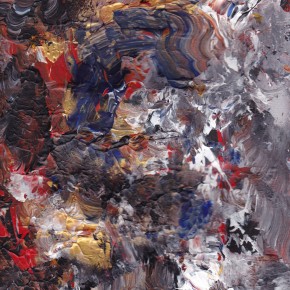
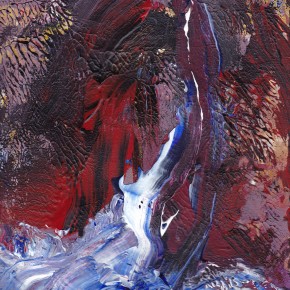
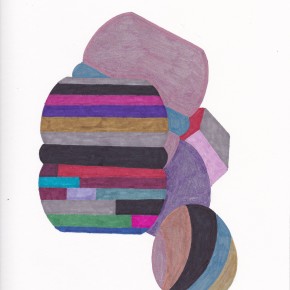
Al Preciado talks about the view from his artist studio in his poem “Jacaranda Blossoms,” about the stable place that keeps him grounded and allows him to branch out and create imaginative work. In Preciado’s other piece, ‘Rising,’ he turns to the unique shapes of clouds to keep him focused while traveling through the Rocky Mountains to visit a loved one. W. Jack Savage’s abstract art seems completely wild and random, but in fact reflects attention to color, balance, and shape.

Shamanic practitioner Holly Sisson contributes a few short poems about getting in tune with the universe, moving and submitting to its rhythms. She points out that there’s no need to force others to join her, since we are all on our own paths and there is only so much we can control. Alexis Durante portrays the physical manifestation of emotion, showing how our bodies are simultaneously at the mercy of life circumstances and marvelous instruments to reflect what we feel.

Ayokunle Adeleye’s column deals with one of the natural and societal limitations that often comes with being young or at the beginning of one’s career: a tight budget. He urges his fellow young Nigerian students and entrepreneurs to invest in their futures rather than buying flashy items just to show off. One can gain the ability to bring about freely chosen long term goals by living within restrictions in other areas.

We hope that you will make reading through this issue of Synchronized Chaos Magazine one of your freely chosen goals, and invite you to enjoy the work of our contributors.


Essay from Brooke McCarley

Thru Hiking the Appalachian Trail

Brooke D. McCarley

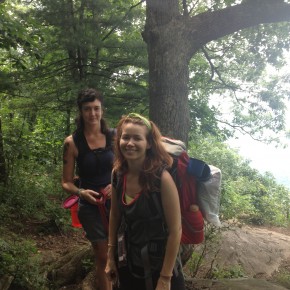
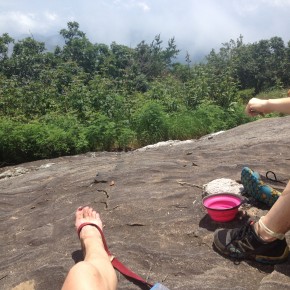
The beginning of the Appalachian Trail is about a 4-hour drive from Birmingham to North Georgia. It then uncurls for 2181 miles through woods, mountains and mental-breaking points until it reaches Maine. Hiking the A.T. or parts of it was one of my vague goals until my friend suggested we do a section hike for our yearly vacation. Then the idea of being stranded in the woods with only my backpack became a sharp reality.

A few years before, we went to Vieques, a tropical beach near Puerto Rico. The last time we traveled together we spent some nights in New Orleans with a borrowed tent that smelled like buffalo dung surrounded by retired people in RV’s. We downgraded. Therefore hiking the A.T. seemed like a natural progression for us. Our luxurious hotel would be a two-person tent that we would roll up and stuff in our backpacks every morning. Our bathroom regimen also included a burial service for our waste, while our dogs bowed their heads in silence.

Our boyfriends didn’t think we could do it, and my parents begged me not to try it. If omens and maybe God exist then they, too, were telling us to go back home due to the thunderstorms that floated above us on our drive to the North Georgia mountains.

We were going to hike roughly 35 miles in five days and park one of our cars at our beginning spot and the other car at our final destination, Hogs Pen Gap. The first night we parked our cars at Hogs Pen and decided to sleep in her Yaris since it was already past midnight. It was too dark and lonely on the top of the mountain to set up a brand new tent. We were four hours behind schedule due to the storms and also needing one last good meal of tacos and beers before we lived on trail mix for days. However, sleeping the first night in her car left me optimistic for the rest of the trip. If my 6-foot-1-inch frame could curl up in a Yaris and sleep with a belly full of tacos and beers then I could do this hike.

We can do this hike as long as we can find the trail.

Continue reading

Artwork from W. Jack Savage

W. Jack Savage is a retired broadcaster and artist. He is the author of six books (wjacksavage.com) To date, thirty-two of Jack’s stories have been published by various online and print magazines, and eighteen of his pictures have been published as well. Jack and his wife Kathy live in Monrovia, California.