From
Peter Jacob Streitz
Mature content ahead, click to continue.

Struggling with Words


Struggling with words—
like learning to dance, or memorizing jazz,
or courtship, one’s last—
is worth it. Though with all these,
I stammer as I reach my void of vision—
          the blindness behind my eyes,
          my fence of expression.

The slipperiest words show best
how context gives them taste—
tart and sweet—and lodges them,
      mossy and furrowed
      like the pit of a peach.

So this struggle persists,
since when it succeeds
thoughts and feelings find their mates,
and I renew my belief:
clear words connect us
      like the air that we breathe.

And in spite of the murk,
we thrust our words forward
hoping to reveal and capture it all:
crafting words even for the absence of things, like
         shadows and sky and death and blank,
         and the something in the nothing
                  of negative space.

Leaning over the waves, we tack our way.
We trim the sails of letters and speech,
plunging black waters, shaping the wind,                              .
          searching beyond and beneath.
Walking the Figure Eight


Across an autumn landscape we walked
with asymmetric interests in one another.

We talked about art, as we couldn’t us.
We looped through this ruse, and I made my case
for paintings that draw me in and out.

You countered with sculpture because it is solid,
inserting a certainty in a world often soft.

And though I was prone to be strong and stable,
by you, I trembled like a branch in a storm.

But you were as sure as you were subtle,
like the leaves that floated past your body,
elusive as the plans made at dances.

Still I waltzed through this canvas,
taking my chance, while you—
a marble goddess—sat it out.


A Prophesy of Black Holes

If we were creatures
at the bottom of dark oceans—
close descendants of our planet’s first life—
perhaps we would share a sacred belief:

            One that pictures our final deliverance
            from the lowly rocks of birth and death
            to a place above the cloud-dropped mirrors
            breaking upon our roof—
            far beyond the bands of light
            streaming overhead.

            And in this space, where we’ll ascend,
            there’s an infinite hole—
            the black of starless nights,
            where we will live, forever unchanged,
            and illumination will disappear,
            eclipsing the need for sight.


And we’d be certain of this belief
since it was told by ancient blind prophets
who came to our murk from the waters above,
warning that vision goads temptation
and is a curse that should be shunned.
My home on the web is www.johnmiddlebrookpoet.com, and here, you can find the details of my publication history. I live in Bucks County, Pennsylvania, where I manage a consulting firm focused on non-profit organizations. I have been writing poetry since I was a graduate student at the University of Chicago, where I also served on the poetry staff of Chicago Review.
Let’s Learn Latin Dance
In the beginning…
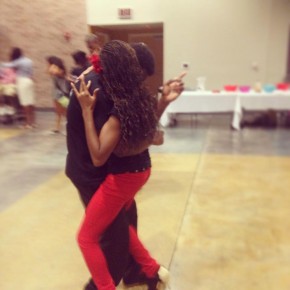
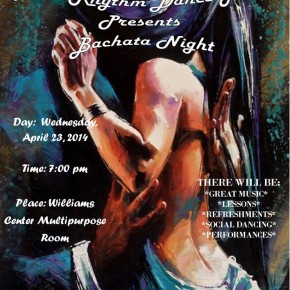
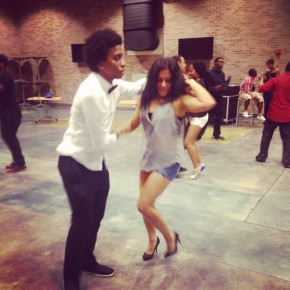
Bodies pressed tightly together, hips moving in synchronization, music fueling their bodies. This describes my mental image of Latin dance. I have been a dancer for many years but never have I done anything close to this style. I started in a ballet/tap class when I was five years old and stuck with it for 13 years. Over this time I have had the opportunity to learn many different types of dance, from hip hop to ballet, but there are many types that were not covered in my years of training. I never had the pleasure of learning Latin rhythm dance but it fortunately has been offered here at the school. I wanted to extend my knowledge of different styles of dance and observing the Latin Rhythm Dance Group here at Georgia Southern initiated my doing so.
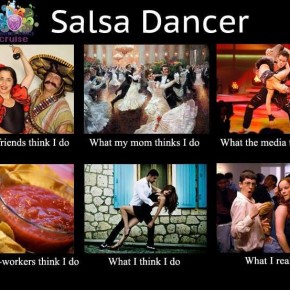
At the beginning of this immersion, I was already a student at Georgia Southern University, and that put me in the position to be a part of this group. My prior experience in dance allowed me to know how to count music, how to move my body, what kinds of responsibilities come with being a dancer, and how it feels to be part of a group. I had no prior knowledge of the Latin dance style, other than what I have seen on T.V. My thoughts were that this ignorance could turn out to be a benefit or a hindrance depending on how the lessons went. I was somewhat hesitant about this dance style because the little amount of it that I had seen appeared to be quite risqué and I was not used to this kind of dancing. The types of dances that a Latin dance group performs are often very sensual, and many originated from brothels and areas of the like. This posed a definite problem on my part, because it caused me to have a bias.
Looping In and Out of the ACM

Computer Club Classroom

Shelves and monitors
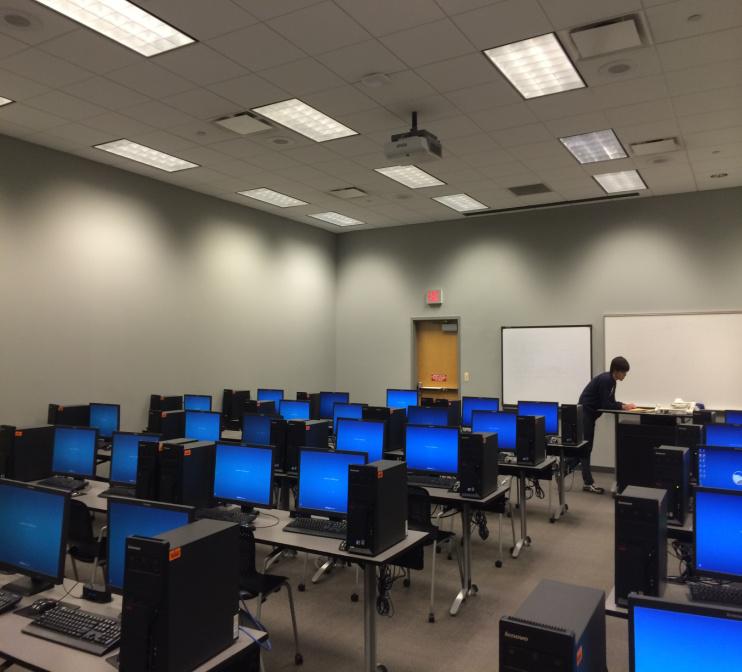
Rows of computers and desks
Declaring and Initializing the ACM
Python, Java, C Sharp. Looking at these three words, many people would simply mistake them for a snake, a cup of coffee, and a music note, but they are so much more. These words, along with many others, make it simple to build a website, a program, or an app. Without them, the world would be an entirely different place. They have not only changed the way we think, but also the way we work.
Whether you specialize in Python, Java, C Sharp, etc., the Association for Computing Machinery (ACM) is where any programmer can come to gain professional knowledge. The ACM describes itself on its website as “the premier membership organization for computing professionals” that, “delivers resources that advance computing as a science and a profession; enables professional development; and promotes policies and research that benefit society.” (acm.org) The ACM stands for betterment of not only themselves, but for society as a whole. This is what I want to stand for in my daily life.
A Feeling of Euphoria
By Chris Kerrigan
Fear of the unknown
Three nights a week, every week, studio two at the Recreation and Activity Center here at Georgia Southern University comes alive with loud beats, quick steps and the laughter of Euphoria dance club. This group of African-American students is GSU’s number one, and only real Hip-Hop dance club and crew, and I had the privilege to get to know them on a personal level. Although I thought I was a respectable dancer, this group of athletic, synchronized, furious, explosive dance machines was able to change my thoughts immediately.
League of Extraordinary Geeks?


The Nest
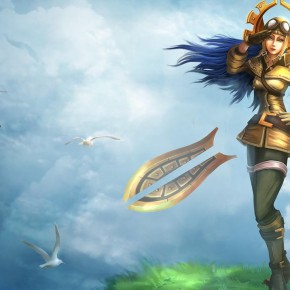
The bed is unmade, simply a twisted mass of blankets and pillows. Packaging from processed foods litters the floor and mostly empty drinks dot every flat surface. Clutter is in every corner gathering dust by the day. Bits of this and that make up the kind of musty environment that is present today. The dingy, undecorated off-white walls are faintly lit from the glow of a 42-inch HD television streaming the image of the popular Massively Multiplayer Online Roleplaying Game(MMORPG) League of Legends from a desktop computer.
Rise of the Resistance: A Tale of Extreme Tag
“We’re never truly safe, and since we’re not safe, let’s have fun.”
Adrenaline, fear, and that wonderful high a person gets from having dangerous fun, exhilaration or euphoria you suppose, courses through your veins, giving speed to your pounding feet. You are running for your life, or at least that is what it feels like, being chased by a member of the mobile deceased. Yes, a Zombie. A nerf blaster beats against your back to the rhythm of your tennis shoes smacking the ground and a cool breeze chills the tiny bead of sweat that had started running down your face. You are very nearly tunnel–visioned on the path before you, on escape, on the patter of feet behind you; are they speeding up? However, you still hear the toll of the bells from the library, really just a projection from a speaker system, but it’s nice to pretend there are real bells, right? The chimes indicate that it just turned seven- p.m. that is; only thirty minutes until cease–fire, then you’ll be safe. A smile crosses your face; you can make it, they will not catch you today.
History and Rules
This scene would be a typical occurrence for a member of the massively popular game, Humans versus Zombies. This intricate game of tag, often shortened to HvZ, was first invented at Goucher College in Baltimore, Maryland in 2005, but has spread to every continent (excluding Antarctica of course) thanks to their wonderful website, Humansversuszombies.com. According to this website, Humans versus Zombies is played at over 650 colleges/universities around the world, including our very own Georgia Southern University. Not only is this game played at colleges, but also high schools, military bases, and in very special cases, public libraries.