Poetry from Irving Greenfield

ON HEARING A MAURICE RAVEL QUARTET

by Irving A Greenfield

From Stresatravel.blogspot.com

The music touched me,

and I touched the music.

A theme, played by the violist,

dug out of the notes with strings and a bow,

thrown to the moment and caught something

something I did not want to remember.

The cantorial chant of the High Holy Days,

now a memory realized;

A plea for mercy, even to me, an unbeliever.

LIBERSTOAD

The mood hurls him into the past;

he’s a small boy curled up on thread-bare couch,

maybe it was green?

Half awake, half asleep,

Listening to the Saturday afternoon performance of Tristan and Isolde.

As he listens now,

seated on high-back chair next to the window with a harbor view.

He listens and reaches back into the past; the music his arms and hands.

Something magical, beyond his ability to understand how that memory,

that image so long gone came back to occupy a place in his brain,

A place he never knew he had,

especially for that insignificant moment when he was a boy

listening as he listens now to Tristan and Isolde

as eternal sleep claims him.

THE MEMORY AND THE MUSIC

The reality and the memory

bridged by the music

an outdoor concert on a sweltering summer’s night

with the salt scent of the ocean heavy in the air

a burst of music

The William Tell Overture”

the pounding hoof beats and a ‘high-oh Silver!’”

And a small boy is sprawled out on the floor

in front of the Majestic Radio

his gray-haired father sits close by

pretending not to listen to the daring-do

of the Masked-man and his Indian friend, Tonto

but listening all the same

The memory of it made sweeter by the music,

by the gallop of so many years

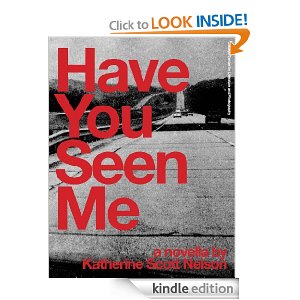
Kim Brown on Katherine Scott Nelson’s novella Have You Seen Me

In the worlds of some teenagers, life can be hard.
The challenges that some teenagers have to endure may make it seem impossible to live.
The violence, drug use, and bad behavior tend to be the escape from the harshness of their realities.
The ridicule, constant fighting and disagreements with parents, school mates and other family members who have no clue about the pain that a teenager is going through do not help. Teenage life can be extreme, even for the calmest teenager. Being accepted for who one really is the hope of many teenagers, but is rarely realized.
There will always be the stigmas, the misconceptions, and the expectations of the world and the family for a teenager to try to live up to. But you will find in this book, Have You Seen Me, a novella by Katherine Scott Nelson, two teenagers, both struggling with their own way of life and trying to make life work right for themselves.
This book is a great read for mothers and fathers, and teenagers who are great at just being who they are. As parents we often get so caught up in trying to structure our children’s experiences that we forget that we live in a great huge world that has more of an influence on our children that we do. The longing to belong as a teenager is important, and this is a difficult season of life. Although we want to create a perfect teenager who always stays on the right path, we should just be thankful for our son and daughter’s soul and life.
In this book you will see how teenagers at young ages are exposed to the most detrimental experiences inside and outside of the home. One chooses to escape momentarily, while the other tries, unsuccessfully at first, to disappear forever.
No matter the problems that a teenager is facing, they should know that there will always be resources that will be able to help them. Running away from the challenges of family and home, unless to escape physical or sexual abuse, can end in tragedy.
Thank God for friends. In this book, we see these two friends who face similar challenges in life, one who runs away to New York City, and another who is cautious enough to endure the test of time. He is confused, yet unable to take such drastic steps to relieve his frustration, and anger. He holds on and is able to still grow as a teenager, and also lend a helping hand to his friend in trouble.
Through hardships, adversities, anger, family disagreements, distressing and difficult circumstances, conditions of pain, sickness, or dysfunction, we need our teenagers to hold on and be strong. We need our teenagers, despite all the right or wrong choices they may have made, to seek refuge in a family member or friend. As we see in this book, the teenager who goes astray not only takes their family and friends through pain, but they also ultimately hurt themselves in the short and long term.
Now, some advice to teenagers:
As teenagers we have to understand that we can be empowered by many people. The main thing is to learn to love discipline, and to learn to love the ones who may have a different view than ours. We as teenagers have to learn to love ourselves and take time to learn about the world, people and places that surround us.
Kim Brown welcomes thoughts and feedback, and may be reached at kimbrown_kimronice@yahoo.com 

Poetry from John Grey


WATCHING MY FATHER SHAVE


Though I’m a willing audience, he doesn’t give a blow by blow.

His mouth is clenched. The lesson is up to my eyes.

Never seen such hairy hands, such huge knuckles.

The razor shrinks inside his fist, its blade peeking out

like a captured sparrow.

What hope has it against the whiskers on that jutting jaw,

the cheeks that fill the bathroom mirror.

He lathers his face with gobs of bright white foam.

Then, with blade close as a kiss, he scrapes along

that relief map of a face,

his fingers like trackers guiding the razor

over bone, under lip, across the red leather of his cheeks.

Miraculously, he doesn’t cut himself.

I swear that razor wouldn’t dare.

Next step, he slaps his skin into submission

with a hot wet hand towel, braces each subdued pore

with smelly stuff from a tube.

He then takes a step back, admires his morning masterwork.

He pats me on the head and leaves the room without a word.

Shaving begins with fascination and ends with an unerring lesson.

And, in between, years I have to grow, and no one saying much.


WHO AM I EXACTLY


Mistakes are made –

I can easily be taken

for my younger brother

but I am not him.

Don’t listen to faint voices

bouncing off the walls

of your conclusions.

First remove the skin.

have me flattened, lifeless,

flesh to flesh, sweat to sweat.

Sometimes identity is exactly that.


But soon it won’t matter.

Other people will have moved into this space.

Misidentification will be replaced

by people who know each other.

Or even emptiness – although

nothing is truly empty- molecules of air

will bump against each other –

bounce this way and that.


Human shape gets some people every time.

Coming together

flutters its visions nonsensically.

What flows sweetly through the head

sounds dumb in the mouth.

Some of my

“No I’m not him” may even remain.


I’m in a new place by then,

not diffidence or solipsism

but because where I’m going

has a future, beyond where my latest step

has taken me.

And there’s my thoughts,

playing to a gallery of one.

Yes, it’s me and not my brother.

Footsteps crackle on all the leafy evidence.


MOON BOY


Art class was a failure.

My moon was half the page

and sat on the roof of the house.

The people outside

were small and fleshless.

The moon’s heft almost drove them

off the edge of the page.


I couldn’t draw what the teacher asked.

There was no separation between my head

and what my hand could do.

I knew the moon was a midget in the sky

and people and buildings towered over me.

But facts never did sit well

with my imagination.


The teacher leaned over my shoulder

but made no remark.

But the girl behind me was rated aloud.

“Very good work, Sandra.”


The teacher had never been where I live.

She hadn’t seen it at night

when I was in bed,

eyes wide and staring out the window,

and the moon was crushing me.


Sandra’s old man beat her mother

and she hadn’t witnessed that either.

Teacher was just pleased that Sandra

had everything in proportion.


MOTHER TREE


When pregnant,

she felt heavy,

like a tree trunk

and its spreading roots.


Her upper branches

bore the baby.

It fluttered out there

with the leaves and the lightning

but she couldn’t budge

from her own hard grounding.


Baby blossomed so far away

she could barely see.

It grew into fruit, ripened,

maybe fell,

but more likely was picked.


But what did scarred bark

know of that?

Or thick strands

of tired wood

nuzzling the dirt?


When pregnant,

she joined a forest

of like trees.


Life after that

was either songbirds

or woodpeckers,

seasons or axmen.


And, of course,

the wind,

the redundant shaking.


John Grey is an Australian born poet. Recently published in International Poetry Review, Sanskrit and the science fiction anthology, “Futuredaze” with work upcoming in Clackamas Literary Review, New Orphic Review and Nerve Cowboy.

Poetry from William Doreski

Running in Place


Running in place on the treadmill

in my basement I note a mouse

creeping up the concrete wall.


Black, short-tailed, thick as my fist,

it clings to the vertical

like a gravestone lichen. I stare


at this mobile punctuation

until I’m running the bases

in a sandlot game. I run so hard


I knock down the first baseman,

second baseman, shortstop, third

baseman and catcher, yet scoop up


the bases themselves and tuck them

in a muscular compact bundle

like a football under my arm.


The mouse applauds with tiny paws

without losing its grip on the wall.

The basement groans and splits open


to admit the sunlight and bathe me

in post-Easter glory. The ballpark

crowd roars and wriggles in its seats.


The treadmill whines as I reach

unnatural speed. Belt and pulleys

strain to accommodate such force.


Metal snaps and I tumble

into the dust between home plate

and first base, and the catcher


tags me out, out, out. Yet still

I’m clutching the bases, including

home plate, so I’ve won anyway,


won without a team to back me.

The mouse has reached the top of the wall.

It disappears into a crevice.


The ballpark crowd has departed

in disappointment, the home team

defeated and the April light


bruised deep blue. I run awhile

longer, but tire so easily

I know all this effort’s in vain.


Drugstore Logic Applied


As I drive in the rainy dark

to the drugstore, the houses

of my neighbors flash as TV

charms them in shifting colors.


Impoverished by fading eyesight,

cooped behind troubled glasses,

I feel rather than see the road

tuck under itself in the thaw.


Snowbanks tall as defensive guards

still flaunt. But they’re knuckling slowly,

crystal by crystal, failing to hold

their form against the keening of rain


and the flop of calendar pages.

I arrive in a huff. The lights

of the chain store fortify products

in which I otherwise have no faith.


As I purchase overpriced drugs

a crowd of pubescents buying

candy and chips hogs the checkout.

Back on the road, lurching through rain,


I wonder if the hidden landforms

survive the torpor of the dark,

or if they fold themselves away

for times when I really need them.


First Outing of a Troubled Year


Eating recycled plastic

at your picnic makes me feel

manlier than the men who munch

organic produce and smile.


The day pouts and blusters.

The lake cringes as the ice cracks

to reveal the first open water

we’ve seen in five months. You pour


wine into my two cupped hands.

I gargle it down and sneer

at men whose dainty fingers,

manicured by smirking experts,


fondle stemware without risk.

Their wine, made from ordinary grapes,

leaves their senses tingling,

while the swill you’ve served inflames


passions that follow the bell curves

of earthquakes. No more, please. The light

in the treetops shivers with fear.

Soon the lake will sprout bass boats


puttering close to shore. Later,

speedboats dragging skiers will comb

the water, scoring fatal wakes.

The cottages will flower. Music


will hush the birdsong, and kids

will taunt each other to drown.

We’ll avoid the lake all summer

and return in the fall when silence


drapes the heaving trees. Your picnic

has saddened me. Maybe it’s the wine,

or maybe chewing the plastic

has loosened all my fillings; [stnza break]


but the passion that could have shaken

the world has faded, leaving a dead

fish stink and crackle of ice

that render me too manly to bear.


Amnesiac Again


Abandoned rather than lost,

memory has abstracted itself

like a pasture buried in snow.


This bedroom with a cairn of clothes

on the floor, an expensive watch

glowering with diamonds and dials


on the nightstand, a woman snoring

in a heap of cats, puzzles me

with its lack of useful clues.


I stuff myself inside the clothes

and creep down a long green hallway

to a stainless steel kitchen


only the rich could afford.

Copper-bottomed pots dangle

as if condemned. A gas range


big enough to roast a hippo

smolders in grim self-confidence.

A woman in uniform asks me


what I want for breakfast. A name,

a place, a green thought to take

outdoors to think in green shade.


The woman breaks eggs in a pan

and sets it hissing on the range.

Something in me broke like those eggs


sometime last night as stars aligned

in obsolete configurations

I’ve never learned to identify.


How clear the boundary between

knowing my name, knowing my place,

and erasure of all but outlines.


I stand in the snowy pasture

and moo and bleat and grumble

while the cook flips the eggs because [stanza break]


she already knows I like them

easy over. This gothic moment

prolongs to enable me


to avoid the reverberation

that would shiver this house to its soul

if I thundered too abruptly.


Canoeing Up the Penobscot


Canoeing up the Penobscot

with a lanky mob of Indians,

I split the current stroke by stroke,

straining every sorry muscle.

The Indians do no better.

Their faces warp as they wrestle


the snowmelt pouring downstream

from the complex of lakes to the north.

I have no money to pay them,

but they feared I’d drown myself

if I ascended the stream alone.

The cloud-casual afternoon hisses


with effort. Spring rain promises,

but withholds until we’re ready

to camp on a cringing stretch of shore.

A highway nearby snores with trucks.

A railroad trills with steel on steel.

Why didn’t I ship my canoe


to the lakes and ride the friction

back to Old Town in studied ease?

The Indians don’t ask. We chatter

and share a dinner of boiling fat.

They like being Indians. I like

being with Indians while the dark


smolders with self-contained rage.

As we lie in our tents the rain

sizzles through the eloquent trees

and defines everything it touches.

At dawn we breakfast on more fat

and mount our canoes. The current


retorts, and midstream I lose myself.

The Indians wave and chuckle

as my canoe reverses and speeds me

downhill with my paddle flailing.

Down, down, past Chester, Lincoln,

Howland, Olamon, Old Town, Bradley, [stanza break]


Orono, Veazie, Bangor,

and then Winterport and Bucksport

and with a heave and sigh into

the bay, Islesboro dead ahead.

I beach my canoe, flop on the sand,

and marvel that I’ve traveled


almost seventy miles this morning.

The Indians must be laughing

as the bay and bare sky are laughing—

the spruce rim of the island

dour as the skirts of ruffed grouse

settling at last on their nests.

Doreski’s work has appeared in various e and print journals and in several collections, most recently The Suburbs of Atlantis (AA Press, 2013). 

Poetry from Valentina Cano

Trust’s Melting Point

He talks as if from on-top an iceberg

that’s disappearing from under his feet.

His words are clipped,

a tap-dance of ice following his lips.

I’m supposed to trust,

to string his words into a necklace

good for every occasion,

but they melt away,

syllable by syllable,

leaving only stains on my dress.

-Valentina Cano

Flame

From snowbrains.com

I will set this house on fire.

I can feel it,

the anger lapping,

running up and down the hallways,

the rustling of flames.

Smoke, dark feathers of it,

filling the pillowcases,

the empty cups and bowls,

as walls begin to blacken.

Day by day,

the house surrenders to flammability

until even its dreams are scalding and red.

-Valentina Cano

Organ

This moment is rubber,

twisting slowly into shape.

The glare of it reminds me

of the tear that passes for a canal at home

with its trash-bag doilies.

The water still enough to be pus.

This morning,

with its smell of scraping matches

and unwashed hair

is molding itself into an organ.

A replacement

for the one I didn’t know I’d lost.

-Valentina Cano

Postcards from Anorexia-Land

Stepping on and off a scale

I lost what I was thinking.

It disappeared like the tissue and fat

that used to curl up like snails

around my hipbones.

Like the clumps of ashen hair I pick up,

spider webs clinging to bathroom tiles.

I have gone away,

handing skin and teeth and bone

to numbers and buttons and zippers.

I have lost.

Myself to myself.

-Valentina Cano

Betrayal

From ElizabethKreutz.com

The bicycle slips from under her,

as sleek and agile as she’ll never be.

It lands on the grass

with an exhale of gnats,

handlebar turned to the sky.

She kicks the spinning wheels,

the grinning chains,

jabs a stick into the links and snaps it.

The sound of it like a slap.

She leaves the bicycle there,

stabbed and staring,

and walks home.

-Valentina Cano

Valentina Cano is a student of classical singing who spends whatever free time either writing or reading. Her works have appeared in Exercise Bowler, Blinking Cursor, Theory Train, Cartier Street Press, Berg Gasse 19, Precious Metals, A Handful of Dust, The Scarlet Sound, The Adroit Journal, Perceptions Literary Magazine, Welcome to Wherever, The Corner Club Press, Death Rattle, Danse Macabre, Subliminal Interiors, Generations Literary Journal, A Narrow Fellow, Super Poetry Highway, Stream Press, Stone Telling, Popshot, Golden Sparrow Literary Review, Rem Magazine, Structo, The 22 Magazine, The Black Fox Literary Magazine, Niteblade, Tuck Magazine, Ontologica, Congruent Spaces Magazine, Pipe Dream, Decades Review, Anatomy, Lowestof Chronicle, Muddy River Poetry Review, Lady Ink Magazine, Spark Anthology, Awaken Consciousness Magazine, Vine Leaves Literary Magazine, Avalon Literary Review, Caduceus,White Masquerade Anthology and Perhaps I’m Wrong About the World. Her poetry has been nominated for Best of the Web and the Pushcart Prize. You can find her here: http://carabosseslibrary.blogspot.com

Short Story by Carol Smallwood

Making Things Better

Carol Smallwood

Excerpt from Lily’s Odyssey (print novel 2010) published with permission by All Things That Matter Press. Its first chapter was a finalist for the Eric Hoffer Award in Best New Writing.

http://www.amazon.com/Lilys-Odyssey-Carol-Smallwood/dp/0984098453

The next session, Doctor wore a suit for the first time, and asked, “How’d you like my new office?”

“It’s very nice,” he said, looking around the stucco room for anything that looked familiar.

A few years ago, the businessmen in town had decided to capitalize on the name, “Avon Creek”. The storefronts and municipal building were redone to resemble Shakespeare’s birthplace, and his comedies were performed at the fairgrounds during the summer. Restaurants offered old English fare and jesters and jugglers in colorful costumes gave street performances for tourists.

“Cal got angry because I was out picking apples with the kids and wasn’t home when he got home, so he shoved me around.”

“Did he hurt you?”

“He didn’t leave any marks.” I didn’t consider them marks because my sleeves covered the bruises on my upper arms.

“Do you think you were right in going?”

“It was right but not right in the relationship of marriage.” I sighed, and added, Cal doesn’t want me to get a job.”

“It isn’t wise to come to any crisis now.”

While canning corn relish, I thought again of what Doctor said about the law of compensation- when you lose something, you gain something. And I smiled at the comforting sound of canning lids sealing–no matter how many times I heard the ping, it satisfied an instinctual need. Kerr glass pints and quarts with neatly printed labels were very attractive when filled with pickles, relishes, pears, tomatoes–proof I’d accomplished something.

But the next day, I couldn’t stop thinking about worms dying in a can that Cal left on his boat after he went fishing; the only way to stop was to imagine being with Doctor. When I went anywhere, I looked at men to see if their nose, mouth, or walk in any way resembled his; I kept saying, hang on, hang on–remember the tree in the woods? Near the barbed wire fence of my grandfather’s- that was all dead, except for one branch? For the last two years, I’d gone to stare at it while the kids made a game out of not stepping on any sticks while chasing each other.

A few months later, I went for a walk with Mark and Jenny, muffled in my jacket, leaving the snowmobile suit matching Cal’s–Uncle Walt’s and Aunt Hester’s Christmas presents. The wind made it too cold to walk along the shore strewn with giant blocks of ice; a red strip on a lone freighter in the distant channel was the only thing preventing it from being a black and white painting. When I went to look for patches of moss on trees, Mark pointed out depressions in the snow, and told Jenny they were Bigfoot’s; Jenny pretended to be scared, and then smiled at me.

When we returned to the road, a sunbeam shone on the top of a large bent pine, and I walked back and forth looking at the large green question mark, till a hawk began circling. Mark had been scrambling up and down the snow heaped by the snowplow with Jenny trying to keep up.

We walked to the tree-lined winding stream, among the overhanging branches, until I heard water running under the ice. When I heard the water but couldn’t see it, I felt a great relief–a Plan must exist–things did make sense- and had a pattern; there was a way out, even if I couldn’t see it. I’d be OK. I followed the gurgling water to the lake and stood smiling in the biting wind while the flowing stream became part of the lake, and tears froze to my face.

At the next session when I told Doctor, “I’ve decided to stop coming,” his chair squeaked, and I knew how much I’d miss the sound. “I’ll always wonder what’s on the other side of things, but it’s equally bad not to enjoy what’s under my nose. Things are better with Cal because I want them to be, and if I left him, I’d still be searching–my feelings for you happened because I needed them to.”

After looking like he was trying to convey something he ended the long silence with, “You can come back.”

“There’s a job coming up I may be able to get,” I said, tasting the blood from biting my cheek. “I’ve enjoyed the sessions and will have to find something to replace them with.”

His face was still flushed when he said, “Maybe studying Hinduism would interest you and give some direction; I’ve told you about how meditation helped me. Begin with the Upanishads and books like this.” He reached for a book with a bald man in a gown, sitting cross-legged with thumb and index fingers joined, to form circles. He named strange-sounding men, but meditating by staring at a point between your eyes had little appeal for me. The Hindu women I saw on PBS didn’t look very well-off–and what did it matter if people may have had a third eye? Doctor concluded, “Take lots of walks because they may teach you more than books.”

On the drive back, I tried to forget his laugh when I’d said, “Things are better with Cal because I need them to be.”


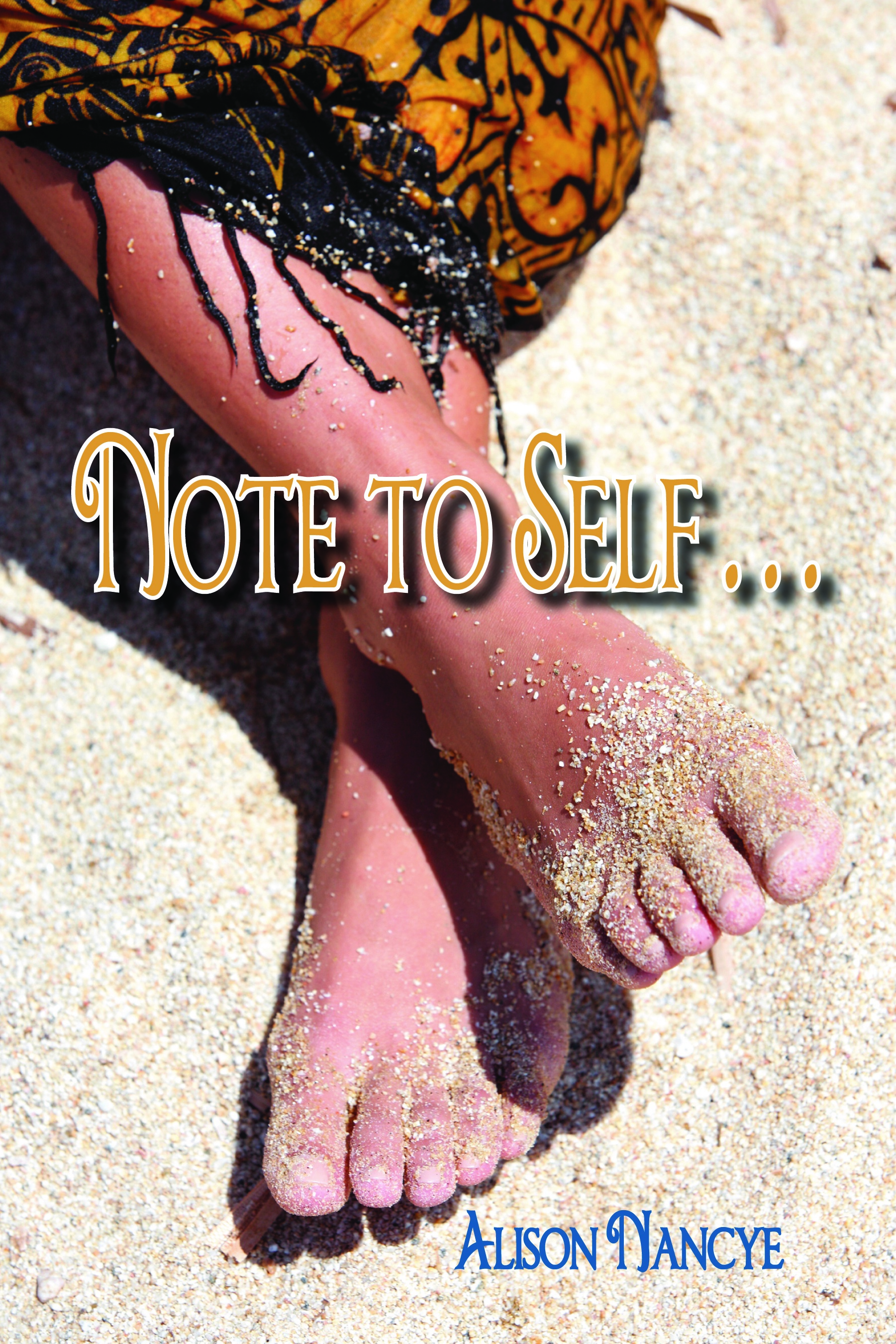
Kimberly Brown on Alison Nancye’s Note to Self


Alison Nancye’s Note to Self is the perfect book for any individual struggling with making life work for them: school, career, family life in general.
(Main character) Beth shows up and checks out, then rediscovers her own life.
Through her transformation, she shows us that it is okay to live our lives according to our own standards. Living up to others’ expectations can leave you stagnated. Beth allows us  to see that simply going along with how others think that we should live, will leave us in a painful, sorrowful and dead-end life.  Beth allows us to see how we can just end up hating our lives and others if we fall into the grips of what others think we ought to be. Beth gives us the courage to stand up to our assailants, whether family, colleagues or foes. She shows us that we can call on God, even when we are not relentless churchgoers, and He will answer our calls. She demonstrates how in her story, time after time, she has called upon God, and how He is so anxious to guide her to a new and improved Beth, and a new life.  She also is exemplifying the need for God’s direction and help, as to what to do next and God is sure to show her that the answers are all inside of her. If and when she decides to follow her own heart, she will then have the mind and capacity to live and make a new life.
  
Beth is the perfect example of many people in the world, young or old, who have yet to find their life’s purpose. Stuck in a world where demands and expectations are already set by both family and society, we need, along with Beth- to learn to let go, and love ourselves, and most importantly, to live. Through the freedom of self-will and living like Beth, one can discover a strength that one didn’t know was there. Whatever it is that we are searching for in life- it will never be obtained or become reality without our stepping out and doing it for ourselves. We were all born to live, but how can we live if we are not living for ourselves, when our mind and body and thoughts are not our own? 
Beth teaches us to live the way that we should, to welcome love, compassion, and growth; to make decisions that we can live and be happy with. Beth teaches us how important it is to live and to focus, and to love the positive players that influence our lives. These are the things that will keep us on track. Regardless of who we’ve grown up with, or who gave us our job, if these people don’t feed our souls with positive reinforcement, we must break contact off with those types of people, to allow an army of positive figures to come in and fill our lives. Beth is brave and courageous-she steps out in life, leaving her old dragged down life behind, after discovering that little voice in her head, along with some loving and compassionate people along the way who cause her to think differently.
Beth is clearly mindful of who she is- she had yet to live with who she was, so she is telling and teaching us that we should remain clear in mind at all times. Although people in life can be critical, it’s better to make choices that best suit our lives and the lifestyles that we want to live.
Beth also reminds us to take pride in our appearance. We never know who’s watching us and who we are attracting, and we want the best – not neck bones that were left over, from the trash. We are all in this life struggle together-if you teach a soul and take time to encourage a soul, it becomes better for your own.
Regardless of how hard the struggle, keep going. No one ever made it to their goal in life by being idle, so when opportunity knocks, go for it. Go for your dreams. They may seem impossible to obtain, but with dedication and consistency, you can reach them. There is nothing in life that is impossible.
Appreciation for life, no matter the state that you are living in, plays a huge part in your happiness. Take the time to see where you are at, and learn to appreciate what you have and work towards better things in life. Anything is obtainable.
With the help of God and good people, you are your ultimate guide, with the power to do anything that you desire on earth. If you are feeling like a carbon copy, this boo, Note to Self, shows you how to access your inner dreams and enjoy yourself and the life around you, by just living. Not just existing and living for other people and their beliefs, but creating your own goals, finding a path and walking it alone, leaving your own tracks.  
Beth, just as I do , believes that we are all Stars. Small or big, rich or poor, everyone has a story and beautiful life, or past experience and wisdom to offer to the world. All we have to do is show up, and reap the great benefits of living, by living from OUR HEARTS rather than anyone else’s…
Go out, good people, and just as Beth did, use your instincts and rational thinking to learn, build and find yourself.
Kimberly Luves is a writer and critic from Palo Alto, California. She appreciates feedback and may be reached at kimbrown_kimronice@yahoo.com