
Essay from Sara Rodriguez: ‘In Memory of D.’

Feb 18th, 2013 @ 12:27 pm › Voices from Solitary

The following essay comes from Sara Rodrigues, a prisoner at Bedford Hills Correctional Facility, a maximum-security prison for women in Westchester, New York. When Sara was sent to prison at the age of 16, she found her friend D there as well. Both Sara and D had life-long struggles with mental health, and while in prison, spent long periods of time in solitary confinement (both Keeplock, which is lockdown in one’s own cell, and SHU, which is the Special Housing Unit).

Sara writes about the difficulty D faced when she was finally released and put on parole, with no transitional assistance to move from prison to the free world. She ultimately ended up back in prison and committed suicide, shortly after giving birth to a baby girl. Sara Rodrigues wrote this piece in the hope of spreading awareness of her situation and the experience of many people around her. She writes, “Too many inmates in New York State under the age of 25 are killing themselves in prisons because they are literally being thrown away like garbage by the court systems.” (Thanks to Jennifer Parish of the Urban Justice Center for forwarding this essay to Solitary Watch.) –Rachel M. Cohen

.  .  .  .  .  .  .  .  .  .  .  .  .

This essay is dedicated to D and all those who have given their minds and/or lives trying to pay their debt to society and to those who will forever be haunted and scarred from our justice system. Once self-worth and hope dies within our souls, what is left behind is a shell of life that can see no future, no redemption and no chance for a normal life. It is then that our minds realize how truly unwanted we are and how on a daily basis we are reminded that society has no use for us. Day by day life becomes very dark, some lose their minds, some will never be the same, and some just give in and take their own lives.

Many people who are sentenced to prisons are very young and have serious behavioral and mental health problems and this environment only makes their sickness worse. This is D’s story and how somehow out of the tragedy of her passing has made me resolve to open people’s eyes to the greater damage that happens to everyone by throwing the very young, mentally and emotionally ill into cages to rot under the pretense that more punishment, isolation, and deprivation will make people change for the better. This story has nothing to do with not doing your time, but doing your time in a healthy corrective facility, not the factories of misery that most of our prisons are today. D’s death had such an impact on me that she inspired me to keep fighting for my sanity, to try to never give up, and to get the word out whether people care to hear the truth or not.

In December 2008, I tripped and fell down the rabbit hole. Instead of “Alice in Wonderland,” I became Sara in Prisonland and I am still to do this day trying to wake up from my nightmare. I was 16 years old entering RCOD (reception) in a maximum-security prison, Bedford Hills. My sentence was eight, years flat and 5-post release supervision, I was scared and in definite culture shock, it was all so alien and overwhelming. Later I learned D was there, to me D was my cousin, my best friend, and a sister all rolled into one. We could talk about anything, she helped me so much to get used to this crazy way to survive my new life. We also argued a lot as young teenage girls often do, now in hindsight I regret ever getting angry and wish I had been a better friend.

Some months later, she was paroled and went home but it did not take long and here she was again. Being so young when she went into prison, the outside world was just too overwhelming for her. This and coupled with the fact that there are no transitional programs for people leaving prisons in the area we live in, which is Jefferson County, this leaves all parolees pretty much on their own. Get out of prison, go report to parole, go to Credo, (drug and alcohol counseling), go to mental health, get a job, pay your rent, don’t drive till we say you can, pay parole, pay credo, be home at curfew. You give up because it is all to stressful, can’t get a decent job because you are just out of prison and no one wants to hire you, zero job programs or training programs for parolees. One can’t even go to VESID (vocational training) until 6 months after you get out of prison and by then it is usually too late.

People need these services as soon as they come home and because of all this lack of support, every parolee is set up for failure. So she just gave in to all the temptation around her and started partying and having a good time, and even though her mother begged parole to try to live in a drug and alcohol program instead of sending her back to prison, they didn’t care and did what they do best. That is to not keep people out of prison but to make sure they end up back in. Do the math, almost zero services and supports for parolees in this country why is this and who lets this happen?

By this time she came back to Bedford Hills, she was pregnant. D’s time in the prison system was not easy, she was an outsider even in prison, she had a extensive disciplinary record which was making her mental health issues worse, and she had a long history of suicidal behavior, she had been hospitalized before incarceration and during. Making matters worse, she was always in Keeplock or SHU and this did nothing to help her problems. In coming back to prison, it was so much harder to deal with than the time before and at that point, I believe she thought nothing would ever change, she was in a cycle she could not get out of and I think she was just getting soul tired.

D was a fun girl who could have done great things in life. She had a good support system; she was creative, beautiful, funny, and smart. She could do hair and nails like a professional, no matter what her issues were she had many good attributes. Even though she did not have a lot, she would give you the shirt off her back if you needed it. This girl was not a nothing; she was a living, breathing, strong willed human despite all of her troubles. To many others and me she was a much better human than many who claim to be A-one citizens.

January 22, 2010 D gave birth to a beautiful healthy baby girl. She got to spend some time with her until arrangements were made for her mom and step dad to come pick the baby up. At this time D seemed to be doing better and holding her own, then within a few months she went on the draft to Albion Correctional Facility. This was the beginning of the end, she hated being at that prison, she was scared of that place because she was always in trouble and spent almost all of her time in shu. It was not long before she had deteriorated so bad she was sent to Marcy Psychiatric, she spent some time there and was shipped back to Bedford. Two days later on June 17th 2010, D was dead; she was found hanging in her cell while she was in keep lock because of three tickets she received while still at Albion. It was two weeks before her 23rd birthday.

Some thought she did it on accident because she didn’t want to go back to Albion and some thought she just had enough but it didn’t matter she was gone and me, I lost my mind, I was alone, grief stricken and sick. This was just too much for my mind to grasp. I became angry with her, God, and everyone around me. Every night I had horrible nightmares, I would wake up screaming and crying hoping this was just another nightmare, but it was real. Something went wrong, she should have never been sent back to Bedford Hills because she was just not stable enough. The fact that she was so desperate speaks volumes about how bleak she thought her situation was. Her family was devastated, as was my family; our worlds were in upheaval and pain.

In many ways, I can totally relate to the feeling of wanting to just give up. Since I came to Albion, I have spent most of my time in the box and I am so tired already. Having a medical condition, every time I go to the box my skin gets horrible, my skin cracks and bleeds, rick now I am so sick, I feel like death. After awhile I start talking to ants, crickets or any other living thing or imaginary thing I can think of so I do not totally lose what is left of my mind. My mother is convinced that they throw people like us in the box so much because they want us to go over the edge and kill ourselves. My mother documents everything that happens to me and she tries so hard to make people aware of what goes on. Right now, she is infuriated that I slipped up about a month ago and tried to hang myself and now I am back in the box for months. Mom says that we are not even allowed to treat animals that bad and keep them locked in cages for months, why is it ok to do it to humans. So yes, we do get tired and in a moment of disparity, I can see just ending it all. I keep telling myself to hang in it won’t last forever hopefully I will listen to my own words and stay strong.

Although she died in prison, I believe the brunt of responsibility for her death lies in the hands of the people who put her in there. Prisons are not equipped or have the time or training to be able to deal with people with mental and behavioral problems. They have been taught that if they just keep disciplining with tickets, Keeplock and SHU, eventually they will stop acting out. This is far from the truth and that is why I believe that everybody I know with mental health or behavioral issues that goes to Albion ends with way worse issues. They are strictly about punishment whether you are guilty of your tickets or not. To them you are just a trouble maker who must love being locked all the time. They aren’t educated to the bigger picture that people like D and myself have always had problems even as small children. If we understood why we are the way we are, and could be normal I know our lives would not have been hard. There are many good decent officers here at Albion, who are fair, try to understand and treat us with dignity and to all of them I say thank you and don’t ever stop having heart, but there are others who well, the only way I can explain how I feel towards them is to refer you to “Harry Potter and the Prisoner of Azkaban” the dementors, the CO’s of Azkaban prison who don’t have a good happy positive thought about anyone, they take all good feelings and thoughts away, drain them of life, and take pleasure in watching you fail.

The powers that be, who send people like D and myself to prison full well know that prisons are dangerous for people with mental, emotional, and behavioral problems and worse than that, send children into adult prisons just because they can. They don’t care to help them get the help they need, it is easier and cheaper to ship them to prisons. Too many inmates in New York State under the age of 25 are killing themselves in prisons because they are literally being thrown away like garbage by the court systems. We need good transitional programs and job training for those whose skills were not up to the training programs in prison and good decent parole officers who talk to people like humans, really support, and help parolees to keep from going back to prison. All these things if they were in place may have saved D’s life. D needed a decent long term residential treatment and rehab program, that was equipped to deal with her mental health issues, not to be thrown away into prison as if she was disposable.

Although D’s death was the most horrible time of my life, it was a learning experience and surprisingly she inspired me to try to be the best person I can be and I do try, and that is not an easy thing in here. I learned not to depend on anyone but God and myself. Since her death, I have realized how making fun of someone, teasing, embarrassing or humiliating someone does hurt. We sometimes do not realize how mean comments can hurt another. I have learned to try to never judge anyone because you never know the circumstances of what they have had to endure that may have made them become the way they are. A big thing I have learned is that with just a little common kindness, it may save a life, and just showing human concern and being there for someone makes a difference and may have a positive impact on them.

In writing this essay, I felt that maybe others that have been in similar situations could possibly relate and may reach out to help someone who needs to be lifted. In choosing this topic I felt the way to get the message to all inmates about the importance of sticking together and helping other inmates instead of being mean to each other. I hope this reaches at least a few hearts and helps them understand the impact we all have on each other’s lives. This situation is real and it happens all the time inside and outside of prison. Try to remember you are not alone and try to never give up on life no matter how bad you feel like enough is enough. D left behind a family hat loved her very much and misses her everyday. More than anything I learned life is so precious, we take each other for granted never understanding that one moment someone can be there and the next day they can be gone from our lives forever. This had to be part of my healing process too; I had to tell her story so she did not die in vain. It is so ironic that my most notable surprising experience was with another inmate who taught me more than she could have ever imagined. Unbelievably I feel her with me sometimes holding me up when I feel like I just cannot do it anymore. No matter how bad people make you feel about yourself, no matter what they call you or how bad they try to degrade you, remember you are not unworthy, that everyone has issues especially the ones who want you to fail because that is the only way they have to feel good about themselves.

In closing, maybe this essay may shake some of the authorities, maybe someone somewhere will have the courage to stand up and start changing the system for the better. If you want people to pay their debts to society, come out and be better people, you cannot keep beating a dead horse with more and more punishment and shame. As we are all aware, many know and see how counterproductive prison can be; now we just need for someone with some common sense who has the power to take action because most of us are really worth trying to save. Too many lives have been lost or tossed aside in the name of paying for your crime.

‘Sand Castles’ and Other Poetry from Darren Edwards

Sand Castles

I can see the heat
rising from your shoulders,
translucent waves that
climb, and climb,
and fly to tickle the feet of God
like an ocean wave
sneaks up on a child
who has spent the day hunting
star fish and filling sand castles
with ages of imagined royalty,
and peasantry, and war, and love, and all the politics
and drama a seven-year-old with heavy brown rimmed
glasses and chicken legs can dream up
and then lies down on his batman beach towel
and sleeps,
and that wave comes creeping,
in a rolling crawl
and just flicks the arch of his foot
before it vanishes
back into the ocean.

This is how your heat travels to God.

Like a vagabond secret agent,
like a poet acrobat,
like Sampson’s hair falling to the floor,
or the scent of the wood Elijah used for his altar
lifted by the wind created from the flap and push
of angels,
like Don McKay’s Icuras—the one who
flew and fell but wasn’t sorry.
And this brings a wry smile to God’s face—all of it—
all of the first graders who still do their flirting with tiny fists,
the suit coats thrown to the ground after another Monday,
the unexpected smiles from sidewalk strangers,
all of the hickies hidden under unseasonable jackets,
the skaters with bloodied elbows and split shins,
all of the fire eating, hula dancing stay at home moms,

and all of our sand castles

though they will be washed away,
light brown streaks
pulled out with the tide.
Because they mean we’re alive,
rolling around below the stars.
We’re alive and blessed,
maybe just for the shortest of time,
maybe just right now,
even just as you’re sitting here
reading this—to know it.

Them

I’ve got a few words for them.
You know,
the dumb muthafuckers responsible
for all the shit going on in the world today.
The ones judging us
as if we need to be judged,
taking our money
and taking our jobs,
corrupting the youth
and filling the sky with smog,
the sideway wound,
act now
think when it’s too late,
crooked glace givin,
consumer life driven,
forget to wipe
because they won’t accept
that they poop too—
Them.

But there is no them
just us
and like Annie Dillard said,
were all a bunch of chickens.
Only I think we’ve been
cooped up too long inside our
own heads
and we’re all really roosters
fighting the urge to crow
at the sun every time it has the audacity
to rise.

And the only person I’ve actually
got the urge to flip off is myself
‘cause I’m sick of being in my own way,
and all I want is two moments of clarity:
one for me
and one for you.
We could share ‘em.
I’d let you play tag with my shadow
through the wrinkles in my brain,
and I could curl up in yours
warm and comfy but too nervous to sleep
just like the first time I slept over at Scottie’s
when he was Goose and I was Maverick
and we listened to Danger Zone
making fighter-jets out of paper cups and masking tape.

That’s what I really want,
a world built of paper cups and masking tape
where we can catch an updraft
pulling 8G’s without leaving our bedrooms.
And the friend flying wingman is a him
or a her
and the jack ass that just cut you off
is a her
or a him
because there is no them
and there never was
only we forgot
to remember
our I’s, he’s, she’s, and we’s
and now the sun’s setting
and begging us
to remember the sound
of a billion people crowing
like we haven’t heard since
before we could talk,
when sound was movement,
vibrations on infant clear skin
like we were seismic detectors of life,
and people were people,
except when they were
airplanes
with wings
that bent like elbows.

Dear Christians

please stop using prayer as a weapon.
Please stop using this beautiful piece of your faith
to hurl back handed benevolence at anyone
who disagrees with you.

When I place my opinions before you
and your retort is that
you’ll pray for me,
I want you to know that
you are tarnishing one of the
very pearls you’re so
worried my damned swiney feet
might stamp upon.

And I have to wonder if you actually
will pray for me.
Tonight, when you kneel at your bedside,
as you commune with your lord,
will you squeeze a cry for my lost soul
in-between thanking him for your vast blessings
and asking for yet a little more?
And what will that sound like?
Will you hide the sarcasm your voice
paraded when you mentioned your intention
to me, afraid that god may not approve
of your mean spirited use of his personal phone number?

You need to know that what you’re doing isn’t
merely an abuse of a religious tenant,
it’s a perversion of what is best in humanity.

At the center of the pagan, the atheist, the Buddhist,
and the scientist there lies a spot where vulnerability,
hope, strength, and need all coalesce into the possibility
of prayer.

It doesn’t matter what, if any, god the words are offered up to,
what matters is the acceptance
that sometimes we are not enough on our own,
that sometimes
we face problems so much larger than us
that our only move, our only hope,
is to reach out
beyond us for something
or someone else.

So, my dearest Christians,
next time someone doesn’t see
things your way
do us all a favor,
instead of lashing them
with promises of prayers,
please, for the sake of humanity,
simply tell them to fuck off
and then go on your way.

Canon

I hold in my hands
a new holy book.
Its cover is not
the bleached white
face of the old family
bible. It’s leather is the cracked
and studded image
of a biker’s jacket
rolling down dust back roads.

No disrespect to Mathew,
Peter, Paul, and the gang,
but they didn’t make the cut
in this canonization.

Inside this book of holy writ
you’ll find,
tattooed on vinyl,
the gospel of Gregg Graffin,
where words bounce to the beat
of Bad Religion,
and with each turn of the page
the words move faster and faster
forcing you to acknowledge
and abandon the hypocritical
parts of yourself just so your
soul can lose enough weight
to keep up with their building pace.

Placed on mahogany panels,
the Epistles of Annie Dillard are
drawn out in careful calligraphy
singing the praises of our natural world
while simultaneously charging
it with the monstrous crimes it commits
every day against the clay footed children
who wonder its face.

The Songs of Montaigne are filled
with farts, frailties, and jokes about
pubic hair, asking that we embrace
ourselves whole and complete,
no longer despising those parts
we’re taught have no place
in polite conversation,
reminding us that
even on the highest throne
we are still seated upon our arses.

And while the psalms of Chardin
glorify the majesty of questions,
the First Book of Descartes
teach us the method best used
for answering them.

Nearing its end
we find the revelations of South Park,
painstakingly composed by
brother Parker and brother Stone
where we can learn about the value
of irreverence, how it cuts through
pomp and false pretense
with a snicker and a sneer,
reminding us that wisdom
and insight can come from
anywhere,
even a narcissistic, anti-Semitic, fat boy
from a small town in Colorado.

Now, if anyone,
upon hearing the contents of this book,
is stressed or offended,
frightened or a little bit off put,
take comfort,
for if, as is so prone to happen,
a war were ever to be waged
over this holy book
you can rest assured
that the scrawny Mohawked,
teens that would wage it
could easily be put down,
after all, it’s tough to win a war
with soldiers wielding angst and ideas.

Dear Politifucks,
We’re not amused.
We’re not surprised.
And we’re sure as fuck
not impressed when you
twist facts to your own
advantage:

Ronald Reagan campaigning
as the “Education President”
when, especially in the eighties, education
legislation was left exclusively under the direction
of the states.

Or, when you leave out inconvenient details.

Case in point, Mitch McConnell
praising how we possess the best health care
system on the planet,
when, in actuality, we only placed first
in preventative care in a study possessing
data from five county. Conveniently
passing by the World Health Organizations’
comprehensive study which proceeded from
a more healthily populated sample size
inspecting a broader range of topics
and placing us thirty-seventh in the world
below Greece, Canada, and Chili.

Watching you play games
with the policies that impact
the process of our daily life
is positively exasperating.

Your childish nature
is not endearing,
when you stumble
over your own double speak
like a 6-year-old trying to talk
his way out of the pile of cookie
crumbs strewn about the kitchen
floor. You can try and cute face
your way out of this one,
but we, as your generally
too tired to give a fuck parents,
are about to wake up.

The information age is coming
full circle and were starting
to move past using the gateway
to enlightenment for only looking
at porn, or photos of kittens with
silly captions. We’re starting to realize
the speed at which we can fact check
the bullshit which pours from your
mouths faster than the toxic waste
you’re constantly trying to convince
my home state we need to let you
bury in our back yards.

The day is coming when no amount
of air time bought with back door
corporate donations can make up
for the ground you lose every time
your tongue splits into another fork.

So, here’s my advice: Stop! Just Stop.
The only people you’re bullshitting
are yourselves, and delusion, political,
pathological, or otherwise is a track recursive
as a monopoly board always leading
back to dissonance and despair
as your own cognitive abilities shouts
“hey asshat!”
every time you pass go.

And whatever currency
of credibility you once curried
with us is as useless now
as the cud being chewed
by all the cows we no longer
resemble, mulling amongst
our masses, tromping wherever
you led us.

You’re about to witness what a wasteland
we can wear your ideology down to
as we magically sprout horns
and like the bulls we forgot we were
wage war with all the fences you’ve
used to weave us
single file
away from the truth.

Bio: Darren M. Edwards is a performance poet, essayist and teacher. He received both his B.S. and his M.S. in English from Utah State University where he also worked as an Editorial Assistant for Isotope: A Journal of Literary, Nature and Science Writing. After graduating, he started New Graffiti: Literature on the Streets which, during its three year run, received a “Best in State” designation from City Weekly. Currently, Darren teaches courses in composition, literature, and creative writing for Dixie State College. In addition, he co-founded Storm the Mic, a weekly open-mic for creative writing.

His essays and poetry have appeared in a number of journals including Dialogue, Irreantum, Camas, and Stone Voices. His writing has received awards from The Association for Mormon Letters and The Utah State Poetry Society. He has also been featured on Utah Public Radios literary program Synecdoche.

Poems from Danish writer Kamilla Boegedal


Deprived of positive thinking

The moon  

the dark side of the moon

The stars, the snow  they glitter at noon

The universe  

the universe contradicts me

But why  am I lost so easily?

It all adds up  

it all makes sense

There is no moon  

there is no conscience  

there is no coincidence

There is no noon.

Pretty

If i climb high enough Into heaven

and bring down a piece of it

maybe seven

Could you believe me then

Proof in hands

or would your blindness of heart

contaminate the chance

of ever convincing you

To see What I see

Just be

What you are and can be

Pretty.


Revelation

I have looked the sun straight in the eye

I was invited, he said he’d got nothing to hide

So I took off my glasses and I took a good look

At what I’d just yesterday mistook  

For an ordinary ball of light

No glamour, no spite

Yet now the Sun of suns was in my sight

And I felt my whole foundation shook

So I peeled off my skin and I threw it away

So that I may live in the land of forever day.


Conclusion by poetry

What if this life was just a cartoon

as dark as the moon

Would we be the heroes on a flying ship

Controlled by a chip

I should fly and save the world

my ego so twirled

These faces are much too beautiful

all, too, so hurtful

Maybe the cartoonists should leave the rest

only design the crest

And to all of us leave the best

making this life not a cartoon


… But a contest


Kamilla Boegdal is a young writer from Denmark. She may be reached at kamillaboegedal@gmail.com


Shamrock, a short story by Linda Allen

He pulled me off the floor and threw across the room onto the vanity. The vanity crumbled and the mirror shattered. I cried out in pain. He laughed a creepy, deep, hollowing laugh. I grabbed a shard of mirror as he lunged at me yet again. “AAAHHHH!!!” I shouted as I plunged the mirror shard into his upper thigh, just above the knee. The revolver dropped to the floor and slid to the corner, by what I assumed to be the closet door. He yelled out in pain and I pulled the mirror shard out of his leg and continued to repeatedly stab him. I propped myself up against the closet door. The shard of mirror was now in the guy’s abdomen and he was covered in stab wounds and blood. My hand was cut and bloody and was bleeding copiously. And yet still he tried to dive at me. The revolver was inches away from both of us. We both went for it.

BANG! BANG! BANG!

Have you ever had your entire life flash before your eyes? Well, I have, and I suppose this is one of those times. You could say I have had more than my fair share of these moments, but I suppose I should back up and start from the beginning. My name is Remmi Pennington. I am seventeen years old, and in my young life I have had more than my fair share of hard times too. My parents Remmington Pennington III and Kalista Deucain Pennington, were told they were having a baby boy, and to the surprise of everyone, doctor and nurses included, I was a girl. I was named Remmilynn Kate Pennington. See, I was a disappointment and mistake from the very beginning of my life. Kalista wanted and needed a boy in order to inherit the Deucain fortune, and clearly that was never happening for her. Kalista hated babies, kids, and most human beings in general. She had her tubes tied before she was made aware I was a girl. Twenty-six hours of labor, an emergency C-section, and tubal tie surgery later Kalista was told the horrible news “It’s a girl” and her dreams of her family fortune went down the drain. Now from the time I was born a girl, I was unwanted and despised by Kalista. When I was three months old, Kalista left me at home for six hours so she could go shopping. When my father got home he was horrified, he fed, cleaned, and spent time with me. My father lectured Kalista for hours and days. From then on I was beaten on a daily basis by Kalista for little to no reason at all, simply for breathing and being alive, I suppose. When I was seven years old, she tried to drown me in the bathtub.

“Kalista, what the Sam Hill are you doing?!” my father shouted as he walked by the bathroom.

My father grabbed Kalista’s arms from behind and pulled her away from the tub. Now, the entire bathroom floor was wet, due to the fighting and kicking I was doing while she was drowning me. So, the slight force with which my father pulled Kalista off made her slide across the bathroom floor and hit her head on the toilet. My father pulled me out from under the water, and even though this only took seconds, it seemed like forever, or that is what my father says, I don’t remember it at all. My father called 911 and was told to performed CPR, as Kalista yelled in the background.

“Let the little brat die! DIE! DIE! DIE! LITTLE BRAT! DIE! DIE! DIE!”

To my father’s delight and Kalista’s dismay, the CPR worked, just as the police and ambulance sirens were heard at the end of the lane. They rushed me to the hospital and Kalista was handcuffed and loaded into the back of a squad car and driven to jail, after the EMTs cleaned and temporarily bandaged her head wound, once at the hospital she received stitches. Kalista was institutionalized after the “near fatal drowning accident,” as her high priced Deucain lawyer said.

When I was fourteen, Kalista was released from the institution and allowed to return home. She was NEVER to be left alone with me, so my father hired an Au pair of sorts. My best friend Seamus O’Henry, the Irish boy that lived just down the lane, walked me home from the bus stop as he always did. Seamus was sixteen and all the girls at school were in love with him. He was an amazing boy, smart, very well read, kind, generous, caring, athletic, and the red hair and the Irish accent –well, that was just a bonus, a perk so to speak. Anyway, back to what I was telling: Seamus and I were in the front garden looking for four-leaf clovers, or shamrocks as Seamus called them. Kalista opened the screen door and stepped out onto the porch.

“Remmilynn, I need your help with something please. Good day, Seamus,” Kalista said in a very strange friendly voice and a smile. She opened the screen door again, and waited for me to enter.

I had a bad feeling, but ignored it in a naïve fourteen year old way. I told Seamus bye and went inside to see what Kalista needed help with. As I walked in the house, Kalista shut the screen door, the front door, and locked them both. I turned to ask what Kalista needed and WHAM! Kalista hit me in the face, just below the eye on the cheek bone, with a red umbrella. My cheek was bleeding, and the force and pain Kalista inflected knocked me to the foyer floor. I put my hand on my cheek and crawled backward toward the stairs, Kalista was swinging and hitting me with the umbrella again and again. I was shouting for the Au pair, to no avail. I continued to crawl backward up the stairs. All the while Kalista was hitting me repeatedly with the umbrella, while saying:

“You dirty little whore. He won’t want you now. You dirty little whore. Dirty little whore! Dirty little whore!”

As I finally reached the landing between the first and second floors, I backed myself against the wall and with all the might I had I kicked Kalista. She fell backwards down the stairs and onto the foyer floor with a loud THUD. As I started to stand, the front door burst open with one fell swoop, pieces of wood from the door frame flying and landing on the foyer floor like pieces of wooden snow. Seamus and Mr. O’Henry came running in, Seamus’ heart-stopping smile aimed in my direction.

“Seamus, son, get Little Miss Remmi out of here.” Click, click went Mr. O’Henry’s Irish shotgun as he cocked it and aimed it at Kalista. “Don’t you move, lassie, or I will shoot you with no hesitation whatsoever.” Mr. O’Henry’s thick Irish accent is really strong when he is mad, and his entire body’s skin turns red with anger and his shamrock colored green eye, the same eyes he and Seamus share, turn somewhat darker green with rage.

Seamus ran up the stairs to me and proceeded to help me to my feet, to no avail. I could not stand. He picked me up with such ease that I was taken aback, he and carried me down the stairs onto the front porch swing, just as the police and ambulance pulled up in front of the house. Mrs. O’Henry came running across the yard, her red curly hair bouncing and blowing as she did so.

“Mr. Pennington is on his way home,” she said to the officers and EMTs as she reached the porch. “But if Miss Remmi needs to go the hospital, I will inform him posthaste.”

I spent six seemingly very long days, in the hospital. I had a broken cheek, fractured ankle, fractured wrist, several broken ribs, and not to mention bruised legs that made it hurt to walk. Seamus came by every day after school and every other chance he got. He brought lunch from his favorite Irish kitchen, his mother’s restaurant, for us several times. Some days he would stay late into the night, just watching me sleep, my cute Irish knight in shining armor, sometimes past midnight. Dad and Mrs. O’Henry would have to force him to go home and sleep in his own bed. When the weekend came, no one could force him to leave. I was released on a Sunday morning, so Seamus was allowed to miss church for the first time in his sixteen-year life, and neither he nor I has ever missed a Sunday since.

Kalista was sent to prison that time, for one year, with mandatory counseling. When the year was up she was released, but not allowed near me, and had to wear an ankle monitor for three months; but by then she had developed a new addiction, well several really, meth, heroin, and unbeknownst to my father or I, cocaine. Kalista moved in with her meth dealer boyfriend, to a rat-and-roach-infested meth apartment. Kalista and my father were in the process of a divorce, but Kalista’s lawyers were dragging it on, she wanted more alimony.

Over the next few years, Seamus and I spent every day together. When my father got sick with cancer, Seamus and the O’Henrys helped us both in so many ways. I sat in my bedroom’s window seat in my black dress and heels, as he O’Henrys deal with the people downstairs. I had to go upstairs. Well Seamus had to half carry me upstairs, after bursting into tears for what seems like the millionth time in three days. As I sit there writing, I rubbed the 14K white gold necklace, with a green shamrock charm, Seamus had made for me and given me on my seventeenth birthday four days before. I looked around my bedroom and notice my half packed suitcase on top of the hope chest at the foot of my bed and remember I am supposed to spend the summer in Ireland with Seamus and the entire O’Henry clan. My father made me promise that whatever might come, I would go and spend my summer in Ireland. The trip was a fortnight away and, since I promised my father that whatever came I would go, I am going.

As I lay in bed, around midnight, I was crying yet again in spite of Seamus holding me, the phone rang. I sat up in bed and answered the phone. It was Kalista, and she wanted the rest of her things brought to her apartment. I told her I would drop her things off in the a.m. before I had to go to work. Kalista reluctantly agreed and I hung up the phone angrily. I laid my head on Seamus’ bare chest and he wrapped his arms around me. I fell asleep.

The alarm woke us at 7:00 a.m. and Seamus and I made love in the shower, then got dressed for work. After I was dressed I went to gather Kalista’s things that I had boxed up years earlier. Two boxes and I would finally be rid of Kalista forever. I was enthusiastic to finally get her stuff out of my house. I called Kalista at 8:30 a.m. and told her I was on the way over. She said they were up, and that it was fine to bring them now, but to hurry up because she had “stuff” to do.

As I pulled into the parking lot of the apartment complex, I took a deep breath before getting out of my car. I grabbed the boxes, locked my car doors, and walked up to Kalista’s fourth floor dump –I mean apartment. I knocked on the apartment door several time before it was opened by Kalista’s boyfriend. He opened the door in a brown towel wrapped around his lower waist. His jet black below the ear hair was slicked back and wet, his long Elvis sideburns perfectly groomed, not a hair out of place. This is who she left my father for –she seriously downgraded.

“Hey woman, the girl is here with your stuff!” he yelled as he backed away from the door, allowing me to enter, but offering no help with the boxes.

Kalista came out of what I assumed to be the bedroom, wearing a brown towel as well. Her blonde hair was wrapped up in a smaller brown towel.

“Put them on the table and get the hell out!” Kalista said with the same amount of disdain in her voice as was in our hearts.

I half tossed, half forcefully dropped the boxes on the kitchen table.

“Now now, ladies cannot we all just get along.” Kalista’s boyfriend said with a smile that was more sexual than friendly

I rolled my eyes, walked out of the apartment right to my car, and drove to work. She had some nerve; I should have punched her in the face. Who did she think she is to talk to me like that? What did I ever do to her to deserve all the physical, mental, verbal, and emotional abuse I received from her my entire life? I have no idea and frankly I would really like to know, but cannot stand to be around Kalista long enough to ask. Not to mention, I have to admit I am terrified of what the answer might actually be.

At 7:00 p.m. I received another call from Kalista saying she needed me to come back by there because she claimed there were some things missing and she wanted to tell me what they were. I told her I would stop by after work and dinner, and Seamus insisted on going. Seamus and I arrived at Kalista’s around 8:00 p.m. I asked Seamus to wait in the car and come in and get me if I was in there longer than fifteen minutes. The music, if you can call it that, was so loud I was unsure my knocks would be heard, but they were. Kalista answered the door after only two knocks and I followed her over to the living room. Three people were sitting there. Kalista’s boyfriend, a muscular shirtless black man who was covered in tattoos with profanity, nude girls, and other very undesirable things, another muscular shirtless white guy with tattoo similar in genre as the black man, they were all snuffing several lines of cocaine through blue looking straws.

“Look, Kalista, I have had a long few days, I am tired, and I just want to be done with you once and for all, so what do you think you are missing?” I said with anger and annoyance.

Just after the last syllable left my mouth, I was grabbed by the white guy who had just snorted two lines of cocaine, and dragged/carried to the bedroom.

“You are my payment for the coke, so top or bottom, sweetheart?” the guy said throwing me onto the bed, if you consider a mattress with dirty sheets a bed, locking the door, and undoing his belt.

God, I knew coming here was a horrible idea, but I had gone against my better judgment and came anyway. Why had I been stupid enough to fall for this ploy again? I got off the bed just as he was about to climb on top of me, I pushed the guy away from me as hard as I could, and went for the door. The music, the kind with profanity every other word, out in the living room was turned up to an ear bleeding volume. The guy grabbed my left arm as I reached for the door lock.

“Kalista said you like it rough,” the guy said with a cocky grin, revealing his drug addict messed up teeth, and pulled me towards him. He tried to kiss me and I stomped on his foot with all my might. He yelled profanities which could rival the music at me in pain.

Again I went for the door and again he grabbed me, this time with more force. He shoved me into the dresser; I hit my back on the drawer pulls and fell to the floor face first in extreme pain. He removed his belt from the loops of his jeans with a loud whoop. I forced myself to stand up in spite of the pain as he removed a revolver from the nightstand drawer. I stumbled backwards towards the door, putting my back against the door, because if there is anything I have learned from my years of abuse, you never turn your back, never show fear, and never show pain. I was terrified and in extreme pain, but I was determined not to show fear or pain and let him think he was going to rape me without a fight. I put my right hand on the lock. He shook his head and the revolver at me in a “don’t even think about it” notion. I looked him dead in the eyes with no fear in my eyes whatsoever. He slowly walked towards me. My heart was pounding; he began unbuttoning his pants, whilst still pointing the revolver at me. I took a deep breath and let him get right up against me; when he went to kiss me, I kneed him in the groin as hard as possible. He knelt to the floor in pain, swearing loudly at me yet again. I kicked him in the stomach while smiling and grabbed the lock.

BANG!

He shot at me and the bullet grazed my right arm and imbedded itself in the door. He then plunged at me while yelling; I moved just in time to avoid being tackled to the floor. He hit the door face first, breaking his nose. He grabbed my leg and I fell to the floor. I turned over onto my back and he crawled on top of me and began to unbutton my jeans. Just as I was about to knee him in the groin again, he lifted me off the floor, I suppose anticipating what I was about to do, and threw me across the room onto the vanity. The vanity crumbled and the mirror shattered. I cried out in pain. He laughed a creepy, deep, hollowing, evil, laugh that echoed off the walls. I grabbed a shard of mirror as he lunged at me yet again. “AAAHHHH!!!” I shouted and threw the shard at him; it scratched his abdomen and landed on the floor. Then I grabbed a larger shard as I plunged the mirror shard into his upper thigh, just above the knee. The revolver dropped to the floor and slide to the corner of the room, by what I assumed to be the closet door. He yelled out in pain and I pulled the mirror shard out of his leg and continued to repeatedly stab him. I propped myself up against the closet door. The shard of mirror was now in the guy’s abdomen and he was covered with stab wounds and blood. My hand was cut and bloody and was bleeding copiously without end. And yet still he tried again to dive at me. The revolver was inches away from both of us. We both went for it.

BANG! BANG! BANG!

The guy fell backwards, three shots to the chest, as the bedroom door was kicked in. The music was turned off in the other room. The police made their way into the room; I was shaking with the revolver firmly planted in my hands. When I saw the police officers, I dropped the gun, and put my hands in the air as high as I possibly could. Seamus came running in the room literally pushing past several officers. He ran over to me and hugged me so tight I cried out in pain.

“I waited ten minutes, like you said, came up heard some commotion, and called the police. I was so scared oh, Remmi baby, I am sorry. I love you so much,” he said letting go and kissing me.

“I love you too, Seamus O’Henry.”

**************************************

Three days later.


O Danny Boy, the pipes, the pipes are calling

From glen to glen, and down the mountain side…

Now I sit here in the Emerald Isles of Ireland, listening to Seamus, my best friend, my Irish knight in shining armor, my true love, and his Irish kin singing O Danny Boy. All the while the wind is blowing through the beautiful moors, valleys, and lush green grass of the Isles as if singing along. I took a deep breath while holding my shamrock necklace; the air is so pure and clean I feel like I am breathing for the very first time.

This be the end of this tale, there be no more to tell ye. Ye want to know what happens next, well that be another tale which is not ready to be told. Ye will have to wait for ‘morrows yet to come. Hehe 😉

Remmi Pennington


Martin Rushmere on the Marin Theater Company’s Waiting For Godot


Waiting for Godot

Marin Theatre Company

Through February 17


A world where evil and killing are virtues while sanity and goodness are punished by death. Samuel Beckett had just lived through that in France , when he wrote Waiting for Godot in 1949 (actually in French as While Waiting for Godot). And now, the new dawn after the war was not so great after all. Stalin was wearing the same cloth as Hitler, just giving it a different name, China was in a civil war and Europe was flattened economically.

Godot reflects this bleakness. The two tramps are symbols of all of mankind – waiting for a better future but with little hope, only ourselves to rely on, keeping our spirits up and trying to figure out what life is all about. And they are tramps because, regardless of riches, all mankind is stripped down to the same essentials in tackling life and thereafter.

One of the toughest plays in the world to stage successfully, because there is no beginning, no plot and no ending, Godot requires a confident director and accomplished actors. (High schools and colleges should avoid it, because the actors have hardly started on life’s road and have little instinct of what Beckett is talking about).

 Marin Theatre Company has certainly achieved that, with virtually faultless performances from all four characters and director Jasson Minadakis knowing what he wants. Mark Anderson Phillips and Mark Bedard are at the top of their game, getting every step and utterance just so.

The question is whether it’s the right achievement. British productions I have seen often veer too much to the maudlin and bleak, producing a plodding, dull result.

Marin Theatre Company does just the opposite. The pace zips along, overcoming leaden patches in the dialogue.

The trouble is that comedy crowds out the somber, right from Estragon in the opening scene trying to pull off his boot. There are so many ways of interpreting this, from pathetic through desperate and all the way up the scale, that it acts as a signal of what the director is aiming for. Minadakis lets us know without any doubt. Certainly there are some delightful passages in Godot but this production overshadows, and sometimes smothers, the grim phases of life that Beckett highlighted.

At one point it seemed as if Bedard overplayed the comedy or was hinting that there is too much emphasis on humor. His one utterance of “We are waiting for Godot” was delivered in the style of a stand-up night club routine on Comedy Central.

Minadakis stays exact to Beckett’s balance of grim, bleak and funny only in the appearance in the First Act of James Carpenter as Pozzo and Ben Johnson as Lucky. Pozzo embodies the materially successful side that humans can aspire to, crushing everyone beneath him. Carpenter excels at that, eliciting a twinge of malice from the audience, who want him to be brought low.

Johnson deservedly earned applause for the nonsensical monologue, which I’ve always thought that Beckett overdid (just what is the point of uttering obscure British place names?), that sums up the constant mental anguish clogging our brains.

For audiences seeing Godot for the first time, this is a fun way to do it. But the deeper, hidden themes are elusive.

.

Martin Rushmere is a journalist and writer in Sausalito, California. He can be reached at martinzim@earthlink.net


Synchronized Chaos, February 2013: Past and Present

Welcome, readers, to the February 2013 issue of Synchronized Chaos! This month, our contributors are going to take you on a journey into the past: we’re presenting a number of pieces which examine bygone days—ranging from personal histories to ancient events to recent incidents to past artistic genres—and tell us something about their connection to modern times. Let’s examine what our authors and artists have to say on the topic…

Poet Shelby Stephenson opens the issue with a pair of eye-catching excerpts from two longer works. Each one takes the events of the past and makes them resonate in a modern context: “Country” draws upon the popular culture of the 1950s and ‘60s and the giants of the country music genre, while “Nin’s Poem: A Bipolar Memoir” takes a more personal turn, drawing on memories of love, education, and historical milestones to weave together a compelling tale.

Personal reminisces are also the subject of Cristina Deptula’s poems in this issue. Cristina, a longtime editor for Synchronized Chaos, contributes “Gordon’s Airplane” (inspired by a family friend who was a private pilot), “Harmony with Nature” (a humorous look at the dichotomy between modern technology and the natural world), and “Wise Construction” (a soul-searching look back at the flaws of past actions).

Regular poetic contributors Linda Allen and Sam Burks both contribute a variety of excellent pieces this month. “David and Goliath,” one of four poems by Linda in this issue, looks back to a traumatic childhood event to tell a story of religious faith and survival in a life-threatening situation. Meanwhile, several of Sam’s poems address the past and its connection to the present: “Your Body Is the Missing Season” describes a past relationship in evocative terms, “The 29th” deals with the passage of time, and “Tomorrow” examines both the present and the future through the lens of the past.

Other exceptional poems come from Teri Louise Kelly, whose “Spore Suite” deals vividly with the brutal consequences of love, life, and relationships past and present, and Tatjana Debeljacki, who contributes four pieces, several of which focus on the pain of the here and now but look towards a more hopeful future.

With his essay “Pilgrimage to Wounded Knee,” Jeff Rasley moves us into a different type of history: incidents which occurred long ago but nevertheless retain all their relevance today. In his piece, Jeff discusses his family’s connection to one of the most shameful events of America’s past and describes how a recent trip to South Dakota helped illuminate some of its modern-day repercussions.

Janine Canan’s poem “Crucifixion of a Woman” deals with an event in the more recent past, but one which is no less significant or problematic. It’s just the first of a set of six “Poems from India” by Janine which range from real-world events to evocation of memories to pieces of abstract beauty.

This issue also includes reviews of three recently-published books. Each one is well worth a read, and each has a significant connection to the past. In Brant Waldeck’s children’s novel The Secret of the Portals, covered here by Bruce Roberts, the link is a stylistic one: the book hearkens back to the epics and swashbuckling adventures of bygone days. Bruce also reviews Windham’s Rembrandt, Jonathan R. Humphries’ depiction of his father’s experiences as an art teacher in the Texas prison system, and ponders upon some illuminating connections to his own past. Meanwhile, Elaine Starkman’s poetry collection Hearing Beyond Sound engages with the past in yet another way: as reviewer Deborah Fruchey explains, it is specifically designed to evoke the memories of old age, and it is filled with references to historical events both personal and political.

Speaking of the world of writing, this month’s installment of Leena Prasad’s column Whose Brain Is It deals with an effect which good stories have had on their readers since the distant past, and which they’ll continue to have as long as they exist. “World of Words” describes the brain’s ability to create vivid mental pictures of the action occurring in stories, and we predict that this experience will be a familiar one to our readers!

In his essay “The Climate War,” Randle Aubrey takes a look at the destructive tactics used by Exxon, Shell, and other major fossil-fuel-dependent corporations. Addressing both the past (the history of questionable practices employed by these companies) and the future (the methods needed to combat them), he makes a compelling case for social reform. A further take on the climate change comes from Dr. John J. Berger, interviewed in this issue by Cristina Deptula; comparing present weather conditions to those of the past, Dr. Berger paints a disturbing picture, but he also creates hope for the future in the arena of renewable energy.

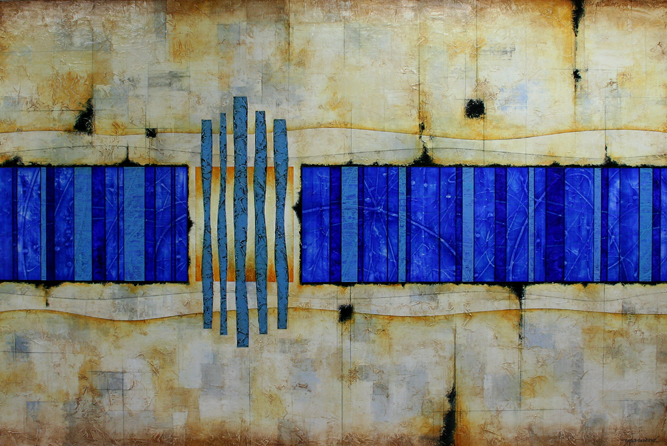
The technology of a much more distant past is referenced in the piece at the top of this post: it’s titled “Aqueduct” after one of the most revolutionary inventions of the ancient world. It, as well as five other superbly-crafted abstract pieces by artist Mark Yearwood, can be found here.

We hope you enjoy this month’s issue of Synchronized Chaos! As always, please feel free to leave comments for the contributors; if you’re interested in submitting some of your own work for the magazine, please send it over to synchchaos@gmail.com.

Interview with Dr. John J. Berger on Climate Change

An Interview About Climate Change, Climate Activism,

 Renewable Energy, and Personal Responsibility with

Energy and Natural Resources Author John J. Berger

Q. How is Climate Myths (and the rest of the series) different from other climate-related books?  What does it add to the debate?

A. Climate Myths: The Campaign Against Climate Science is intended as a concise and easily understood popular book on climate change that you could give to that cantankerous old uncle of yours who believes climate change is some kind of a hoax dreamed up by leftwing environmental fanatics.

Climate Myths is unique in both exploring the massive disinformation campaign that’s been mounted by the fossil fuel industry on climate change, and then simultaneously coupling that investigation with rebuttals of popular fossil fuel industry-sponsored myths and misconceptions about climate change.

The book thus helps account for the fact that although the human role in disturbing the climate has been well known for decades and the role of greenhouse gases has been known for more than a century, U.S. climate policy and, by extension, global climate policy has been significantly stalemated for the past 20 years by opposition from people and institutions supported by the fossil fuel industry.  Climate Myths exposes this below-the-radar universe of powerful industry interest groups that has been so influential in molding public opinion on climate change, and with our legislators.

The operation of these well paid, skillful and predominantly right-wing groups is largely responsible for the fact that many people, including policy makers, have for years now been deeply misguided on climate and energy issues.  Thus, they are now suddenly shocked by the arrival of the extreme weather that that climate scientists have been predicting and warning of for decades.


Q. How did you do the research for Climate Myths? Whom did you talk with, where did you look, etc?

A. I’ve studied and written about energy and environmental issues for decades so I didn’t base this book on casual journalistic interviews.  I read thousands of pages of scientific reports and journals by climate scientists and attended scientific meetings.  I spoke or corresponded with a few scientists when I needed a better understanding of their research or technical questions. I reviewed government studies from NASA, NOAA, the White House Office of Science and Technology Policy, the U.S. Global Change Research Program, and the Intergovernmental Panel on Climate Change.  I also read nontechnical books by scientists like Joe Romm, James Hansen, Mark Bowen, and Tim Flannery and by serious outstanding journalists like Mark Lynas and Fred Pearce.  Mark Lynas’ book Six Degrees, in particular, is extraordinarily useful.


Q. I know this is part of a series, and that you’re going to get into climate systems and solutions in the next two books. Do you have any big ideas or thoughts you’d like to give us as a preview?

A. The book that I’m finishing now is called Climate Peril: The Intelligent Reader’s Guide to Understanding the Climate Crisis. Climate Peril shows how grave the climate crisis is—the tremendous price that we’ve already paid and are going to pay in terms of human and environmental health and socioeconomic well being, and how pervasive the increasingly adverse climate impacts are across many different ecosystems and natural resources.

The present is already deeply alarming: the oceans are rising at an accelerating rate and acidifying; ice is melting in Greenland and the rest of the Arctic and in Antarctica. Extreme weather and fires are on the upsurge. The Amazon and other tropical rain forests are beginning to dry out.  Frozen permafrost holding 1.9 trillion tons of carbon is beginning to melt in the Arctic. Millions of people have already been sickened or died from the effects of the rapid climate change we’ve had so far.  But the future is even more menacing.  If current emissions trends continue, we are heading straight toward temperatures in 2100 that haven’t been seen on this planet in 5 million years. We cannot allow Earth’s temperature to rise to levels that only prevailed long before humans even existed.

Even the so-called safe temperature increase of 2° C would be hotter than at any time in the past 800,000 years. That conceivably could drive the Earth’s climate past various tipping points that could trigger irreversible climate feedbacks.  We don’t yet know enough about the exact temperatures at which these triggers will fire and deliver uncontrollable additional warming.

Absent that knowledge, we are currently conducting a totally unprecedented and reckless experiment with the Earth’s climate.  Climate Peril shows what we’ve already done to the Earth and makes clear that we are heading rapidly towards a climate catastrophe.  One of the most important take-aways from the book is that the 2° C safe warming threshold we often hear about is really not an absolute guarantee of safety, and that we really don’t have much time left to change course in energy and environmental policy, given how vast the changes required of us are.

In the book that follows Climate Peril, a book titled Climate Solutions, I outline the policies that I believe are necessary to address the climate problem as effectively as possible by weaving together energy and transportation with agricultural and forestry programs that, taken together, will arrest the growth of emissions and begin to reduce the burden of greenhouse gases in the atmosphere.  The primary goal of the book is to show how we can combine protection of the climate with economic policies that bring full employment and a just, sustainable economy.


Q. As a science journalist myself, I’d like to know what would you say about the role of science writing and journalism in the movement to restore and protect the Earth. What can writers do that adds to the work of the ecologists and other scientists?

A.  I believe that science writers, like translators, are vital to communicating complicated ideas of science into language the public can understand.  This creates a larger bloc of people who really understand climate issues and the choices that have to made about them.  Science writers understand the methods and language of science and ideally are able to convey it more simply and clearly in ways that are more interesting to people without specialized backgrounds.

One way they do this is to humanize the issue by writing stories in which scientists are protagonists portrayed as characters overcoming obstacles in a saga of discovery. Science writers also sometimes focus on the human implications of research, for example the child cured of asthma by a new medicine or a wetland restored by the ecologist or hydrologist who understands how nature operates and therefore can write a prescription for repairing it.

In that sense, science writers can highlight good work that can then serve as a model for others to follow. The science journalist can also synthesize and correlate important field observations and bring new scientific and investigative findings to light, as Rachel Carson did with the harmful effects of DDT. Cynics would have us believe that bringing truth to light and expecting change is naïve, but dispelling lies and inaccurate information was essential for controlling pesticides and tobacco and thereby protecting public health. It is equally or more important for science writers to dispel the lies and misinformation that are now so current about climate change so that public officials and leaders have accurate information on which to base climate policy. The information itself is not sufficient to bring sound policies—hard political organizing is necessary—but honest information is a necessary prerequisite.


Q. Who is the main target audience and what is the main goal of Climate Myths?  Is your primary goal to convince those skeptical about climate change, or to educate the general public, or to inspire activists to take even more pro-environmental action?

A. While I hope to reach the general public, I understand that most people are not buyers of books on climate change.  So I think this book will appeal mostly to intellectually curious people; to college faculty and students, environmentalists, activists, renewable energy advocates and entrepreneurs as well as legislators and their aides. As I mentioned earlier, it would be a good “pass along” book for a friend or family member who is confused or skeptical about climate science.


Q. What would you say to those concerned about the scalability of renewable energy technologies to people who say it can help on a small scale but won’t replace oil or coal anytime soon given our standard of living in the West.

A. If you look at the magnitude of the renewable energy resources and their declining costs and versatility and increasing adoption rates along with the still-extensive opportunities for increased energy efficiency, you can’t help but see that renewables have the capacity to meet very large energy demands indeed. Our wind resources alone are far greater than our electrical demand. There are huge untapped solar resources in the southwestern deserts of the U.S. and northern Mexico and on rooftops throughout much of the nation.  We also have important geothermal and biomass resources and new technology is emerging to harness wave energy. Hydroelectricity has been an important resource for generations. The main obstacle to the wider use of renewables is political rather than technological. I explain my views on renewables in some detail in previous books like, Charging Ahead: The Business of Renewable Energy and What It Means for America (University of California Press) and in Beating the Heat: How and Why We Must Combat Global Warming (Berkeley Hills Books) and in “Renewable Energy Sources as a Response to Climate Change” a chapter I wrote for Climate Change Policy (Island Press), a volume edited by the late Stephen H. Schneider and others.


Q. Why and how did you choose to emphasize restoration ecology as an approach to caring for the environment?  What makes it especially important, alongside other strategies?

A. Restoration is a proactive way of addressing damage that’s already been done to the Earth.  Conservation is critically important.  But if we confine ourselves solely to conserving what’s left of Earth’s natural bounty, we will forever be forced to defend a steadily shrinking perimeter of relatively untouched, healthy resources.  Nature is always under threat and has to be defended vigilantly. Without a proactive environmental restoration agenda, we’ll always be on the defensive in simply trying to protect the environment.  Our goal should be to improve the environment, not merely to slow further losses. Moreover, restoration is often necessary to arrest environmental degradation, like soil erosion for example, and prevent further inexorable damage.

Overall, we’ve got a tremendous backlog of badly damaged natural resources on this planet in the form of severely disrupted mined land, clearcut forests, abused rangeland and prairie, toxic waste sites, and polluted rivers, lakes, streams, and estuaries. With ever-increasing global demands on natural resources, we need to return these injured resources back to healthy, productive condition wherever possible.


Q. What are some of the best ways ordinary people can get involved in helping our environment and transforming our energy systems? I know you’ve talked about that in Restoring the Earth (Knopf, Doubleday Dell).  What would you say people and policymakers should do that would be practical and have an impact? By the way, we’re an international magazine and plenty of our readers are non-Western (India, Pakistan, Eastern Europe, parts of Africa, etc.) Would you have different thoughts and suggestions for them? I know the condition of the planet affects everyone!

A.  As you noted, whole books have been written on these questions. The answers vary a great deal depending on the nature of the problem, location, and the conditions surrounding it.  I’ll mention a few general principles first and then some more specific ideas.

First let me address the policy question.  Many constructive steps can be taken.  We need to phase out all public subsidies to the fossil fuel and nuclear industries and impose a carbon tax on fossil fuels. This will make fossil fuel use progressively less competitive and will provide revenue that can be used to build a renewable energy economy. The burning of fossil fuels is the main problem, and the use of nuclear power is not a cost-effective way of replacing them. We need to give producers of nonpolluting power generous long-term energy production tax credits to make clean energy even more profitable to producers and to help them in securing long-term financing. The use of coal power without carbon sequestration has to be phased out as quickly as possible and renewable energy R&D needs to be scaled up. The destruction of forests and wetlands needs to be stopped globally and policies need to be implemented in agriculture to reduce nitrous oxide and methane emissions.

In the U.S. we need a comprehensive national energy plan aimed at nothing less than a total transformation of our national energy system.  It needs to include a steadily increasing national renewable energy requirement, the electrification of the transportation system, more and better energy storage technologies, and modernization of our electric transmission system and its reorientation to enable our remote renewable energy resources to provide their abundant power to major urban markets.  Furthermore, it needs to be designed in the context of a domestic full employment and economic revitalization plan aimed at creating a sustainable and more equitable society, so that ordinary people will both benefit from, and vigorously support the plan.  Calls for such a program initially have to come from below, from organized but ordinary working people.. Pressure will work its way gradually upward from this base to put powerful pressure on those in power at the top.

In terms of personal action, each person has different gifts and passions. We each need to do something that makes best use of our talents and determination not to stand by while the Earth and the climate are abused.  I don’t live in Eastern Europe or in a developing nation in Asia or the Southern Hemisphere so I’m not sure I’m in a position to advise people in those societies.

These are some general thoughts mainly for the U.S., although some may apply elsewhere. Fundamentally, protecting the climate is a large and complex issue.  Trying to work alone can be overwhelming, so work with others. Find organizations whose concerns you share and volunteer with them or support them in any way you can.  On a personal level, we can all try to avoid wasting energy and resources, and we can be conscientious when we shop or invest so we support companies that are trying to behave in environmentally and socially responsible ways, for example by observing Fair Trade practices and using renewable energy. We can also read widely and educate ourselves about climate problems, share our knowledge with others, and become involved in the political process.

The least we can do is exercise our right to vote, a right people fought and died for.  Yet almost half the American electorate doesn’t even bother to vote in presidential elections.  Far fewer vote in off-year elections. Less than 56% of those eligible voted in the 2012 presidential context.  People under 30 were even less engaged—about half of them didn’t vote.  My suggestion is, don’t fail to vote!  And during campaigns, support candidates who are working for climate protection, safe energy, economic justice, and truly representative democracy. When elections are over, demand meaningful action on climate change from your political representatives.  Let these powerful people know what your concerns are and that you will absolutely not support them—and will discourage others from voting for them—if they fail to stand up for climate protection, the environment, and the public good.  Don’t accept “no” for an answer.  Recruit others to join you in political action and organizing.  Support new candidates who understand the problems and what needs to be done.  Use people power to create a groundswell of political pressure for change.

Change comes from the bottom up. We may not have the financial support of wealthy corporations or major donors, but millions of people do care about the Earth and the climate. We need to find and connect with them to build a politically powerful base for change. Don’t forget to also commend leaders when they do the right thing. They also very much need encouragement and support.

I believe there is still reason for hope, but that we are perilously close to irreversible climate change that will trigger uncontrollable global warming.  We don’t know precisely how close we are—no one has a year and a date—but scientists at the prestigious Hadley Research in the UK have said that if we continue on our present course, it could happen as early as the middle of this century.  That’s less than 40 years from now and probably within your lifetime.

In terms of the rapidly rising carbon content of the atmosphere and the rising global average temperature, we are clearly close to the point at which, for example, we finish melting the Arctic sea ice, destroy the Amazon rain forest, release more carbon from permafrost, and possibly oxidize the massive Indonesian peatlands, putting so much carbon into the air that the strength of the ensuing positive feedbacks overwhelms anything we could conceivably do to counteract these powerful natural forces. The hour is very late to begin making the dauntingly vast and pervasive changes in energy production and use, along with the far-reaching land use changes required to rapidly and definitively set global emissions on a downward trajectory. The work that needs to be done is so enormous in scope and scale that the prospect is absolutely sobering, but I believe it is still conceivable to accomplish.

On the daunting side, population is still growing toward 9 billion; global energy demand is climbing; global oil and gas exploration and development is booming—including production of highly polluting tar sands and oil shales and oil and gas drilling in fragile frontier locations. Trillions of dollars have been committed worldwide to the fossil fuel energy and transportation enterprise. The quicker we change over to clean energy systems, the more of that infrastructure will have to be retired before it wears out. The large corporations holding those assets will resist that with everything they’ve got and will mobilize their lobbyists and pull all the financial strings that large campaign contributors hold to control Congressional representatives.  (It’s important to note, however, that some fossil fuel plants are old and have already been fully amortized.  Their outputs can readily and economically be replaced without much controversy by renewable facilities and by greater investment in energy efficiency.)

Meanwhile, construction of the needed renewable energy facilities and new transportation technologies is not going to be a walk in the park.  Expanding the electric grid involves jurisdictional issues and building new renewable energy facilities requires time-consuming environmental studies, permits, and battles over rights of way.  Better and less costly energy storage facilities are needed to compensate for the intermittency of some renewable technologies.  Better batteries are needed for electric vehicles.  Then people will take time to adapt to new vehicles and modes of transport. Less expensive biofuels with fewer environmental impacts need to be mass produced.  Forests, wetlands, and prairies that naturally sequester carbon in soils need to be protected, enhanced, and restored; global agricultural practices need to be improved to reduce their emissions.  A lot needs to happen very, very quickly.

On the encouraging side, the nation and the world have the natural resources, the scientific knowledge, the collective economic might, and the energy technologies to deal with the extraordinary global crisis we face.  When faced with epochal threats like Pearl Harbor and World War Two, the U.S. pulled together and rose to the occasion.  Once political leaders really fully grasp that we are in the midst of a global emergency with everything ultimately at stake and no time to waste, then they will finally get that we must slash carbon emissions and create a worldwide renewable energy economy. From that point, the shift will begin to accelerate and—if climate change has not by that time begun to undermine our economy—the creation of the new energy economy will revitalize the global economy. Then as new jobs materialize and emissions fall, the process will inspire new hope for a sustainable future.

To accomplish this, our greatest challenge is develop the political will as a nation and as a family of nations to take the bold and far-reaching actions that are absolutely necessary to reduce greenhouse gas emissions to protect the climate, human life, and the environment that sustains us.

We don’t have time any more to lament the situation or make excuses for inaction.  Everyone can do something.  We need all hands on deck.  Be determined. Fight the good fight.  Do something, no matter how insignificant you may think it is. Chances are you have more power and influence than you think. Millions of other people are out there who already silently agree with you. They will stand up if you do.  Use your power.  Amazing and tremendous things have been done and will be done by committed individuals.