Poetry from Linda Allen

“Hello Autumn”

Red, gold, green, purple, orange, yellow and brown

Your colors are perfectly beautiful

Hello Autumn, nice to see you again


Landscapes are bright and colorful

Trees look alive

Hello Autumn, nice to see you again


The air is so fragrant and clean

The wind sings with the colors of the trees

Hello Autumn, so glad you are here


Leaves on trees brighten the mood

While holidays start to approach far too soon

Hello Autumn, so glad you are here again


Pumpkin pies, jack-o-lanterns, pecans, and evergreens

Your colors are on display for all to see, smell, and taste

Hello Autumn


The time we spend together is bittersweet

The time we spend together is far too short

Hello Autumn, wish you would never leave


Red, gold, green, purple, orange, yellow and brown

As we part and your beauty Falls, even the trees look sad

O goodbye Autumn, ‘til we meet again


“All Hallows Eve”

Long dark streets

Houses decorated to scare

All Hallows Eve approaches


Jack-o-lanterns being born

Skeletons on display

All Hallows Eve approaches


Kids will be in costumes, masks, and capes

To be who they always dreamed to be for just one night

All Hallows Eve approaches


Ghosts, goblins, ghouls, zombies, witches, vampires, bats, and other dark things

Appear in the night ready for frightening good fun

All Hallows Eve approaches


Get ready for the night

Be ready for a fright

Dress for the occasion

Stomachs at the ready

All Hallows Eve approaches


Best not be scared of things that go bump in the night

For they only last from dusk till dawn

And in the morning you better pray your skin is not white,

For the morning light may be the last

OOOOWWWW HAHAHAHAHAHA!!

Happy Halloween!

Linda Allen is an American from Oklahoma who may be reached at lindaallen4119@att.net and welcomes comments and thoughts on her writing.
Synchronized Chaos, September 2012: Inspiration

“Where do you get your inspiration?”

Most artists have to field this question with relative frequency, yet very few are able to articulate a comprehensive answer. Indeed, inspiration is a complex concept to wrestle with—it can come from almost any source and, depending on the situation, can lead to a fascinating variety of results. Therefore, we’ve decided to make the September 2012 issue of Synchronized Chaos a study in inspiration. We think you’ll be quite interested to see the many places from which our contributors draw their ideas—and the diverse ways in which they exercise their creativity…

We begin the issue with a very unique form of artwork: digital poetry. Wrapping words, sounds, and images together in a video format, poet Mary Ann Sullivan crafts a distinctive and memorable set of works which take their inspiration from many different sources. Joan of Arc, surely one of history’s most inspirational figures, is the subject of one notable piece; the other spurs for these poems’ creation include such diverse items as religious texts, found objects, and even the notion of language itself.

It’s a real-life event which provides the inspiration for this installment of Leena Prasad’s monthly column Whose Brain Is It?: the hatching of eggs born to a duo of pigeons which had nested on the fire escape of her building. From this springboard, Leena goes on to discuss the phenomenon of nurturing newborns and the biological chemicals which are associated with parental behavior. Both humans and animals come in for discussion, as well as the respective roles of male and female parents.

Lack of inspiration can be quite a dreadful thing, as our columnist Chris Cooper can testify. He was in attendance at a Republican Party fundraiser in Pleasanton, California, and he came back dismayed by the level of enthusiasm (close to nil) at the event. As Chris describes in his article “Snoozefest: The Decline and Fall of the California Republican Party,” the event’s dullness and lack of focus on actual issues mirrors the party’s out-of-touch and distinctly uninspired response to modern problems.

Sometimes it’s the readers of a piece who need a little inspiration in order to reach their goals. In her essay “Create It,” Bramani Spiteri expresses frustration with the cultural trend of sacrificing happiness and satisfaction in favor of staid and unfulfilling lives. She argues that, instead of settling for a dull job and a life of “just getting by,” people should follow their dreams and inject a little more creativity and joy into the modern world—and we predict that many of those who read her thoughts on the matter will feel inspired to do just that!

Sam Burks, one of Synchronized Chaos’ most talented poetic contributors, appears in this issue with “Gravity, An Illusion.” The piece portrays a troubled romantic relationship which has taken more than a few twists and turns and lost much of its former inspiration. It also features a particularly inspired use of poetic language, as traditional metaphors for romance and relationships appear in new and different contexts.

Cristina Deptula, longtime editor and contributor to our magazine, contributes an article on a real-life medical mystery: the outbreak in recent decades of “nodding syndrome,” a debilitating condition which has affected thousands of children in the eastern regions of Africa over the past several decades. Cristina reports on the current efforts to combat the problem: the medical researchers on the scene have a challenging task ahead of them, but they draw considerable inspiration from the resilience of the affected communities.

Readers of our previous issue will recall the first chapter of Peter Lynch’s memorable novel Newman-X. This month, we have the second installment of the story, in which we continue to follow its troubled young narrator on his odyssey through the pitfalls of the modern world. In this segment, he inspires himself to perform a little self-observation, as well as some research into the neuropsychological concepts which are so relevant to his life, but nevertheless his self-destructive behavior continues unabated…

We hope you enjoy this month’s issue of Synchronized Chaos! As always, feel free to leave comments for the contributors; if you’re interested in submitting some of your work to the magazine, please send it over to synchchaos@gmail.com.

Create It: An article by Bramani Spiteri

Create It

By Bramani Spiteri

We have all had big dreams.   When we were kids, we wanted to fly or have x-ray vision, we wanted to be superheroes.  As we got older our dreams got more realistic, but they were still big.  We wanted to buy a big house, multiple cars, go to college, have a happy family.  We got out of school looking to change the world, make an impact; then our dreams got smaller.  We lost sight of the big picture.

Now, we go to work and just want to make it through the day.  It is a story that we are so familiar with that it is nearly an expected path; but why?  Why are we content to just get by?  Why are we not striving to get what we need and what we want?  Does there have to be a point where our dreams become small, our jobs become just a necessity, and our ambitions to create change become irrelevant?  The answer is no!

It is unfortunate that it has become culturally acceptable to go to work, dislike your job, feel unfulfilled, and be generally unhappy in your professional life.  Yes, making ends meet is important, but there is no point along your path where it should be OK to just settle.  Not only do you as a person need to consider the ramifications of such an existence but we must understand the impact an unhappy work force can have on the economy at large.

At a time when markets continue to decline, unemployment rates are high, foreclosure rates are skyrocketing, and inflation and interest rates are growing exponentially faster than wages, it is important for this country to look for answers that are not readily apparent.  The mistakes that were made in the real estate, banking, and manufacturing industries are obvious and, although the changes may not be as effective as needed, changes are being made.  But there are other issues, issues that are so engrained into our society that most people do not know they even exist.  Some of these issues include a false sense of entitlement, lack of work ethic, an overwhelming presence of denial, and an inability to cope.

A generally dissatisfied work force only enhances many of these other detrimental attitudes, but here’s the kicker: it is no one’s fault but your own!  Take responsibility for your choices.  Regardless of your circumstances it was your choice to abandon your dreams and settle.  Now I know most of us do not like to hear that, but it is the truth.  Which brings me to the message of this article; this is a rally cry.

To everyone that feels dissatisfied or unfulfilled, choose to change.  Define your dream, own your dream, and then make your dream reality.  It surely will not be easy, but it will be worth it.  If you truly desire the change you will sacrifice for it.

Now your dream may not fit very nicely into the life you have built while you were settling for mediocrity.  That means you have to be creative.  You know that at fifty years old you are not going to become a prima ballerina, but that does not mean you cannot dance every day of your life.  Use the resources that you have to make it happen.  Take classes, join a performance group that fits your needs, spend time watching ballet.  Maybe being creative means opening your own dance studio and supporting the next generation of dreamers.   It is this creativity that can help us turn this economy around.

Ingenuity has driven the American economy to new heights time and time again.  In this purposed grass-roots movement, the creativity begins with each individual.  You have the license to create your perfect situation, to make something new, improve something old, or just do something different.  Pay close attention as you make this journey; see how your creativity and passion become contagious.

As creativity and passion grow within communities we will begin to reap benefits as a whole.  Not only will creative thinking produce jobs, resources, and networks, but it would be nice if everyone woke up in a better mood because they enjoy their work.  Seek out your passion, nurture it, become it, and watch it become bigger than you ever imagined.

Create the job of your dreams; create the life of your dreams.

Bramani Spiteri is the coordinator of the performance arts network Soul Expressions (www.BramaniSoulExpressions.com). She can be reached by email at Bramani@BramaniSoulExpressions.com and by phone at 304-282-6826.

Digital poetry from Mary Ann Sullivan

Mary Ann Sullivan, who created the four videos below, is an expert in the field of digital poetry–a format which takes full advantage of the artistic possibilities of electronic media. Going beyond traditional poetic forms, digital poetry combines written text with audible and visual elements to create a unique and rewarding work.

These poems fit in particularly well with this month’s theme: they draw their inspiration from a fascinating variety of sources, ranging from notable individuals (Joan of Arc, who receives a rousing tribute in “What Can Burn, What Cannot”) to found objects (“Broken Wings,” which was written after the artist came across a mass of feathers while walking in the woods) to the everlasting beauty of the Bible (“A Tree Near Water,” which is specifically inspired by Psalm 1) to the English language and the relationship between words and images (“A Noun Thing”–certainly a fitting subject for a poet who combines the two in such an interesting fashion!). Watch and listen below to see how these diverse sources can inspire an excellent body of work…

“What Can Burn, What Cannot”:


“Broken Wings”:


“A Tree Near Water”:


“A Noun Thing”:


Mary Ann Sullivan is a poet, novelist, essayist, and lecturer. A former Cistercian and Dominican nun, she currently teaches at Hesser College in New Hampshire. More biographical information, as well as several more examples of her digital poetry, can be found on this page.

Snoozefest: The Decline and Fall of California State’s Republican Party: An article by Chris Cooper

Snoozefest: The Decline and Fall of California’s State Republican Party

by Chris Cooper

My column this week for Synch Chaos is about the decline and fall of California State’s Republican Party.

As a crack shot intern/reporter for Synch Chaos, I see the problems with today’s Grand Old Party establishment. It’s more of a snoozefest with even the candidates asleep at the wheel.

I went to a fundraiser at a private home in Pleasanton. The food was terrific and the people there were ones I had known for years. But, with the election being ninety-seven days away, was anyone talking about the issues important to the voters? Not really, and I am surprised at that.

I was cornered by a man who asked my thoughts on the high speed rail bond project and I told him “Well, it’s more like a pork spending project that we don’t need and can’t really afford. It’s going to be taking a lot of bonds out of the treasury and also a lot of money away from the treasury too that could pay down California’s debt.” He thought I was right on about all of that.

I told him, let’s get serious about medical care for seniors and others who need it. Let’s put people back to work, let’s fix the economy and let’s put an end to the guest worker programs. Let’s put an end to putting Prop 30 (a sales tax measure) back on the table for this election.  I told the man this was just a snoozefest that we were attending. He asked what makes it a snoozefest…It was more like a love fest gone wrong.

There was a candidate for District 7’s Senate Race whom no one was really speaking to, and then the candidate for Congress from Livermore was so bland that he basically had nothing to offer. It seemed that people were just hanging around him because he needed company. The poor candidate just kept looking at his salad and seemed to realize that maybe he was too bland a candidate to really make a difference.

Now, what does this guy do for a real living to make it through his day? Let me tell you, the guy is a used car dealer out in Livermore.

No one was paying attention to the issues. No one wanted to discuss the issues. Everybody was just there to eat food and re-hash the same arguments that we have up in Sacramento and the same arguments from the past presidental campaign of 2008.  No candidates were asking for any volunteers. Not offering any yard signs or even trying to recruit or register volunteers.

The host of the party, whose name I won’t use, looked like he was bored to death himself. He kept going out on the back patio grilling up more food and the more I ran into the host, he kept yawning. He saw this was a snoozefest too, and even the guests were bored. People were talking about their kids’ soccer games or their wives’ jobs or their husbands’ jobs or the baseball season and the cost of the 49ers’ new stadium.

Nobody was even talking about defeating President Obama. There was not even a mention of the Mitt Romney Campaign in the Bay Area.

Which is just as well, since Mitt Romney basically is out of touch with this country. Mitt Romney represents Bain Capital and the investment firm that he started, and for which he outsourced jobs overseas.

And then he promises to have real jobs here in the United States! Should he get elected? He wants his Mitt in your Pocket.

Now, who would you rather have for president: Mitt Romney from Bain Capital or Barack Obama?

The Father’s Instinct: September’s Whose Brain Is It?, a monthly neuroscience column by Leena Prasad

The Father’s Instinct

Note: this neuroscience column is published monthly in SynchChaos.com magazine

topic nurturing
region pituitary gland, hypothalamus
chemicals oxytocin, prolactin, testosterone, vasopressin


tiny bundles
white yellow orange red
chicks being fed

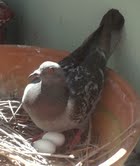
The newborn pigeon chicks are being fed by their grey and black father. A few weeks ago, they were two tiny white eggs.

“They hatched!” I send a text message to my boyfriend. We take delight in this incubation-hatching-fledgling drama taking place just outside our apartment. Despite advice on the internet that pigeon birth cycle can turn into a nuisance, our curiosity wins and we allow the budding pigeon family to stay in the twigs nest they have built near our fire-escape stairs.

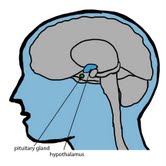
After the hatching, the father sits on the chicks to protect them as they grow. Sometime I see him feeding them but mostly he is a stoic silent dad, acting under the influence of his instincts. At night, the mother takes over the job of nurturing. Both parents’ brains are releasing the prolactin hormone which is secreted by the pituitary gland via instructions from the hypothalamus. In the case of birds, this chemical is released when the bird sits on an egg. Prolactin causes the secretion of milk in both pigeon parents thus the father is able to feed the chicks during the daytime and the mother at night. There is a decrease in the father’s testosterone level at this time also which is why he is able to shift from copulation to nurturing.

In humans, women start to secrete prolactin as the child is about to be born and continue to secrete it during the breast-feeding phase. Males, however, do not release prolactin nor do they show a reduction in testosterone production when the female is involved in child care. That is, unlike bird fathers, the human male does not decrease his sex-drive while his wife is rearing a new child.

In addition to prolactin, a woman’s hypothalamus also causes the release of oxytocin (via the pituitary gland) for the production of milk. Oxytocin is a catalyst in inducing labor so a female mammal can give birth. It is possible that birds also secrete oxytocin but more research has been done on rats and humans than on birds. Rats are often used in experiments because they are mammals, have a body and brain that is very similar to humans, and are much cheaper and easier to use for experiments than humans.

Beyond milk creation and inducing labor, the oxytocin neurotransmitter has the powerful affect of elucidating emotional bonding which results in the maternal drives required for child care. I suppose if we ever had a child, my boyfriend would probably help raise the newborn but he would not be producing oxytocin at the level that I am producing and would not feel the same level of chemical imperatives for nurturing.

Even though the human male’s brain keeps itself isolated from the nurturing drama by not releasing prolactin or extra oxytocin, there are other “potential” chemical activities that occur. In male voles, a rodent similar to a mouse, a hormone called vasopressin induces paternal care by the males. This study, however, has not been correlated to humans.

I watch the progress of the birds on my fire-escape and connect with the “maternal” instincts of the father pigeon. I do not see the mother much because it is too dark when she shows up. Since I am not pregnant, nor do I have a newborn, I do not have prolactin circulating in my system nor do I have an unusually high level of oxytocin. Oxytocin, however, is being released in my body consistently because I am in a committed romantic relationship (this chemical is not just for mothers, it is also released in humans when any bonding activities occur). I do not know for sure if the oxytocin in my body makes me feel more sympathetic to the pigeon parents but I suspect that it does. Either way, I am enjoying this pigeon child-care ritual.

Leena Prasad has a writing portfolio at http://www.FishRidingABike.com. Links to earlier stories in her monthly column can be found at http://www.WhoseBrainIsIt.com.

Dr. Nicola Wolfe is a neuroscience consultant for this column. She earned her Ph.D. in Clinical Psychopharmacology from Harvard University and has taught neuroscience courses for over 20 years at various universities.

References:

1. Bridges, Robert. Neurobiology of the Parental Brain. Academic Press 2008.

2. Numan, Michael; Insel, Thomas R. The Neurobiology of Parental Behavior. Spring 2011.

3. http://www.pleasebekind.com/pigeon.html

“Gravity, An Illusion”: A poem by Sam Burks

Gravity, An Illusion
by Sam Burks

I let you go

Lord knows
it was hard
to do
to accept that your wings
aren’t broken
and to move my cupped hands apart
and watch you fall
fall
fall right through
the floor

But it was just an illusion

My eyes were entertaining my brain
as we wept by the river
as we kissed in the trees
as we died on the mountain
and as we were reborn
on two different roads
angling out
towards two opposite coasts
where we would ask ourselves:
is the sun rising or
is the sun setting?

Two questions
one answer
that couldn’t be found
in a million places

I let you go

And you came back
Lord knows
I wish you didn’t
I wish the river was dry
I wish the trees were dead
and the mountain flat
I wish the roads
went further
than this

And you watched me fall
fall
fall right back into
your cupped hands
as the sun was rising
and setting
in your eyes

Two roads
one destination
that we
will never reach

Sam Burks is from the San Francisco Bay Area and can be reached at srburks@gmail.com.