Larry Azoth focuses on drawing, painting, and photography, primarily in the areas of still life and portraits. To learn more about the artist, visit his page on artreview.com.

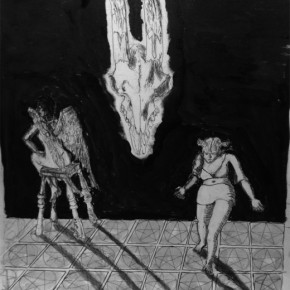
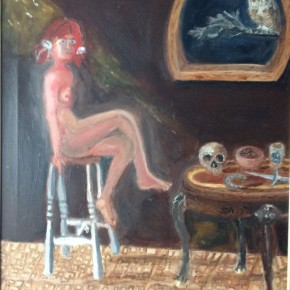
Larry Azoth focuses on drawing, painting, and photography, primarily in the areas of still life and portraits. To learn more about the artist, visit his page on artreview.com.
[Article/Interview by George Teseleanu]
Full name:
A.A. Smith
Date of birth:
July 31st 1982
What is your current location?
Olympia, Washington, USA
Tell us a little about the art styles that you use.
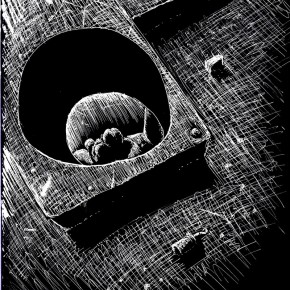
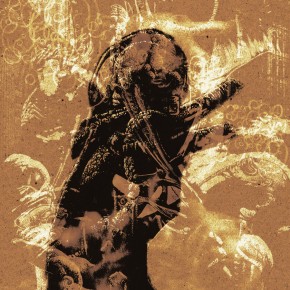
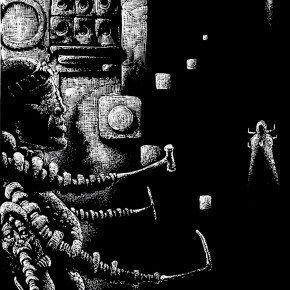
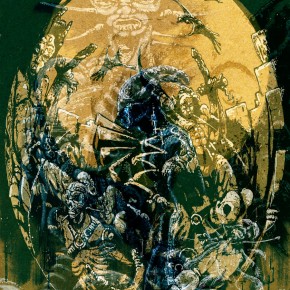
I present bodies, men, characters or mere figures, in states of mutation and landscapes that are similarly altered. In some they emerge from fields of black, others half buried in organic texture. It’s largely about decay and the breakdown of patterns. Aspects of it change all the time, but most trace back to long years of imitating Dali, Giger, or Alex Raymond. Much of my style is determined by working in pen exclusively, making any error a part of the final product.
What are your tools of trade?
Pilot G2 0.38mm, Pilot V-Ball, Sharpe Magnum, Uniball Vision, Gelly Roll gel pen, Photoshop.
Why did you choose these art styles?
Apart from my inspirations, it sort of chose me organically over a long time. I first attempted hatching because of Raymond’s use of it in early Flash Gordon comics. Everything else grew out of long drawing sessions in sketchbooks, often in cars or on buses.
What is your favorite one and why?
My favorite style at the moment is my reversed white on black pictures. For the longest time shadow had no place in my art, now it’s back with a vengeance.
What other art styles would you like to experiment with?
I’ve long wanted to be able to do the sort of thing Aubrey Beardsley did, the very stark and mannered far-out woodcut style. I’ve also long wanted to work more in other media, namely sculpture and film.
What is your favorite art movement and why?
Surrealism, easily. It is the first time art was permitted to explore the depths of the mind without having to depend on religious iconography or illustration as an excuse. Dali introduced me to it and the discoveries of de Chirico, Tanguy, and Ernst sealed my love for the movement. It’s amazing what one can find in a public library.
How can you define in your own word, surrealism?
There are many grandiose definitions for it, but I prefer simply to call it the art of dreams, or the unconscious. There’s more to it than that, but I find the best surrealist art resonates with me on that level, as if I’m visiting the dream of some long dead artist. More than 90% of the art I see I can just shrug and move along, but a de Chirico or Dali painting makes me pause, like something has imperceptibly changed.
Who is your favorite artist and how do you connect with his/her works?
It is a toss-up between Salvador Dali and H.R. Giger. The connection is, by now, historical. I have been admiring their works for roughly 19 years now, most of my life. It began, back then, with a mad and inexplicable excitement when viewing the works of these artists. Part of it has to do with the extreme technical ability of each and that it is used to convey the macabre and surreal. Each had a unique take on the body, on use of space, and each employed a recognizable visual language. I would argue that few artists have brought the viewer so thoroughly into their minds as Dali and Giger. Of course I admire others, for similar reasons: Max Ernst, Beksinski, Tanguy.
What influenced you to become an artist?
I was encouraged to be creative since early childhood, and of course all children draw. My parents owned many books on art history, and these were part of the germ of my interest in art. We visited museums as well, and that helped.
How long have you been an artist?
That really depends on one’s definition of “artist”. If it’s meant professionally, I was first paid for my art in 2008. If it’s meant seriously, I have been since around 1995. If it’s meant simply creating, I have been almost since birth.
How did your family and friends react of you being an artist?
Generally positively. My friends and teachers were always concerned whether I could make a living at it (and I never have yet). My immediate family was more concerned whether I was doing what made me happy. Some of the grandparents were a little cooler about the idea, but that may only be a generational thing.
Where do you get your inspiration from?
Almost everywhere. My dreams and imaginings make up a large part of it, but often too it’s the world and the desire to make fun of it. I spend a lot of time on public transportation and in fast food restaurants, both of which provide kinds of inspiration. I’m also an avid movie watcher, having seen a few thousand of them, so those tend to inspire as well.
What determined you to do collaborations?
Having a younger brother who also draws did. We began collaborating at a young age, probably around the time I finally got used to him.
What can you tell us about your first collaboration?
The first outside of childhood was probably an Exquisite Corpse done with Gromyko Semper 3 years ago. I was fairly disappointed with my end of it.
Can you tell us how collaborations influenced your art?
Since a large part of my art has been collage of one form or another, I tend to collaborate with some artists posthumously. Sometimes it’s like reverse engineering, learning the other artist’s process. I’m always open to another artist’s viewpoint, and a collaboration can be like a meeting of the minds. I don’t know what degree it’s all helped me, but I’m glad for the experience.
Can you tell us how collaborations influenced you?
The early stuff with my brother spoiled me a bit because we never had to communicate much, we pretty much knew what the other would do. In my adult life I find other people need a lot more input and I have trouble with that.
Do you promote/ sell/ showcase your artworks?
Deviant Art is really the only form of promotion I have going. I’ve never had an exhibition or anything like that. Many of my works are available as prints and I am open for commissions.
How the Internet did influence your art?
The internet is what ultimately got me going on really producing art, mostly because before going online I had no audience for it. I went between various sites looking for a good place to put my art, but Deviant Art proved to be the only fit. It was the first time I actually had a receptive creative outlet, so it got me making art consistently. Before DA I made probably, a hundred drawings a year. Since I’ve been on DA I do about 500 drawings a year.
Where can people see your artworks and how can they contact you?
On Deviant Art: http://leothefox.deviantart.
———————————————————————————————————————-
You can contact George Teseleanu at blana_de_maimutza@yahoo.com.
[Article by Adrianne Anderson]
Francis Tapon used to work in Silicon Valley big business before he quit his job to become a travel writer.Francis has hiked the Continental Divide Trail, the Pacific Crest Trail, the Appalachian Trail, and has just finished his second book, called The Hidden Europe: What Eastern Europeans Can Teach Us, which covers history, culture and travel tales from every country in Eastern Europe. 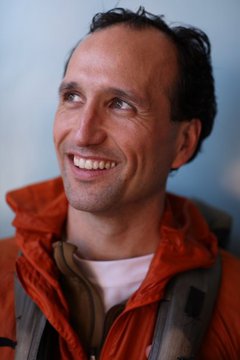 He also maintains a website chock-full of blog posts, podcasts, and videos, and is gearing up for a 3-year adventure in Africa.
You have so much content on your website! Including some articles that launched quite a furor…
[Laughing] There are a few articles that are controversial. I felt like this latest book is about what Americans can learn from Eastern Europeans. But of course in the process of writing about that I think about things that Europeans could learn from Americans.
In Eastern Europe, the whole concept that the CIA’s behind everything is a surprisingly prevalent notion. It surprised me when I got to Eastern Europe and all sorts of people said, “Well the CIA did that…” And I’d say, “What? CIA?” I had to explain that the CIA’s not that all knowing.
And the other one is the American smile. We are heavily, heavily criticized for our fake American smile. And I do think that there’s some justification for that but again I felt it’s not nearly as strange as you might think. But to Eastern Europeans, whenever I asked them what they thought about Americans, they mentioned the “fake smile.” Bam, over and over again. It’s a common criticism.
Can you talk about your writing process?
The traditional methodology that people tell you to do is write fast and just get all the ideas down and then edit later. I’m not very good at that. I will sometimes not let a sentence go before starting the next one.
I had two editors who gave me editorial advice—this section is kinda boring, or this needs to be explained better, whatever. But I also had something, what I called Beta readers, just like you Beta test a site. So I basically said, anybody who’s interested can sign up on a distribution list & be a Beta reader. So I would send out chapter by chapter as the book was getting written.
So that’s the best type of crowd-sourcing. The readers benefit because they’re getting a sneak peak at your work and feel like they can have an influence. It benefits me because I’m getting real input. It was super valuable because a lot of my Beta readers were Eastern Europeans, and it was very important for me to have that sanity check, to have them make sure I’m not saying something super offensive, misleading, or inaccurate.
The Hungary chapter, which is the longest chapter in the whole book, is really controversial for Hungarians to stomach. I had a lot of Hungarians read it and it was an eye-opener for them, and it was great because they challenged my thoughts and it refined the chapter. So it ended up being a stronger chapter.
It was all this informal editing that I think made the book better, and made the book, not necessarily well-received by all Eastern Europeans, but at least it was fair.
The tone of Hidden Europe and in some of your blogs is so strongly opinionated at times—did you always have that voice or did it develop over the course of your life?
I think in my 20’s, I was a sponge. And I still am a sponge. But I’ve gotten so much evidence about certain things that I feel confident enough to say okay, this particular issue, I feel strongly enough to say this is the way this is because I’ve heard both sides of the story, I’ve heard it all, I’ve seen so many different angles, and this makes sense.
At the very conclusion of the book [The Hidden Europe], there’s an Answering the Critics’ section. [He reads] “Some may say this book creates and reinforces stereotypes. Some may say, ‘I jumped to a chapter on one country and it sucked.’ Some may say, ‘Who are you to give advice to my country?’ Some may say this book is too basic for sophisticated, knowledgeable Europeans. Some may say this book isn’t scientific.”
So I address each of these at the very end. I know there’s still going to be plenty of people that’ll give me one-star reviews on Amazon and they’re going to say those same things.
But it’s interesting because even though it seems opinionated, and sometimes almost irreverent, it’s objective in an interesting way because you’re laying out every part of your logical process, transparently.
That’s right, and I was thinking recently about the whole idea of balance. In reporting, this whole idea of balance is you want to get both sides of a story, right? And sometimes people confuse balance with truth or confuse balance with reality.
For example, in my book, I sometimes point out the benefits of communism, of how there was security, everybody had a home, everybody had a job, people had social security, they had basic medical care. But there were also all sorts of horrendous problems with communism. Just huge. So in the end, my message is ‘communism sucks.’ It was a flawed system; it had all sorts of negative problems.
I’m sometimes strong on a certain issue—but if you really sit there and you have an open mind, I think it’s defensible. I don’t expect people to agree about everything I say, but I think they should read and say, ‘You know I don’t agree with all your conclusions, but I totally see how you got there.”
I’m gonna get in so much trouble for this book, I just know it! [laughs] I’m just waiting for the nationalists to come crucify me! Like, “You said that about my country?!”
The Hidden Europe offers a ton of history and context while staying entertaining. How do you incorporate historical research into your writing process?
I read a lot. I’m just an information sponge. I’ve never owned a television in my life, but reading is probably my biggest source of facts.
Now for this book, though, I talk about this whole idea of getting history through people. In other words, getting into their brains and saying, for example, You tell me what California history is like. You tell me what American history is like…
There’s an often repeated quote that victors write history. But I think that’s kind of B.S. in some ways because in the end, history lives on in people’s heads, and the victor can write whatever he wants.
I’m curious about what’s the history in people’s brains, capturing the way they see the world. And a lot of times there is a disconnect between what objective historians say. I do want to document what people on the streets say and teach their children. But at the same time, I want the reader to understand when those beliefs venture into fiction.
And it’s a tricky thing. I recognize throughout the whole time that my source may not be entirely objective either, and I may be burdened by my own bias going into it. But still I think I have a competitive advantage in writing this because I’m not Eastern European in any way. I’m a third Chilean, a third French and a third American. In my house we spoke Spanish, I went to French school for 12 years, but I grew up in America.
So as a result, I’m not terribly nationalistic or one-sided about almost anything. I see multiple perspectives all the time. So I think that I can be more objective than the typical person. That doesn’t mean I’m perfect either, so I do my best and just try to explain this is what I believe, these are the facts that I’ve read and they sound more plausible…and then occasionally use something called logic! [Laughs]
I really enjoyed the scene with the Polish man who talked with you for hours about Poland’s history.
Almost everything he said was actually factually correct, so I let him tell the story. But other times, I let people tell the story and then I point out, after or in the middle of the conversation, that they’re incorrect.
What was interesting was it also made me re-evaluate how I see American history or French history, or even Chilean history. You wonder, am I looking at these things fairly and honestly and un-biasedly? So I think it was also helpful for me on a personal level.
So with your earlier mention of the CIA theories in the Balkans, did you trace that to a deeper fear?
I did. Eastern Europeans are quick to believe conspiracy theories because they lived through communism and war. Communism restricted the information flow and an entire generation grew up with the belief that anything the media and the government tells you is a lie. That’s an axiom that they have in their brain, in their DNA, and of course they had good reason to believe that.
Furthermore, they had a double-whammy. Communism was replaced by a war-time situation. So governments always tightly control the media during times of war. Even governments with long traditions of the free press, like the U.S., clamp down on the media during intense wars.
So until the 21st century, Balkanians have always lived in a society of misinformation. The problem is, now that Communism and wars are over, Balkanians haven’t adjusted. They’ve kept the habit of doubting everything and having more confidence in whatever their drunken buddy dreamed up at the BBQ!
Can we step back and talk about your time in college & graduate school? Can you talk about why you chose to major in religion for your undergraduate degree?
I thought it was the most important question we can ask ourselves—in other words, is there a supernatural force, power, God? And if so, of all these different religions, is there one of them that is tuned into the right frequency? I came in as a Christian but I had an open mind, and so as a result, I studied Islam, Buddhism, Sufism, Taoism, and Confucianism. And the more I studied the more I saw of course the common bonds religions have between themselves, but I also found inconsistencies, things that didn’t really make sense or I didn’t agree with.
And then you moved to Harvard Business School. When you were sitting in class, did your comments, as a religion-major, differ from those of, say, economics majors?
In business school, especially in the first year, I had the reputation of being kind of a goofball. I was one of the only people in the whole class who didn’t have a study group. Everybody was quite paranoid about passing and getting good grades, and I just didn’t worry about it at all. My grades were just average, but I was hoping to be average. I just wanted to graduate and I’m happy.
It was a great experience. The best thing about it was the people you meet—from all over the world, twenty-five percent of people were foreigners. I’m a big believer that: surround yourself with people who bring you up, not bring you down. That give you energy as opposed to take your energy. And I think that’s one of the benefits of HBS [Harvard Business School] is that people really have this positive influence.
And here’s the other thing I remember is that business school is about relationships. Ultimately it’s about interpersonal relationships and walking out of school with a bunch of connections. There you could potentially argue about the fake American smile! [Laughs] People just wanting to be friends and network. I think it’s less competitive than medical school, than law school, than engineering school—it’s more about the relationships than anything.
So then you graduate and start working with major tech companies in California, but ultimately choose to leave that career for long-distance hikes across the U.S. You were hiking thousands of miles, sometimes alone. What do you think about when you’re walking for such an incredibly long period of time?
I think when you walk for a long time, your mind eventually gets into a rhythm-like, meditative state. Eventually it’s all mechanical so your brain gets fired up—not having to think about the laborious uphill climb or the bear attacking me, or the where to go on the map. Eventually you get into a groove, and so once you’ve walked for a few weeks, all of a sudden the issues disappear. You have a serenity in your brain that allows you to contemplate your life, the world, the universe, just everything in a way that I think is hard especially in the modern life of people who life in cities. With the internet, cell phones, it’s really hard to get that kind of time out.
Even on the Appalachian Trail today it’s different than when I did it ten years ago. I think there’s a lot more people using smart phones and tweeting along the way and keeping connected. I didn’t have a cell phone on any of my long hikes. So I was truly disconnected on the Continental Divide Trail. I went 2,000 miles without seeing one backpacker. It’s incredible. The whole state of New Mexico, 700 miles, I saw one guy with a dog, out for a day hike.
But you’ve also done some trips with a partner. Which do you prefer?
Having done both, I would say I enjoyed my experiences more when I was with someone. When I was traveling through Eastern Europe for three years, I was alone most of the time, but people were always around, so I would have the interaction. So it’s better to have a travel partner, but when you’re going to touristy places, outside the wilderness, the downside is that you’re less likely to interact with locals. If you and I are on the bus together, we’re gonna talk to each other. But if I’m by myself, I’m gonna look at my neighbor and start talking to him.
But overall anyway, to answer your question, it’s better to be with somebody. I don’t want to do Africa alone, that’s for sure. I will postpone my journey until I find someone who’s appropriate who’d want to go on that trip.
How will you find someone that wants to leave for Africa for 3 years? I suppose there are tons of adventurous people in the Bay Area.
All over the world, actually. But there are two levels of adventurous people. There’s adventurous and then there’s really adventurous. A lot of people say, ‘Oh I wanna travel the world,’ but then all of a sudden, when they’re faced with the reality of it, they kind of shy away. But I think as I publicize the event and plan more, more people will become aware who have serious wanderlust.
But every single time I go on a long trip—whether it’s every time I’ve walked across America, those two times I walked across Spain, or five months in Eastern Europe and then later three years in Eastern Europe—every single one of those journeys just…it changes you in some way.
For me at least, it feels like, wow, I’m really living, I’m alive! Yeah a little of it’s adrenaline but it’s just fulfilling and feels like your life has so much more meaning. You’re beyond the drudgery, beyond the kind of routine-ness that so many people have, just kind of living their programmed existence— and then all of a sudden you’re really engaged with the world, you understand the environment and it changes your perspective.
And then of course, the worst thing is you become addicted to it! (Laughs) But it’s the first leap, I think, for many people—the first initial one that seems so scary.
Do you think people get afraid that if they leave they’re giving everything up?
Of course! A lot people say, “Francis, don’t you get homesick when you’re traveling?” and I say, “No. I’m carrying home inside me.” In other words, I feel comfortable anywhere, any place, it doesn’t matter whether I’m sleeping outside or in a nice hotel, or in some strange country where I don’t even speak the language. Anything that’s important you’re taking it with you.
It’s incredible, these days we’re just completely spoiled. You can replace the physical stuff, but relationships you can actually maintain a decent amount. Free video chats, social networks, and email allow us to not completely abandon our friendships. Never before had travelers had such an ability to stay connected with their friends back home. Technology allows us to give up less than travelers in the past.
So you’re not giving up much. It’s also about what you gain. You can focus on what you lose but then you don’t think about all you’re gaining. And to me the net-net is no contest.
————————————————————————————————————————————————————————-
You can contact Adrianne Anderson at adrianne@cemproductions.org.
Synchronized Chaos Magazine – April 2012: Heavy (so to speak)
This month’s issue is loaded with poetry, artwork, timely articles, reviews, and more!
James Pollard’s dark and figurative artwork is appreciably mysterious.
The heat intensifies in Linda Allen’s descriptive poem: Just Another Day in the Life in Oklahoma.
In Heavy Red, Neil Ellman interprets the weight of the universe.
The world is full of poets, but are poets creating more “good” poetry or “bad” poetry, and where is the inspiration anymore? Check out the work of Janine Canan.
Additional poetry this month comes from returning-favorites Sam Burks and Dave Douglas. And returning neuroscience columnist Leena Prasad explores the underlying physical and cognitive bases for empathy and understanding in her piece, Whose Brain Is It.
We are also happy to feature writing from Monty J. Heying. Heying’s Birthday Cake and Baby Teeth is a highly autobiographical story based on his years in a Texas orphanage.
In interviews…
* George Teseleanu interviewed Surrealist Illustrator Marc Gosselin. This artwork is a must-see!
* Jaylan Salah interviewed Laura Weinbach of Foxtails Brigade. Weinbach started Foxtails Brigade in 2006 with Sivan Sadeh. Their third album was released last December.
In performance reviews…
* Christopher Bernard reviewed Tontlawald, at the Cutting Ball Theater in San Francisco, California, and also Voices of Light, at UC Berkeley’s Zellerbach Theater in Berkeley, California
* Jessica A. Sims reviewed The Abduction From the Seraglio (Yanked from the Harem – Mozart), presented by Pocket Opera
* Bruce Roberts reviewed Ken Ludwig’s Moon Over Buffalo, at Chanticleers Community Theater in Castro Valley, California.
For you Foodies, you’ll definitely want to check out Roberts’ other article on Seattle’s newest pub and restaurant: The Pine Box. The Pine Box officially opened on March 26th in Seattle Washington’s “Capitol Hill” neighborhood and offers a menu that focuses primarily on gourmet pizza, and of course, beer.
In other science-related interests, Suzanne Birrell reviewed a recent lecture on the topic of aging. The lecture was hosted by the Northern California Science Writers Association (NCSWA) and was given by Professor Tom Rando, MD, PhD, on March 21, 2012, at The Basque Cultural Center in San Francisco, California.
We hope you enjoy this month’s issue of Synchronized Chaos Magazine! As always, feel free to leave comments for the contributors and if you’re interested in submitting to the magazine, send your work to synchchaos@gmail.com.
The grass is high
over my ankles in length
All the rain last week
made the grass sprout
like a child
all overnight
High noon I started to mow
Man was that dumb
It was a hot Oklahoma day
The sun was beating down on me
I mowed the front yard
and was sweating profusely
Neighborhood children playing
The sneezing and allergies were
more of an annoyance than all the sticks
that I had to dodge or be hit in the face
Bruises on my legs
show the truth
show the fact that I could not dodge
and walk at the same time
Thank God for nothing, but shade here
On to the right side yard
The grass is even taller over here
at about my lower thigh in length
Whoa the ground is softer than usual
I find myself sinking
Sneezing and allergies not so bad over here
Huh that is strange
Five minutes and I am done
I made better time than usual
On to the back yard
Wow! High Noon has a new meaning back here
The sun is beating down on me
No shade in sight
I always thought my backyard
was the surface of the sun
Today it was proved to me
Over half way finished and now there is
a size 9 foot print sized hole
in the yard
Sank to my ankle, the ground was
dry and soft all at the same time
HD Vision Aviators® sunglasses on my face
Still the sun is hot and bright
But the colors of the day are amazing
The greens, the blue skies and white clouds, and even the dirt brown is pretty
Just another day in the life in Oklahoma.
———————————————————————————————
Linda Allen may be reached at lindaallen4119@att.net.
Heavy Red
(after the painting by Wassily Kandinsky)
Every bubble in the universe
every line and arc
every wave
the sound of mourning
and the scent of birth
every color has its weight—
a molecule of red
contains the universe
the endless heaviness
of sleep.
——————————————————————————–
(after the painting by Wassily Kandinsky)
Between anarchy and calm
a world.
Between the chatter of stars
and the shape of a syllable
a word.
Between meaning in a line
and the reason of a square
a doubt.
In perfect unison
the licks of a flame pretend
that they have souls.
——————————————————————————–
Improvisation No. 27 (The Garden of Love)
(after the painting by Wassily Kandinsky)
Passion grows
in this improvised garden of love
in its tangle of arms and limbs
where the shape of a leaf
becomes the tongue
of my awakening
the spray of parting lips
my Eden
my spring
a yellow sun
and the scent of flesh.
How about being tapped on the shoulder
by a Muse, or dragged by your hair
to pen and paper?
What about old-fashioned Inspiration?
And leaving those other jottings
to the trash bin of the mind?
Teaching writing? Wouldn’t it be better
for everyone to read?
Aren’t there too many poems
people don’t want to read already?
Wouldn’t it be kinder
to serve someone hungry soup?
Inspiration—what’s that anyway?
Where does it come from?
Some god you haven’t met yet?
Instead of technical games and tricks,
why not get out on the road and walk
until you meet Her.
In memory of Robert Duncan
and all the other inspired Poets
——————————————————————————————
There is bad poetry, mediocre
poetry, and good poetry.
Bad poetry and good poetry
cannot be taught.
To write bad poetry requires a big ego
that only bad parents can give.
Good poetry is given
by the gods.
But mediocre poetry
can be taught.
——————————————————————————————
Competition means
wasting yourself on making others
feel less.
Whereas Excellence
means inspiring others
to become more.
——————————————————————————————
From Janine Canan have come many books of poetry including Ardor: Poems of Life, Changing Woman (Small Press Review pick) and Of Your Seed (recipient of an NEA grant); two award-winning anthologies, Messages from Amma and She Rises like the Sun; translations of two early 20th century poets, Francis Jammes and Else Lasker-Schueler; illustrated storybooks, Journeys with Justine and Walk Now in Beauty; and Canan’s collected essays Goddesses Goddesses. Janine lives in California’s Valley of the Moon where she is a practitioner of holistic psychiatry, graduate of New York University School of Medicine and Stanford cum laude, and follower of Indian humanitarian Mata Amritanandamayi. Visit JanineCanan.com for more information.